-
-
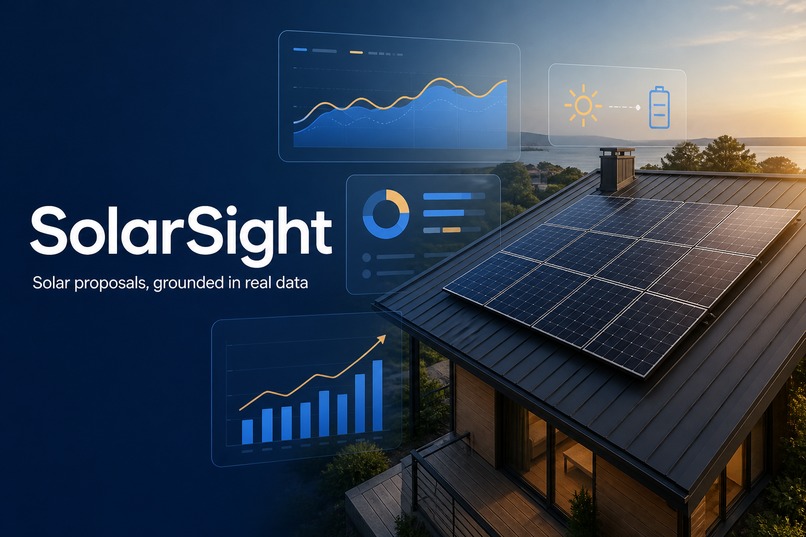
SolarSight — data-grounded solar proposals for small installers.

Inspiration
Small solar installers compete with national businesses that have dedicated sales, engineering and operations teams. Yet the customer still needs a simple answer: what fits on my roof, what will it produce, what will it save, and what will it cost? For a small installer, turning those questions into a credible proposal can mean switching among satellite maps, spreadsheets, finance calculators, design tools and document templates.
SolarSight was built to compress that work into one browser workflow and to test a second idea at the same time: can a founder run a real software business with AI agents taking on much of the engineering and operational load?
What it does
SolarSight has two modes. The free consumer estimator lets a homeowner enter an address, place panels on a satellite roof view, describe household usage and compare solar-only and solar-plus-battery outcomes. The installer product turns the same modelling engine into a branded sales workflow. An installer lays out arrays, enters real prices and assumptions, and receives production, bill savings, payback, NPV and IRR estimates grounded in PVGIS irradiance data, hourly battery simulation, load profiles and country-specific incentives.
Publishing spends one quote credit and creates a private share link. Branding and payment details are snapshotted at publication, and accepted versions carry a versioned hash. That makes the commercial record tamper-evident: neither side can quietly rewrite the version that was accepted. Later revisions are free, so installers can correct or improve a proposal without being charged again.
Gemini is part of the product, not a decorative chatbot. In the quote editor, an installer can select Draft intro with Gemini. A server-side Gemini API call receives only the quote's computed system size, panel count, production, savings, payback, battery and locale data — not the customer's name or email — and drafts an 80–120 word homeowner-facing introduction. The output is inserted as editable proposal text and is never published without the installer reviewing it. Existing text is not overwritten without confirmation.
How it was built
The frontend is React and TypeScript, with a Hono API on Cloudflare Workers and Cloudflare D1 for accounts, organizations, quotes, versions and the credit ledger. Google Maps Platform supplies Places address autocomplete and live satellite imagery. PVGIS supplies irradiance inputs. Polar handles credit-pack checkout and Resend handles transactional email.
The project began on 2 August 2026 and reached a working production flow that day: signup, organization setup, quote creation, calculation and publication. The current repository contains more than 200 commits. The product is live at getsolarsight.com, with an installer flow at getsolarsight.com/installers.
AI-native operations
AI also helps operate the business day to day. Issue-driven development agents turn requests — including requests dispatched from a phone — into pull requests. Cody, an AI code reviewer, reviews pull requests for correctness and risk before merge. A weekly GTM manager agent reads production metrics, appends a weekly log and opens milestone issues when the first real signup, first real published quote or campaign-exhaustion gate is reached. A Reddit scout researches relevant homeowner questions and drafts a strictly bounded set of helpful replies for human approval. A market-watch workflow supports the continuing maintenance of incentive data and sources.
Humans keep the high-consequence decisions. The founder chooses product direction, approves external messaging, decides whether to send campaigns, controls deployments and secrets, and reviews financial and customer evidence. AI proposes, implements, reviews and monitors within explicit limits; it does not invent customers, send unapproved public replies, spend money or publish a customer's proposal on its own.
This operating model matters for the Small Business Services category. SolarSight is intended to give a small installer more of the capability of a larger sales operation without forcing them into another expensive monthly subscription. It can help installers quote more opportunities, communicate complex energy and finance results in plain language, and spend more time on design, installation and customer service. If adoption grows, the product can support jobs beyond the founding team in installer onboarding, country-data maintenance, support and channel partnerships, while enabling local installation businesses to compete for more work.
Challenges and learning
The hardest problems were not prompt engineering. They were product trust, data licensing, geographic differences and operational honesty. Google Maps imagery has jurisdiction-specific terms, so imagery stays browser-direct and is never embedded in generated PDFs. Financial estimates require versioned assumptions and clear uncertainty rather than one magical number. The Gemini feature needed a privacy boundary, rate limits and failure behaviour that did not expose provider errors. AI operations needed similarly explicit boundaries between analysis, recommendation and action.
The commercial experiment is still early. As of the 12 August production report, SolarSight had one real signup, one real organization and one real quote created, but no real published quote and no paid credit order. Arms-length revenue is $0. The first outbound campaign is live; marketing spend is $0. Those numbers are included because the goal is to build an honest business, not to relabel founder tests as traction.
What's next
The immediate test is conversion from a real signup to a published quote and then from free credits to a paid pack. Product priorities will follow observed friction in that funnel. The longer-term goal is a multilingual, multi-country proposal platform that lets small installers produce trustworthy solar and battery proposals quickly while an AI-native operating system keeps the company lean.
Built With
- cloudflare-d1
- cloudflare-workers
- drizzle-orm
- gemini-api
- hono
- maps
- polar
- pvgis
- react
- resend
- tailwind-css
- typescript
- vite

Log in or sign up for Devpost to join the conversation.