-
-

loading page
-
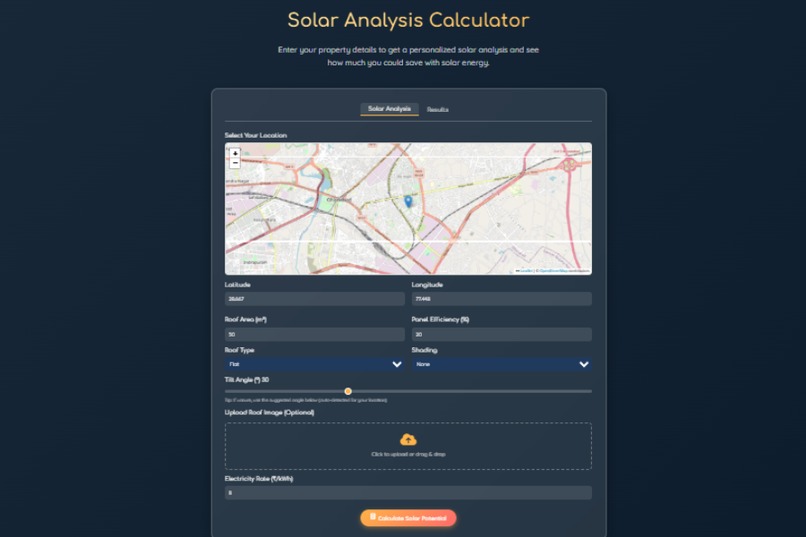
heart of the website
-
homepage

## Inspiration
I’m a person who loves to work with sustainable and meaningful ideas the kind that don’t just exist on paper but actually make a difference. One afternoon, while scrolling through endless posts about climate change and rising energy costs, I realized something: We talk about sustainability, but we rarely show people how accessible it can be. I wanted to create a tool that could bridge the gap between awareness and action a web app that tells you, “you could save the planet and your wallet too.” That’s how Solar Scout came to life
## What it does
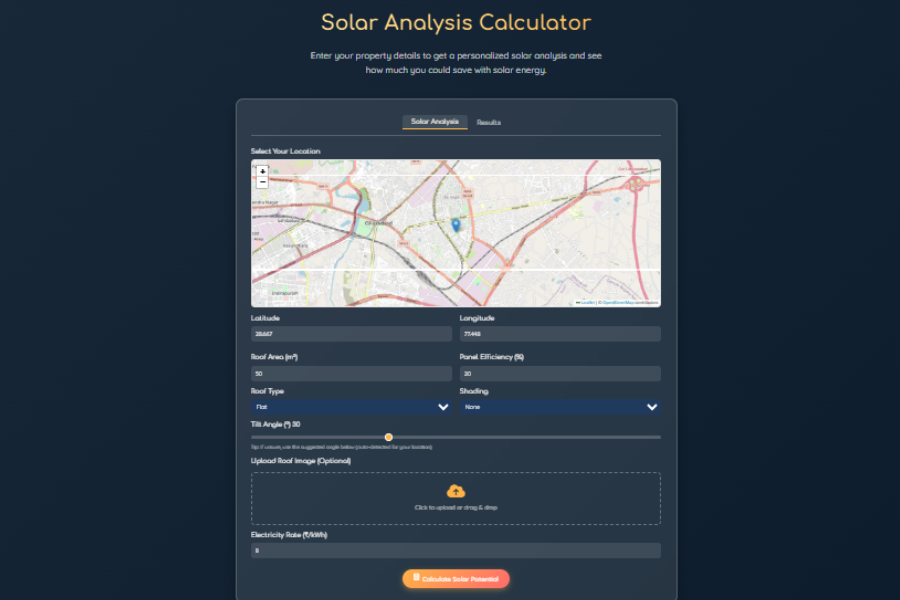
SolarScout is a web-based tool that lets users: Enter their location ,rooftop/balcony size Estimate yearly solar power generation (kWh/year) See potential cost savings View their carbon offset in terms of trees planted SolarScout uses monthly solar data and efficiency factors to calculate the realistic annual energy output with this model: $$ Yearly Solar Output=months∑(I month×Efficiency×Area×Days×S×T×R) $$ I=Solar irradiance for the month S = Shading factor T = Temperature correction R = Performance ratio
## How we built it
Built using HTML, CSS, and JavaScript for an interactive and responsive design. Integrated solar irradiance and climate APIs to fetch real-time data. Used a monthly solar output formula to calculate accurate yearly estimates. Added interactive maps for easy location selection and visualization. Focused on a clean, user-friendly UI to make solar awareness simple and engagin
## Challenges we ran into
No good story comes without challenges and SolarScout had plenty: Getting accurate month-wise solar data from reliable APIs Designing a UI that feels both technical and friendly Accounting for users who live in apartments instead of houses with roofs
## Accomplishments that we're proud of
Built a working solar potential calculator from scratch Integrated real-world solar data into a clean interface Simplified a complex scientific concept into something anyone can understand Designed a tool that promotes green awareness and action
## What we learned
Bridging science and simplicity — translating complex solar equations into an interactive, user-friendly experience. Using real data effectively — transforming irradiance and climate information into meaningful insights. Applying design thinking — realizing how thoughtful UI/UX choices influence user trust and engagement. Solving problems creatively — adapting formulas and fixing data inconsistencies under real-world constraints. Building with purpose — understanding that impactful technology focuses on awareness and action, not perfection.
## What's next for SolarScout
Satellite-based Roof Scanning: Integrating AI and geospatial data to automatically detect rooftop dimensions, shading, and orientation from satellite imagery for precise solar potential mapping. Connecting with Local Authorities & Agencies: Partnering with municipal energy boards, renewable energy authorities, and local sustainability offices to help users directly apply for solar installation schemes or government subsidies from within the app. Space-Oriented Data Expansion: Incorporating datasets from NASA’s POWER Project and ESA’s Earth Observation to improve solar irradiance prediction accuracy on a global level. ** Community & Collaboration:** Launching an open dashboard where neighborhoods can compare their solar footprints, share energy insights, and collectively track their carbon offset impact.


Log in or sign up for Devpost to join the conversation.