-
-
Solar Concentrator for Animal Warmth
SolarPaw: Tracking Sunlight for Sustainable Warmth The Inspiration: A Simple Need for Basic Comfort Our journey began not in a lab, but with a simple, heartbreaking observation: the struggle of animals in shelters and farms during the cold winter months. While humans can layer up and turn on heaters, our animal companions often rely on inadequate bedding or energy-intensive heat lamps that are costly and environmentally unsustainable. We were inspired by a fundamental need—the need for warmth—a basic comfort that is essential for the health, well-being, and survival of countless animals. We asked ourselves: could we harness the abundant, free energy of the sun to provide a clean, low-cost, and autonomous source of warmth? This question led us to the concept of a solar concentrator. But we didn't want just any heater; we wanted a smart one. One that actively seeks out the sun, maximizing the energy harvested even on short winter days, and delivers that energy efficiently to where it's needed most. This vision became SolarPaw.
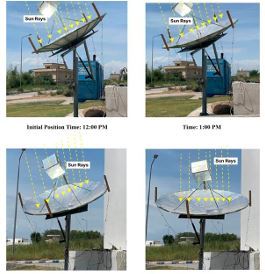
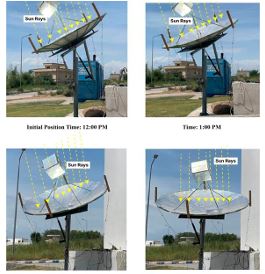
How We Built SolarPaw: A Step-by-Step Journey Our build process was a methodical translation of our design into a functional prototype. Design and Simulation: We started in SolidWorks, meticulously designing the parabolic dish, the spiral copper tube receiver, and the robust mild steel support structure. We used SolTrace to simulate the path of sun rays and confirm that our dish geometry would effectively focus light onto our small receiver. Structural Fabrication: The frame was welded from mild steel, chosen for its strength and durability. Adjustable bolts at the base allow for height modification to compensate for the sun's changing seasonal path. The Heart of the System: The Receiver: We constructed a 1x1-foot insulated box housing an 18-foot long spiral copper pipe. The interior is lined with a ceramic fiber blanket ($1200^\circ\text{C}$ rating) and a reflective mirror at the bottom to minimize heat loss and maximize energy absorption. Integrating the "Brain": We wired the LDR sensors, Arduino Uno, IBT-2 motor drivers, and 24V linear actuators according to our circuit diagram. The custom algorithm we developed allows the system to compare light intensity from the four sensors and actuate the motors to correct its position, always seeking the maximum sunlight. Testing and Validation: Our experimental results were thrilling. We achieved a temperature rise from 30.2C to 70.8C in just three hours, confirming the system's practical effectiveness and putting us well on the path to our target temperature.
Challenges We Faced The path wasn't without obstacles. Each challenge taught us a valuable lesson. Wind Resilience: Our initial design was not robust enough. Through iterative FEA analysis, we reinforced the structure to withstand significant lateral wind forces, ensuring operational stability and safety. Precision Tracking: Getting the actuators to move the large dish smoothly and precisely was difficult. Calibrating the sensor inputs and motor outputs required fine-tuning our control algorithm to prevent overshooting or jerky movement. Heat Retention: Our first receiver prototype lost heat too quickly. This led us to research and integrate the ceramic fiber insulation, which dramatically improved thermal efficiency by containing the captured energy.
SolarPaw's Benefit to Animals: A Brighter and Warmer Future SolarPaw is more than an engineering project; it's a potential paradigm shift in animal care, directly addressing the theme of the Animal Hack Hackathon 2025. Sustainable Warmth for Shelters & Farms: It can provide a primary or supplemental heat source for outdoor kennels, farrowing huts for pigs, brooders for poultry, or shelters for calves and goats. This reduces reliance on fossil-fuel-powered heat lamps, lowering electricity bills and the carbon pawprint of animal husbandry. Enhanced Animal Welfare: Consistent, comfortable warmth reduces stress, prevents hypothermia, and can improve immune response in young and vulnerable animals. This leads to healthier, happier animals and can potentially lower mortality rates. Off-Grid Utility: Its self-contained nature makes it perfect for remote farms, wildlife rehabilitation centers, or disaster relief scenarios where grid power is unavailable or unreliable. Animals get warmth powered purely by the sun. Safety: Unlike traditional heat lamps, which can be a fire hazard if knocked over or come into contact with bedding, our system concentrates heat safely within an insulated receiver. The heat can then be transferred to a safe, animal-friendly surface or used to warm water for radiant heating systems. SolarPaw demonstrates that with innovation and compassion, we can use technology to provide for those who cannot provide for themselves. It's a step toward a future where sustainable energy ensures the well-being of all creatures on our planet.

Log in or sign up for Devpost to join the conversation.