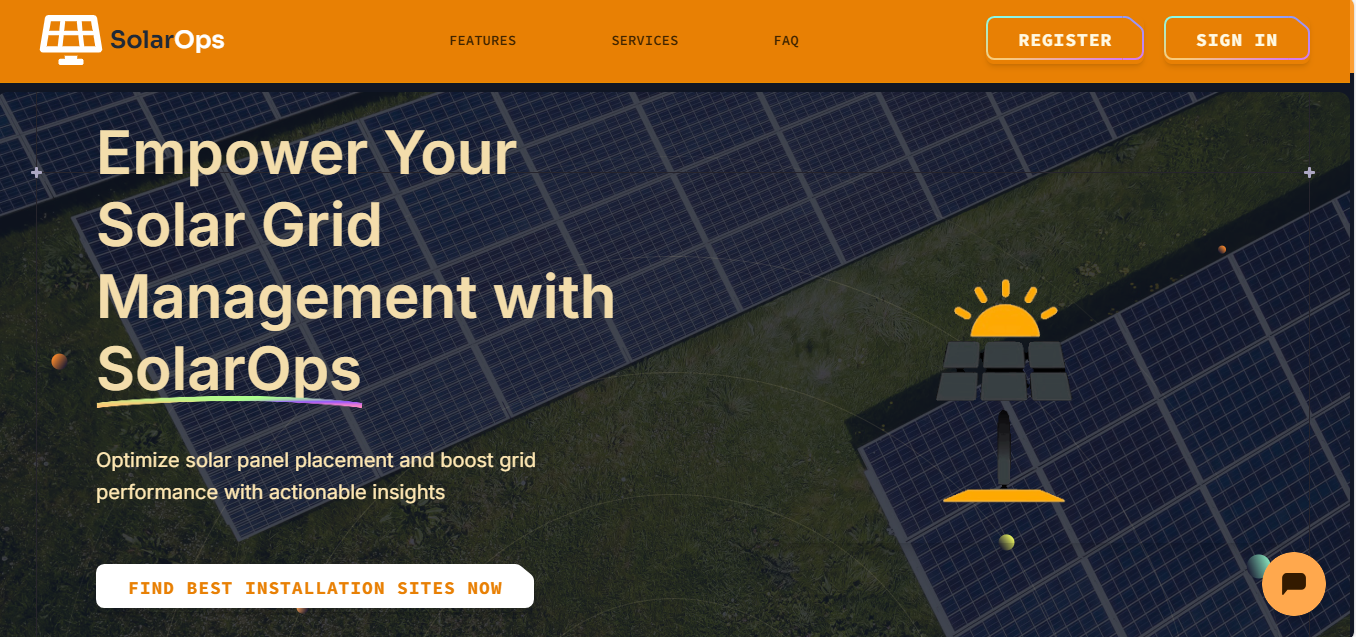
SolarOps 🌞
Problem Statement 🚨
Climate change demands a shift toward renewable energy, yet many solar panel installations are inefficient due to poor site selection. Grid workers often lack tools to identify optimal locations for solar panels, leading to wasted resources and suboptimal energy production.
Solution ✅
SolarOps is a web-based platform that empowers grid workers to identify the most efficient locations for solar panel installations using AI-driven analysis and data visualization tools. By combining solar irradiance data, weather patterns, and terrain analysis, SolarOps ensures every panel contributes to a greener planet.
Inspiration 💡
The inspiration for SolarOps came from the urgent need to address global challenges like climate change and the transition to renewable energy sources. With solar energy emerging as a key player in sustainable energy, we recognized a gap in the tools available to optimize solar grid performance. By leveraging technology, we aimed to create a solution that aligns with UN Sustainable Development Goals (SDGs), particularly:
- SDG 7: Affordable and Clean Energy
- SDG 9: Industry, Innovation, and Infrastructure
- SDG 13: Climate Action
SolarOps is our attempt to make solar energy more accessible, efficient, and impactful, contributing to a greener future.
What it does 🌞
SolarOps is an AI-powered platform designed to revolutionize solar grid management by providing advanced insights and automation for solar energy optimization. It offers:
- Optimal Placement Analysis: Uses geospatial data and weather patterns to recommend the best locations for solar panel installations.
- Fault Detection: Employs image recognition models to detect faults in solar panels through uploaded images.
- Energy Forecasting: Predicts solar energy production using real-time weather data, ensuring accurate performance insights.
- Live Monitoring: Tracks and visualizes solar grid performance through interactive dashboards, helping operators identify inefficiencies or potential issues.
SolarOps empowers grid operators to make informed decisions, increasing solar energy efficiency while promoting clean energy adoption.
How we built it 🛠️
The development of SolarOps involved a combination of technologies and methodologies:
- Machine Learning Models: Leveraged Convolutional Neural Networks (CNNs) for fault detection and Gradient Boosting algorithms for energy forecasting.
- Weather Data Integration: Integrated real-time data from the Meteomatics API to analyze weather patterns for energy predictions and optimal placement analysis.
- Geospatial Visualization: Created interactive heatmaps using geolocation data to visually represent high-potential solar installation areas.
- Web Interface: Designed an intuitive and responsive web application using React and Tailwind CSS for seamless user experience.
- Cloud Deployment: Hosted the platform on a scalable cloud environment for real-time data processing and accessibility.
Challenges we ran into 🚧
Building SolarOps presented several hurdles:
- Data Reliability: Ensuring the accuracy and consistency of real-time weather data was critical for the platform’s success.
- Model Optimization: Training models to balance accuracy and computational efficiency took significant effort.
- User-Centric Design: Creating a simple and engaging UI for non-technical solar grid operators while handling complex data was challenging.
- Scalability: Ensuring the platform could handle data from multiple locations without performance issues was a technical challenge.
Accomplishments that we're proud of 🎉
- UN SDG Alignment: Successfully aligning our platform with the UN Sustainable Development Goals and creating a meaningful impact.
- Advanced Fault Detection: Developing a highly accurate image recognition model for solar panel fault detection.
- Interactive Insights: Creating intuitive visualizations like heatmaps and dashboards that simplify complex data for end-users.
- Scalable Platform: Delivering a scalable solution that can adapt to different regions and grid systems.
What we learned 📚
SolarOps was a transformative learning experience for our team:
- Gained expertise in machine learning and deploying models for real-world applications.
- Enhanced our skills in data visualization and creating user-friendly interfaces.
- Learned to work with real-time APIs and integrate external data sources effectively.
- Deepened our understanding of the renewable energy sector and the critical role technology plays in promoting sustainability.
What's next for SolarOps 🚀
The journey for SolarOps has only begun, and we aim to:
- Expand Data Sources: Incorporate satellite imagery and IoT sensor data to enhance insights and predictions.
- Global Adaptation: Adapt the platform for international use by integrating regional weather APIs and expanding geospatial analysis.
- Mobile Application: Develop a mobile version for on-the-go accessibility.
- Partnerships: Collaborate with solar energy providers and government agencies to scale the impact of SolarOps.
- Community Engagement: Enable community users to track and contribute to clean energy initiatives, fostering local climate action.
With SolarOps, we’re committed to driving innovation in renewable energy, empowering communities, and contributing to a sustainable future.
Built With
- cnn
- fastapi
- gradient-boost-algorithm
- mern
- meteomatics
- mongodb
- mvc-architecture
- railway
- tailwindcss
- vercel

Log in or sign up for Devpost to join the conversation.