-
-
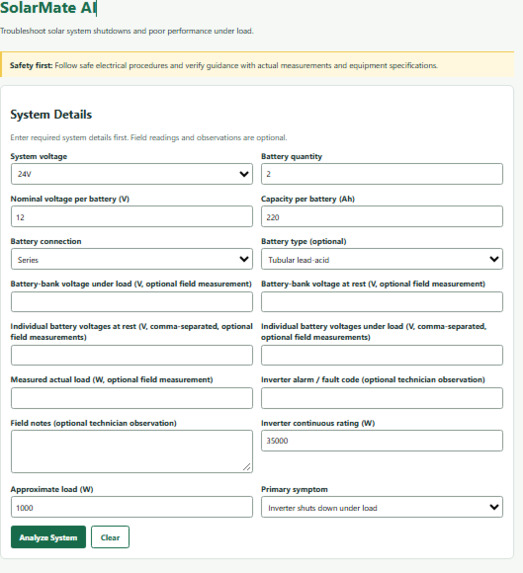
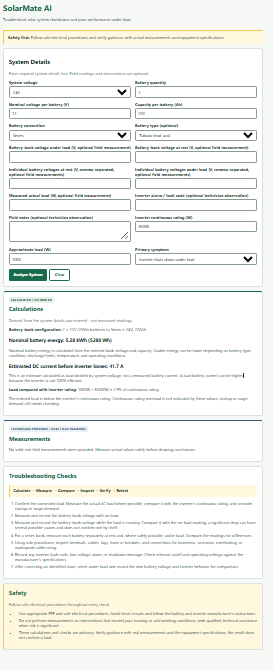
The input form
-
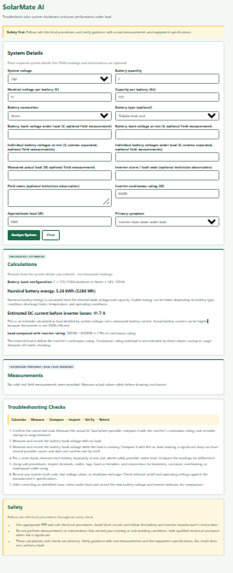
The analysis results
-
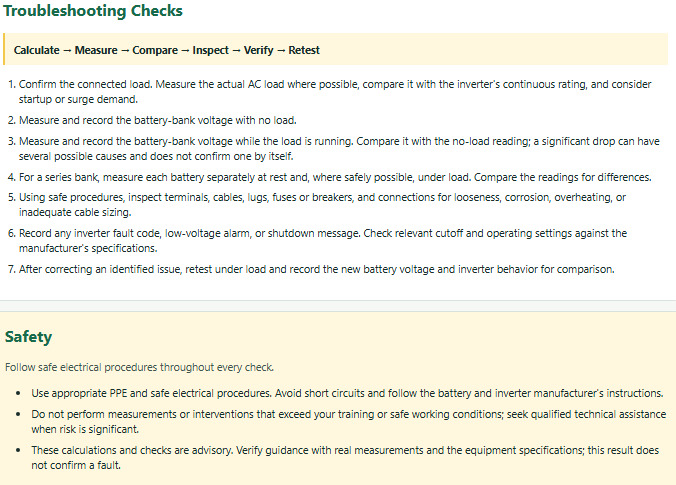
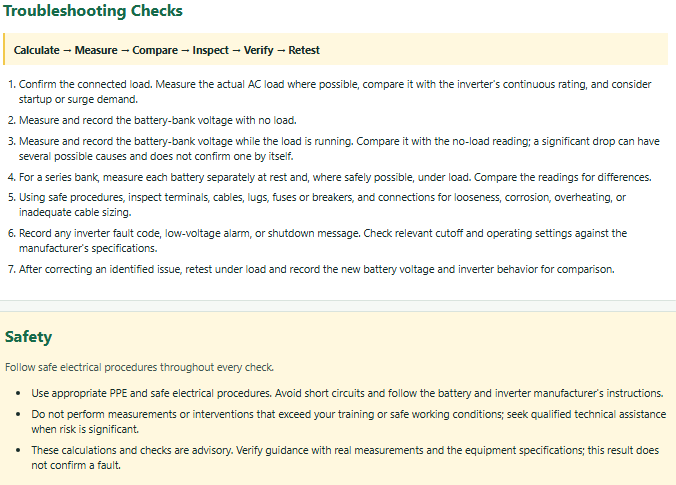
The troubleshooting and safety guidance
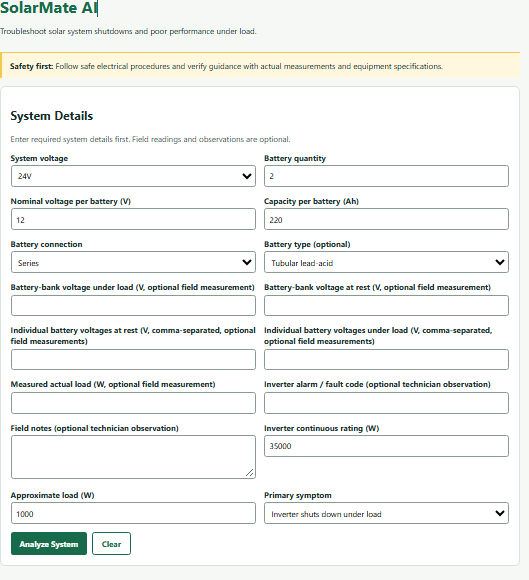
Inspiration
Solar technicians often need to make quick decisions when a solar system shuts down or performs poorly under load. Before replacing equipment, a technician needs to collect the system details, perform basic calculations, take real measurements, and check the system methodically.
I wanted to build a small, practical tool that could organize this troubleshooting process and work without an internet connection, paid AI APIs, or cloud services.
What it does
SolarMate AI is a field-oriented solar troubleshooting assistant for technicians.
A technician enters the system voltage, battery configuration, inverter rating, approximate load, symptom, and optional field measurements. The application then:
Validates the battery configuration. Calculates battery-bank voltage and nominal battery energy. Estimates DC current before inverter losses. Calculates inverter loading. Separates calculated values from technician-provided measurements. Highlights invalid or inconsistent inputs. Provides a structured troubleshooting sequence. Includes safety guidance and reminders to verify findings with real measurements and manufacturer specifications.
For example, for a 24V system using two 12V 220Ah batteries in series, SolarMate AI calculates:
24V × 220Ah = 5,280Wh = 5.28kWh nominal battery energy
For a 1,000W load:
1,000W ÷ 24V ≈ 41.7A
This is an estimated DC current before inverter losses, not a measured value.
The application does not claim to confirm a fault. It helps the technician organize the investigation.
How we built it
I used the Devpost Learn Skill Pack to move through the project in stages: scope, PRD, technical specification, build, testing, review, and ship preparation.
I built the application with:
Python Flask HTML CSS JavaScript
The calculations and validation are deterministic, so the same inputs produce consistent results. The application runs locally and does not require a database, cloud service, or paid AI API.
I used a coding agent through flipped interaction: instead of simply accepting generated code, I reviewed the implementation, asked questions, tested each development slice, and verified that the result matched the intended design.
Challenges we ran into
One of the biggest challenges was keeping the project focused.
The original idea was much broader and included solar sizing, installation guidance, maintenance, and fault diagnosis. During development, I narrowed the first version to one clear use case: troubleshooting solar shutdowns and poor performance under load.
Another challenge was making sure the application did not confuse calculations with actual field measurements. Solar troubleshooting depends on real measurements, so the application must never invent a battery voltage, load measurement, or fault condition.
I also had to make validation clear enough to prevent an incorrect battery configuration from producing misleading results. Accomplishments that we're proud of
I am proud that SolarMate AI became a working end-to-end application rather than just an idea or prototype screen.
The application can:
Accept a complete solar system case. Perform repeatable calculations. Validate battery configuration. Accept optional technician measurements. Handle invalid optional measurements without crashing. Provide an ordered troubleshooting workflow. Provide safety guidance. Clearly distinguish calculated values from measured values. Run locally without paid services.
I also tested the application on both desktop and mobile layouts. The final build passed 17 automated tests, including validation, calculations, measurements, troubleshooting guidance, and responsive presentation.
What we learned
The biggest lesson was that using a coding agent effectively still requires understanding the problem and reviewing the work.
I learned how to break a technical idea into a manageable scope, write a PRD and technical specification, build the application in small slices, test each slice, investigate problems, and make sure the final result matches the original requirements.
I also learned how to turn practical solar troubleshooting knowledge into a repeatable software workflow:
Calculate → Measure → Compare → Inspect → Verify → Retest
What's next for SolarMate AI
The next stage is to expand SolarMate AI carefully while keeping the field-focused approach.
Future versions could include more troubleshooting scenarios, additional system configurations, better guidance for interpreting technician measurements, equipment-specific references, solar system sizing tools, and eventually optional AI assistance for more complex troubleshooting cases.
The goal is to grow SolarMate AI into a practical assistant that helps solar technicians work through problems systematically, while keeping real measurements, safety procedures, and manufacturer specifications at the center of the process.
Built With
- ai-assisted
- css
- devpost
- flask
- html
- javascript
- learn
- python
- skill

Log in or sign up for Devpost to join the conversation.