Problem Statement
Individual solar panel owners have no easy way to tell whether a lower-than-usual output day is just weather, or an early sign of a system problem (panel degradation, wiring fault, inverter issue). Generic weather apps don't know the owner's actual system; plant-management dashboards are built for commercial operators, not a single household. Most owners just watch the number go up and down without knowing what to expect or what to do about it.
Solution Overview
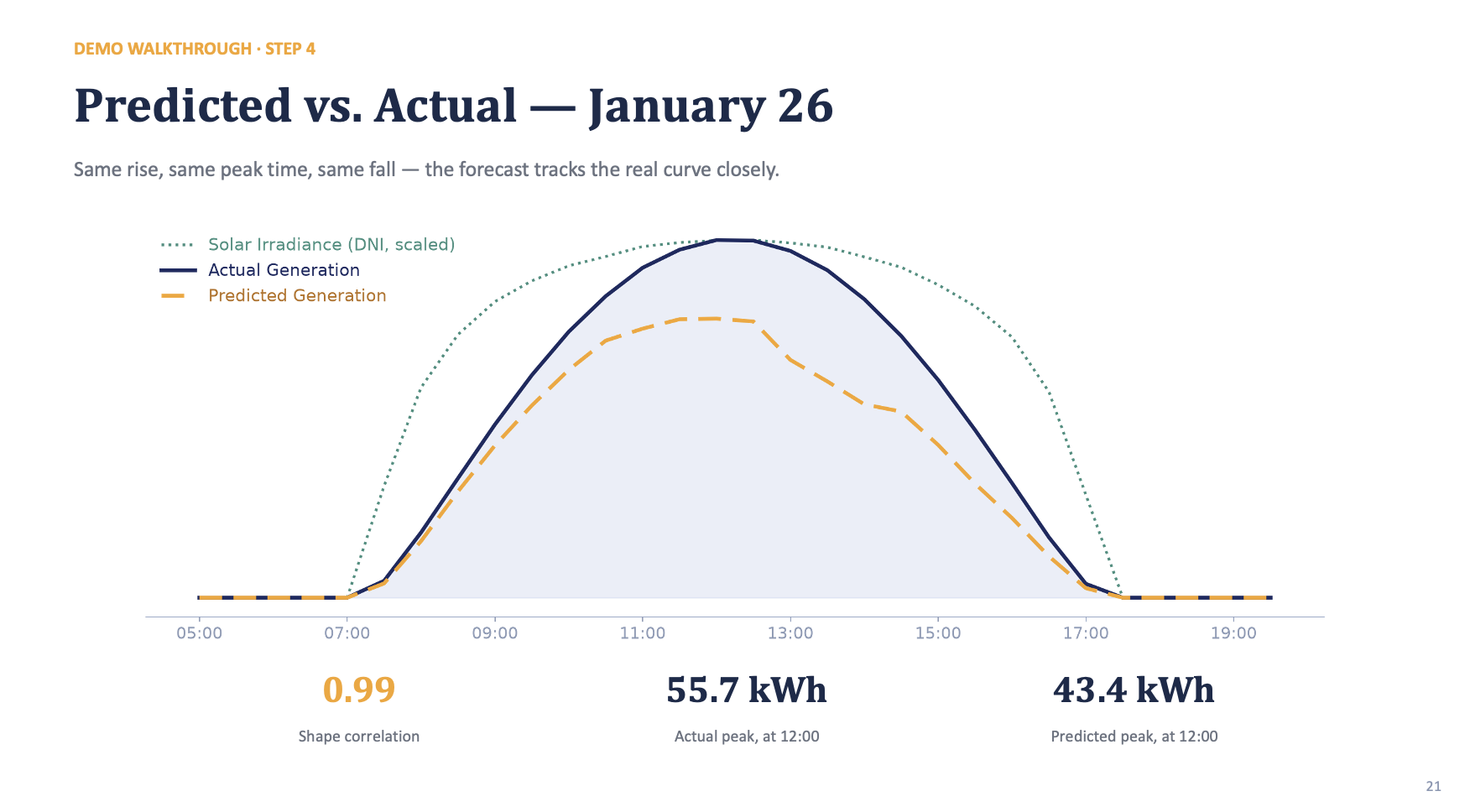
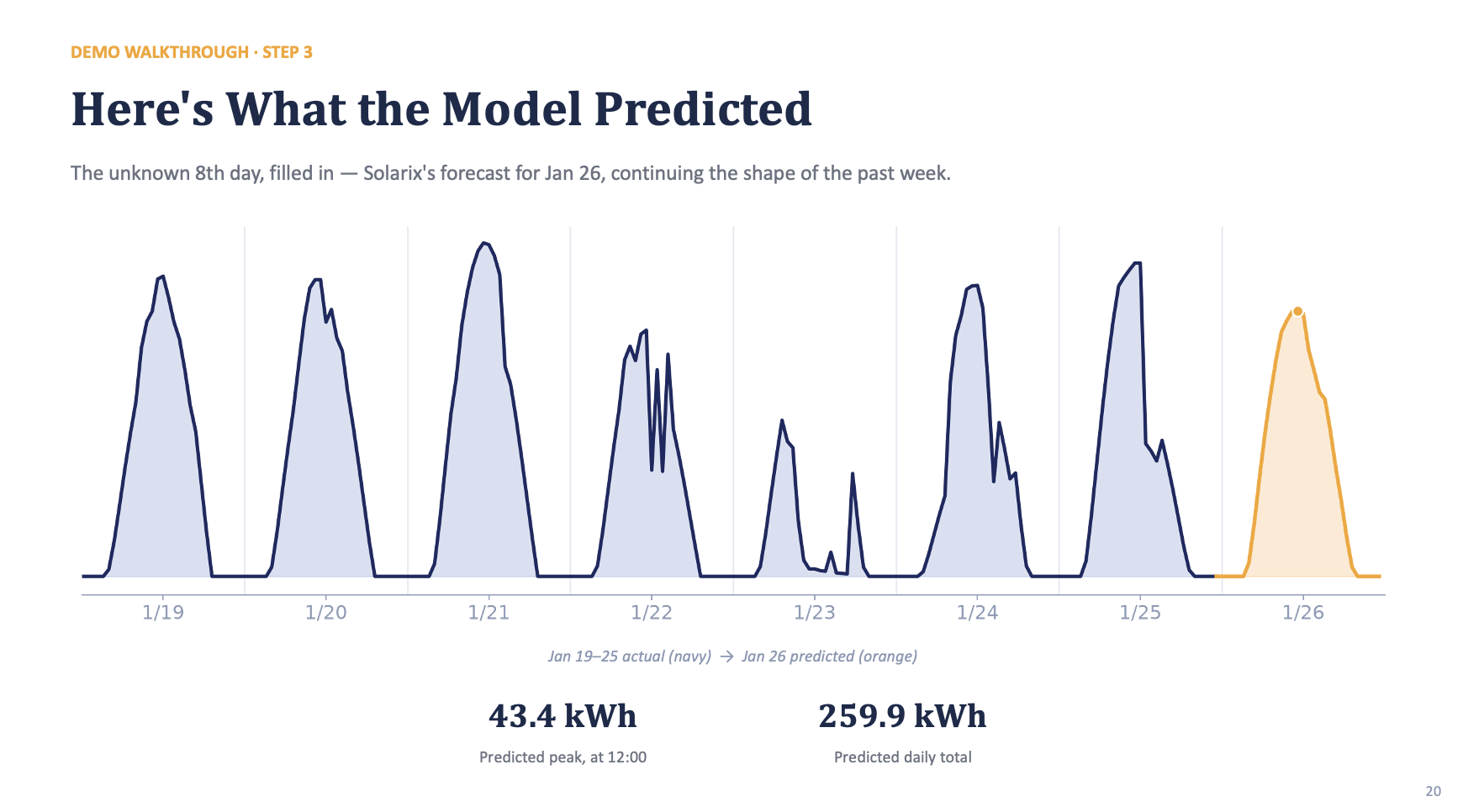
Solarix trains a regression model on a site's own historical generation and weather data (irradiance, temperature, humidity, wind speed) and predicts the next day's output at 30-minute resolution using only the preceding 7 days — no live weather feed required. The prediction is turned into a personalized, plain-language power usage guide by an LLM, so a non-technical user gets a concrete recommendation ("run the dryer between 11:00–13:00") instead of a raw chart.
Key Features
- Day-ahead generation forecast — 30 predicted values (05:00–19:30, 30-min intervals) from a Random Forest model trained on 7-day lag features (7 days × 3 time-offsets × 6 variables + 2 cyclical hour terms = 128 features)
- Dashboard — today's total predicted generation with a real vs-yesterday comparison (against actual measured generation, not another prediction), a peak-generation-time card, a lowest-generation-time card, and an hourly forecast line chart
- LLM-generated power usage guide — GPT-4o-mini turns the forecast into concrete, time-specific recommendations (e.g. best window to run the washing machine/EV charger, when to avoid heavy appliance use); falls back to a fixed template automatically if the LLM call fails, so the API never breaks because of it
- Login as trigger — logging in kicks off the forecast pipeline for the signed-in facility, making the demo feel like a real product rather than a static chart
Target Users
Individual residential solar panel owners (B2C) who want a simple, no-setup way to know what to expect from their own system tomorrow and how to use that power well — not commercial plant operators or installers.
Inspiration
While solar energy is a leading eco-friendly power source, it suffers from a critical limitation: unpredictable power generation heavily dependent on weather conditions and environmental factors. We created Solarix to minimize this unpredictability and maximize solar energy efficiency using machine learning.
What it does
Solarix is an intelligent platform designed to predict solar power generation and help manage energy more efficiently using advanced machine learning models. By analyzing patterns in weather and environmental data, it provides optimized strategies for energy production.
How we built it
- Machine Learning: Built data analysis and prediction models using Python, Pandas, and scikit-learn. We trained and compared Multiple Linear Regression and Random Forest models, tuning Random Forest via Grid Search (
n_estimators=600,max_depth=12,min_samples_leaf=10,max_features=sqrt), and evaluated both using RMSE, MAE, and R². - Backend & Frontend: Built a FastAPI (Python) backend for feature engineering and model inference, and a React frontend with Recharts for the hourly forecast dashboard. Deployed the frontend and backend on Render, with the trained model served via GCP Vertex AI.
- Data Source: Used a pre-processed solar power dataset from a DACON forecasting competition (7-day weather and generation history at 30-minute resolution).
Challenges we ran into
- Dealing with noise in solar energy data and figuring out the correlations between variables to improve prediction accuracy was a major hurdle.
- We initially built our own preprocessing pipeline (missing-value interpolation, outlier detection) on real plant data, but couldn't reach reliable performance within our timeline — partway through the project we switched to a validated, pre-processed competition dataset instead, which meant re-running our model comparisons under time pressure.
What we learned
- We gained a deep, practical understanding of the end-to-end process of solving real-world environmental problems using machine learning.
- It was a valuable experience to strengthen our practical skills in time-series data handling and energy prediction modeling.
- We learned how to take a trained model from a notebook to a live GCP Vertex AI endpoint and wire it up to a real backend and frontend.
Built With
- fastapi
- flask
- google-cloud
- html/css-machine-learning-&-data-science:-scikit-learn
- javascript
- languages:-python
- next.js-cloud-&-database:-aws
- numpy-backend-&-frontend:-node.js
- pandas
- postgresql
- pytorch
- react
- tensorflow


Log in or sign up for Devpost to join the conversation.