-
-
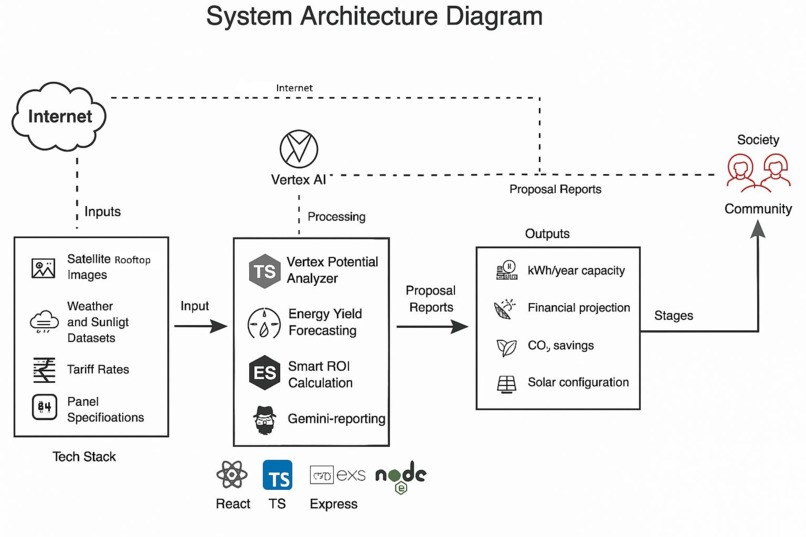
System_architecture
✨ What Inspired Us
The idea for SolARise came from a simple observation — we see so many rooftops in cities sitting unused, while the need for clean and affordable electricity keeps growing. Many people want to switch to solar, but they are unsure whether their rooftop is suitable and if the investment is worth it.
That gap inspired me to think:
“What if AI could instantly tell anyone how much solar energy their roof can produce?”
This thought became the starting point for SolARise. We wanted to build something that not only helps individuals save money but also contributes toward a more sustainable planet.
📚 What We Learned
Throughout this project, we learned a lot — both technical and real-world concepts.
✅ Technical Learnings
- How to work with Google Maps API and satellite imagery
- Using Vertex AI for rooftop detection and forecasting
- Real-time database handling with Firebase Firestore
- Integrating React and Node.js for a seamless web application
- Working with time-series data for energy predictions
- Designing User Experience (UX) for non-technical users
🌍 Domain Knowledge
- Basics of solar energy, sunlight patterns, and rooftop efficiency
- How tariffs, subsidies, and ROI affect user decisions
- Understanding sustainability initiatives like SDG-7 and Vision 2030
This project transformed our knowledge into something practical and genuinely useful.
🛠️ How We Built It
We broke the system into multiple components to make it manageable:
- We started with Google Maps to allow location-based rooftop selection
- We integrated Vertex AI Vision to analyze roof shapes and usable area
- We built a forecasting model to estimate yearly energy output
- We developed an ROI calculator to show costs and savings clearly
- We added a Gemini-powered assistant to explain insights in simple language
- Finally, we designed a dashboard where communities can assess sustainability impact
We kept improving the interface so even a beginner can understand their solar potential.
⚔️ Challenges We Faced
The journey wasn’t smooth — we faced several challenges:
Satellite image accuracy Rooftop detection was tricky because angles, shadows, and tree covers affected results.
Data collection Getting reliable weather and solar irradiance data per location took time.
Integrating multiple services Making frontend, backend, Maps API, and Vertex AI communicate properly was complex.
Performance and cost optimization Vertex AI can be expensive, so we had to optimize the number of API calls.
Simplifying insights for users Converting technical solar metrics into something that anyone can understand was a big design challenge.
But each obstacle taught us something new and made the product stronger.
🌍 Why This Project Matters
SolARise isn’t just a tech product — it’s a step toward a greener, smarter world.
If more people adopt solar because of our platform:
✅ Electricity bills will reduce ✅ Emissions will drop ✅ Our cities will become more sustainable
Even as a prototype, it has the power to create real impact.
🙌 Final Note
This project taught us that technology can solve real environmental problems if built with purpose. SolARise represents that purpose — turning unused rooftops into renewable energy powerhouses.
“Small ideas can create big changes — especially when powered by AI and passion.”
📌 Abstract
SolARise is a smart platform that helps people discover how much solar power their rooftops can produce and how much they can save by installing solar panels. Today, most homes and institutions do not use solar energy simply because they don’t know whether their roof is suitable, how much it will cost, or how long it will take to recover the investment. Manual inspections are also time-consuming and expensive.
SolARise solves this challenge using satellite data and Artificial Intelligence. It analyzes any rooftop, detects usable solar area, predicts yearly clean-energy output, and calculates money savings, payback period, and CO₂ reductions. A built-in Gemini AI assistant explains the results in simple language and generates proposal reports that homeowners, businesses, and government planners can easily understand.
The platform also offers a community dashboard that highlights solar-friendly zones within a city, helping governments design effective clean-energy policies aligned with global sustainability goals like Saudi Vision 2030 and UN SDG-7: Clean Energy for All.
By making solar planning transparent, affordable, and digital — SolARise encourages individuals and communities to confidently shift toward renewable energy and a greener future.
🎯 Why SolARise?
- Rooftop solar potential remains largely unused
- Traditional feasibility surveys are costly and slow
- People struggle to understand solar savings and ROI
- Government lacks large-scale rooftop analysis tools
SolARise makes solar decision-making easy, intelligent, and accessible.
💡 What SolARise Offers
- ✅ Automated rooftop evaluation
- ✅ Accurate energy output predictions
- ✅ Clear financial benefits and payback period
- ✅ Easy-to-understand proposal reports
- ✅ City-level sustainability insights
Turn every roof into a clean-energy asset.
🧠 How SolARise Works — Workflow
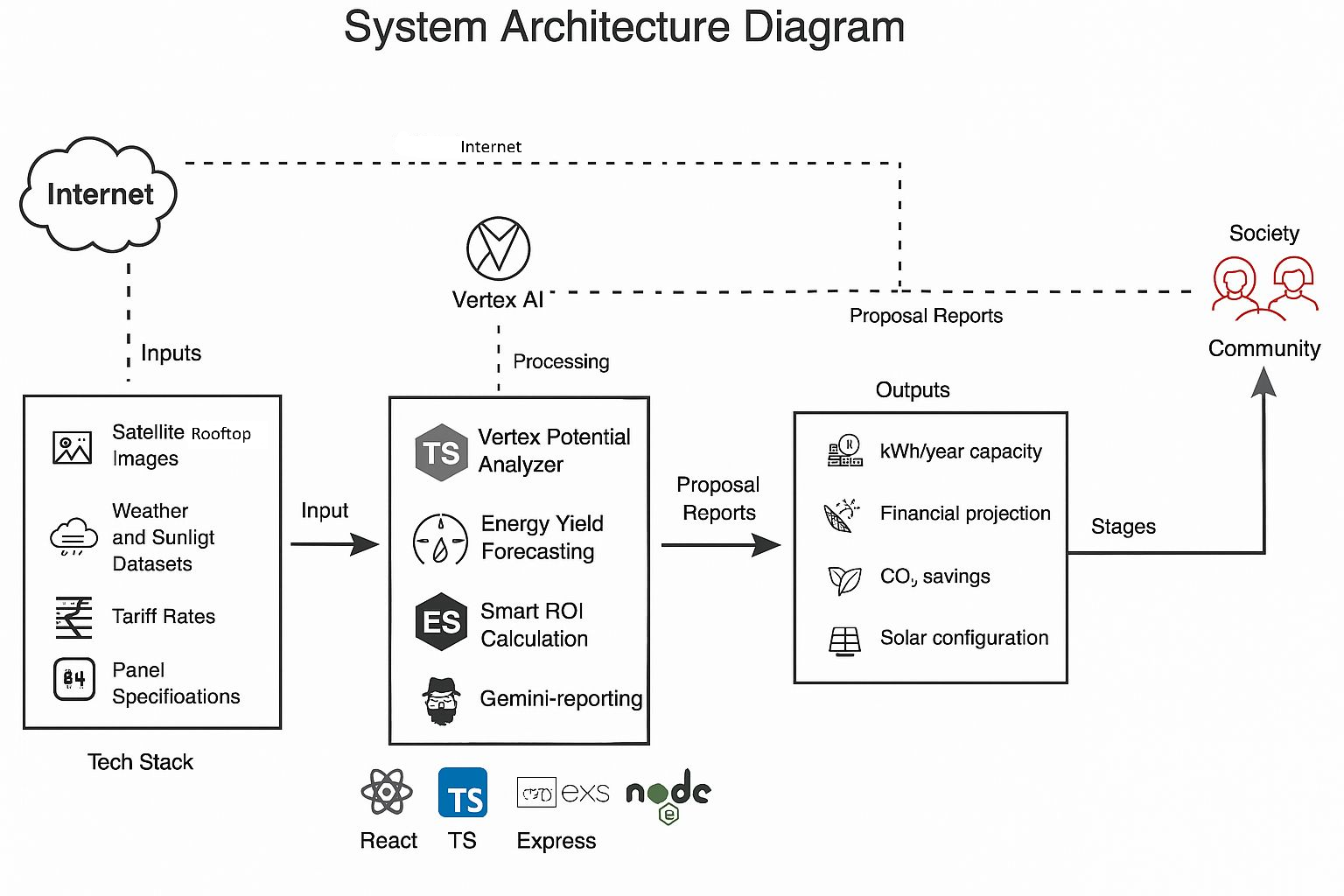
- User selects a rooftop location on the map
- The platform collects:
- Satellite images
- Sunlight and weather patterns
- Tariff and subsidy data
- Vertex AI analyzes the rooftop and forecasts yearly solar energy
- Smart ROI Engine estimates savings and environmental impact
- Gemini explains the results and prepares a proposal
Users can either decide for themselves or share the report with installers or policy groups.
🌟 Key Features
Rooftop Solar Potential Detection Automatically detects the usable rooftop area, panel placement zones, and shading regions.
Energy Yield Forecasting Predicts monthly and yearly solar energy generation based on sunlight patterns and weather.
Smart ROI Calculator Shows total installation cost, savings, and payback period.
Gemini Sustainability Assistant Provides explanations and generates detailed proposal reports.
Interactive Solar Map Displays rooftop analysis directly on maps.
Community Solar Dashboard Highlights hotspots and environmental impact at a city scale.
🔍 Inputs & Outputs
Inputs
- Satellite rooftop imagery
- Weather & sunlight datasets
- Electricity tariff & subsidy data
- Solar equipment specifications
Outputs
- ✅ Solar energy capacity (kWh/year)
- ✅ Cost vs. savings chart
- ✅ Carbon footprint reduction
- ✅ Best panel configuration
🌍 Expected Impact
- Increases solar installation adoption
- Reduces grid energy usage and carbon emissions
- Supports smart-city planning
- Saves cost for households and organizations
- Encourages climate-positive behavior in society
✅ Conclusion
SolARise makes rooftop solar planning smarter, faster, and more transparent. With its AI-driven intelligence and real-time visualization, users can instantly discover their solar potential without needing expert surveys.
SolARise helps cities unlock their hidden rooftop capacity and move toward cleaner, more sustainable living.
Built With
- express/python
- javascript-(transpiled)-framework-&-tooling:-react
- languages:-typescript
- node.js
- postgresql
- vite-ui:-shadcn-ui
