-
-
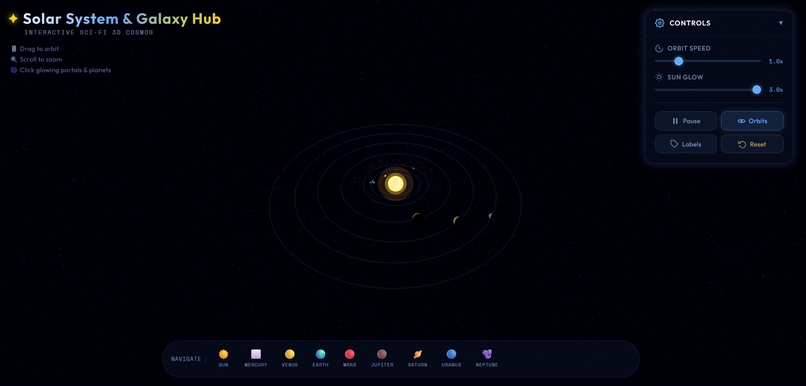
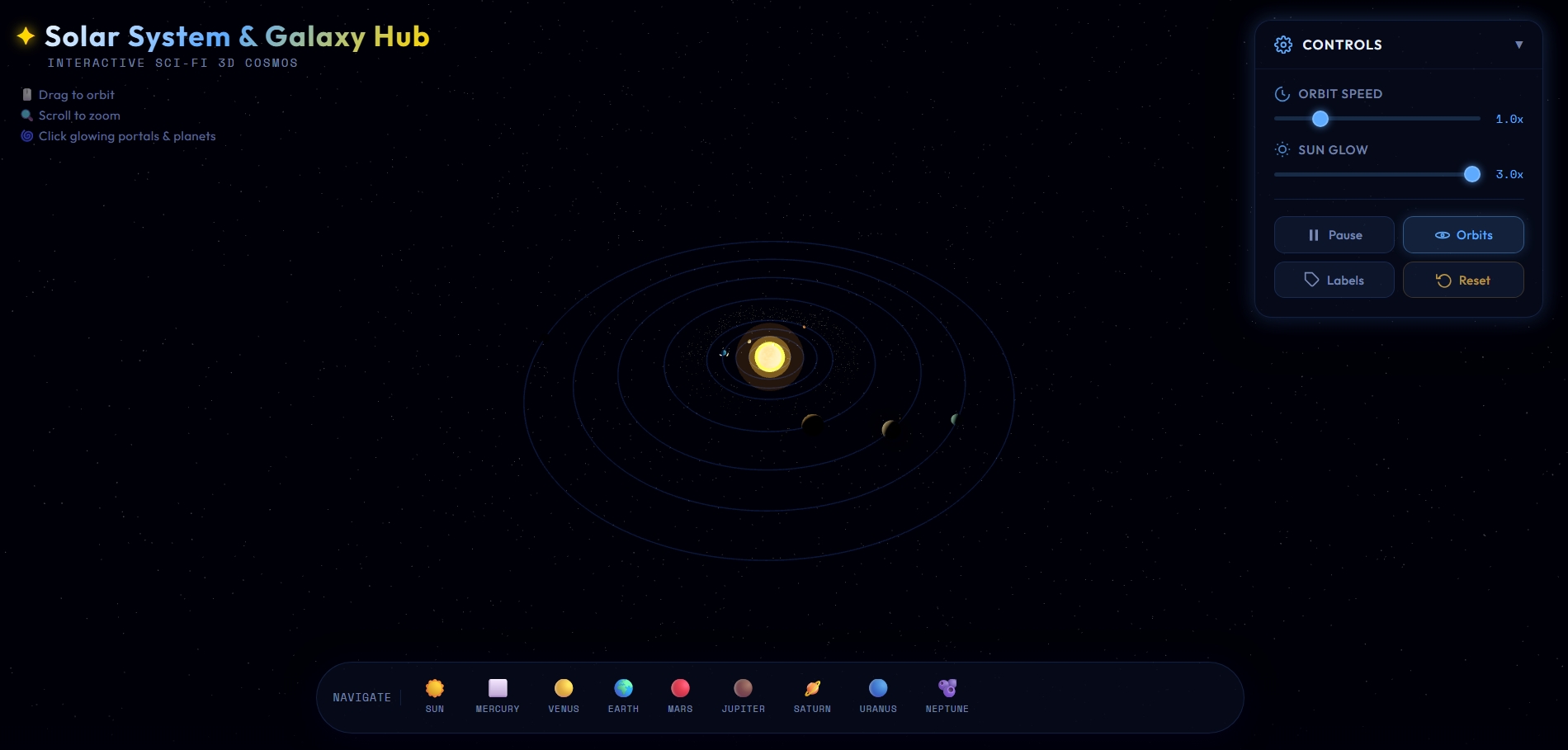
Solaris 3D Overview — Full system view displaying real-time planetary orbits, instanced asteroid belts, and glassmorphic HUD controls.
-
-
-
Inspiration
Humanity has always gazed at the night sky with wonder. As modern WebGL and 3D web technologies evolve, we wanted to build a web experience that brings the awe of space exploration straight to the browser — without requiring heavy downloads or external game engines.
Inspired by deep space sci-fi aesthetic, Solaris 3D combines real Keplerian planetary mechanics with a futuristic Sci-Fi Galaxy Hub that lets users explore celestial bodies, moons, satellites, and distant galactic star systems in real time.
What It Does
Solaris 3D is a fully interactive 3D space visualizer with dual view modes:
☀️ Interactive Solar System View:
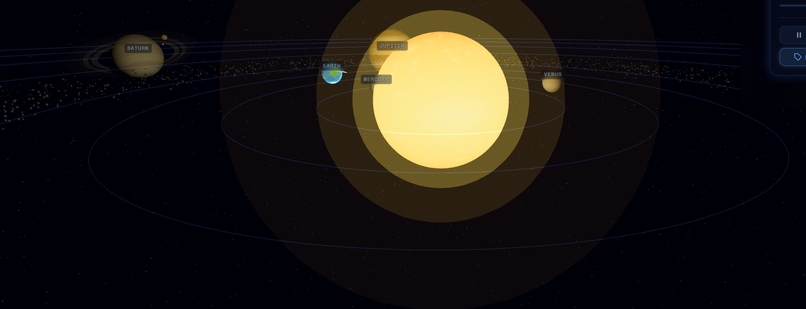
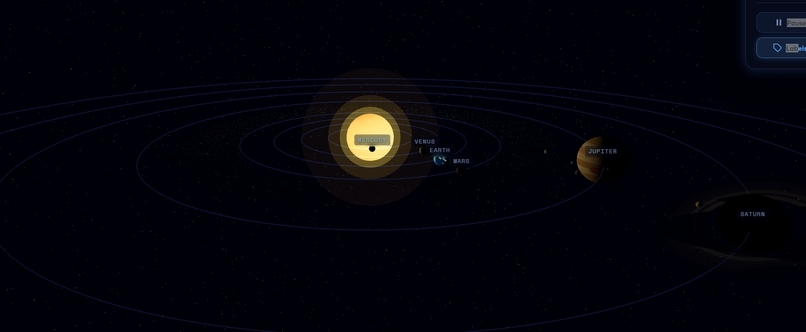
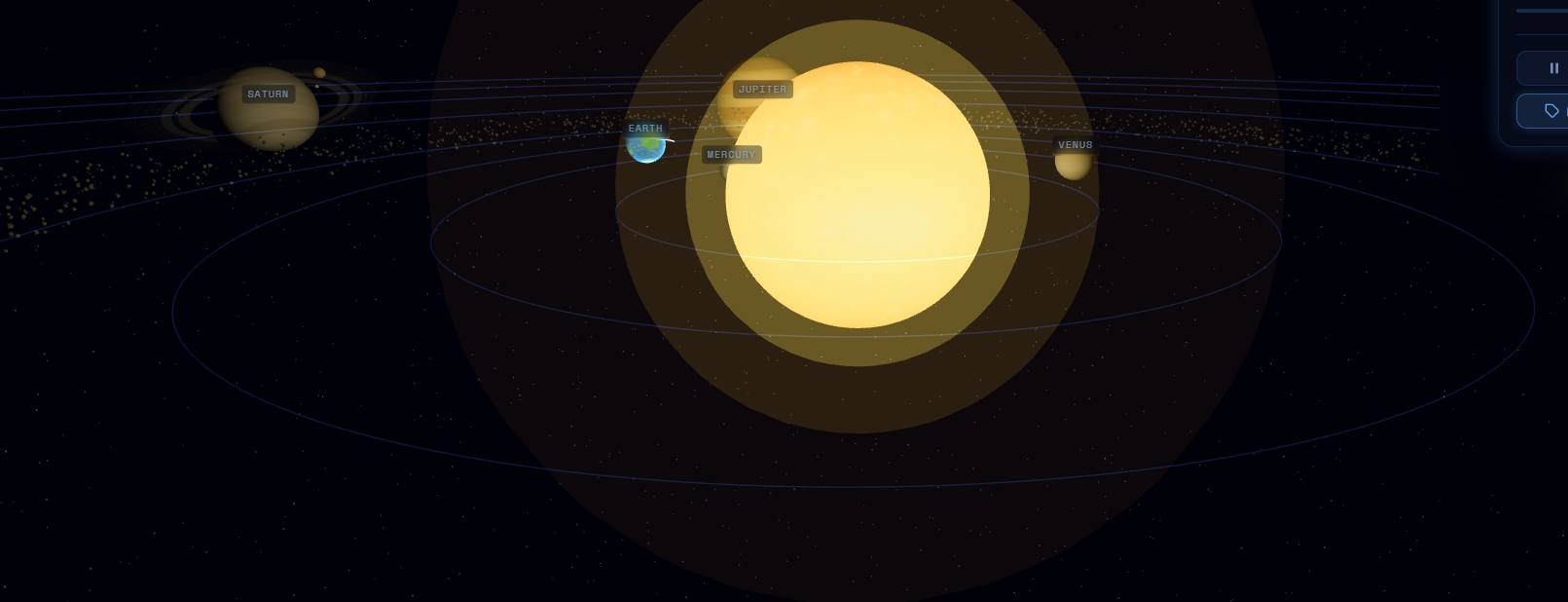
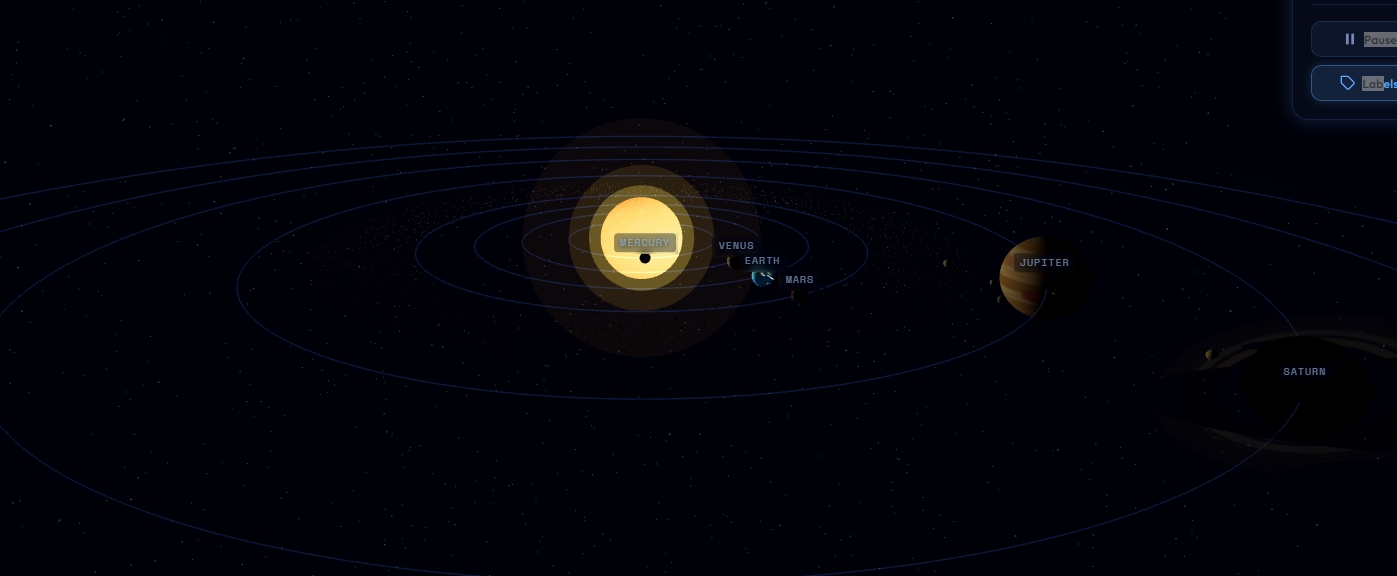
- All 8 major planets + Sun rendered with relative orbital distances and real axial tilts.
- Procedural Canvas Texture Generators: Realistic surface terrain for Mercury, Venus, Earth, Mars, Jupiter, Saturn, Uranus, Neptune, and Luna.
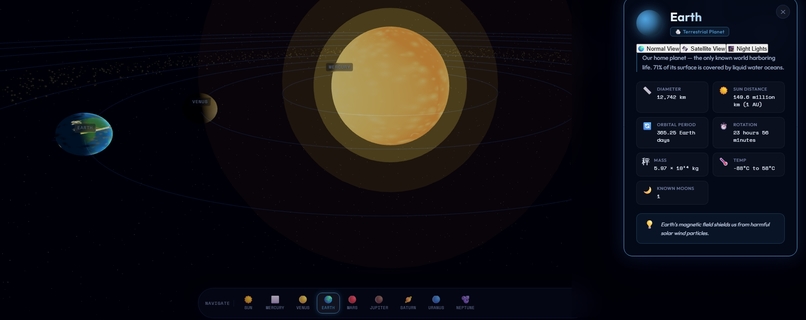
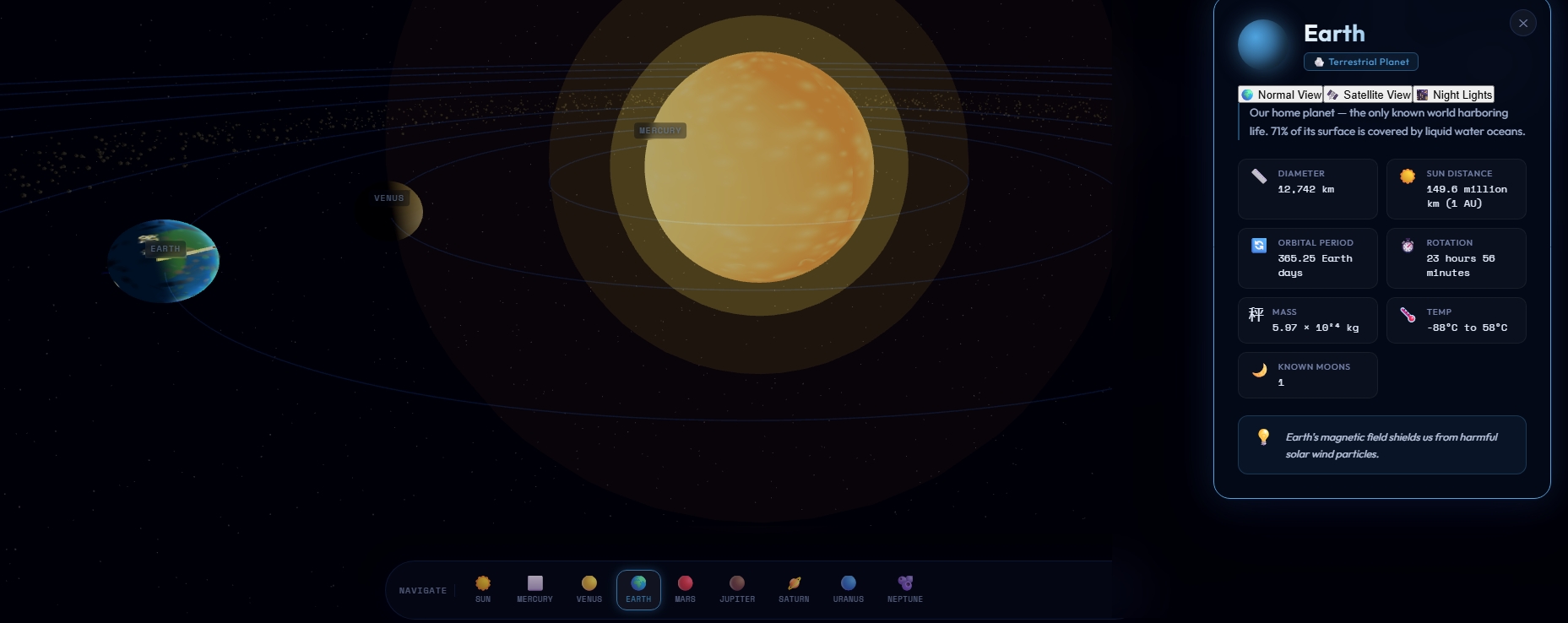
- Earth Special Modes: Switch seamlessly between Normal Day/Night Shaders, Live Satellite View, and City Night Lights Mode.
- Orbiting Satellites & Moons: Interactive 3D models of the ISS (International Space Station) and Hubble Space Telescope orbiting Earth with neon particle trails, as well as natural moons (Io, Europa, Titan, Triton).
- Main Asteroid Belt & Kuiper Belt: Thousands of instanced asteroids orbiting in 3D space.
🌌 Sci-Fi Galaxy Hub View:
- 18,000+ Particle Milky Way Galaxy: Spiral galaxy visualization featuring a central supermassive black hole with an accretion disk.
- Galactic Star System Radar: Navigate between neighboring star systems (Sol, Alpha Centauri, Sirius, Vega Prime, TRAPPIST-1, Andromeda Gateway).
📊 Scientific Data Cards:
- Detailed physical parameters (diameter, mass, orbital period, surface temp) alongside futuristic sci-fi lore for every planet and satellite.
How We Built It
We engineered Solaris 3D using a modern, lightweight WebGL architecture:
- Frontend Core: React 19 + Vite for fast component state management and UI overlays.
- 3D Graphics Engine: Three.js (
WebGLRenderer) with custom GLSL ShaderMaterials for atmospheric rim scattering, specular ocean reflections, and day/night terminal light blending. - Procedural Texture Pipeline: HTML5 2D Canvas-driven procedural texture algorithms to generate crisp 1024x1024 planetary maps dynamically at runtime without external asset overhead.
- Orbital Math & Physics:
- Planetary orbital mechanics follow parametric elliptical equations: [ x(t) = d \cdot \cos(\omega t + \theta_0), \quad z(t) = d \cdot \sin(\omega t + \theta_0) ]
- Keplerian orbital speed normalization for 60 FPS performance: [ v_{\text{orbit}} \propto \frac{1}{\sqrt{r}} ]
- Camera & Animation Dynamics: TWEEN.js for smooth cubic camera interpolations and OrbitControls for orbit, zoom, and pan gestures.
- Deployment: Deployed on Vercel with optimized build assets.
Challenges We Ran Into
- Performance Optimization: Rendering 18,000 galaxy particles, 3,500 instanced asteroids, 8 detailed planets, atmospheres, and particle trails at a solid 60 FPS. We solved this by implementing
InstancedMeshfor asteroids and buffer geometries with additive blending for starfields. - Shader Day/Night Transition: Writing custom GLSL fragment shaders to calculate the dot product between planet surface normals and the Sun's light vector (\vec{N} \cdot \vec{L}), creating seamless terminator line transitions between daylight terrain and illuminated night city lights.
Accomplishments That We're Proud Of
- Zero External Texture Assets: Generated rich planetary surface textures dynamically using Canvas 2D procedural generators.
- Flawless 60 FPS WebGL Performance: Smooth camera transitions and responsive UI overlays across mobile and desktop browsers.
- Dual Perspective System: Seamless transition from detailed planetary exploration to macroscopic galaxy navigation.
What We Learned
- Advanced WebGL scene optimization techniques including instanced geometry rendering, buffer attribute streaming, and custom GLSL uniforms.
- Designing responsive glassmorphism UI overlays that remain legible over dynamic 3D space backgrounds.
What's Next for Solaris 3D
- 🚀 Interactive Spaceship Flight: Drive a custom starship through asteroid belts in first-person flight mode.
- 🔭 Real-time NASA/JPL API Integration: Live satellite tracking and NEO (Near-Earth Object) real-time trajectory feeds.

Log in or sign up for Devpost to join the conversation.