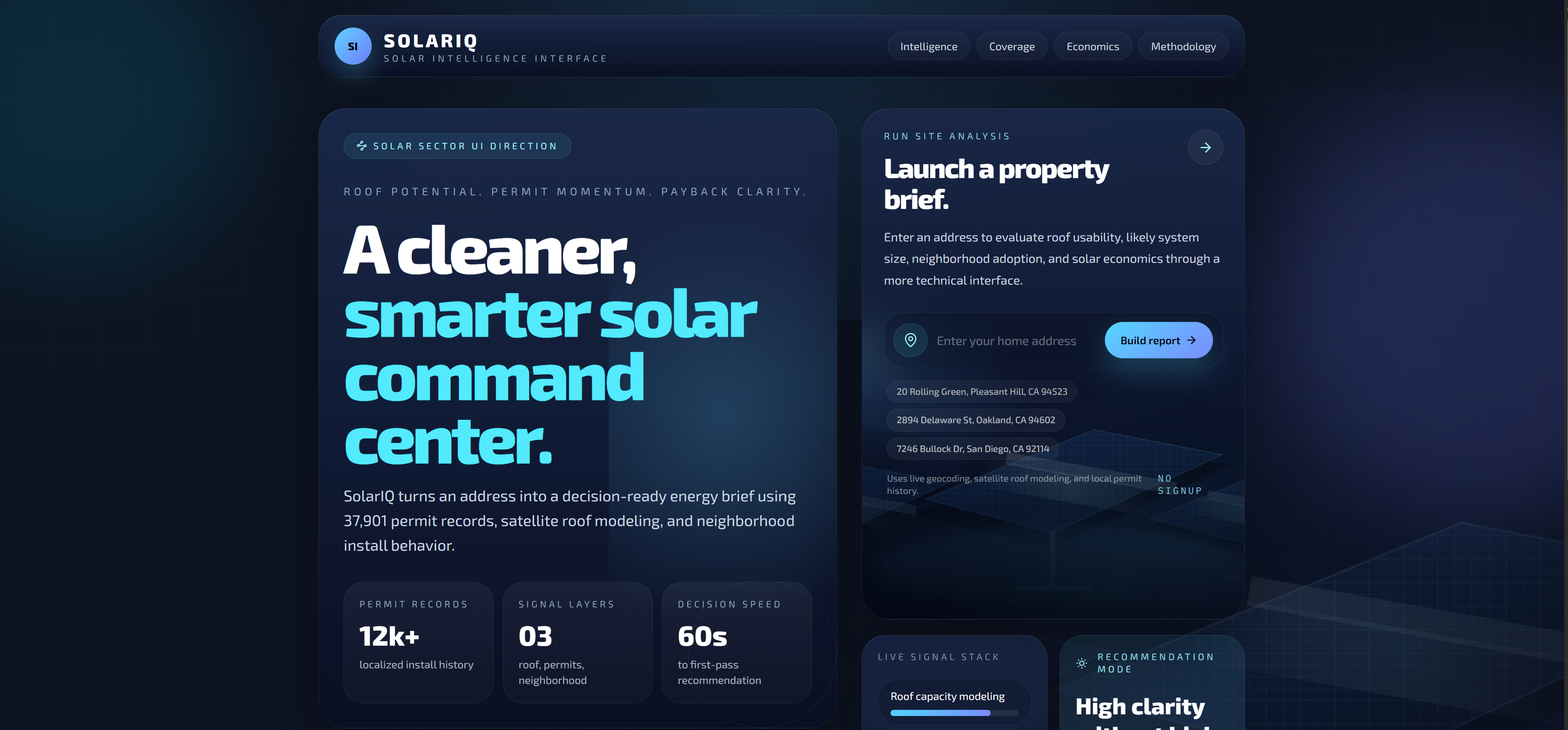
SolarIQ — Know Your Neighborhood's Solar Potential
What Inspired Me
Living in San Diego, solar panels are everywhere. But most homeowners still don't know if solar is actually worth it for them. Not generic advice. Not a sales pitch from an installer. Real, data-backed answers based on what their actual neighbors are doing.
That question drove everything. What if you could just type your address and instantly know how solar-ready your neighborhood is, what your neighbors are saving, and whether you should make the switch?
SolarIQ was born from that idea.
What I Built
SolarIQ is a neighborhood solar intelligence platform powered by real permit data, cloud infrastructure, and generative AI. It answers the question every homeowner is secretly asking:
"Should I actually get solar panels?"
The Neighborhood Map shows every solar installation in your area plotted on an interactive map, pulled from thousands of real solar permit records via the ZenPower dataset.
The Solar Report Card gives your zip code a score. How many installs? What's the average system size? What's the trend over time? I compute estimated annual savings using real kilowatt values from the dataset:
$$\text{Annual Savings} = kW \times \text{Sun Hours/Day} \times 365 \times \text{Cost per kWh}$$
The AI Solar Advisor is where it gets exciting. Powered by the Gemini API, users can have a real conversation about their specific situation. Gemini receives your neighborhood's actual permit data as context and gives answers that are grounded in reality, not marketing.
How I Built It
- React
- Supabase
- Gemini API
- Firebase (GCP)
- Google Sun API
- Vercel
What I Learned
Going into this hackathon, the goal was simple: build something real in limited time. What I actually learned was how powerful it is to combine structured datasets with generative AI.
The ZenPower dataset is incredibly rich. Variables like kilowatt_value, issue_date, latitude, longitude, and JOB_VALUE unlocked insights I didn't expect. Solar City records even include BATTERY and EV_CHARGER flags, letting me identify homes going fully off-grid.
Feeding structured, hyper-local data into Gemini as context transforms it from a generic chatbot into something that genuinely feels like a knowledgeable local advisor.
Challenges I Faced
Solo and first hackathon. No team to divide work. Every decision, every bug, every design choice landed on one person. Time management became the real engineering problem.
Data variety. The ZenPower dataset spans multiple source tables (Records, Solar City, SunRun, Freedom Forever) with different schemas. Normalizing and querying across them cleanly took real effort.
Making AI feel grounded. Getting Gemini to answer specifically rather than generically required careful prompt engineering, injecting the right neighborhood statistics as context so responses felt personalized, not canned.
Scope control. The dataset unlocks so many possible features that deciding what NOT to build was one of the hardest challenges of the weekend.
The Result
A working, cloud-deployed web app that turns raw solar permit data into actionable neighborhood intelligence, with a conversational AI layer that makes it accessible to anyone, not just data scientists.
Solar adoption shouldn't require a spreadsheet or a sales call. It should take 30 seconds and an address.
That's SolarIQ.
Built With
- firebase
- geminiapi
- google-maps
- googlecloudplatform
- next.js
- react
- supabase
- tailwind
- typescript
- vercel

Log in or sign up for Devpost to join the conversation.