Inspiration
Last-mile delivery remains one of the biggest inefficiencies in logistics. Traffic congestion, fuel dependency, and delivery delays increase operational costs and reduce customer satisfaction. Inspired by autonomous logistics innovations like Amazon Prime Air and Zipline, we envisioned a smarter, solar-powered drone system that could reduce delivery time, optimize energy use, and operate autonomously within a defined urban range.
We wanted to design a solution that demonstrates how AI and renewable energy can transform delivery infrastructure — not just as a concept, but as a scalable system simulation.
What it does
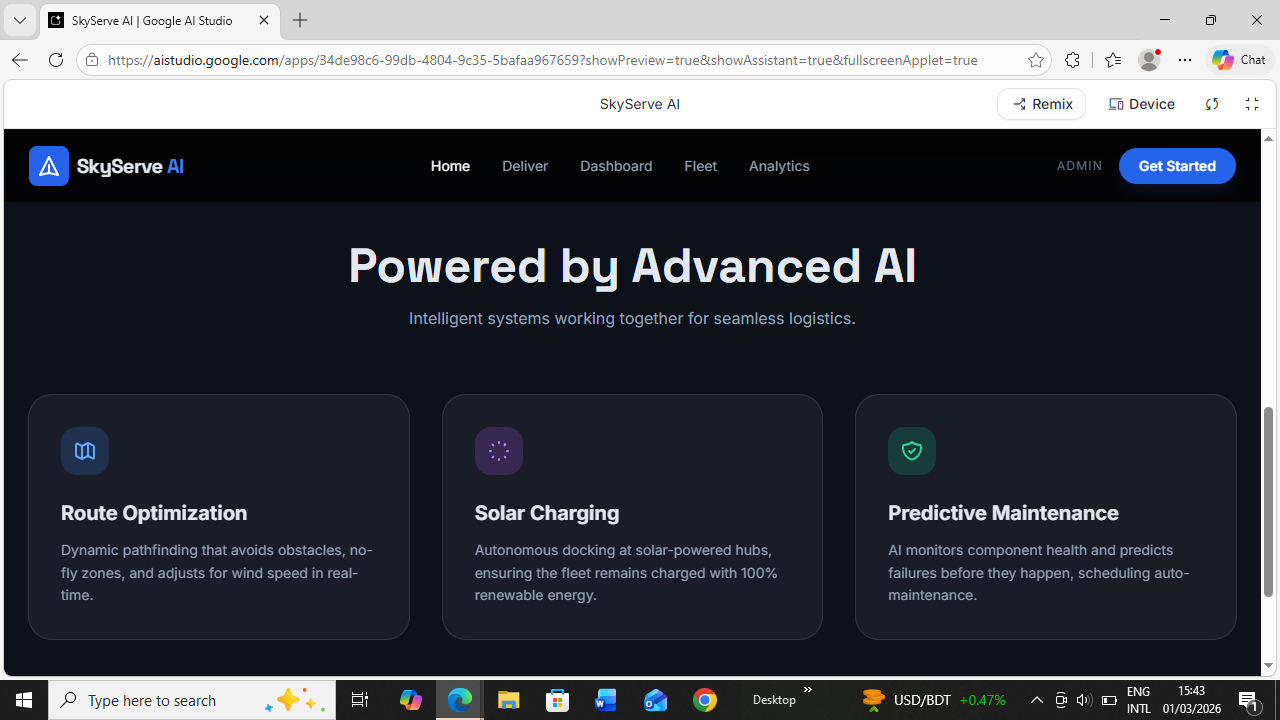
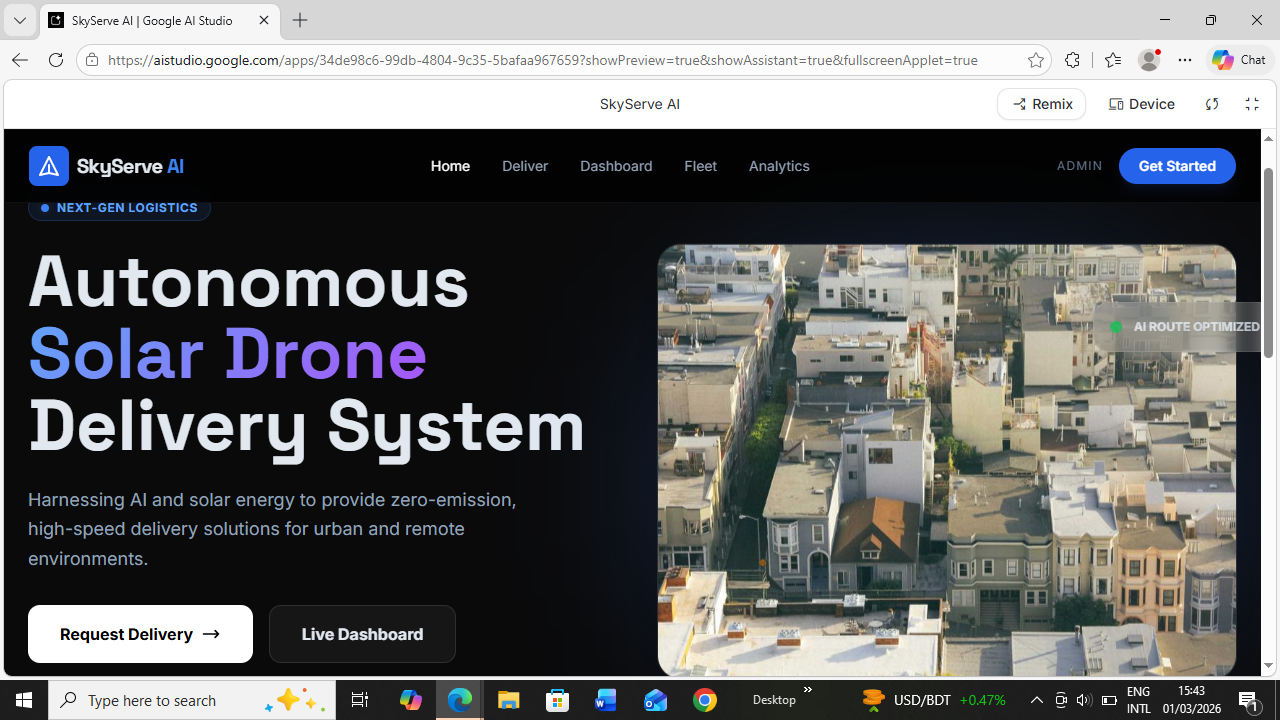
SkyServe AI is a fully responsive web-based simulation of an autonomous solar-powered drone delivery system.
The platform allows users to:
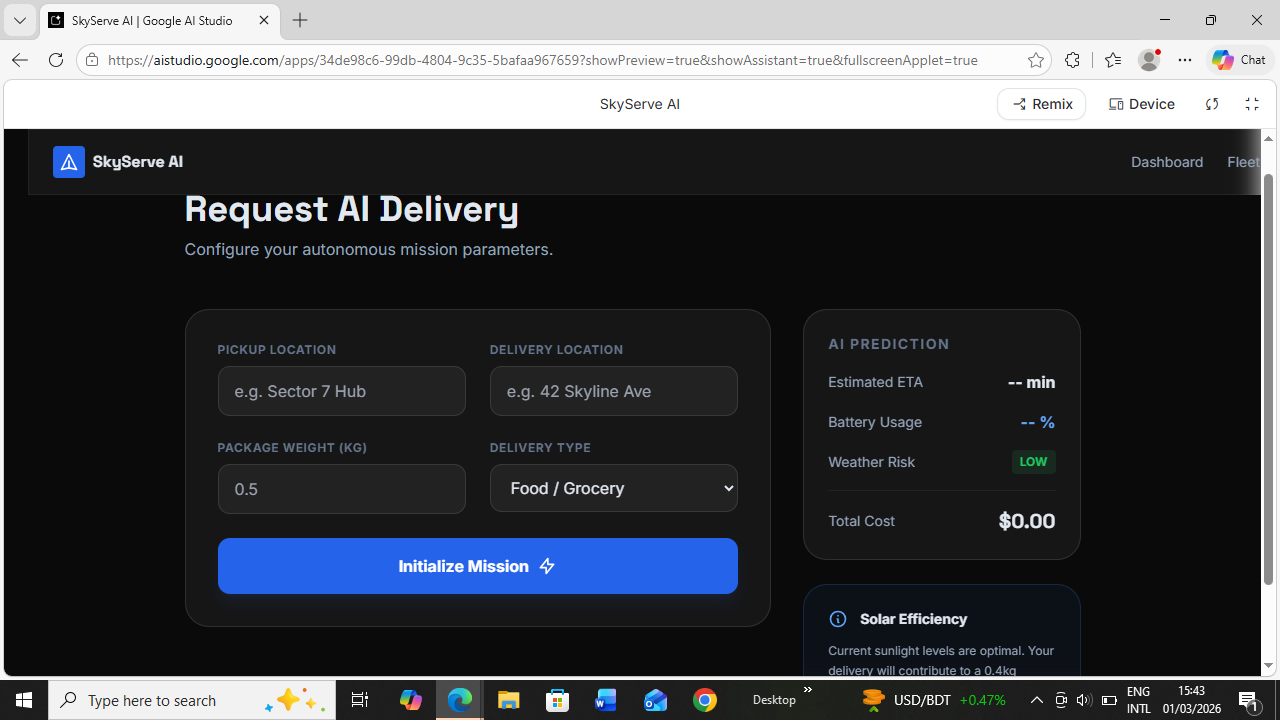
Book a delivery by entering pickup and destination details
Select parcel type and priority
Receive AI-based delivery time and cost estimation
View battery usage prediction
Monitor weather risk impact
The system includes:
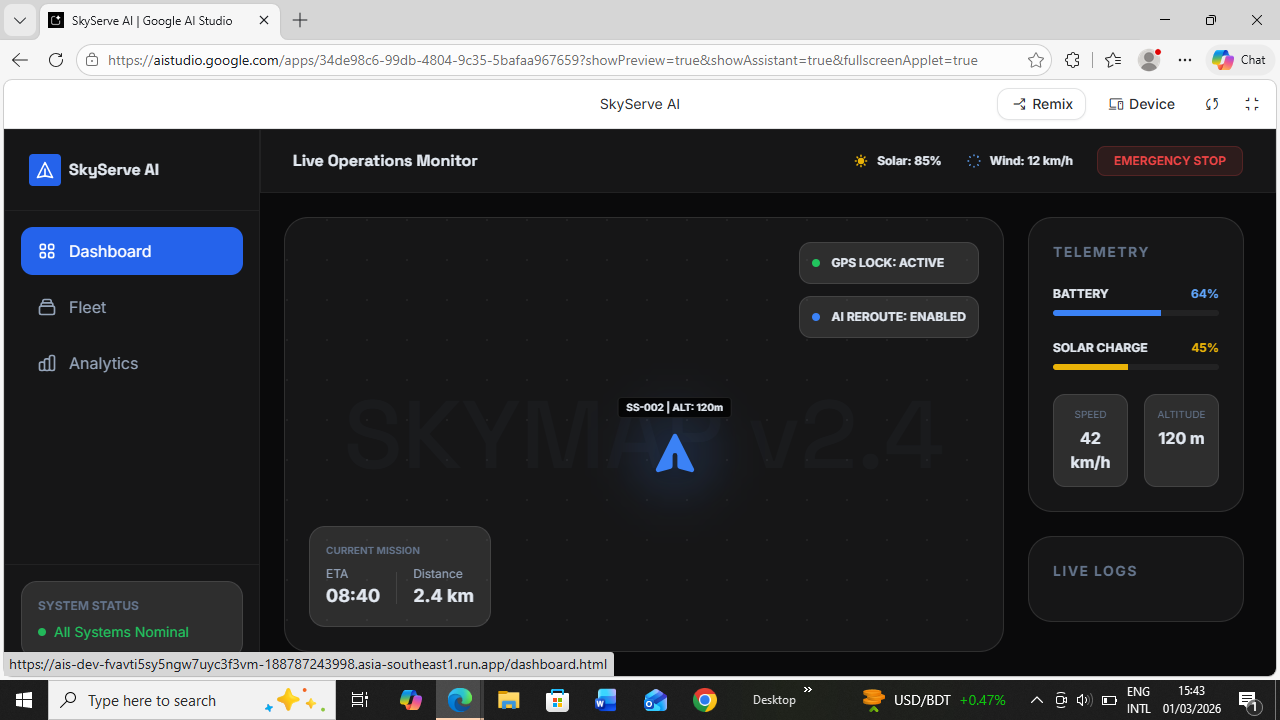
Live drone dashboard with battery and solar charging simulation
Fleet management system with multiple drones
Predictive maintenance tracking
Weather intelligence module
Obstacle detection simulation
How we built it
SkyServe AI was built as a single-page, fully responsive web application using:
HTML5
CSS3
JavaScript (Vanilla)
Bootstrap 5
Chart.js
We implemented modular JavaScript functions to simulate:
Route optimization logic
Distance-based battery drain
Weather risk scoring
Random obstacle detection events
Solar charging cycles
Predictive maintenance after repeated deliveries
All data is handled dynamically using JavaScript objects and arrays to simulate real-world drone fleet behavior.
Challenges we ran into
Simulating realistic AI behavior without a backend.
Designing real-time updates inside a single HTML file.
Creating believable drone fleet logic using only frontend scripting.
Maintaining responsiveness while handling multiple dashboard sections.
Balancing simulation realism with browser performance.
We overcame these challenges by structuring our JavaScript logic modularly and implementing interval-based real-time simulation loops.
Accomplishments that we're proud of
Built a complete drone logistics simulation in a single file.
Designed a fully responsive SaaS-style dashboard.
Implemented real-time drone status updates.
Created a predictive maintenance simulation model.
Integrated solar charging logic and weather intelligence.
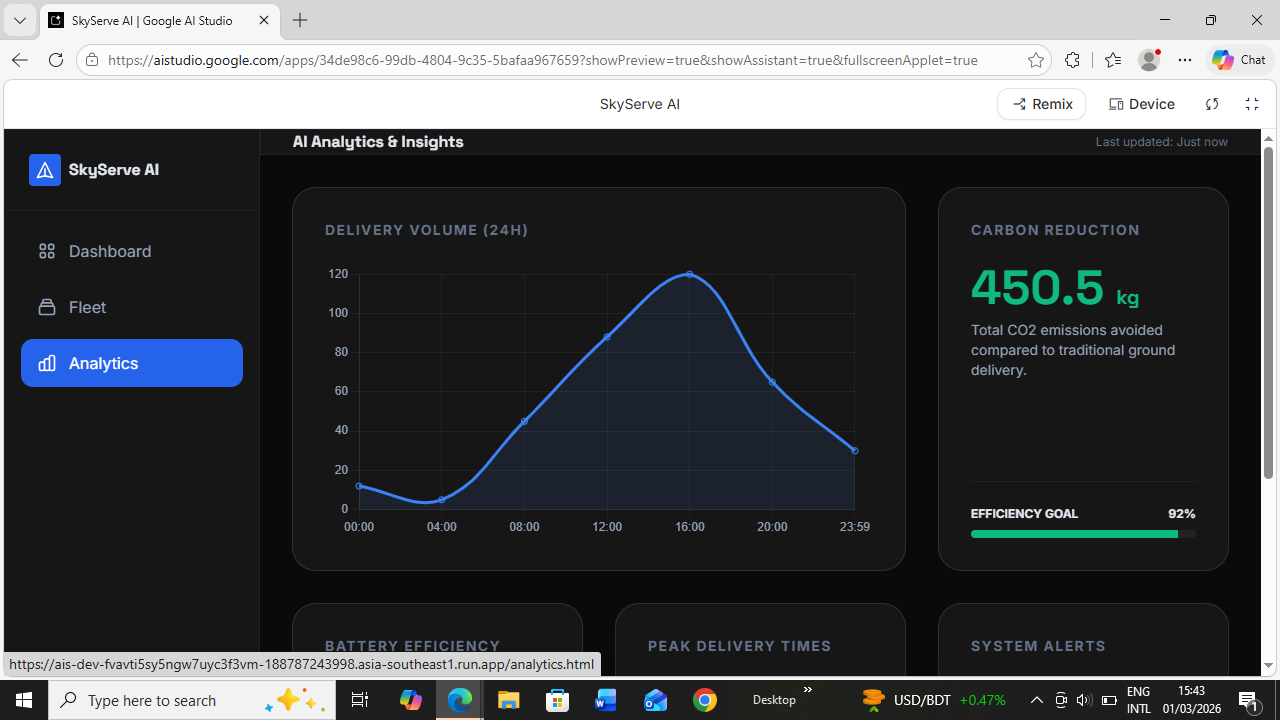
Developed analytics visualizations for delivery performance.
Delivered a project that looks like a real startup prototype, not just a demo.
What we learned
Through building SkyServe AI, we learned:
How to architect simulation-based systems without backend dependency.
How AI decision logic can be abstracted into algorithmic frontend models.
The importance of user experience in technical products.
How predictive maintenance and energy modeling can be simulated efficiently.
The complexity behind real-world drone logistics systems.
This project deepened our understanding of smart infrastructure, automation systems, and AI-driven operational logic.
What's next for SolarDrone AI Delivery
The next phase includes:
Integration with real backend APIs (Node.js / Express).
Real-time GPS mapping using Mapbox or Leaflet.
Live weather API integration.
AI-powered route optimization using real datasets.
Payment gateway integration.
IoT integration with actual drone hardware.
Machine learning-based delivery demand prediction.
Multi-drone autonomous coordination algorithms.
Our long-term vision is to evolve SkyServe AI into a real smart-city drone logistics platform that can reduce delivery time, operational cost, and carbon footprint at scale.
Built With
- bootstrap-5
- chart.js
- css3
- giminiai
- github
- html5
- javascript
- lovableai


Log in or sign up for Devpost to join the conversation.