Inspiration
What it does
Inspiration
California's transition from Net Energy Metering (NEM 2.0) to the Net Billing Tariff (NBT) changed how homeowners are compensated for exporting excess solar electricity. Under NBT, solar exports are typically credited at rates much lower than the retail price of electricity, making it harder for homeowners to capture the full financial value of their solar panels.
Meanwhile, Silicon Valley Clean Energy (SVCE) has identified another challenge: despite California's abundant midday solar generation, EV charging remains heavily concentrated overnight. SVCE's GridShift evaluation found that most participating EV charging occurred between midnight and 6 AM.
We realized these two problems could be connected. What if we could help solar homeowners recover more value from their electricity while simultaneously encouraging EV charging during solar-rich hours—without sacrificing the convenience of overnight charging?
That question inspired SolarCharge.
What it does
SolarCharge is a financial autopilot for homeowners with rooftop solar, an electric vehicle, and California's Net Billing Tariff.
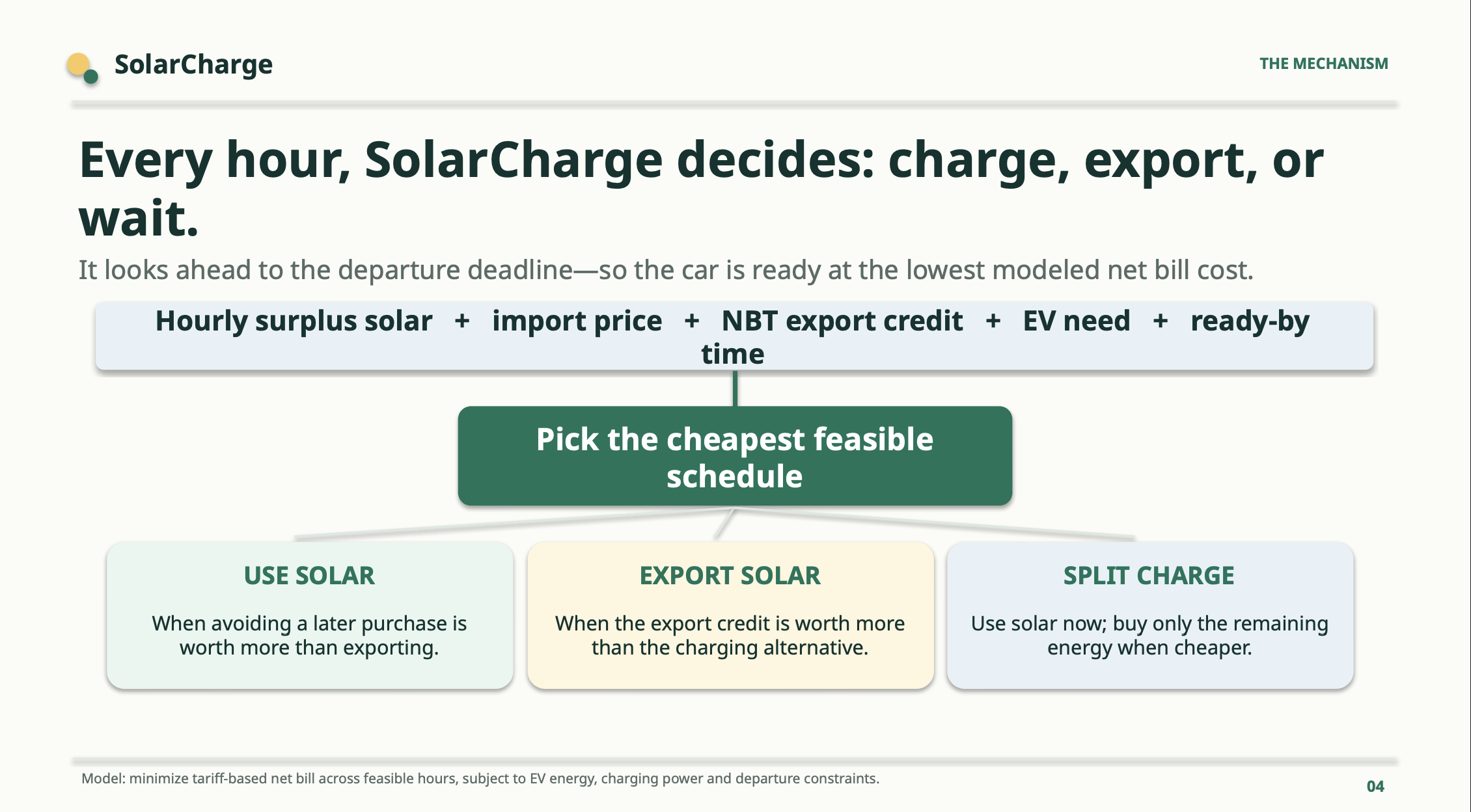
Instead of asking customers to understand complicated electricity tariffs or manually schedule charging, SolarCharge helps them make three decisions:
- Charge now: Use excess rooftop solar to charge the EV instead of exporting it for a relatively low credit.
- Export now: Sell excess solar electricity to the grid when its export value makes that option more financially attractive.
- Split charging: Use available solar during the day and top up with grid electricity overnight when necessary.
SolarCharge compares the financial consequences of these options, accounting for electricity import prices, solar export credits, household energy consumption, and EV charging requirements.
Customers simply specify when they need their car ready, their target battery level, and the minimum savings that would justify changing their routine.
The app calculates an optimized hourly charging schedule and explains the financial impact in plain language.
For example, rather than telling a homeowner to charge at noon, SolarCharge can explain:
“Using your rooftop solar to charge today could save you $5 compared with exporting that electricity and purchasing power overnight.”
The interactive prototype demonstrates how these recommendations change with solar production, electricity rates, battery requirements, and customer availability. Actual vehicle control is simulated rather than connected to physical charging hardware.
How we built it
We developed SolarCharge around a data-driven optimization engine and a customer-friendly web interface.
Research and data
We investigated California's NBT structure and SVCE's electricity programs, using publicly available sources including:
- SVCE's residential electricity rates and GridShift pilot findings.
- PG&E's E-ELEC time-of-use rate structure.
- PG&E's 2026 hourly Energy Export Credit reference data.
- California Public Utilities Commission documentation on NBT and avoided electricity-system costs.
Because SVCE customers receive generation service from a community choice aggregator, their export-credit treatment differs from PG&E's bundled-generation customers. We separated verified tariff information from the assumptions needed for our prototype.
Optimization engine
We built an hourly energy simulation that considers rooftop solar generation, other household electricity use, EV energy requirements, charging-power limits, and customer availability.
For each charging strategy, the engine calculates grid imports, solar exports, import charges, and export-credit value.
It then compares feasible charging schedules to find the lowest modeled net electricity cost while meeting the customer's battery-readiness requirements.
Customer experience
We designed a responsive website that translates these calculations into understandable decisions.
Instead of exposing customers to dozens of hourly prices, the interface highlights their recommended charging plan, estimated savings compared with their usual overnight routine, and the financial consequences of alternative choices.
We also added an hour-by-hour simulation so users can see when SolarCharge chooses to charge the EV, preserve solar exports, or wait for cheaper electricity.
Challenges we ran into
1. Understanding California's electricity billing system
NBT is more complicated than simply comparing electricity prices during the day and night. Solar exports and grid imports have different financial values, and SVCE generation charges must be distinguished from PG&E delivery charges.
We discovered that the official PG&E export-credit sheet explicitly directs community choice aggregation customers to their generation provider for the applicable generation export pricing.
Because we could not fully verify SVCE's 2026 generation export-credit schedule, we built the prototype with transparent, adjustable assumptions rather than presenting simulated results as actual customer bills.
2. Making optimization genuinely useful
Our initial concept focused on encouraging midday charging through targeted rewards and incentives.
However, we realized that many customers already charge overnight because it is convenient, inexpensive, and ensures their vehicle is ready the next morning.
Financial incentives alone do not necessarily overcome that behavior.
This led us to redesign SolarCharge around the customer's existing financial interest: getting more value from their own rooftop solar while preserving battery readiness.
3. Competing with existing smart-charging solutions
Our early simulations revealed that a competent solar-following charging strategy can already capture much of the potential financial benefit.
This challenged us to develop a clearer distinction: SolarCharge evaluates the opportunity cost of exporting electricity under NBT, identifies when preserving exports is preferable, and explains the financial tradeoff to customers.
We recognize that demonstrating additional savings over existing sophisticated charging products will require further validation.
4. Turning complex calculations into a simple experience
The optimization involves many variables, but customers should not have to understand all of them.
We repeatedly simplified the interface until the core decision became easy to follow: How much could I save by following SolarCharge's recommendation instead of charging overnight?
Accomplishments that we're proud of
We connected two energy challenges into one customer-centered solution.
Instead of treating lower NBT export compensation and underutilized midday EV charging as separate problems, SolarCharge explores how addressing one could help address the other.
We are particularly proud of:
- Building a functioning hourly optimization prototype that compares charging immediately, exporting and charging later, splitting charging across periods, and financially optimized scheduling.
- Making the opportunity cost of solar exports visible, so customers can understand both the electricity purchases they avoid and the export credits they give up.
- Protecting customer convenience through battery targets, departure-time requirements, optional recommendations, and simulated automatic charging.
- Using real public tariff information while clearly distinguishing verified inputs from modeled assumptions.
- Stress-testing our assumptions, including cases where financial optimization produces no additional savings over ordinary solar-following.
Our annual scenario simulations suggested that households with EVs available during daylight hours could capture meaningful savings relative to overnight charging. However, those results are based on synthetic household profiles and partially assumed tariff inputs, not measured customer outcomes.
What we learned
Our biggest lesson is that energy optimization is not just about finding the cheapest hour. It is about understanding what customers value and making the better decision effortless.
We learned that:
- Customers care about having a vehicle ready when they need it, not about optimizing electricity markets.
- Rooftop solar is not financially free to consume. Under NBT, using it means giving up a potential export credit.
- Maximizing solar self-consumption is not always the same as maximizing financial savings.
- Midday charging opportunities depend heavily on whether a vehicle is actually available at home during solar-production hours.
- Sophisticated algorithms are only useful when they deliver meaningful improvements over simpler existing strategies.
- Transparency about assumptions and estimated savings is essential for building customer trust.
Most importantly, we shifted from asking “How do we convince customers to charge midday?” to “How do we make financially beneficial charging decisions automatic, while preserving the convenience customers already enjoy?”
That change shaped our final product.
What's next for SolarCharge
Our next goal is to move from a simulated financial optimizer toward a validated, customer-ready charging service.
First, we want to improve financial accuracy. We'll confirm SVCE's applicable NBT generation export-credit rules and integrate complete customer-specific import and export billing calculations.
Second, we'll test realistic household data. Using actual or appropriately authorized solar production, electricity consumption, and EV charging records, we'll evaluate how SolarCharge performs across different seasons and customer routines.
Third, we'll connect compatible EVs and chargers. With customer permission, SolarCharge could eventually execute optimized charging schedules automatically, with manual override and battery-readiness protections.
Finally, we'll validate real customer and grid impacts. We want to measure incremental bill savings, automation adoption, reliable vehicle readiness, changes in electricity imports and exports, and the resulting effects on grid costs and emissions.
Our long-term vision is for SolarCharge to become a financial autopilot for home electrification—starting with solar and EV charging, then potentially expanding to batteries, heat pumps, and other flexible household energy resources.
Our goal is simple: help customers make the most of clean energy without making them think about electricity every day.

Log in or sign up for Devpost to join the conversation.