-
-
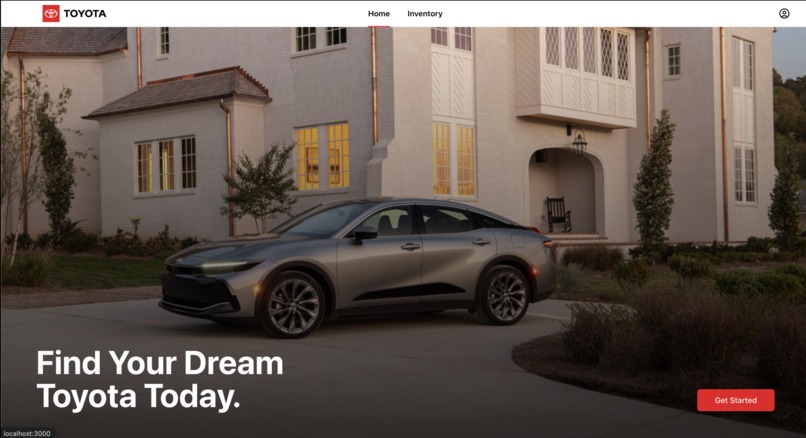
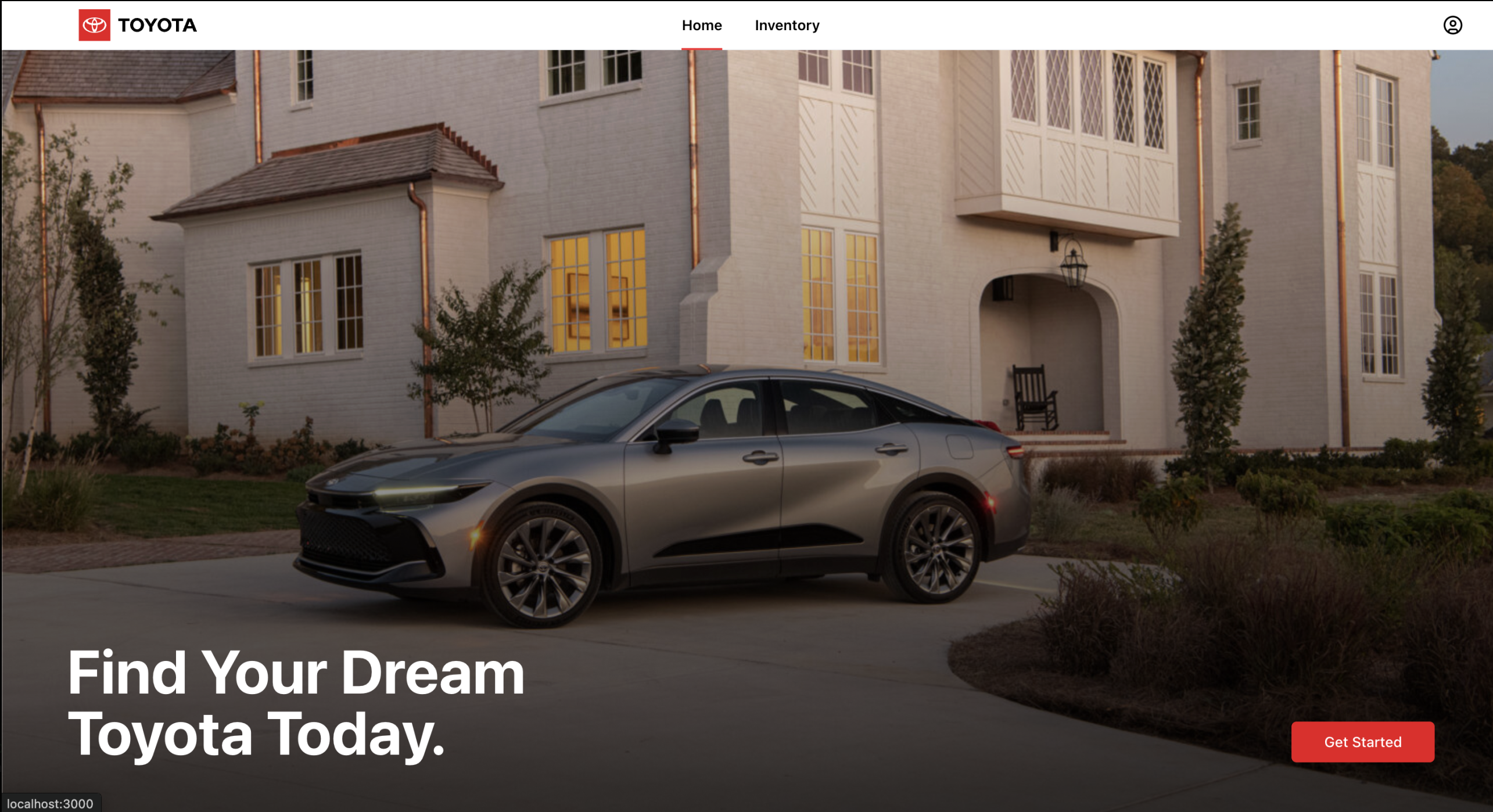
Home page
-
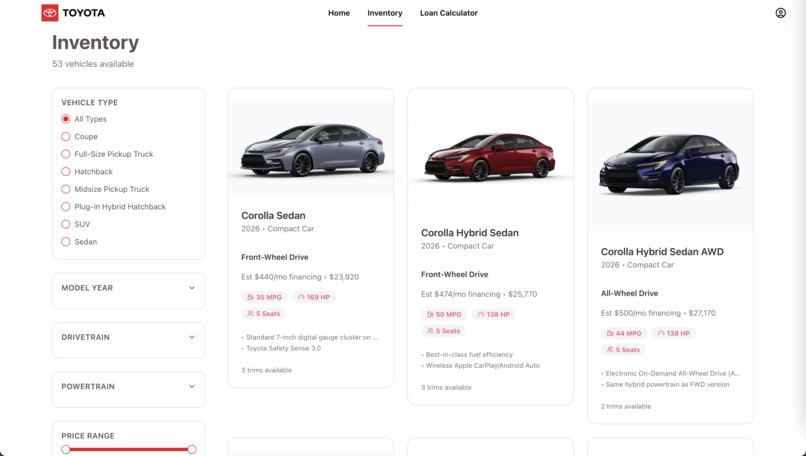
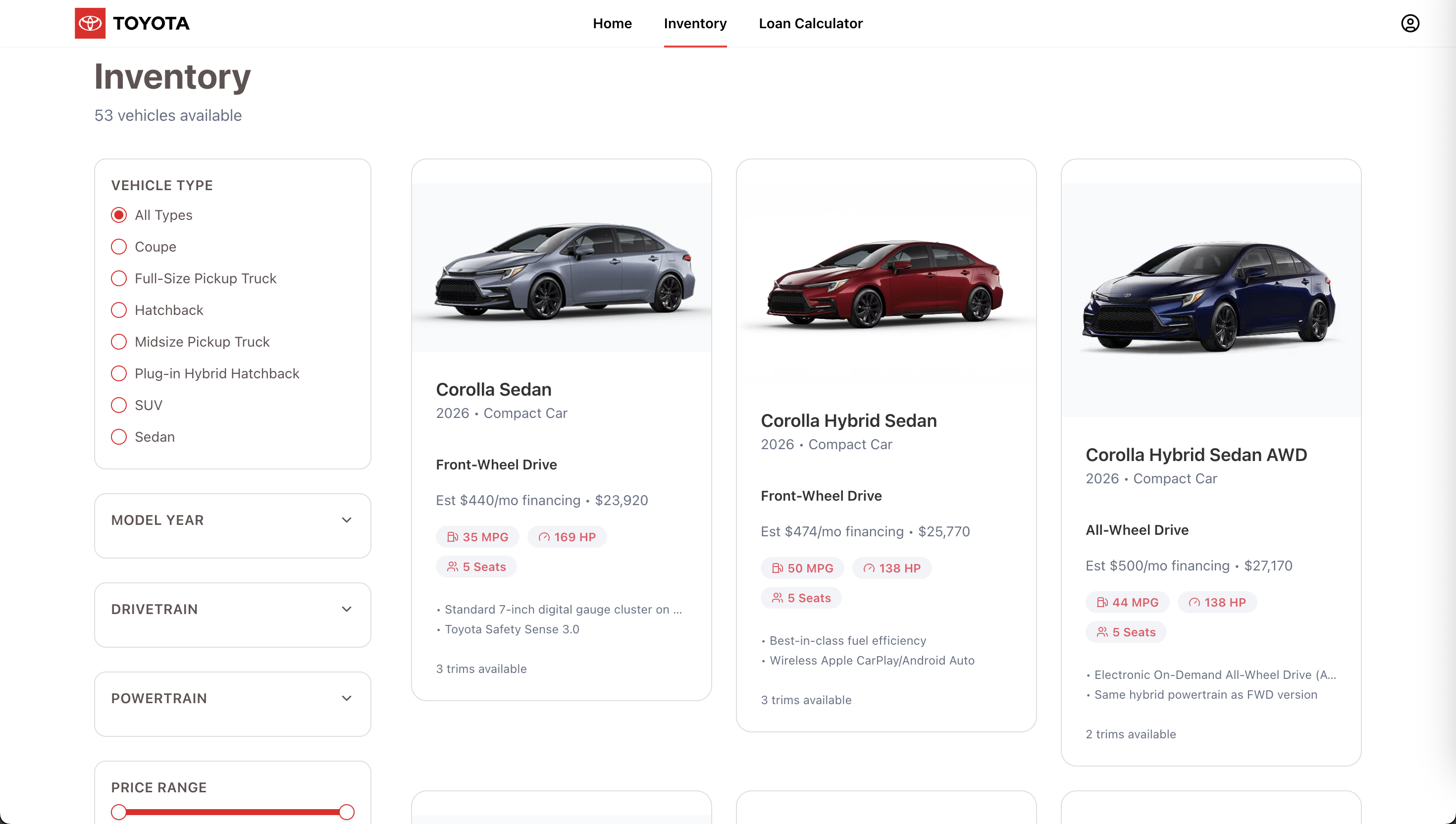
Inventory page
-
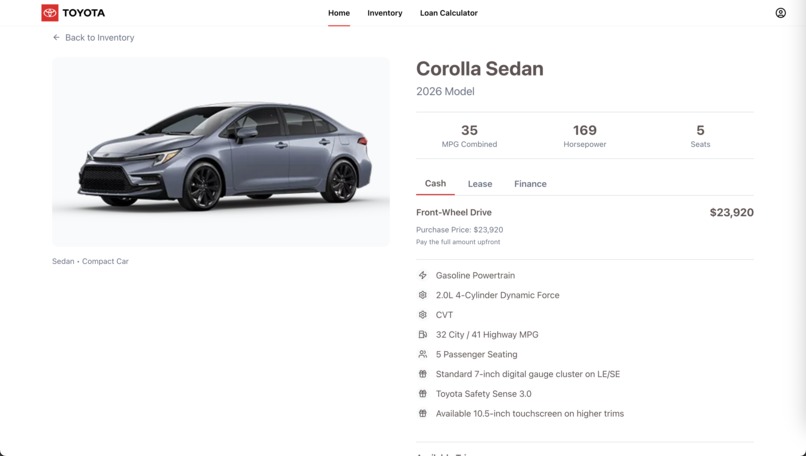
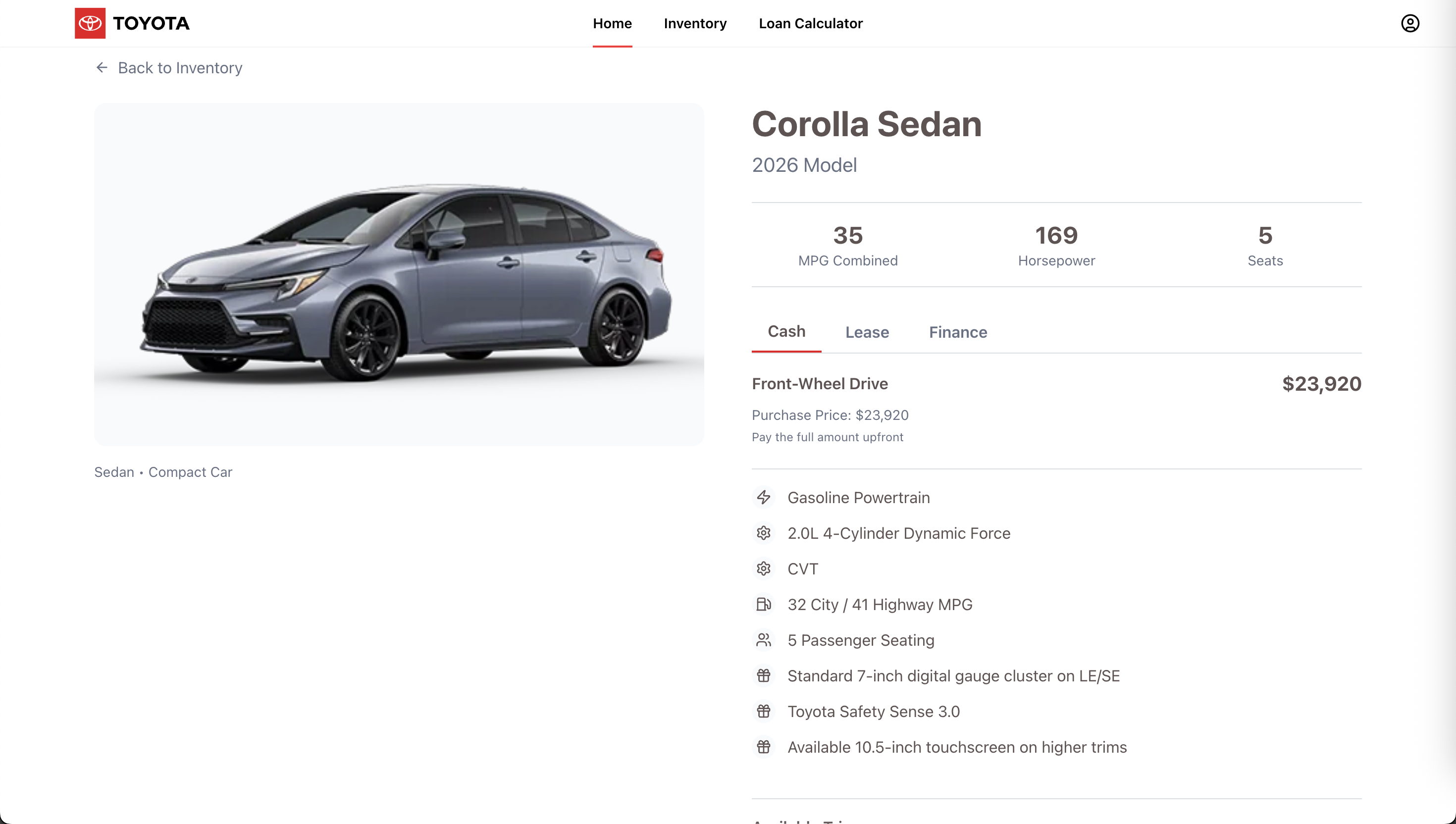
Detailed Car Info page
-
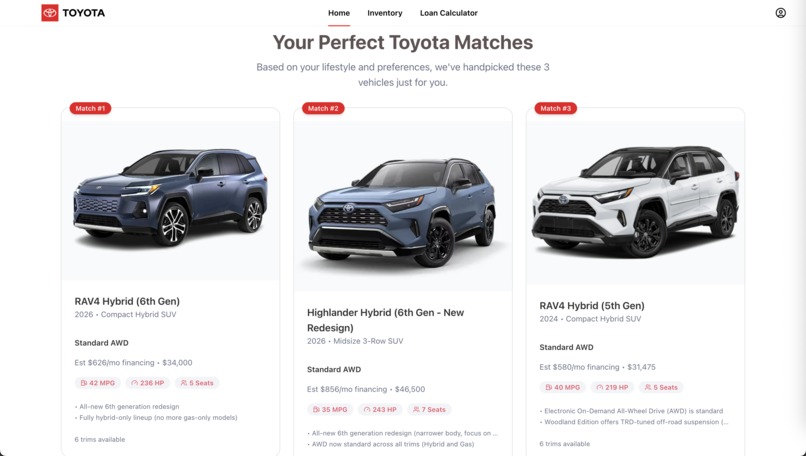
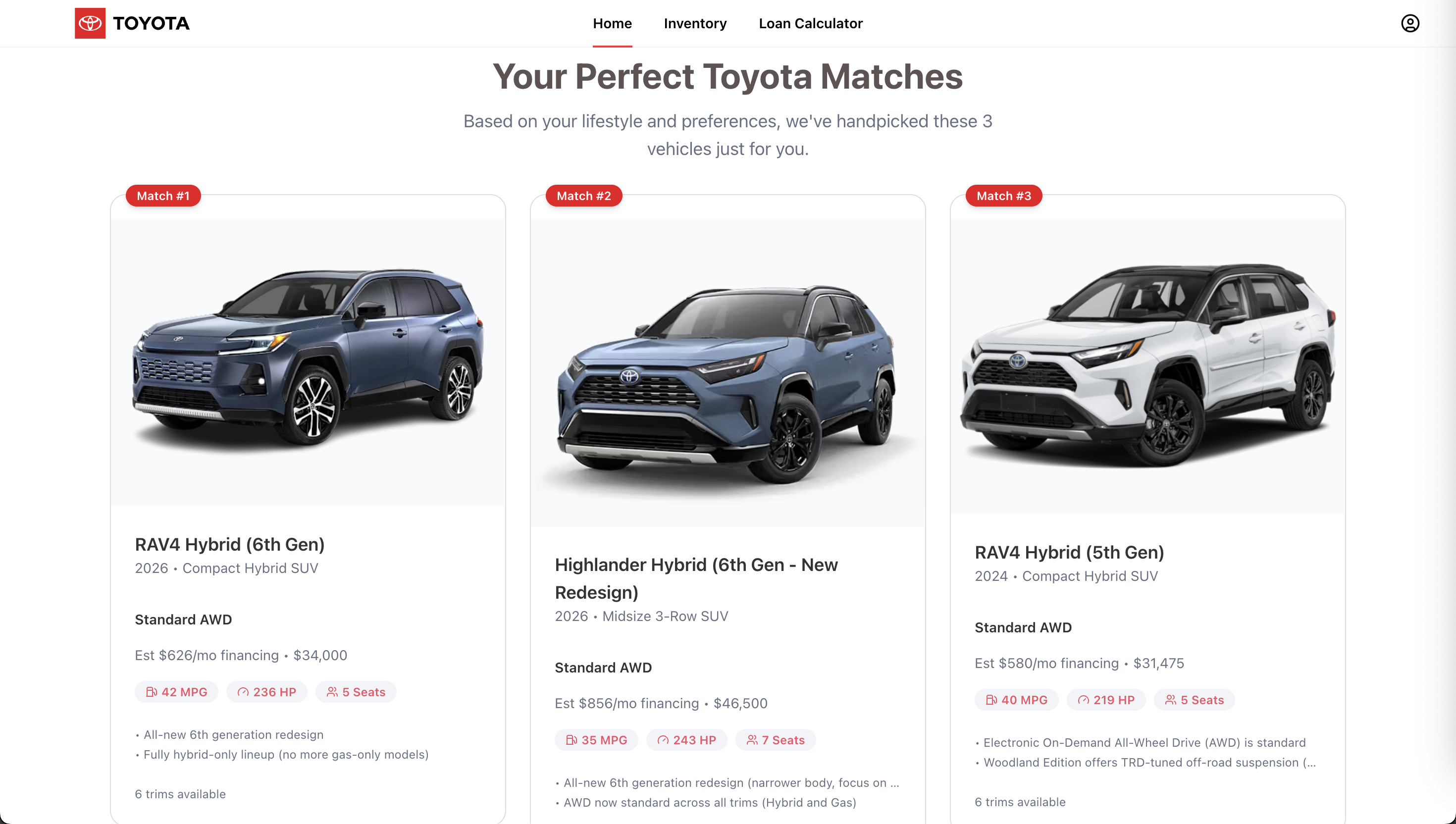
AI Recommendation page
-
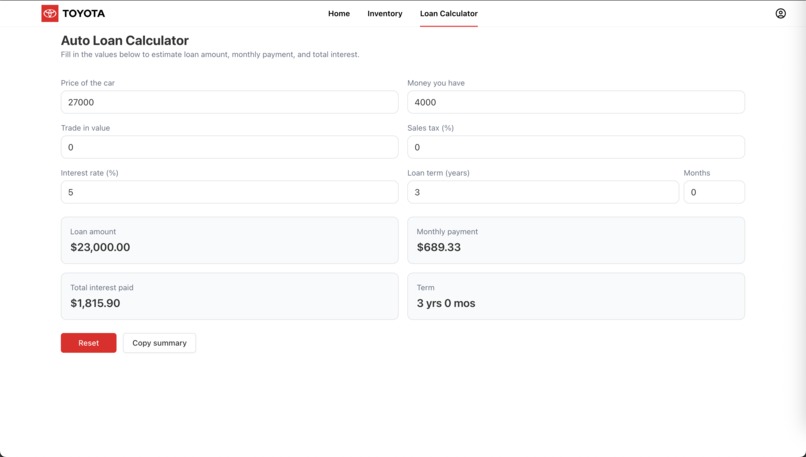
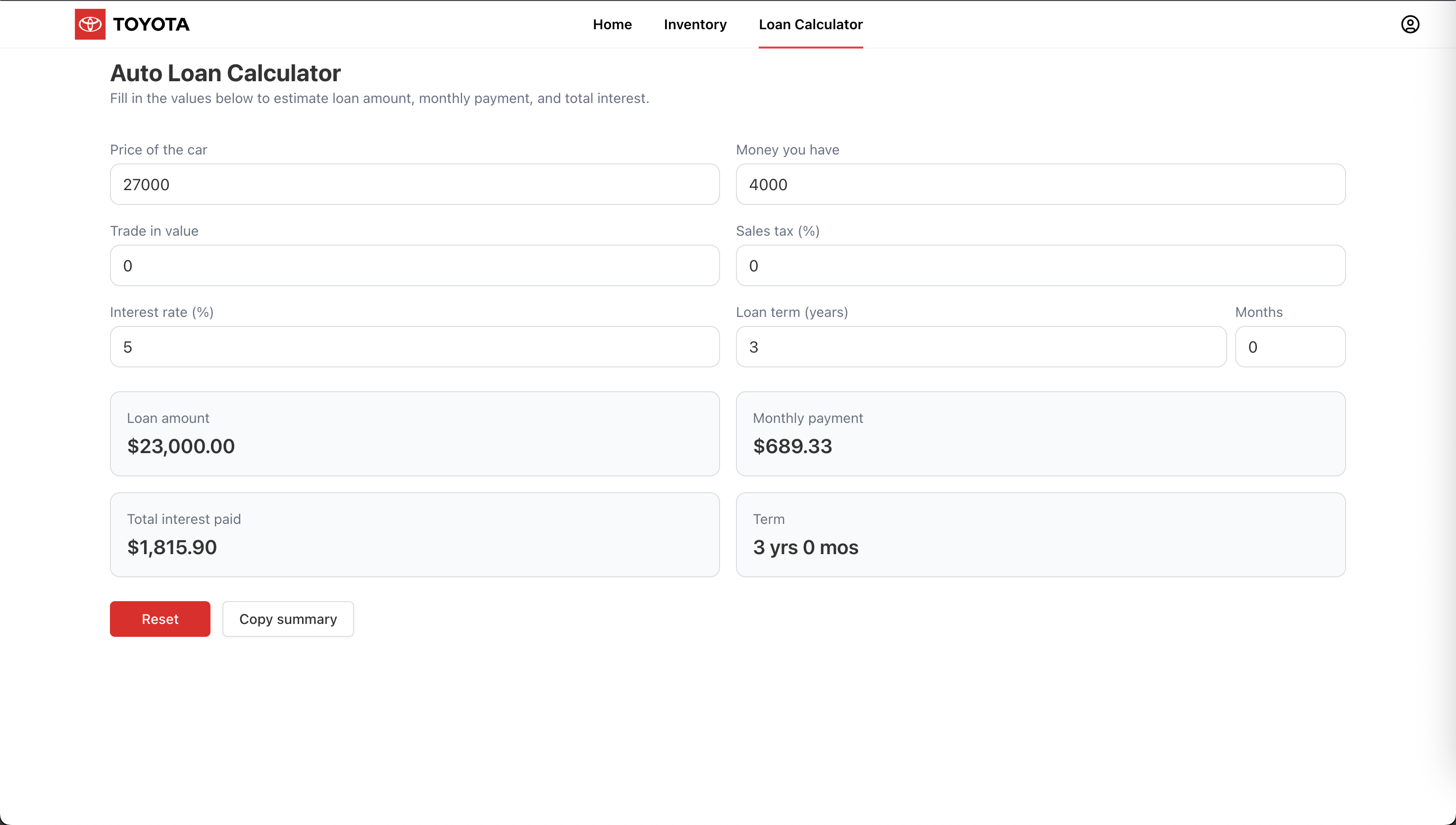
Auto Loan Calculator page
Inspiration
The traditional car buying experience is often overwhelming and inefficient. Customers spend hours browsing through hundreds of vehicles without clear guidance on which models truly match their needs and lifestyle. We were inspired to solve this problem by creating an intelligent vehicle discovery platform that combines the power of AI with Toyota's extensive vehicle lineup.
Our inspiration came from three key observations:
- Decision Fatigue: With hundreds Toyota models and countless configurations, customers struggle to narrow down their options
- Mismatched Expectations: Buyers often overlook vehicles that would be perfect for them while focusing on models that don't fit their actual needs
- Financial Uncertainty: Many shoppers don't understand the financial implications until late in the buying process
We envisioned a platform that could understand a customer's lifestyle, preferences, and budget upfront, then intelligently recommend the perfect Toyota vehicles while providing transparent financial planning tools.
What We Learned
Throughout this project, we gained valuable insights across multiple domains:
Technical Learning
- AI Integration: Implementing GPT-4o for personalized recommendations taught us how to craft effective prompts that balance user preferences with product specifications
- State Management: Managing complex multi-step forms and quiz flows while maintaining data consistency across authentication boundaries
- Modern React Patterns: Working with React 19 and Next.js 16's App Router gave us hands-on experience with the latest server components and streaming patterns
- Type Safety: Leveraging TypeScript with Zod validation schemas helped us catch errors early and maintain robust data contracts
UX Design Learning
- Progressive Disclosure: Breaking down the 11-question quiz into digestible steps improved completion rates
- Financial Transparency: Real-time loan calculations with interactive sliders help users understand affordability immediately
- Personalization Balance: Finding the right number of questions to gather meaningful preferences without causing quiz fatigue
Product Learning
- Automotive Domain Knowledge: Deep diving into vehicle specifications, powertrains, and trim levels across Toyota's entire lineup
- Customer Psychology: Understanding how different buyer personas prioritize features (safety vs. performance vs. efficiency)
- Financial Products: Learning the nuances of auto financing, leasing calculations, and payment estimation formulas
How We Built It
Architecture Overview
We built a full-stack Next.js application with a clear separation between the client-facing experience and AI-powered backend services.
Frontend Stack:
Next.js 16 (App Router)
├── React 19 (Server & Client Components)
├── TypeScript 5 (Type Safety)
├── Tailwind CSS 4 (Styling)
├── Radix UI (Accessible Components)
└── React Hook Form + Zod (Form Validation)
Backend Services:
Next.js API Routes
├── OpenAI GPT-4o (Recommendation Engine)
├── Supabase Auth (User Management)
└── Vercel AI SDK (Streaming Responses)
Development Process
Phase 1: Data Foundation We started by building a comprehensive vehicle database containing detailed specifications for 50+ Toyota models. Each entry includes:
- Multiple powertrain configurations
- Detailed performance metrics (horsepower, torque, MPG)
- Pricing information across different trims
- Seating capacity and dimensions
- Key features and available options
Phase 2: User Authentication Implemented Supabase authentication with a multi-step sign-in/sign-up flow:
- Email collection
- Password entry
- Session management with SSR support
- Protected route middleware
Phase 3: Personalization Quiz Designed an 11-question questionnaire covering:
- Usage patterns (commuting, family trips, adventures)
- Capacity needs and trip distances
- Budget constraints ($10k-$100k range)
- Environmental factors (fuel efficiency, garage availability)
- Lifestyle requirements (pets, outdoor gear, cargo)
- Financial preferences (new vs. used, finance vs. lease)
Phase 4: AI Recommendation Engine Built the core intelligence using OpenAI's GPT-4o. The AI considers multiple factors simultaneously:
- Budget constraints
- Lifestyle needs
- Environmental preferences
- Feature priorities
- Family size
- Commute patterns
Phase 5: Inventory & Detail Pages Created a filterable inventory system with:
- Multi-select filters (type, year, drivetrain, powertrain)
- Price range sliders
- Dynamic vehicle cards with key specs
- Detailed vehicle pages with comprehensive information
Phase 6: Financial Tools Developed an interactive loan calculator with real-time calculations:
$$\text{Monthly Payment} = \frac{P \times r \times (1+r)^n}{(1+r)^n - 1}$$
Where:
- $P$ = Principal loan amount (price - down payment - trade-in + sales tax)
- $r$ = Monthly interest rate (annual rate ÷ 12)
- $n$ = Total number of payments (years × 12 + months)
$$\text{Total Interest} = (\text{Monthly Payment} \times n) - P$$
Phase 7: Agentic Automation Created a Python-based automation agent using:
- Selenium for browser automation
- Nemotron 70B LLM for intelligent interactions
- Autonomous test drive scheduling capability
Challenges We Faced
Challenge 1: AI Consistency & Accuracy
Problem: Initial GPT-4o responses were inconsistent, sometimes recommending vehicles that didn't exist or ignoring key constraints like budget.
Solution:
- Implemented structured prompts with explicit model ID lists
- Added response validation to ensure recommended vehicles exist in our database
- Created fallback logic for edge cases
- Used JSON-mode responses for structured output
Challenge 2: Form State Management
Problem: Managing quiz state across page refreshes and authentication redirects while maintaining progress.
Solution:
- Implemented
localStoragefor client-side persistence - Created a custom hook for quiz state management
- Added progress indicators to show completion status
- Implemented graceful degradation if storage is unavailable
Challenge 3: Complex Filter Logic
Problem: Inventory page needed to support multiple simultaneous filters (type, year, drivetrain, price) with smooth performance.
Solution:
// Efficient multi-filter implementation
const filteredVehicles = vehicles.filter(vehicle => {
  const typeMatch = selectedTypes.length === 0 ||
                    selectedTypes.includes(vehicle.type);
  const yearMatch = selectedYears.length === 0 ||
                    selectedYears.includes(vehicle.year);
  const drivetrainMatch = /* ... */;
  const priceMatch = vehicle.price >= minPrice &&
                     vehicle.price <= maxPrice;

  return typeMatch && yearMatch && drivetrainMatch && priceMatch;
});
Built With
- ai
- nextjs
- openai
- postgresql
- react
- supabase
- tailwind
- vercel


Log in or sign up for Devpost to join the conversation.