-
-
Home
-
Main page


Inspiration
The Solar System is a fascinating subject that has intrigued humanity for centuries. As technology advances, we are able to explore more of the universe beyond our planet. With the rise of virtual reality and 3D rendering, it is now possible to create immersive experiences that allow people to explore space in ways that were once unimaginable.
Our inspiration for the Solar System Explorer project was to create a fun and educational way for people to learn about our neighboring planets and celestial bodies. We wanted to provide an interactive experience that allows users to feel like they are actually traveling through space and exploring the wonders of the solar system.
We recognized that there are many apps and websites out there that provide information about the solar system, but most of them are limited in their interactivity. We wanted to create something that was not only informative but also engaging and entertaining for users.
What it does
Solar System Explorer is a web app that allows users to embark on an interactive tour of our solar system. With this app, users can explore planets, moons, and other celestial bodies while learning about their unique characteristics and features.
The app is built using HTML, CSS, and JavaScript, with Three.js incorporated to create a realistic and immersive 3D experience. The starry background provides a beautiful setting for users to explore the vastness of space, while the realistic 3D objects and animations make it feel like they are actually traveling through the solar system.
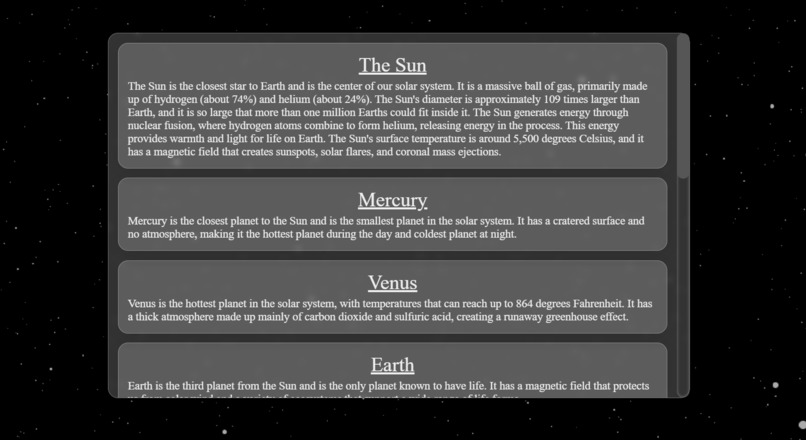
One of the key features of Solar System Explorer is its interactivity. Users can choose any planet or moon from the solar system and view detailed information about it, including its size, distance from the sun, and unique characteristics. They can also zoom in and out to get a closer look at each celestial body, rotate them to see them from different angles, and even toggle different layers such as surface textures and atmosphere.
Solar System Explorer provides an educational and engaging experience for users of all ages. It can be used by students to learn about the different planets in our solar system, by astronomy enthusiasts to explore the latest discoveries and research about space, or simply by anyone who is curious about the mysteries of the universe.
Overall, Solar System Explorer is a fun and informative way to explore the wonders of our solar system. It offers an immersive and interactive experience that is sure to inspire curiosity and interest in the mysteries that lie beyond our planet.
How we built it
The first step in building Solar System Explorer was to create a design that would be both aesthetically pleasing and functional. We used HTML and CSS to create the layout of the app, including the starry background and the user interface elements. We also used CSS to create animations that would make the app feel more interactive and engaging.
To create the 3D objects and animations, we turned to Three.js, a powerful JavaScript library that allows us to create realistic 3D objects and animations. We used Three.js to create the planets, moons, and other celestial bodies in the solar system. We also used it to create the lighting effects that give the app a realistic and immersive feel.
One of the most challenging aspects of building Solar System Explorer was incorporating the information about each planet and moon in the solar system. We used JavaScript to create a database of information about each celestial body, including its size, distance from the sun, and unique characteristics. We also used JavaScript to create the interactivity features, such as the ability to zoom in and out and toggle different layers.
Throughout the development process, we paid close attention to performance and optimization. We used techniques such as lazy loading and minification to ensure that the app loads quickly and runs smoothly. We also tested the app extensively to ensure that it works well on a variety of devices and browsers.
Overall, building Solar System Explorer was a challenging but rewarding experience. We were able to combine our creativity and technical skills to create an app that is both informative and engaging. We hope that users will enjoy exploring the wonders of our solar system with Solar System Explorer and that it will inspire curiosity and interest in the mysteries of the universe.
Challenges we ran into
Building Solar System Explorer was not without its challenges. While the end result was a polished and engaging web app, we encountered a number of obstacles along the way that required us to think creatively and problem-solve to find solutions.
One of the main challenges we faced was creating the 3D objects and animations that would give the app its immersive and realistic feel. While Three.js is a powerful tool for creating 3D objects, we had to experiment with different techniques and settings to achieve the look and feel we wanted. We also had to optimize the 3D objects to ensure that they loaded quickly and did not impact the app's performance.
Another challenge we faced was incorporating the large amount of information about each planet and moon in the solar system. We had to find a way to present this information in a way that was easy to understand and visually appealing, while still being informative. This required us to experiment with different UI designs and information layouts until we found a solution that worked well.
Performance optimization was another significant challenge we encountered. With so many 3D objects and animations in the app, we had to be careful to optimize the code to ensure that it loaded quickly and ran smoothly on a variety of devices and browsers. We used techniques such as lazy loading and minification to reduce the app's load time and overall file size.
Finally, one of the biggest challenges we faced was ensuring that the app was user-friendly and intuitive to use. We had to think carefully about the user interface design and ensure that users could easily navigate the app and find the information they were looking for. We also had to test the app extensively to identify and fix any usability issues.
Despite these challenges, we were able to overcome them through experimentation, collaboration, and hard work. The end result is a polished and engaging web app that allows users to explore the wonders of the solar system in an interactive and immersive way.
Accomplishments that we're proud of
There were many accomplishments that we are proud of in building Solar System Explorer. This project was a significant undertaking, and we are pleased with the final result.
Firstly, we are proud of the level of interactivity and immersion that we were able to achieve. By using Three.js, we were able to create a 3D environment that makes it feel like users are actually traveling through space. The ability to zoom in and out, rotate the planets and moons, and toggle different layers gives users a level of control and interactivity that is rare in educational web apps.
Another accomplishment that we are proud of is the amount of information we were able to incorporate into the app. We spent a lot of time researching and gathering information about each planet and moon in the solar system, and we were able to present this information in a way that is both visually appealing and informative. Users can learn about the size, distance, and unique features of each celestial body in the solar system, which makes the app not only engaging but also educational.
We are also proud of the performance optimization we were able to achieve. With so many 3D objects and animations, we had to be careful to optimize the code to ensure that the app loaded quickly and ran smoothly. Through techniques such as lazy loading and minification, we were able to reduce the app's load time and overall file size.
Finally, we are proud of the collaborative effort that went into building Solar System Explorer. This project required the contributions of multiple team members, each bringing their own unique skills and perspectives. Through collaboration, experimentation, and communication, we were able to build an app that we are proud to share with others.
Overall, Solar System Explorer was a challenging but rewarding project. We are proud of the level of interactivity and immersion we achieved, the amount of information we incorporated, the performance optimization we achieved, and the collaborative effort that went into building it. We hope that users will enjoy exploring the wonders of the solar system with Solar System Explorer and that it will inspire curiosity and interest in the mysteries of the universe.
What we learned
One of the most significant things we learned was how to use Three.js to create 3D objects and animations. Three.js is a powerful tool that allows developers to create immersive 3D environments, and we were able to learn the basics of using it to build our app. We gained an understanding of how to create objects, apply textures and materials, and animate objects in a 3D space. Another thing we learned was how to work collaboratively as a team. As we developed Solar System Explorer, we had to communicate, delegate tasks, and work together to achieve our goals. We gained an understanding of how to coordinate efforts, share ideas, and support each other to achieve a common objective. We also learned the importance of planning and prioritization. In a hackathon environment, time is limited, and it's important to use it effectively. We had to plan our work carefully, prioritize tasks, and adjust our plans as necessary to stay on track. This experience will be useful in future projects, as we continue to work on complex tasks and projects with tight deadlines.
Finally, we learned the value of persistence and creativity. Building Solar System Explorer was a challenging project, and we faced several obstacles and setbacks along the way. However, we persisted and found creative solutions to problems, which allowed us to complete the project successfully. This experience will be useful in future projects, as we continue to tackle complex and challenging tasks that require persistence and creativity.
What's next for Solar System Explorer
While Solar System Explorer is a complete and functional web app, there are still many opportunities to expand and improve it in the future.
One area where we could expand the app is by incorporating more celestial bodies and information about them. While we have included the major planets and moons in the solar system, there are many other fascinating objects such as asteroids, comets, and dwarf planets that could be added. We could also include more detailed information about the history and exploration of each object.
Another area where we could improve the app is by enhancing the interactivity and engagement. We could add more features such as quizzes, games, or simulations that allow users to experience the solar system in different ways. We could also incorporate user feedback and suggestions to make the app even more engaging and useful.
We could also explore ways to make the app more accessible and inclusive. For example, we could add features that make the app more accessible to users with disabilities or that allow users to customize the app to their preferences.
Finally, we could explore opportunities to integrate Solar System Explorer into educational curricula. The app could be used as a teaching tool in schools and universities to help students learn about astronomy and the solar system. We could work with educators and experts to develop lesson plans and activities that use the app to enhance learning.
Overall, there are many opportunities to expand and improve Solar System Explorer in the future. We are excited to continue exploring these possibilities and to share our app with more users who are interested in the wonders of the universe.


Log in or sign up for Devpost to join the conversation.