
Inspiration
While solar energy offers many benefits, it's crucial to enhance the efficiency of solar panels for effective utilization. However, optimizing this efficiency can be challenging due to the various factors that influence the performance of solar panels. Traditional computation methods may work well for straightforward optimization tasks, but in real-world scenarios, the results can be skewed due to strict adherence to constraints. To address these challenges, we propose a novel approach using physics-informed neural networks (PINN).
What it does
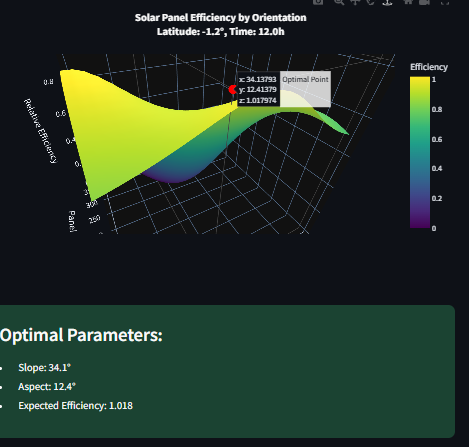
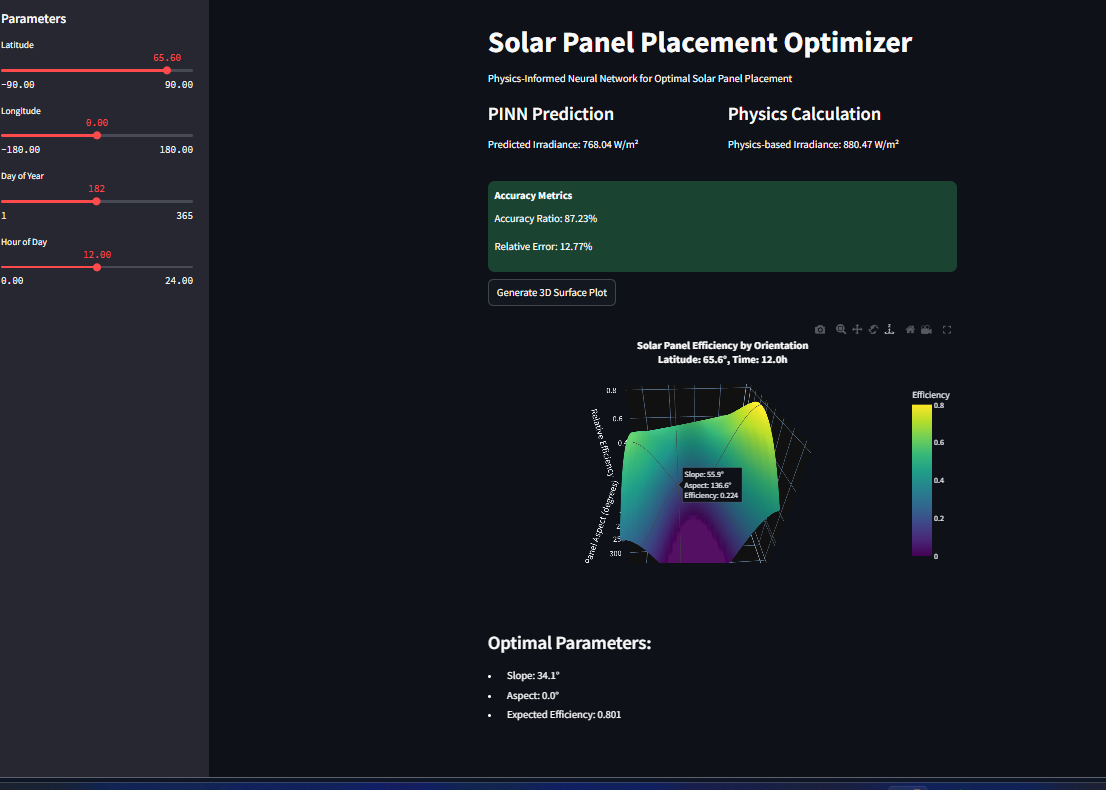
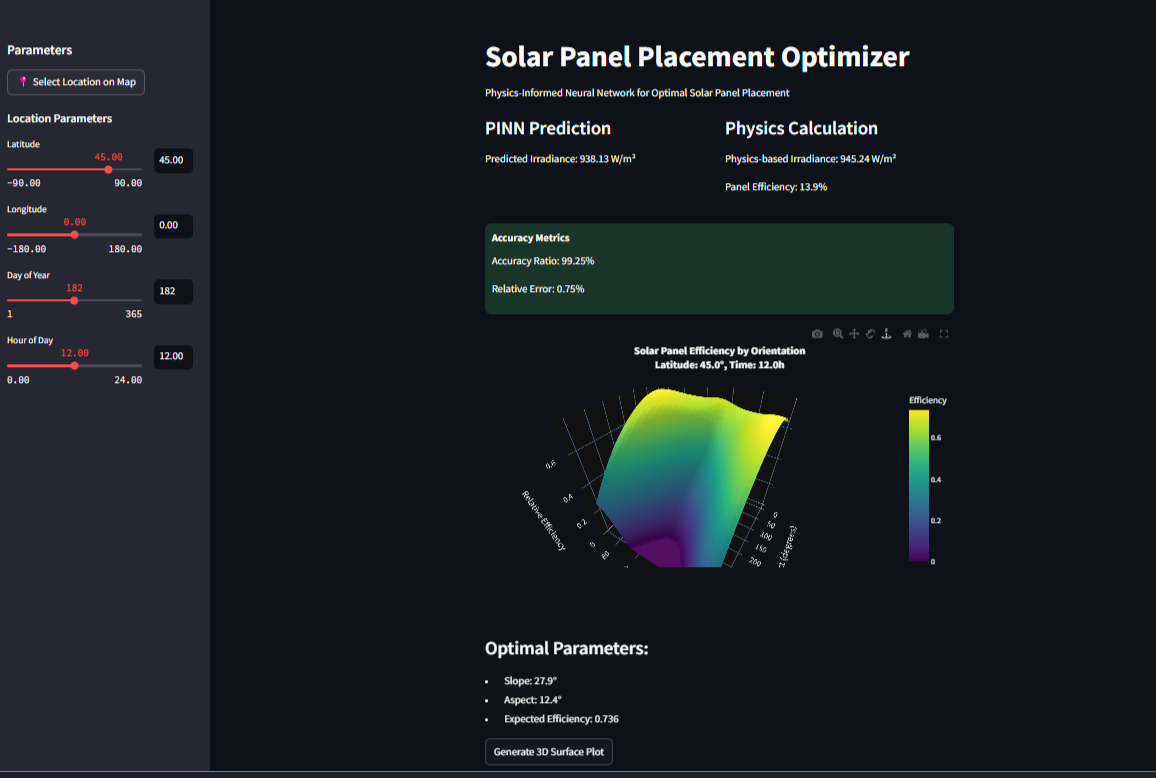
The Solar Panel Optimizer is a PINN model designed to predict irradiance and determine the efficiency values for solar panel replacements. This model effectively handles complex computations of differential equations by training a network on solar irradiance data. Through this project, we demonstrate how the integration of neural networks can innovate solutions for optimization challenges, particularly in energy efficiency. To enhance the use of renewable energy, we provide users with optimal efficiency values tailored to their location, timeline, and specific requirements for solar panel replacements. This way, users can save time in identifying the best locations and maximize their earnings with targeted recommendations from the model regarding panel placement.
How we built it
Our model encompasses general neural network architecture, and it is built with one input layer with 6 neurons; 3 hidden layers, two of them 128 neurons, the other 256 neurons; one output layer with 1 neuron. However, Unlike traditional artificial neural networks, these neural networks are trained with governing equations which enable the model to learn complex physical computations accordingly. Thanks to this specific feature, they can be adaptable to any field in physics. In our case, the PINN model is trained to predict solar irradiance under considerations of world conditions, including several factors that affect the calculation of irradiance.
Challenges we ran into
While building this model, we primarily faced challenges in determining the best approach due to the model's complexity. We conducted an in-depth analysis of solar irradiance computation and engaged in sophisticated processes. Identifying the factors that significantly affect solar panel efficiency proved to be particularly challenging. Some factors were negligible, while others had a substantial impact, requiring us to rigorously process this phase.
Accomplishments that we're proud of
Our most significant achievement was developing the main strategy for the overall structure, as the integration of the PINN model for renewable energies, particularly solar energy, turned out to be more challenging than anticipated. Additionally, we successfully trained our model to achieve over 96% accuracy, demonstrating its precision in predicting outcomes compared to physics-based results.
What we learned
We learned how engaging and innovative physics-informed neural networks stand out as solutions for sustainable development goals, particularly renewable energy. Thanks to this model, we're sure that such processes can be made efficiently since its flexibility is really remarkable. Additionally, we gained a deeper appreciation for the importance of optimization in real-world applications and the necessity for innovative solutions to propel global progress.
What's next for Solar Panel Optimizer
Our main strategy with Solar Panel Optimizer is to expand its coverage in solar physics. We aim to include other factors that make the results much closer to the real world results. Additionally, on the side of solar panel replacement, we intend to broad the related subjects; thus, the model will not only be responsible for solar-based computation, but it is also trained to predict optimization of wind turbines.

Log in or sign up for Devpost to join the conversation.