Inspiration
We live in a world drowning in files. My own downloads folder had more than 1,500 files when I started this project. Existing tools organize files by name only, or rely on generic AI agents that quickly lose consistency in large folder structures. We wanted something smarter: a system that organizes files the way humans naturally do.
What it does
Solar Flow is an AI-powered file organization system that solves three core problems:
- Deep File Structure Understanding
- Problem: Current tools rely on file names and fail with complex folder structures
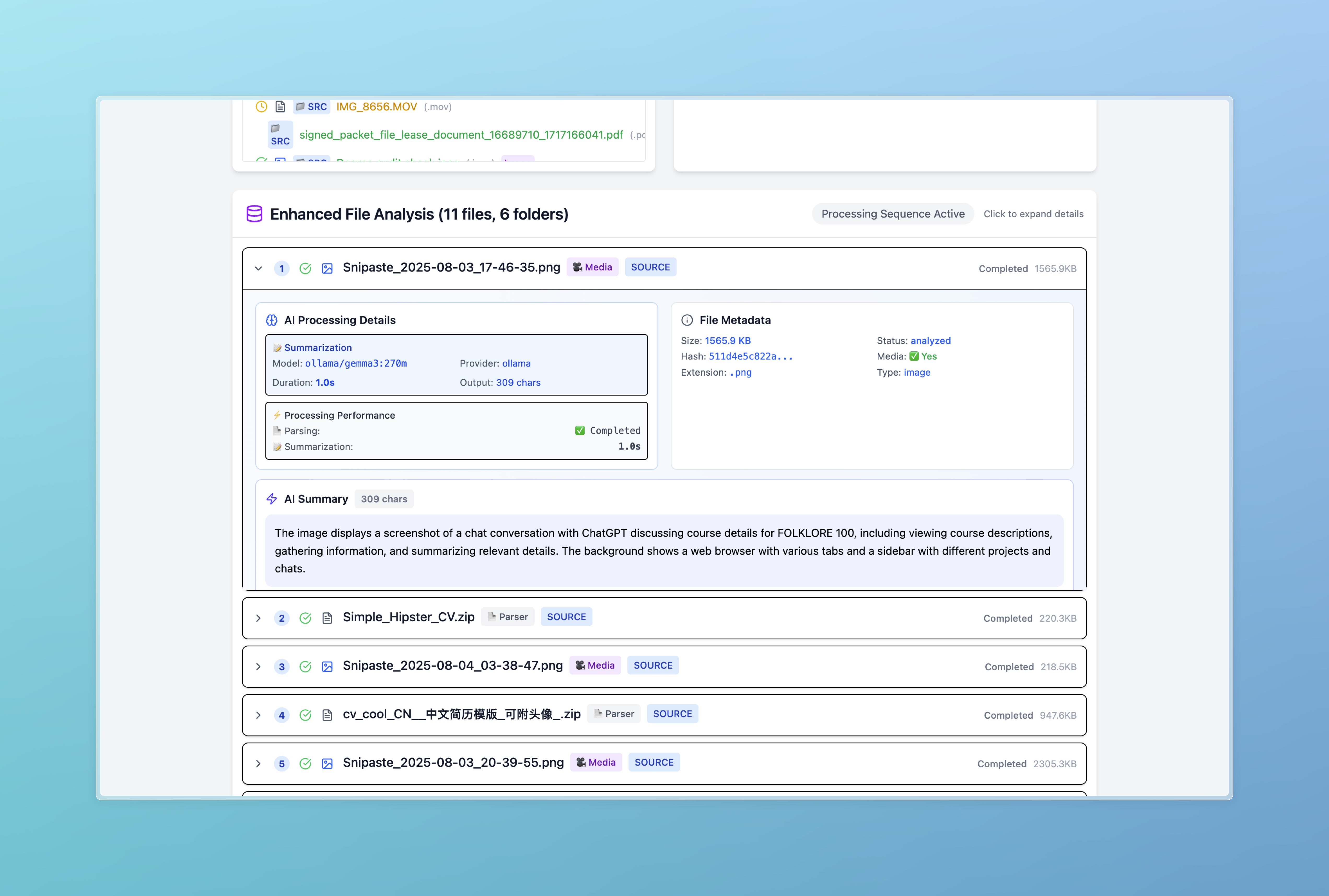
- Our Solution: A tree-based approach with a custom database powered by embeddings
Innovation: A lightweight indexing agent that summarizes files and generates embeddings locally, running efficiently in the background
Intelligent Content Search
Problem: Users re-download files because they can’t recall names or keywords
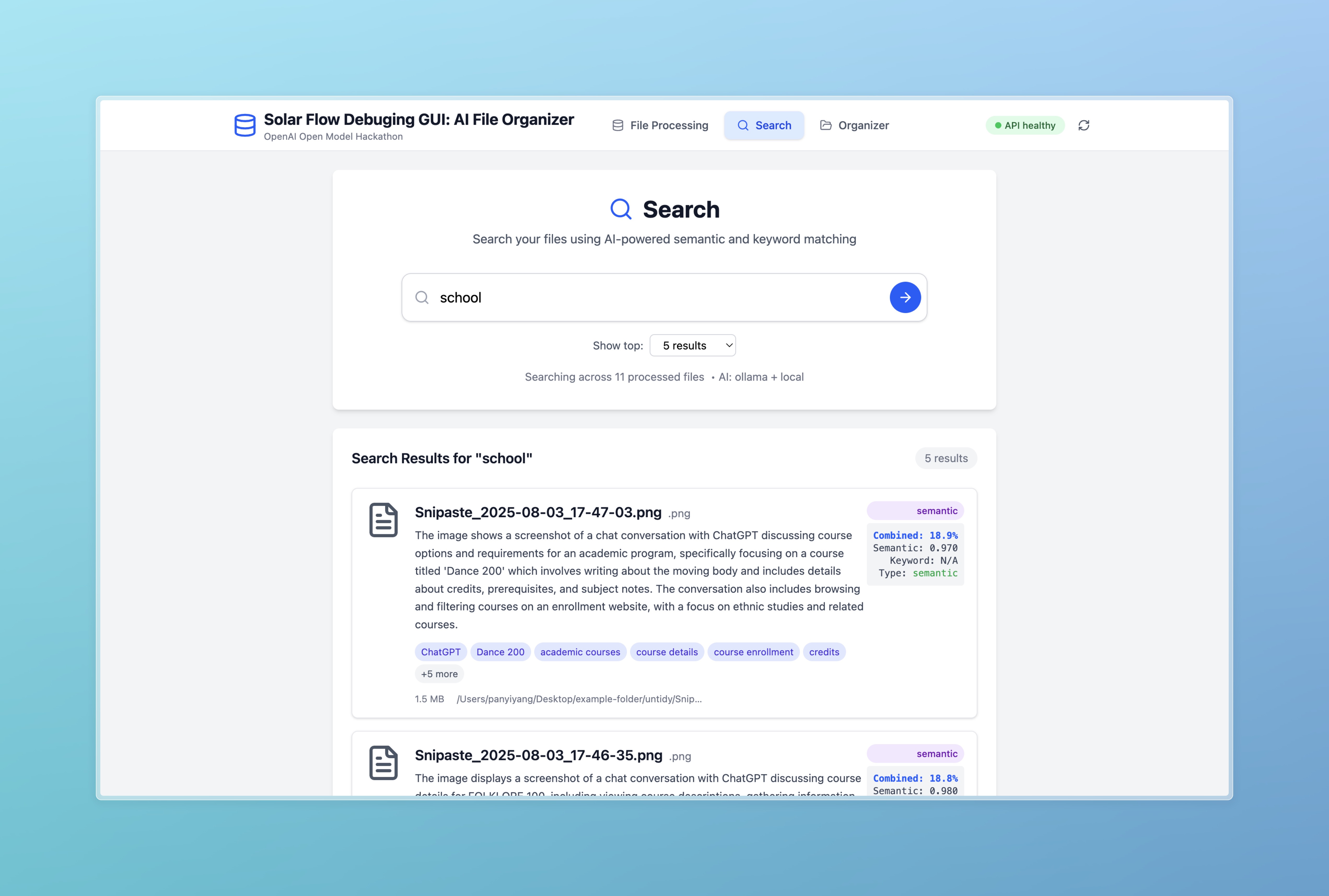
Our Solution: Lightweight vector + keyword search, enabling discovery by both content and metadata
Benefit: Find files by what’s inside them, not just what they’re called
Human-like Organization Behavior
Problem: Tools don’t adapt to personal workflows
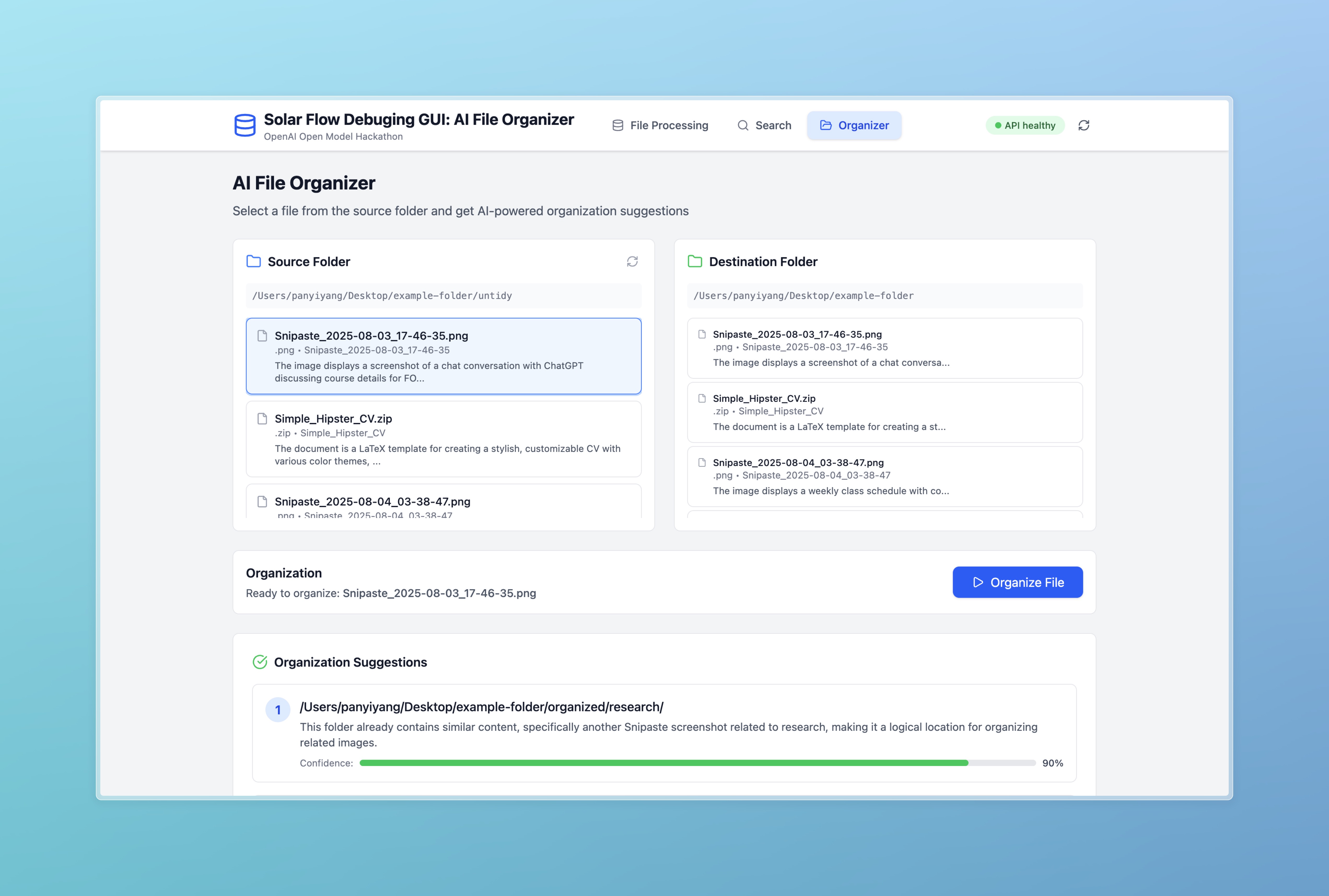
Our Solution: An organizer agent trained to mimic user behavior and suggest personalized structures
Result: Organization that feels intuitive and natural
How we built it
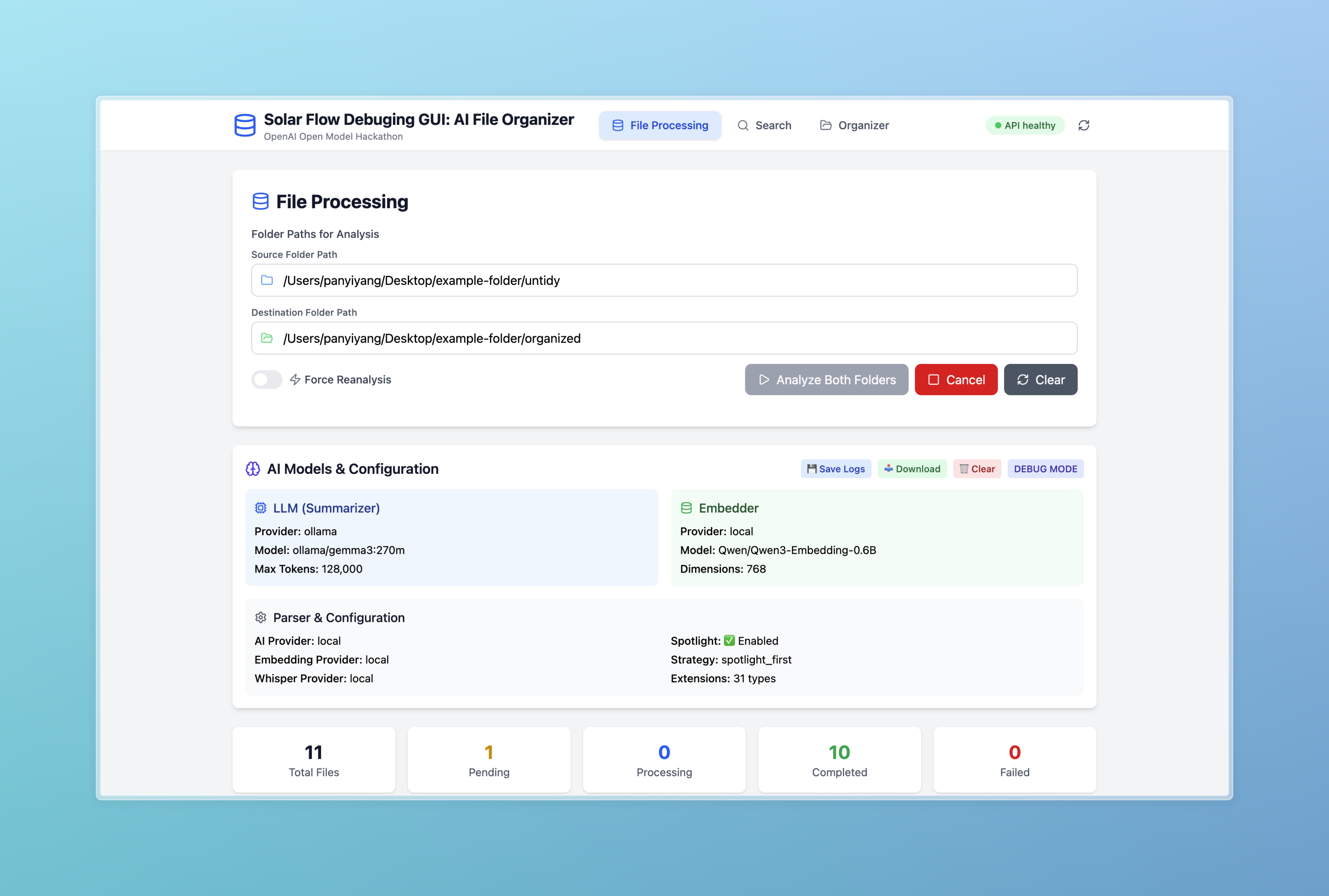
- Architecture: Async pipeline (File → Parser → Summarization → Embeddings → Database → Search)
- Backend: Python (Quart, SQLite + vector extensions)
- Frontend: React 19 + Vite + Tailwind CSS with real-time progress tracking
- AI Integration: Supports both local (Gemma3:4b, Ollama) and cloud models (OpenAI GPT-4, GPT-5, GPT OSS), plus Whisper for audio/video transcription
- File Support: 30+ formats using Spotlight (macOS) with MarkItDown fallback
- Search: Hybrid semantic + keyword scoring algorithm
Challenges we ran into
- Time: As UW–Madison undergrads balancing research, startups, and internships, time was tight. AI tools like ChatGPT and Claude helped us accelerate brainstorming and coding.
- Learning Curve: We were beginners in agent design and database architecture, so we spent significant time learning fundamentals.
- Resources: No high-end GPUs. We optimized by using Mac hardware acceleration and carefully selecting efficient models.
- Consistency: Ensuring agents behaved reliably required careful prompt engineering and rich context.
- Compatibility: Supporting multiple embedding models forced us to design flexible, interconnected database tables.
- Storage vs. Accuracy: Balancing speed, storage, and precision in search was a constant tradeoff.
Accomplishments that we're proud of
- Working Prototype: A fully functional system built under time and resource constraints
- Research Potential: A foundation to publish on LLM performance in file organization tasks
- User Experience: Enhanced usability with AI-generated folder icons for visual navigation
- Experimentation: Learned how to design agents, structure embeddings, and optimize pipelines in practice
What we learned
- How to design consistent, context-aware AI agents
- Building async pipelines with real-time progress tracking
- Designing flexible vector databases that support multiple models
- Integrating multi-modal AI for text, audio, and image content
- Balancing performance, accuracy, and resource constraints
What's next for Solar Flow -- A file organization master
- Native GUI: A SwiftUI-based macOS app
- Model Fine-tuning: Optimizing Gemma models for indexing and OpenAI OSS models for organization
- Codebase Rewrite: Improving maintainability and scalability
- More File Types: Extending to specialized formats
- Advanced Features: Folder watching, automated workflows, and batch operations
- Academic Publication: Documenting our findings for the research community


Log in or sign up for Devpost to join the conversation.