-
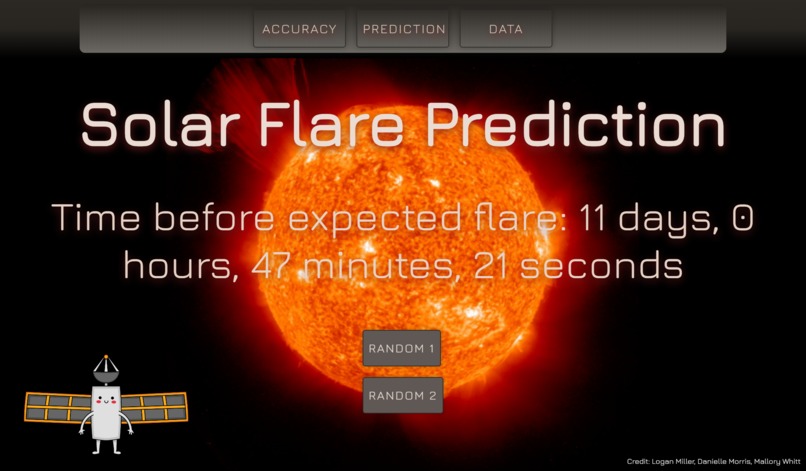
Prediction Screen
-
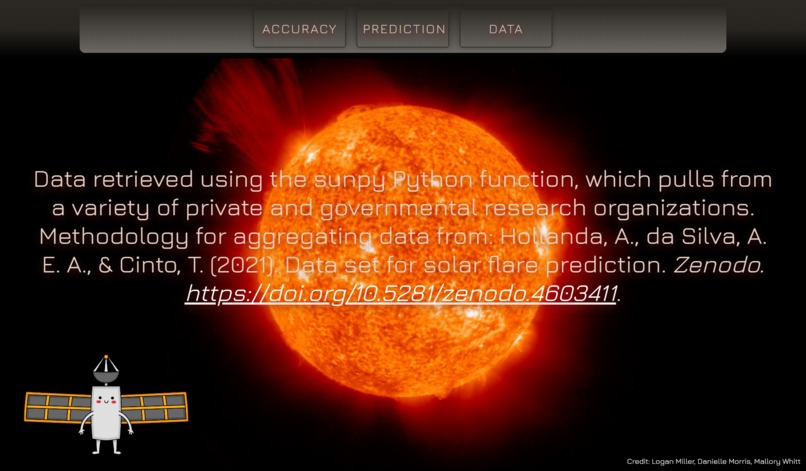
Data Credits
-
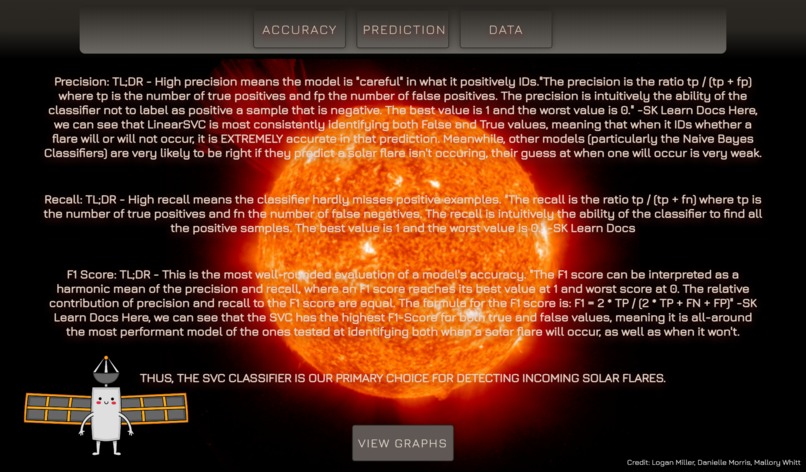
Accuracy and Explanation
-
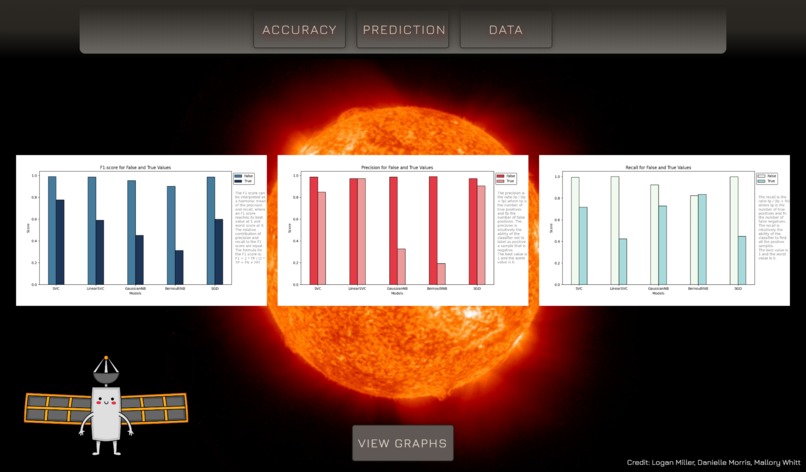
ML Model Comparisons


Inspiration
We were inspired to create a project on solar flares because we thought the space theme was neat, and also because solar flares are a powerful and interesting phenomenon. Once we realized there was a very important application to our project, integrating the model into the software of satellites (and saving lots of money), we were more excited. We also wanted to in
What it does
Our project analyzes historical data in order to predict if a solar flare event of class M or X is likely to occur using machine learning. It then outputs the result of the prediction onto a website. A variety of ML techniques were used to find the best model, and it was determined that SVC ML is the most accurate.
How we built it
We broke the problem up into three categories: data manipulation, machine learning, and visualization. Data manipulation primarily used pandas to import the DSFP dataset and adjust the features in order to prepare for the prediction steps. Machine learning primarily used scikit-learn and the various models within to evaluate which classifier was most effective at predicting solar flares, and then using that model with a specifically tuned set of hyperparameters to predict whether a solar event will or will not occur. Visualization primarily used HTML, CSS, and JS in order to create a website that would be used to display the predictions, as well as serve as documentation for our project.
Challenges we ran into
Having no experience in web development, learning how different UI elements worked together and making sure they did not override each other was a challenge. Tuning hyperparameters was also a challenge at first, as not having a strong math background made understanding which parameters were important to the model's success was very difficult. However, diving into
Accomplishments that we're proud of
The functionality of the website and its sleek interface were proud accomplishments. Especially, we are proud of the accuracy generated with SVC using our fine-tuned parameters.
What we learned
We learned how to use different machine learning functions in Python, how to use UI/UX languages and tools, how to access a variety of databases and integrate those into a project, how to manage and reverse-engineer datasets, how to run a website, some photo editing tools, and more.
What's next for Solar Flare Prediction
What we hope to do is broaden and modernize the dataset we use. Currently, the DSFP dataset only goes from 2010-2017. Broadening the range of the dataset would allow us to both increase the accuracy of the model, and make more real-time predictions. We attempted this during the hackathon, however, the DSFP dataset used aggregate data from numerous sources, and the way to access some of the data has changed drastically since DSFP's creation in 2019. The process of rewriting the dataset generation code was too involved due to the time constraint of the hackathon, but the potential is still present and something we hope to achieve by continuing this project into the future.

Log in or sign up for Devpost to join the conversation.