-
-
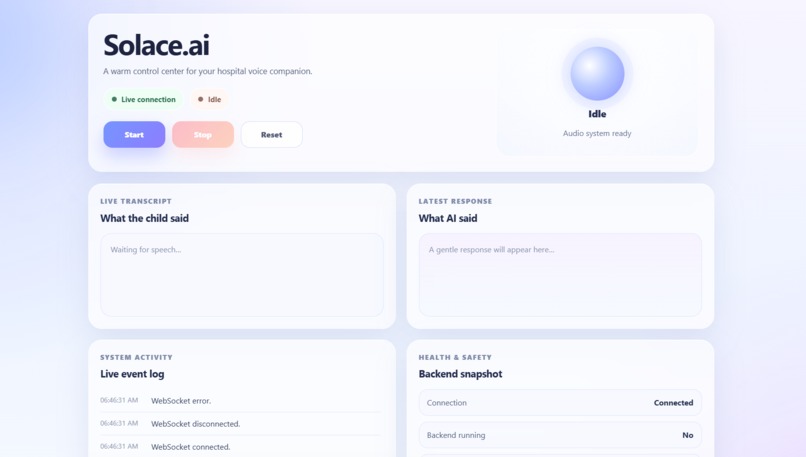
Website
Inspiration
Children experiencing prolonged hospital stays often face extreme fear, isolation, and stress. While their physical health is closely monitored, their emotional well-being can be harder to consistently support. This led me to build Solace.ai: a real-time voice-based AI companion designed to provide safe, emotionally aware conversation for children in hospitals.
What it does
Solace.ai is an always-available, voice-driven AI companion designed to support children during extended hospital stays by providing natural, emotionally aware conversation through a plush interface.
A user activates the system with a wake word and speaks normally. The system captures speech, processes it in real time, and responds with a calm, supportive voice. Unlike traditional assistants that operate on one-off commands, Solace.ai maintains a continuous, multi-turn dialogue, allowing for fluid, back-and-forth conversation without repeated prompts.
How I built it
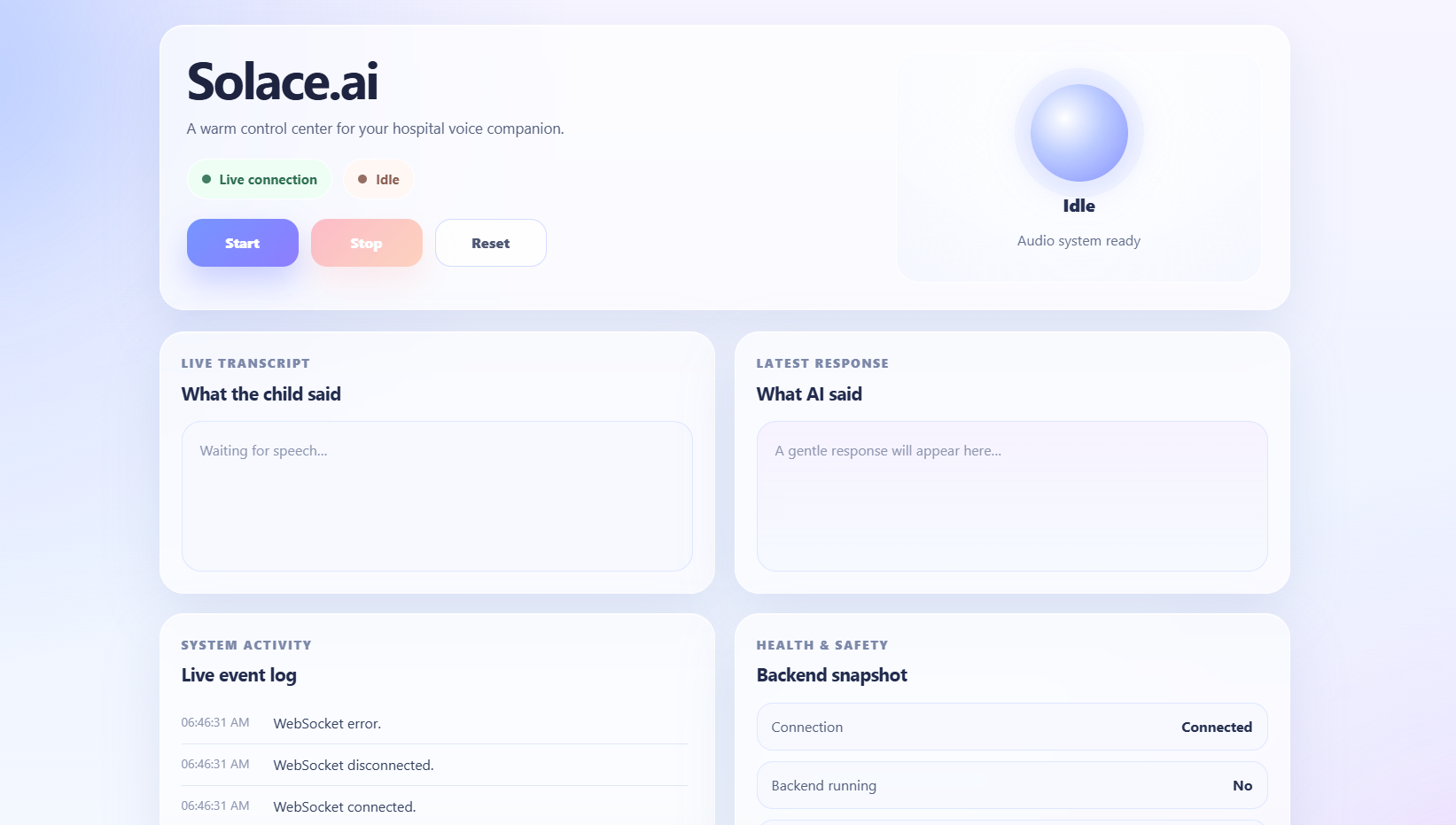
Built as a real-time, stateful voice AI system using a FastAPI backend and React frontend
Wake word detection using openWakeWord for hands-free activation
Voice Activity Detection using Silero VAD to capture speech until silence
Speech-to-text using OpenAI Whisper
Response generation using OpenAI GPT with prompt-engineered emotional safety
Text-to-speech using OpenAI TTS for natural voice output
Audio playback with real-time interrupt handling
Multi-turn conversation with short-term memory for context-aware dialogue
WebSocket streaming for live transcripts, logs, and system state
Plush companion used as the physical interaction interface
Challenges I ran into
It was quite difficult finding the right model that could deliver both fast and high-quality responses. We had to balance latency and response quality, since slower outputs would break the flow of conversation while faster ones sometimes lacked depth or emotional nuance. This required careful testing and iteration to achieve a response style that felt both natural and reliable in real time.
Accomplishments that I'm proud of
Working as a solo developer, I’m proud I was able to create a fully functional, real-time voice AI system that supports natural, multi-turn conversation and feels genuinely comforting to interact with.
What I learned
I learned how to build real-time AI systems using FastAPI, Whisper, and OpenAI APIs, while managing latency and designing for human-centered impact.
What's next for Solace.ai
Next, I plan to evolve Solace.ai from a working prototype into a system that can be safely and realistically used in pediatric care environments.
In the short term, I will improve emotional awareness by incorporating tone and sentiment analysis, and further optimize latency to ensure consistently smooth, real-time interaction. These improvements can be implemented using the existing stack (FastAPI, Whisper, and OpenAI APIs), making them immediately feasible.
In the medium term, I aim to collaborate with healthcare professionals and caregivers to validate the system’s behavior, ensuring responses are safe, age-appropriate, and aligned with real patient needs. This phase would rely on accessible resources such as small-scale user testing, clinical feedback, and existing hospital outreach programs.
In the long term, I hope to be able to explore controlled pilot deployments in pediatric settings using commodity hardware (standard laptops and audio devices), avoiding the need for specialized infrastructure. I will define clear success metrics such as engagement time, response satisfaction, and reductions in reported loneliness to evaluate effectiveness.
Throughout this process, I will prioritize safety, accessibility, and human-centered design, ensuring the system augments caregivers rather than replaces them while remaining practical to deploy with limited resources.
Built With
- fastapi
- javascript
- openai
- python
- react
- shadcn
- tailwind
- uvicorn
- vite
- websockets


Log in or sign up for Devpost to join the conversation.