-
-
-
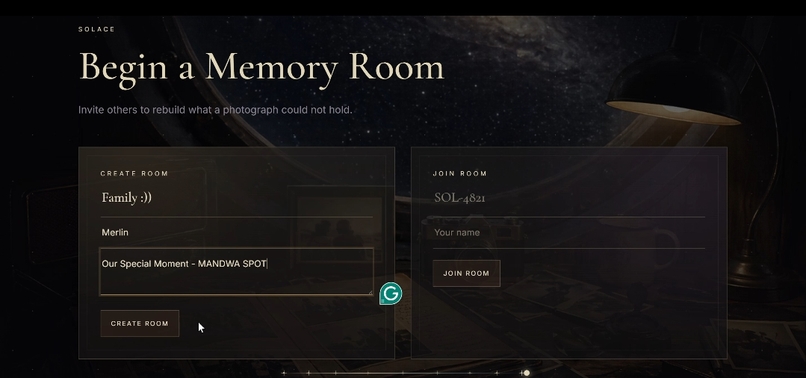
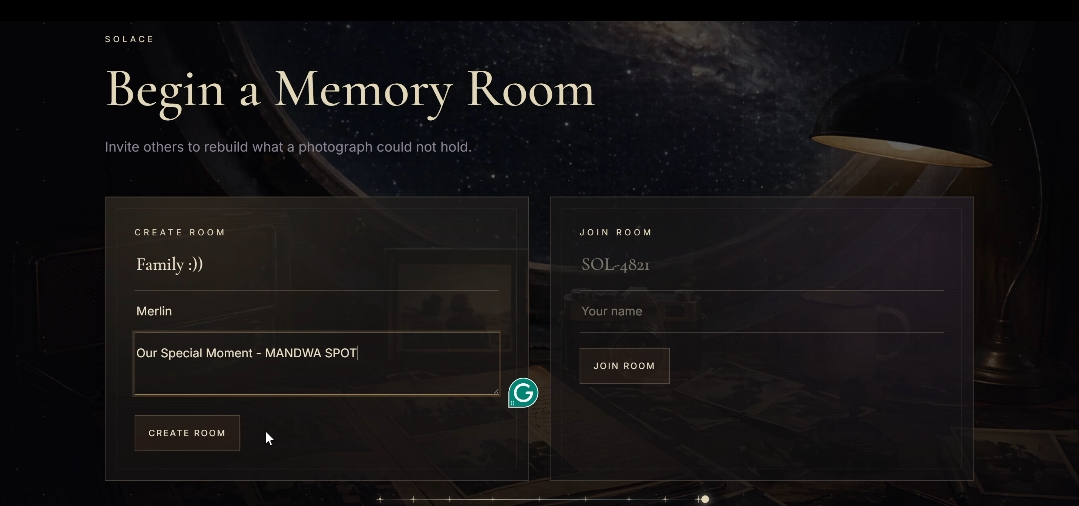
Create a room with your loved ones for them to share their perspectives on one of your special moments !!!
-
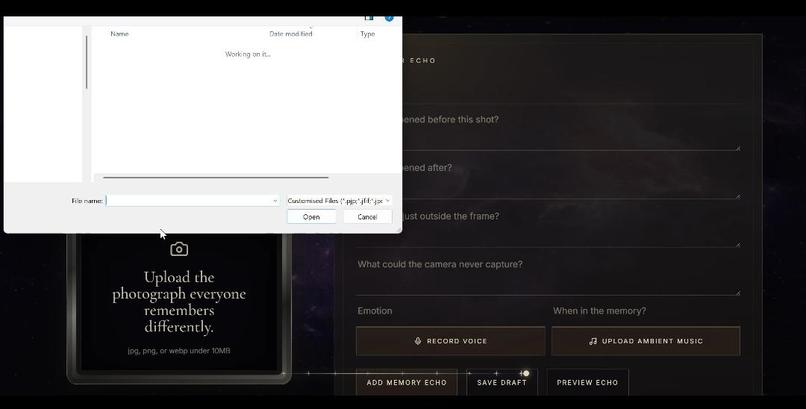
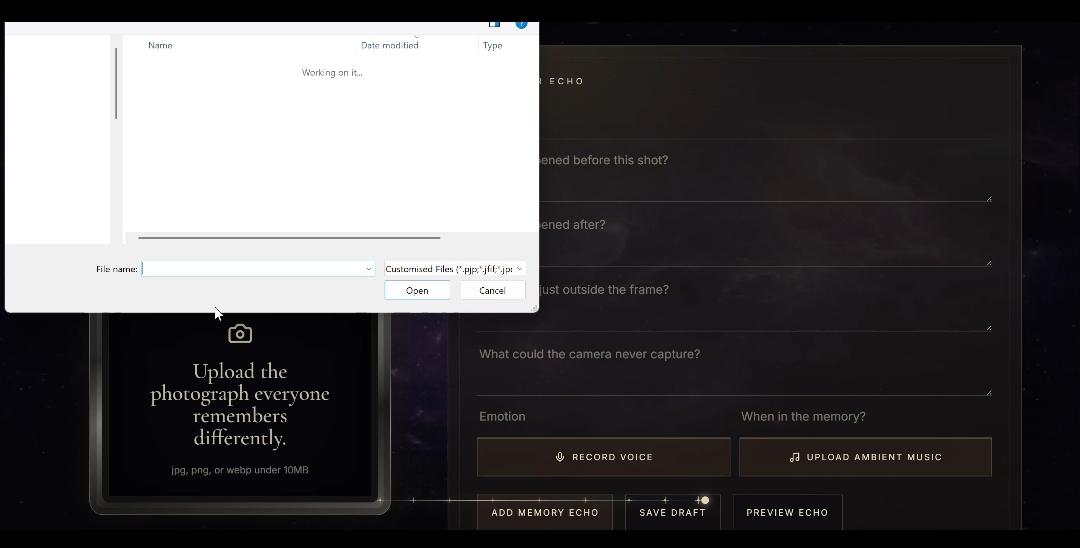
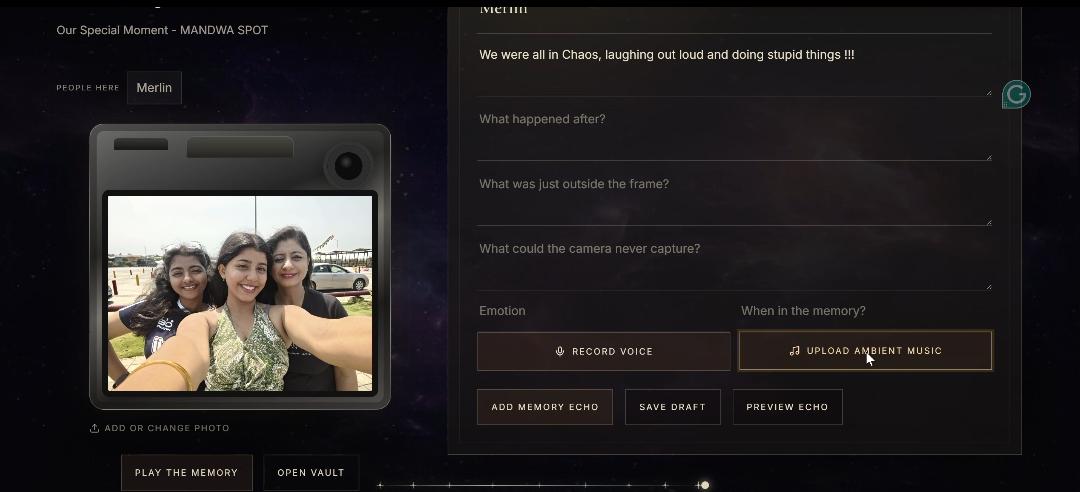
Upload your photo here and begin reminiscing about what happened before the photo, after and outside the frame.
-
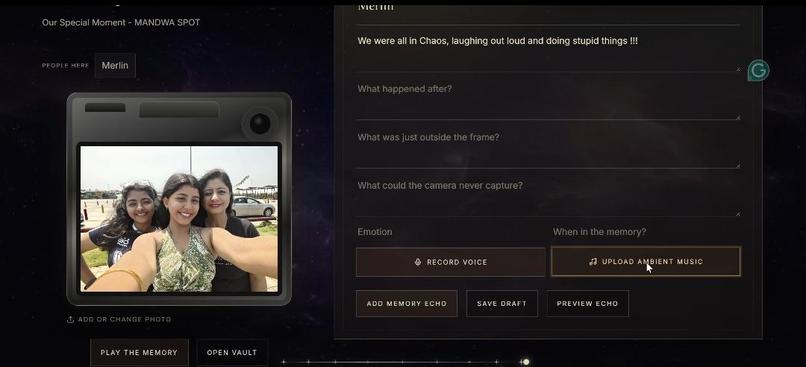
Add music that resonates with the emotional tone of this photograph.
-
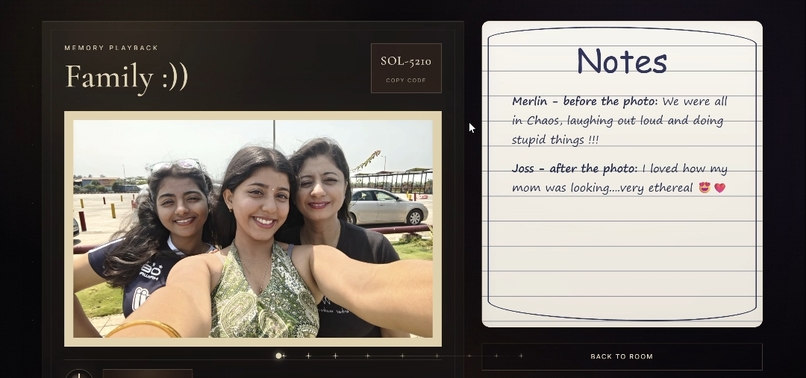
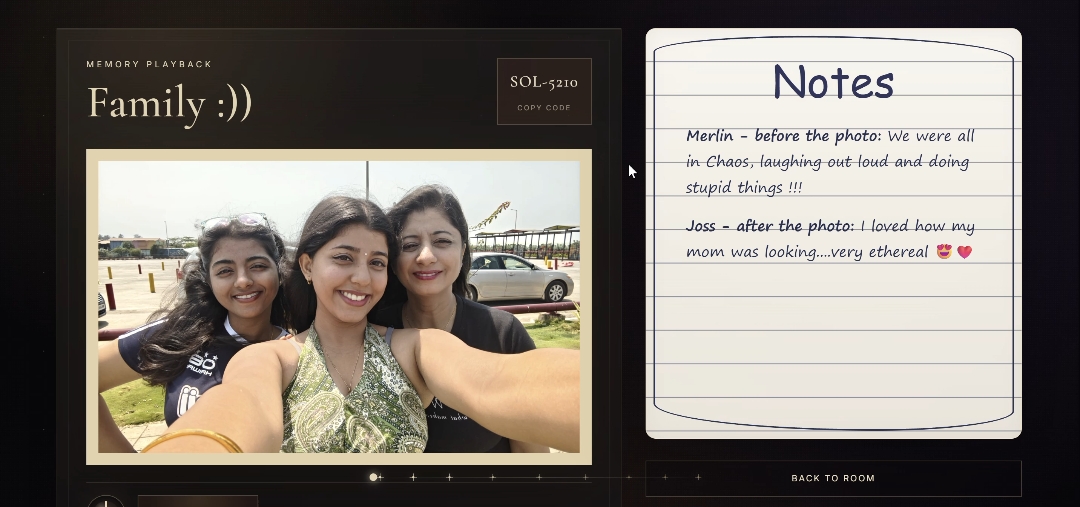
Play your memories, layered with every emotion written beside them.
Inspiration
A photograph captures a moment, but rarely captures how each person experienced that moment.
I was inspired by the idea that memory is never singular — it is layered, emotional, and often different for everyone involved.
Two friends can look at the same old photograph and remember entirely different things: one remembers tension before the shot, another remembers laughter after it, another remembers something important happening just outside the frame.
That led me to ask:
What if a photograph could preserve many perspectives of the same moment, not just the image itself?
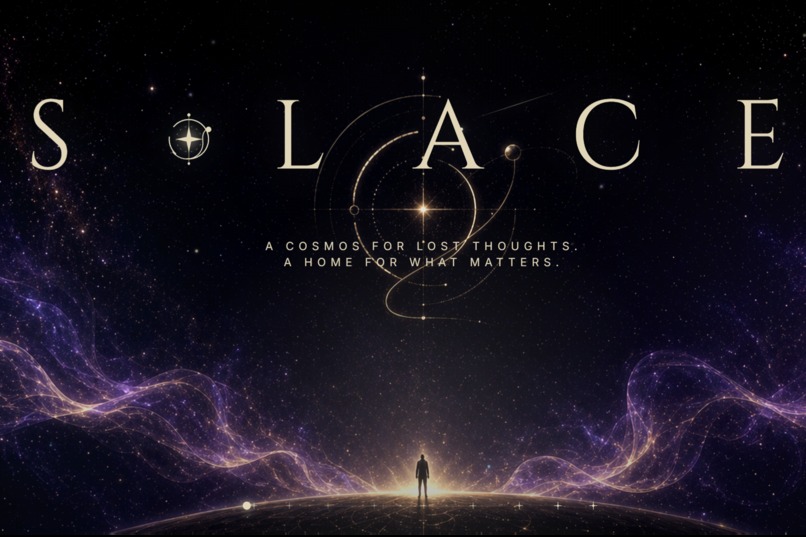
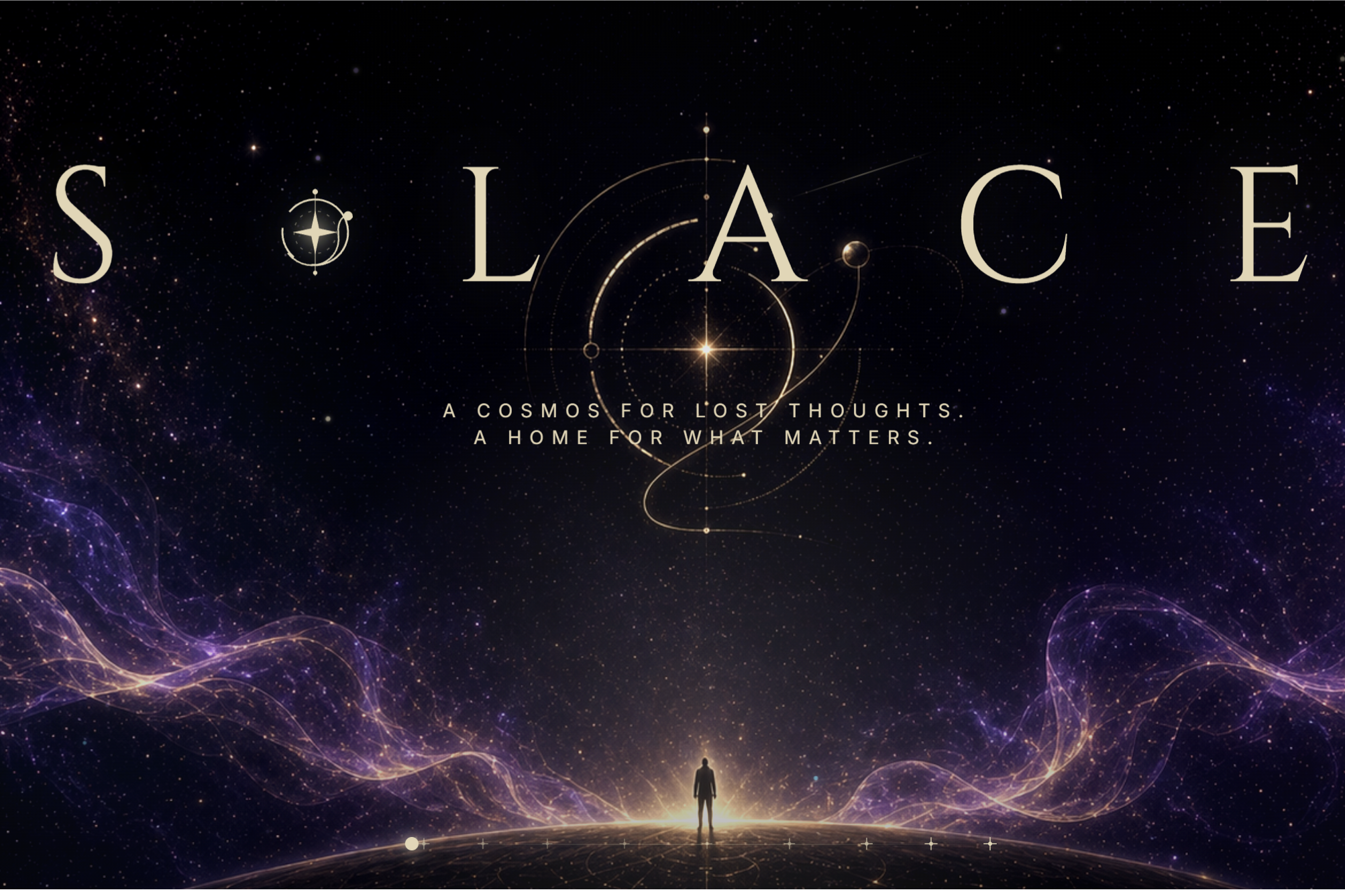
That became Solace.
The name itself is personal.
I arrived at Solace partly through a piece of music that means a lot to me — Solas by Jamie Duffy.
Whenever I listen to it, it makes me reminisce about old school friends, their shenanigans, small forgotten joys, and all the little moments in life I did not realize I would miss one day.
That feeling of warm remembrance shaped this project.
It is also why I incorporated this music into the website experience itself — not as decoration, but as part of how the product invites reflection.
What it does
Solace is a collaborative memory reconstruction platform built around one idea:
One photograph can hold many memories.
Users can:
- Create or join a shared memory room using a unique code
- Upload one anchor photograph
- Invite others who were part of that moment
Each participant adds a personal Memory Echo by contributing:
- What happened before this shot
- What happened after
- What was happening off-camera
- What could not be photographed
- What happened before this shot
Attach voice recollections and ambient sound
Revisit the photograph through a custom playback experience that lets users hear different perspectives of the same moment
Instead of preserving a photograph as a static image, Solace turns it into a living collaborative memory artifact.
How I built it
I built Solace as a web application centered around shared interaction and emotional storytelling.
Core technologies used:
- React + TypeScript
- Vite
- Tailwind CSS
- Collaborative room logic with unique room codes
- Image and audio upload handling
- Custom playback interface for layered Memory Echoes
The system centers around three parts:
1. Memory Rooms
Shared spaces where people contribute around one photograph.
2. Perspective Layers (Memory Echoes)
Each participant adds their own recollection.
3. Memory Playback
Users can listen to one perspective at a time or revisit multiple perspectives together.
I designed the interface to feel warm, nostalgic, and human — more like interacting with a memory object than using a traditional app.
Challenges I ran into
Designing for subjective memory
People often remember the same event differently.
At first I saw that as inconsistency.
Later I realized those differences were the product.
That changed the direction of the project.
Balancing atmosphere with usability
I wanted the interface to feel poetic and emotional while still being intuitive.
Finding that balance took several iterations.
Making playback feel meaningful
I did not want playback to feel like a normal audio player.
It needed to feel like revisiting a shared moment.
Designing that interaction was a major challenge.
Accomplishments that I'm proud of
I’m proud Solace became more than a media-sharing concept.
It became a way to think about memory as layered perspective.
Things I’m especially proud of:
- Reframing photographs as collaborative memory artifacts
- Designing the Memory Echo concept
- Building shared memory rooms through unique codes
- Creating a custom perspective playback interaction
- Turning “what exists outside the frame” into a design problem
- Integrating music and atmosphere into the emotional experience
Most of all, I’m proud the idea stayed emotionally grounded while remaining practical.
What I learned
I learned preserving something is different from helping someone rediscover meaning in it.
I also learned memory is not objective storage.
It is interpretation.
Designing for that taught me to treat contradiction, emotion, and incomplete recollection as valuable — not as errors.
I also learned that personal inspiration can sometimes lead to stronger design decisions than purely technical ideation.
What's next for Solace
Next, I would like to explore:
- Family oral history preservation
- Intergenerational memory rooms
- Collaborative legacy storytelling
- Shared memory capsules that evolve over time
- New ways to visualize overlap between different perspectives
Long term, I imagine Solace becoming a way to preserve not only moments —
but how those moments were remembered.
Photographs capture what happened.
Solace reveals how it was remembered.
Built With
- animations
- api
- audio
- css
- express.js
- framer
- gradients
- html5
- json
- lucide
- mediarecorder
- motion
- node.js
- prisma
- react
- router
- tailwind
- typescript
- vite


Log in or sign up for Devpost to join the conversation.