
The problem
Mix/master teams do not only need another processor. They need to know which source, which version, which measurements, which listening evidence, and which human decision sit behind an export. A project can look “finished” while the source is wrong, the evidence is stale, calibrated measurement is missing, or nobody has actually approved the result.
SOL AUDIO makes those boundaries visible. It is a Korean-first mix/master decision system that does not replace a DAW, choose a winning master, or automatically approve a release.
What the public demo does today
The public browser tools accept only rights-cleared WAV files and keep preview processing local:
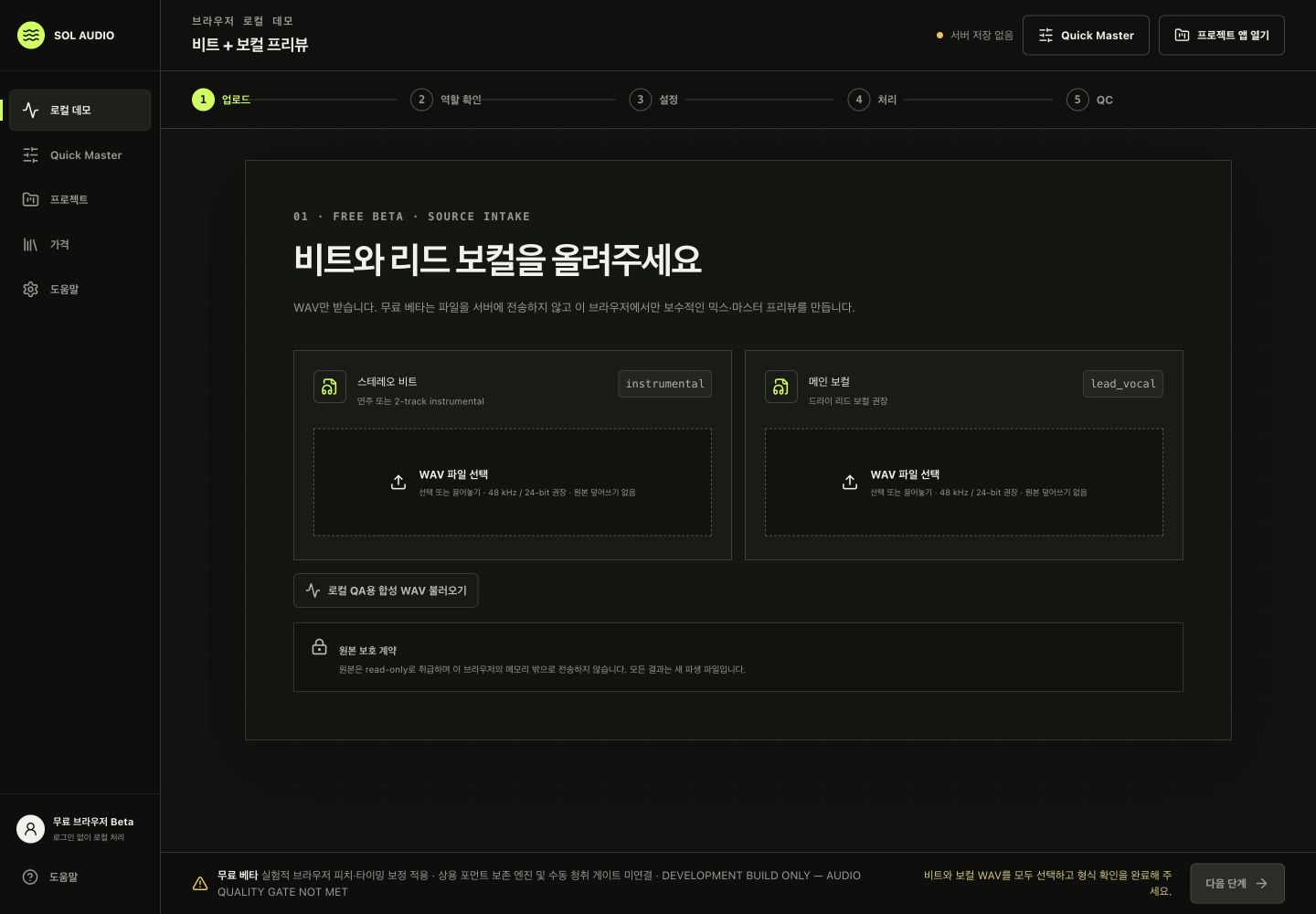
- Browser Local Demo validates a stereo beat and lead-vocal WAV, creates a local 48 kHz / 24-bit preview, and records a source manifest.
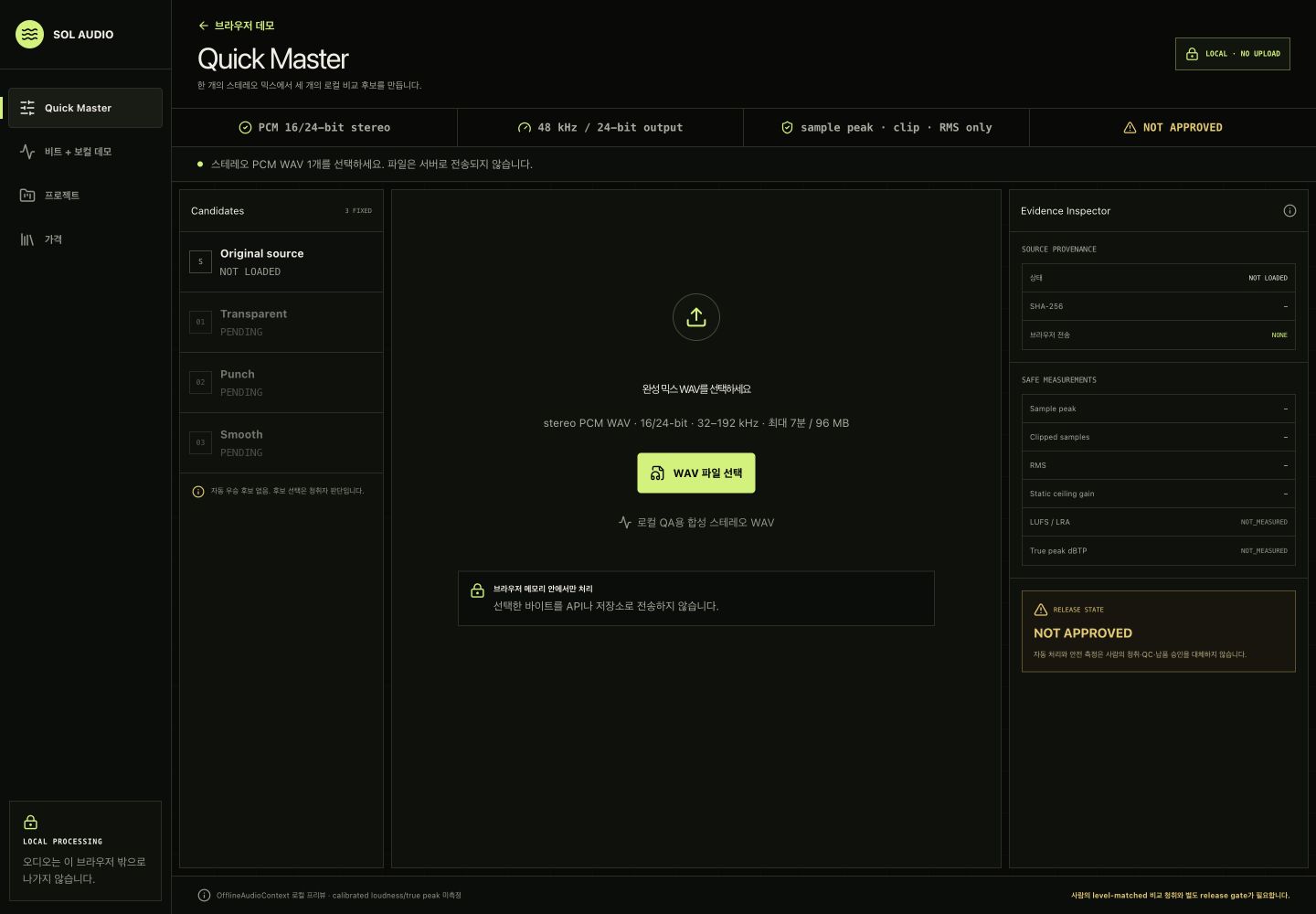
- Quick Master accepts one stereo PCM WAV and renders three intentionally different local comparison candidates: Transparent, Punch, and Smooth.
- Each Quick Master output includes checksums and a manifest so the listener can compare a known input with known derived previews.
The listener—not the app—chooses what sounds right. These are browser-local previews, not a claim of professional release mastering.
Evidence-first control plane
The local professional workflow is built around traceability rather than a black-box “master” button:
- Private PCM WAV/BWF-oriented upload and server-truth validation.
- Immutable source assets and a deterministic sealed source set.
- Registration of an externally rendered DAW stereo-mix candidate.
- Job-bound safe-metric analysis in an isolated Python runner.
- Real waveform data, measurements, findings, and provenance.
- Short-lived signed WAV playback with HTTP Range support.
- An evidence-linked 11-item listening checklist.
- A role-aware human approve/reject decision that remains PENDING_RELEASE_GATES when release requirements are incomplete.
The current safe metrics include sample peak, clipping, DC offset, silence/dropout, channel balance, stereo correlation, and mono fold-down delta. Calibrated LUFS, loudness range, and true peak are deliberately reported as NOT_MEASURED until an authoritative calibration suite passes.
How we built it
SOL AUDIO uses React, TypeScript, Next/vinext and Vite for the web surface; Web Audio API and OfflineAudioContext for browser-local rendering; Cloudflare D1/R2 adapters and Drizzle for the control-plane boundary; AJV contracts; Playwright/axe coverage; and an isolated Python worker using NumPy, SciPy, SoundFile, and pyloudnorm.
Quick Master strictly validates the declared RIFF boundary and PCM layout before decoding, checks decoded parity before rendering, and records SHA-256 evidence for the source and outputs. The release flow is intentionally fail-closed: it cannot emit a release-approved state or delivery success while required evidence and calibration gates are absent.
OpenAI Build Week scope and how we used Codex / GPT-5.6
SOL AUDIO began as a local-development baseline. For the Build Week work, I used Codex with GPT-5.6 as an engineering copilot to turn the product contract into testable TypeScript/Python vertical slices, harden strict WAV intake and stale-evidence handling, enforce fail-closed release gates, improve the public browser surfaces, run and interpret validation, and document the project’s truth boundaries.
GPT-5.6 is used through the Codex engineering workflow; it is not presented as a runtime audio processor. It does not receive raw user audio, select a master, complete a listening checklist, or approve a release. That separation is deliberate: local previews keep audio local, while human listening remains the final decision.
Challenges and what we learned
The hardest part was resisting false certainty. We had to make the demo useful without claiming calibrated loudness, professional mastering, or an approval that the system cannot prove. That led to a product rule: every generated artifact must retain its source/version/evidence context, and every positive release state must be earned by explicit gates.
What’s next
Next we will add a deployable worker/storage path, calibrated meter evidence, authoritative golden-vector and manual audio QA, synchronized A/B/loudness matching, release packaging with final rehash and signed delivery, and persistent stale/revocation records—without weakening the human review boundary.
Built With
- audio
- cloudflare
- react
- typescript
- vite
- web

Log in or sign up for Devpost to join the conversation.