-
-
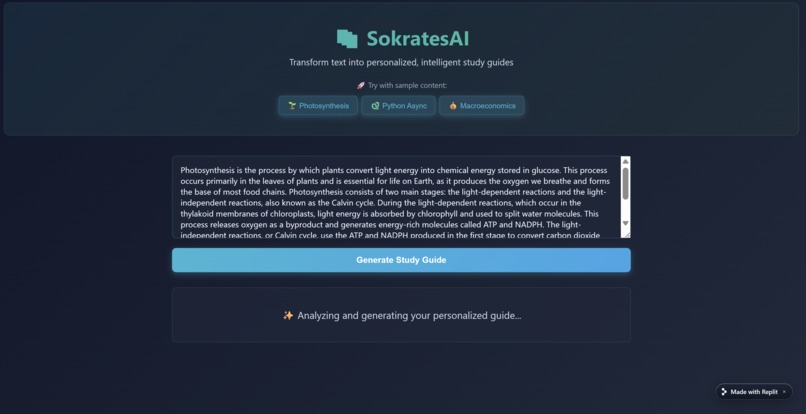
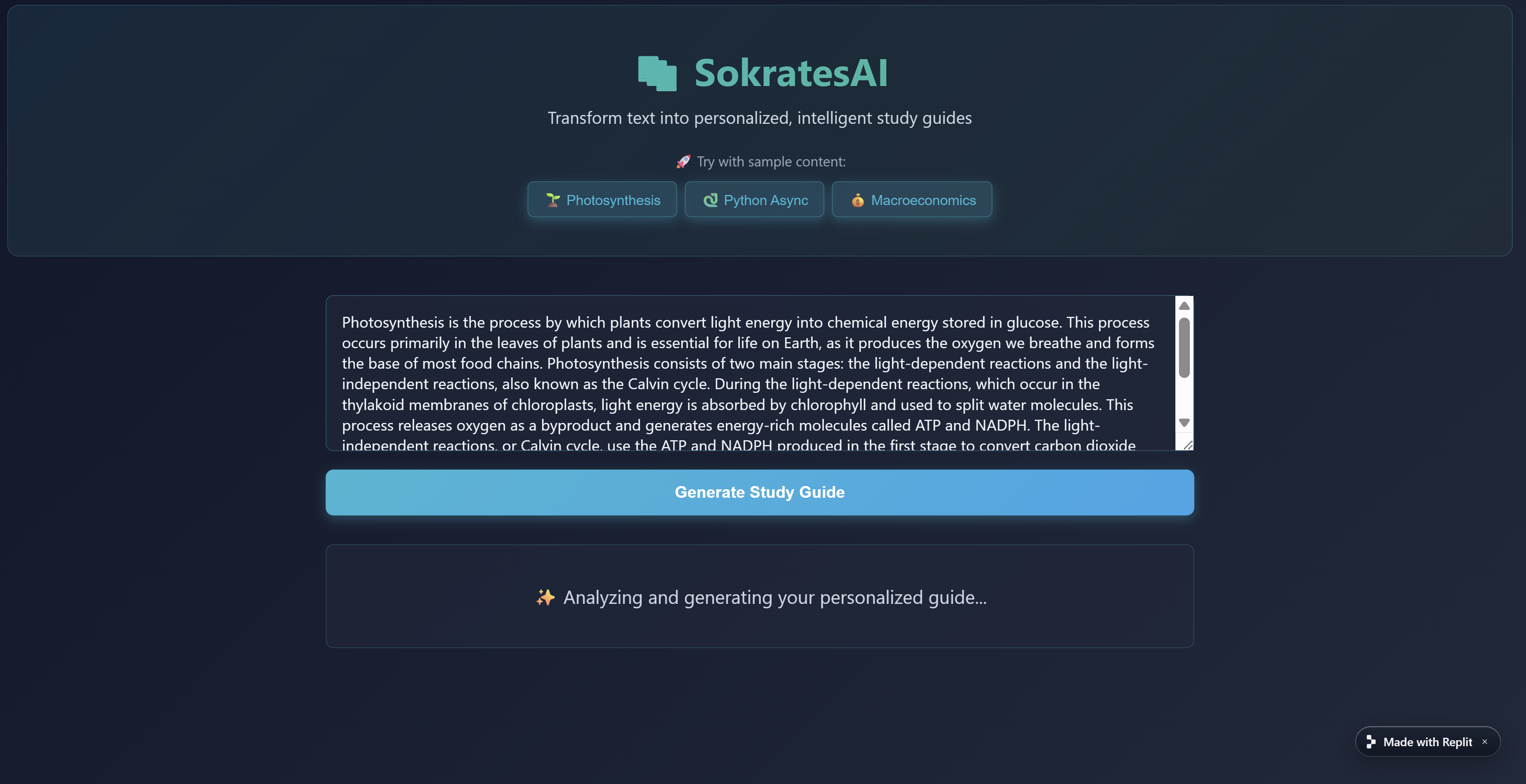
Input any text or study topic to instantly generate personalized learning material.
-
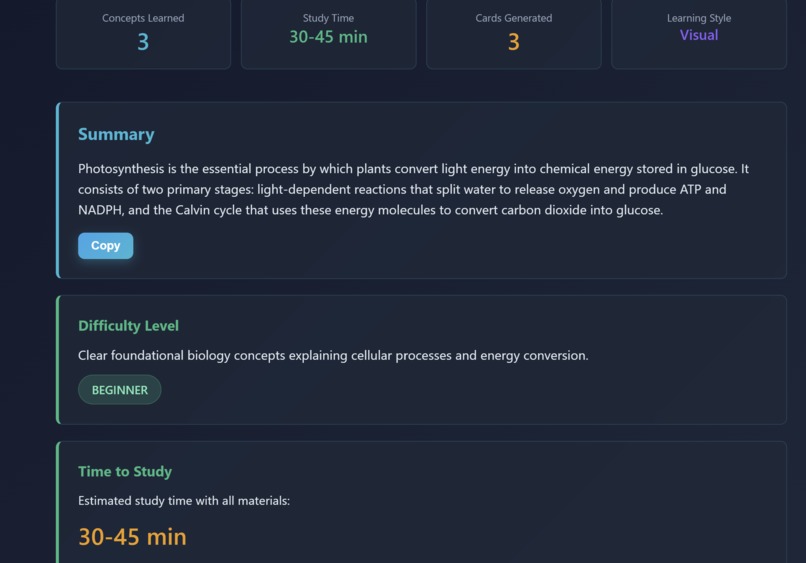
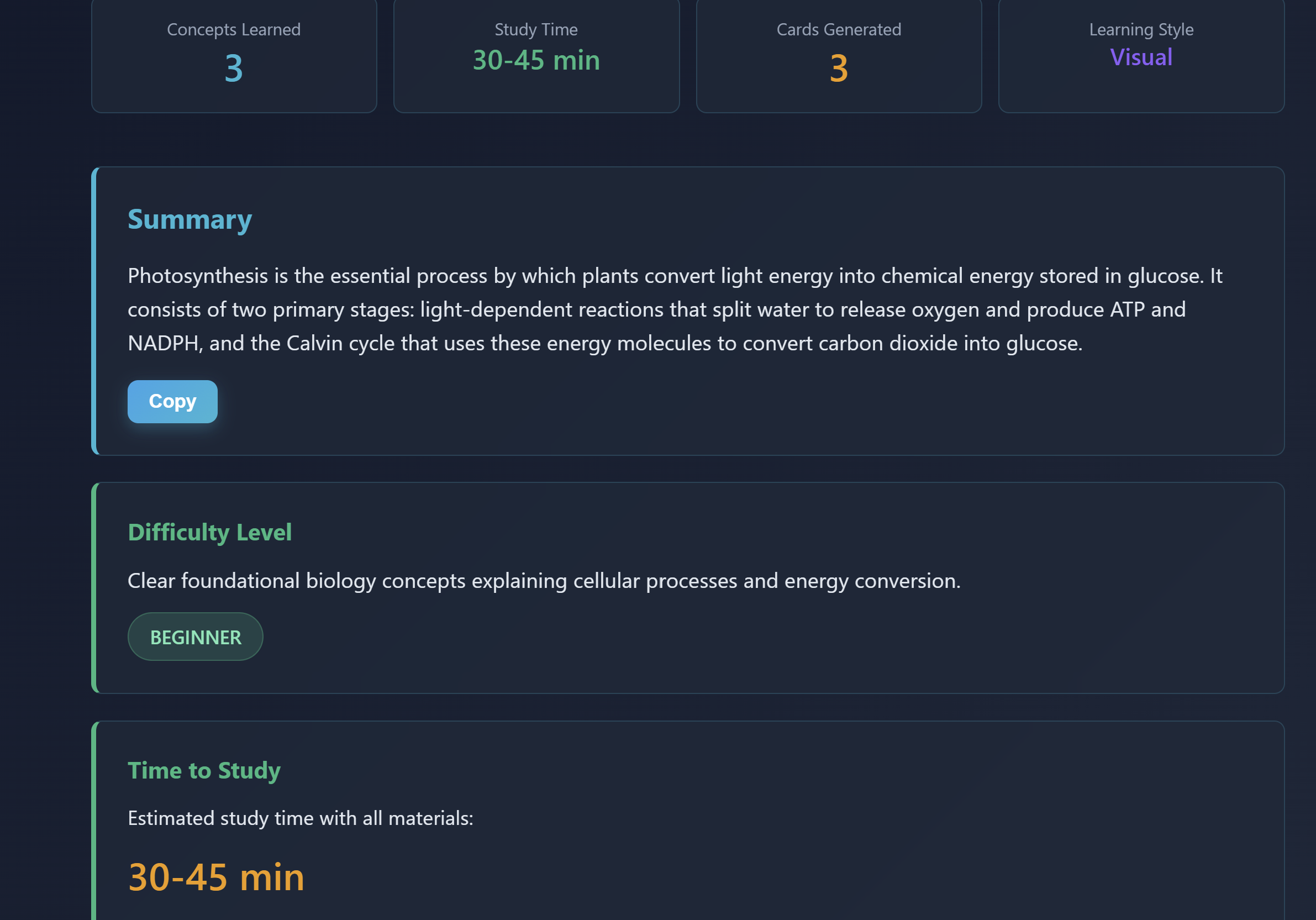
Overview dashboard featuring key metrics, AI-generated summaries, and difficulty ratings.
-
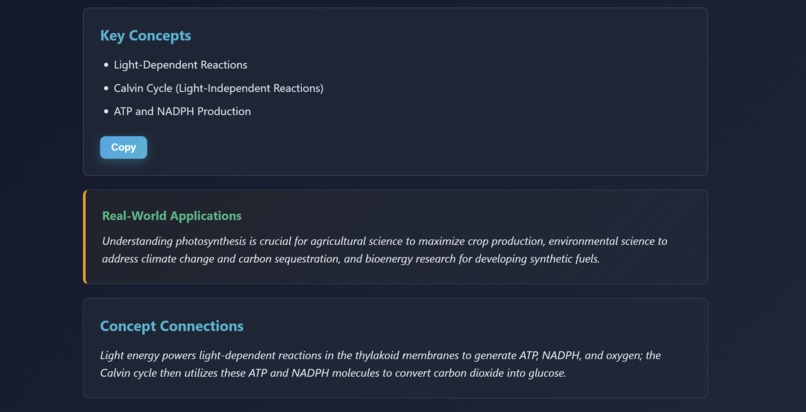
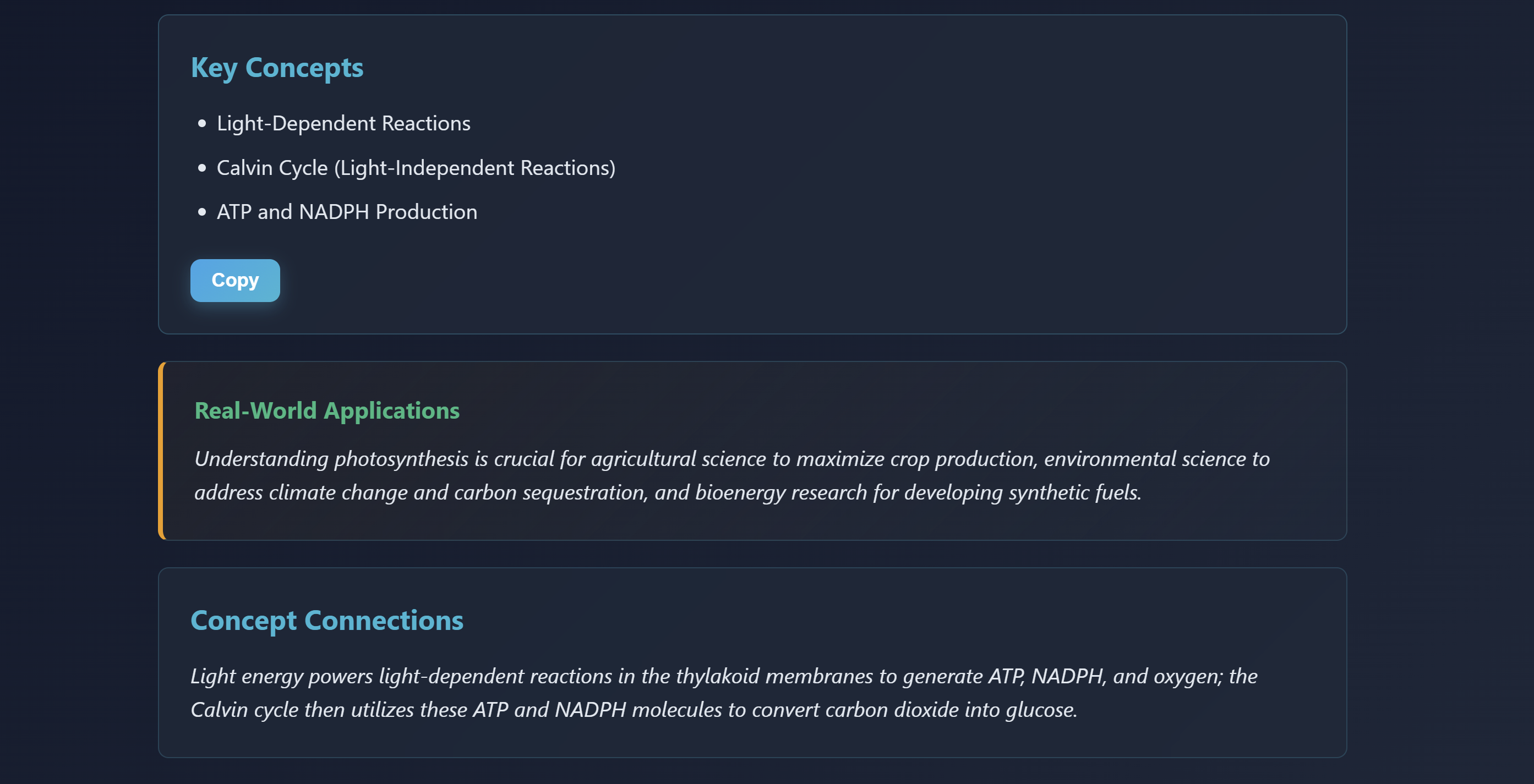
Core concept breakdowns paired with real-world applications and structural connections.
-
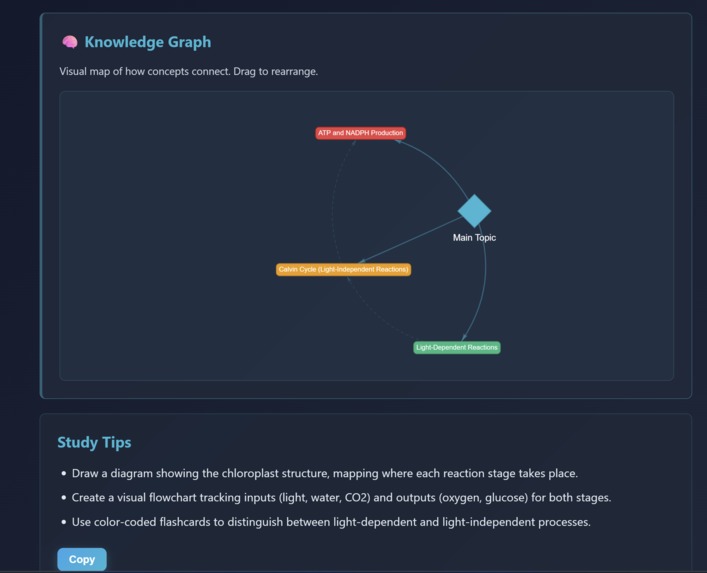
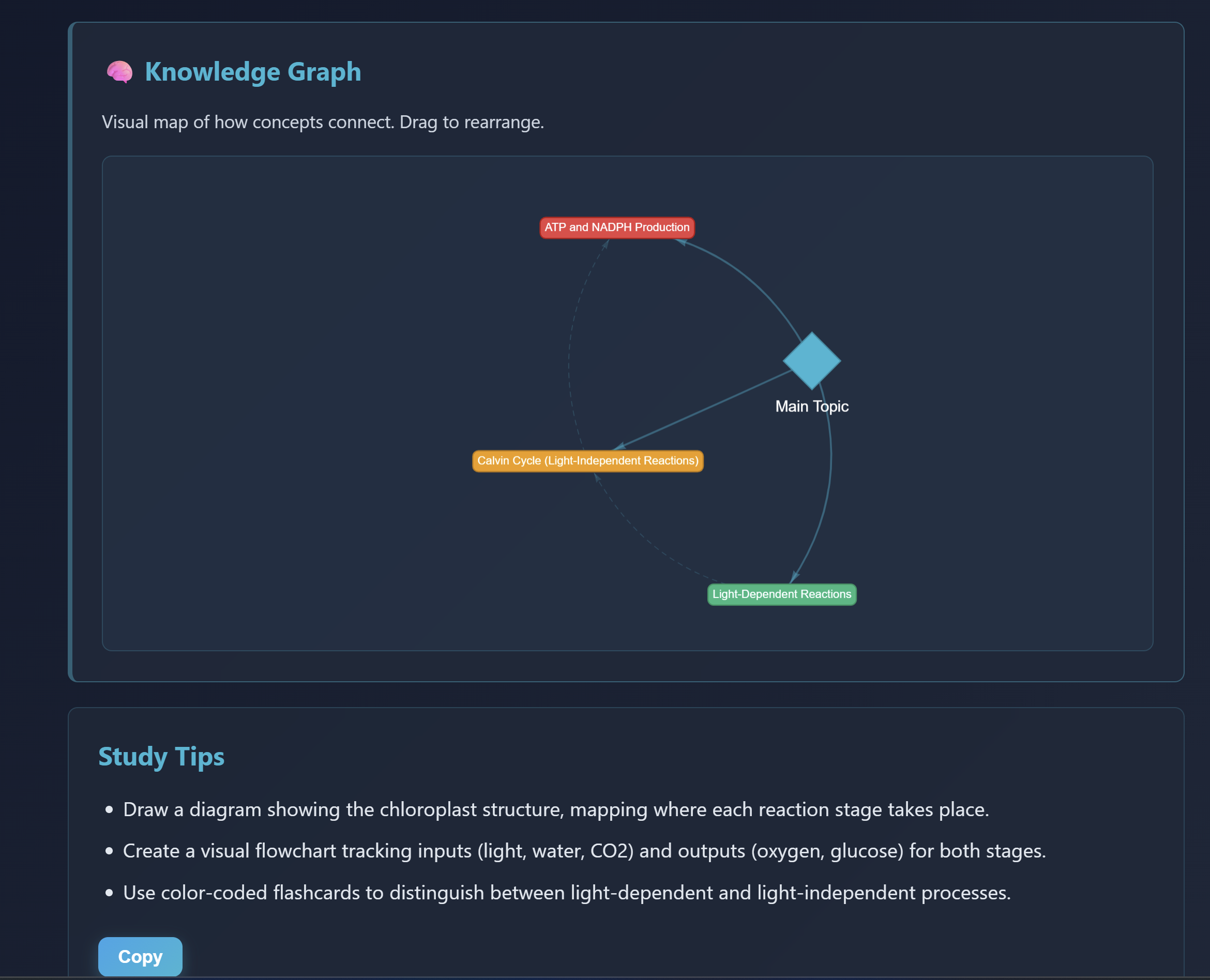
Interactive visual knowledge graph mapping concept relationships alongside study tips.
-
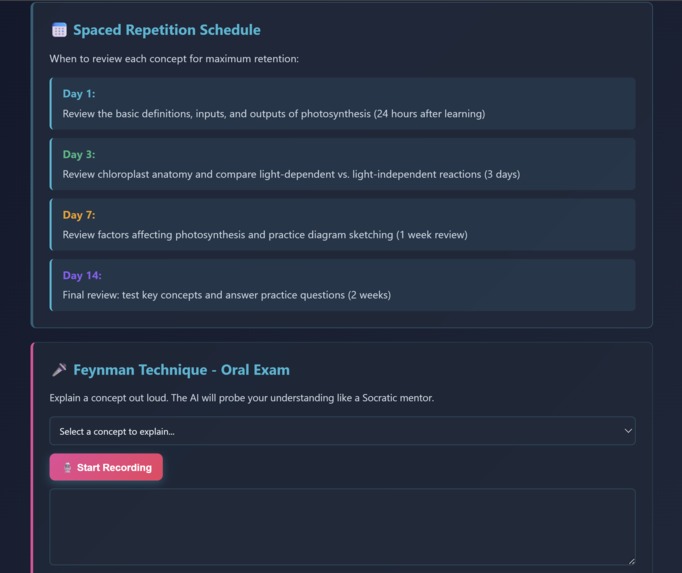
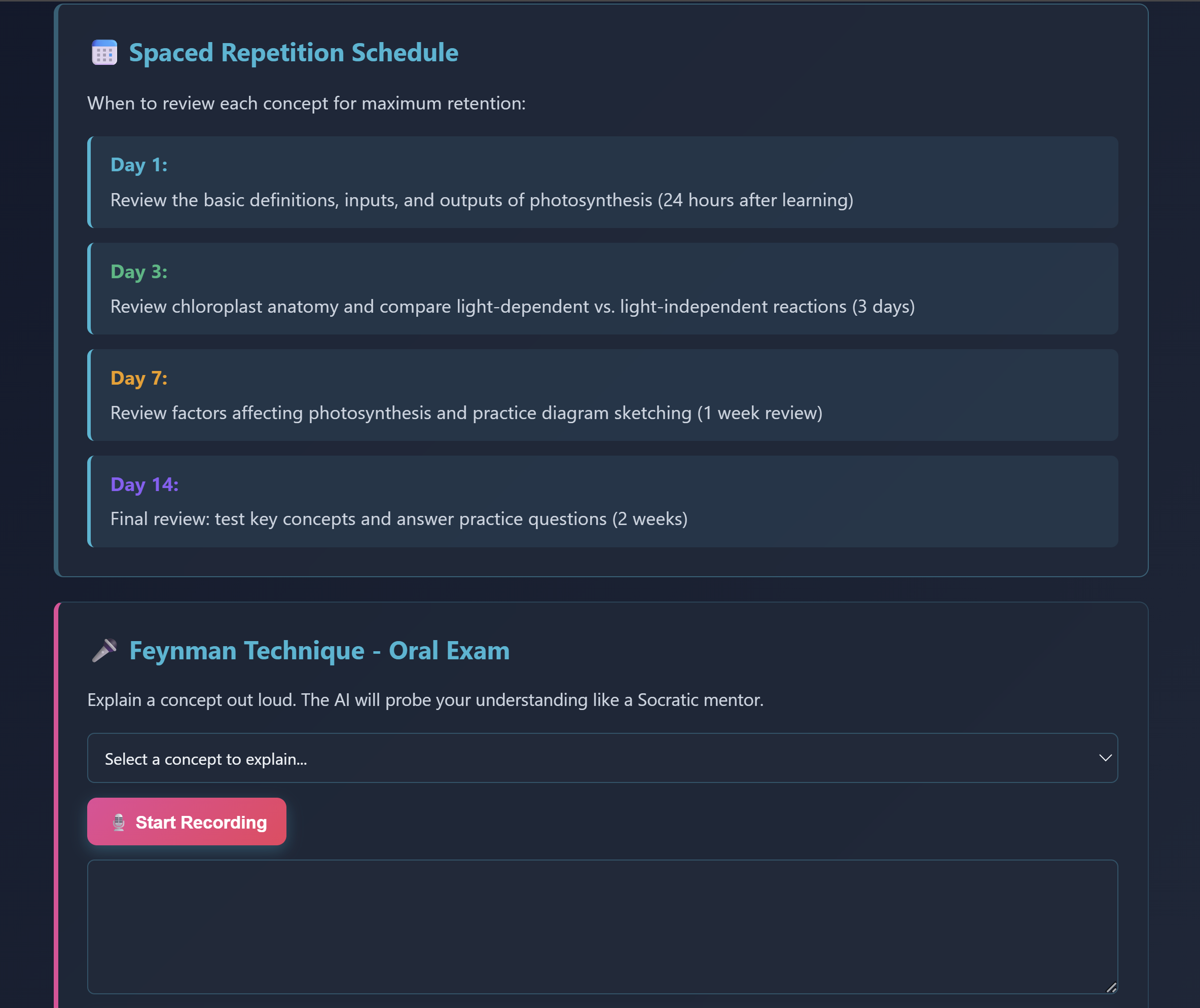
Automated spaced repetition schedule and Feynman-technique oral examination tool.
-
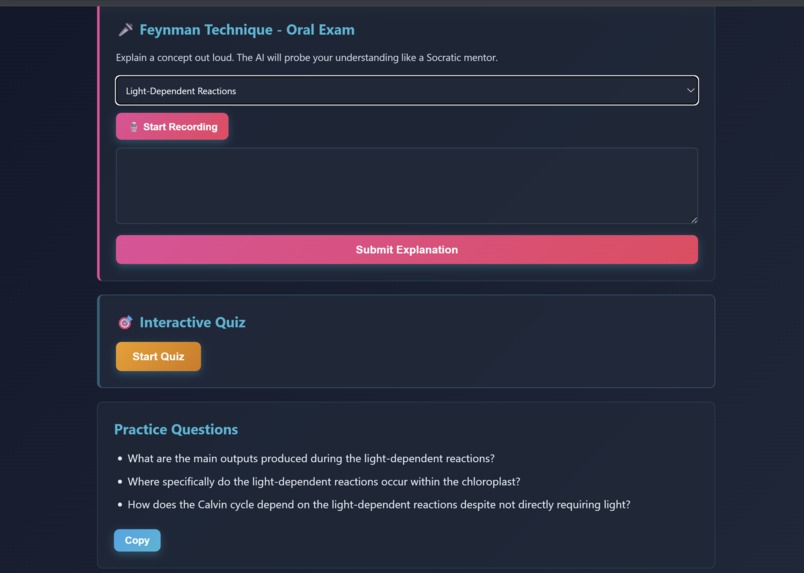
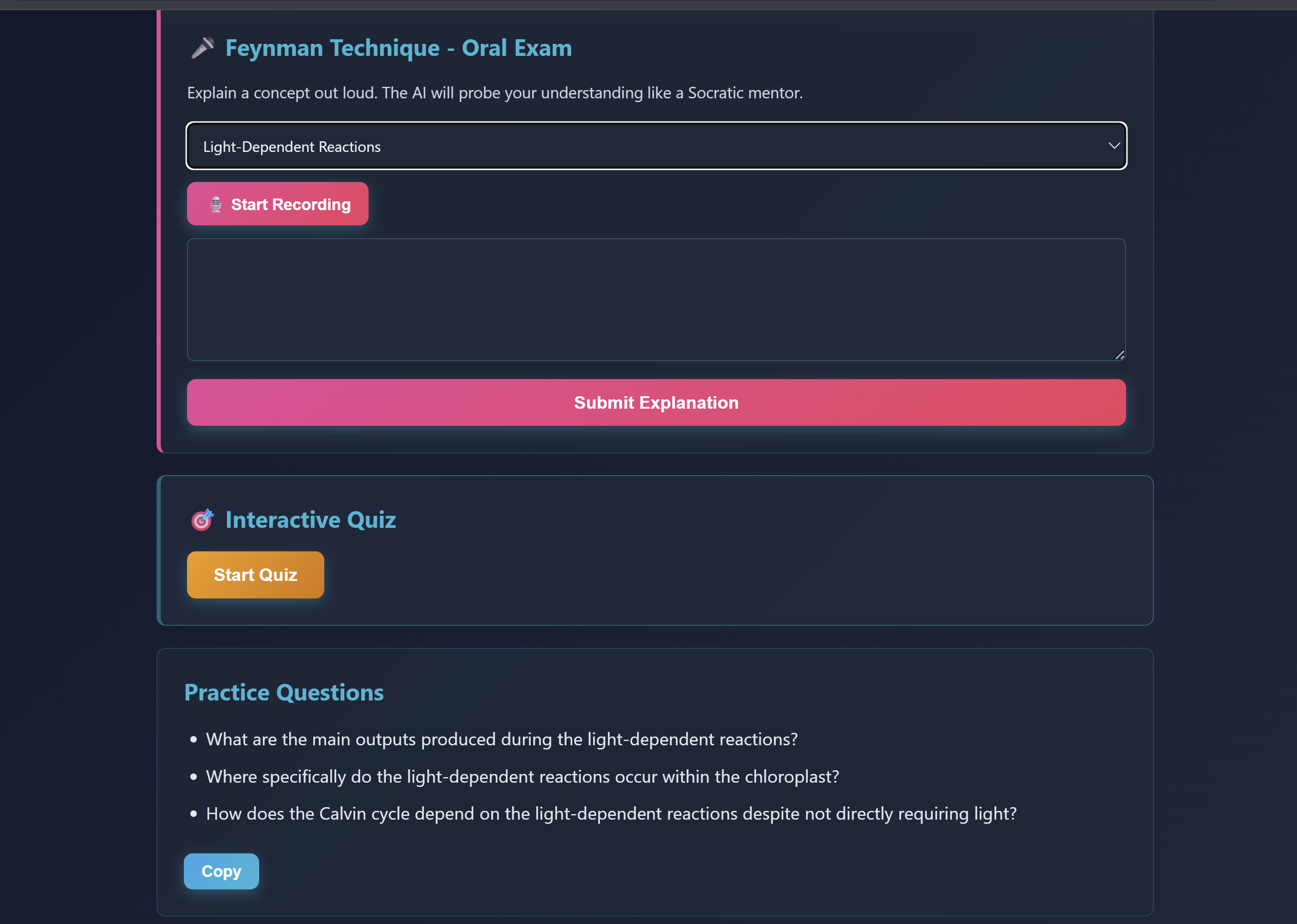
Active recall practice with interactive quizzes and concept check questions.
-
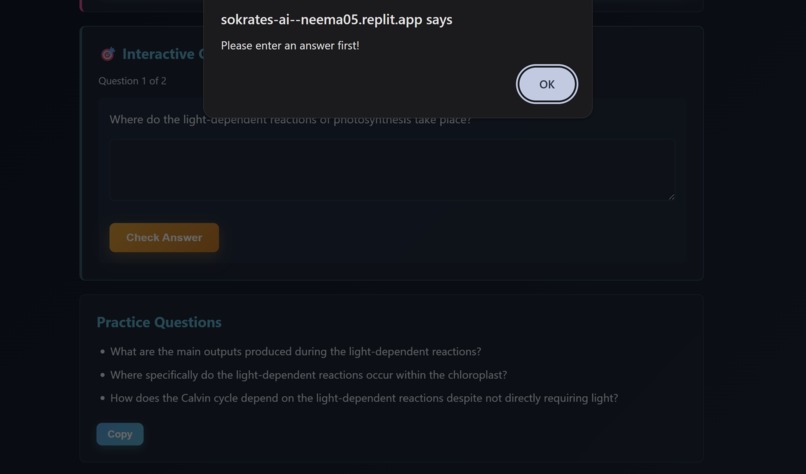
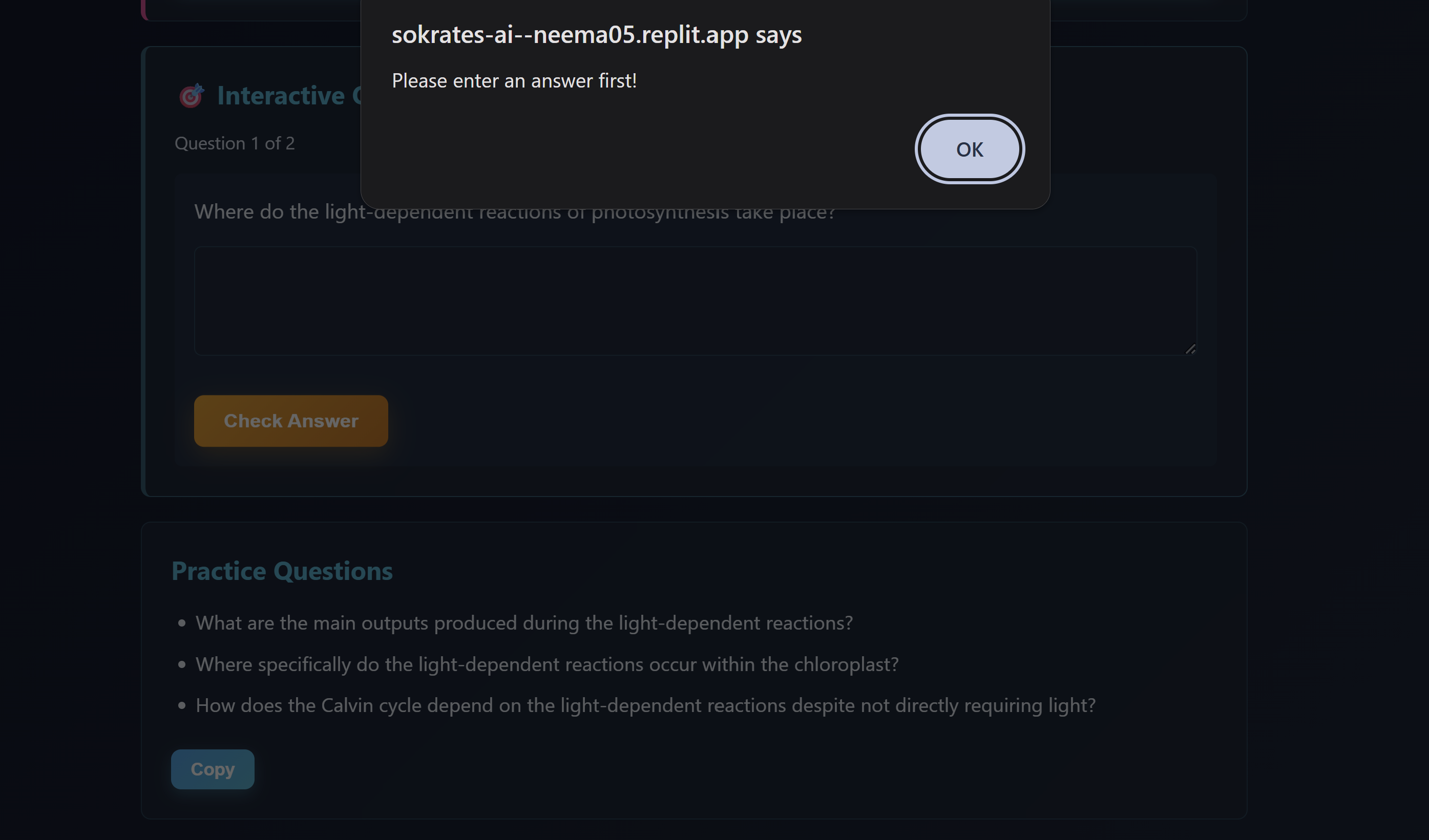
Smart input validation ensuring active student response before checking answers.
-
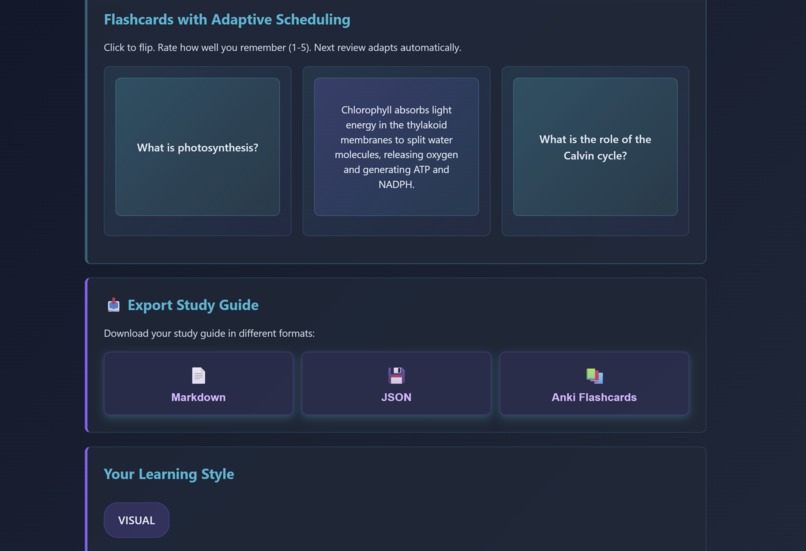
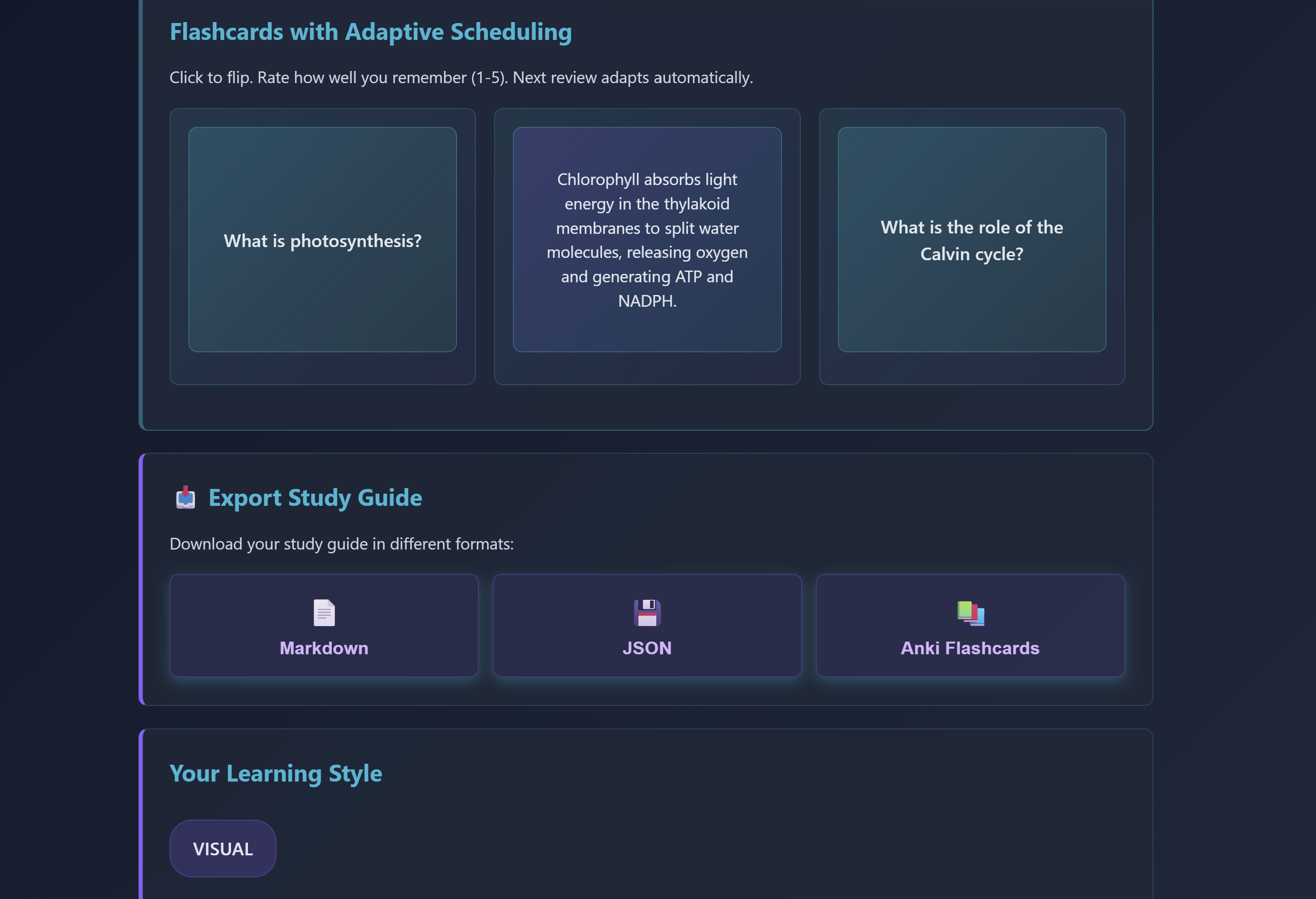
Adaptive flashcards with multi-format export support for Markdown, JSON, and Anki.
The Problem
Students spend countless hours manually creating study guides, flashcards, and practice materials. This process is:
- Extremely time-consuming (3-5 hours per topic)
- Often incomplete or poorly organized
- Not personalized to learning style or difficulty
- Doesn't implement evidence-based learning science
We asked: What if AI could generate personalized, scientifically designed study materials in seconds?
Our Solution: SokratesAI
SokratesAI is an AI-powered Socratic learning platform that transforms any text into comprehensive, adaptive study guides. Named after Socrates, history's greatest educator, our tool doesn't just teach—it asks the right questions until you truly understand.
Key Features
Feynman Technique - Oral Exam
- Explain concepts aloud using your microphone
- AI acts as a Socratic mentor, probing your understanding
- Identifies misconceptions in real-time
- Forces active recall (proven by cognitive science)
Socratic Debugger
- AI generates deliberately buggy code or proofs
- You spot the error and fix it
- Learn through problem-solving, not passive reading
- Higher-order thinking: analysis and synthesis
Interactive Knowledge Graph
- Visual network of concept relationships
- Drag-to-arrange using vis.js physics engine
- Shows how ideas connect and build on each other
- Spatial learning for visual learners
Adaptive Spaced Repetition (SM-2 Algorithm)
- Fixed schedule: Day 1, 3, 7, 14 (based on Ebbinghaus's Forgetting Curve)
- Adaptive algorithm: Rate flashcards 1-5, adjusts next review date automatically
- Harder cards appear more frequently
- Mastered cards appear less often
- Based on SuperMemo-2 algorithm (used in Anki)
Interactive Quiz System
- Auto-generated questions from content
- Instant feedback with hints
- Related concept references for wrong answers
- Progress tracking and scoring
Multi-Format Export
- Markdown (for notes and documentation)
- JSON (for tool integration)
- Anki flashcards (one-click import)
How We Built It
Tech Stack
- Backend: Python and Flask
- AI: Google Gemini 3.6 Flash (free tier, 2-5 second response time)
- Frontend: HTML5, Vanilla JavaScript, CSS3
- Libraries: vis.js (knowledge graphs), Web Speech API (voice recognition)
- Deployment: Replit.com (free tier)
Architecture
- User pastes text into the interface
- AI generates structured JSON (summary, concepts, quiz questions, flashcards, etc.)
- Frontend parses JSON and renders interactive UI
- Multiple API endpoints for specialized features (Feynman evaluation, bug generation, SM-2 rating)
- Stateless architecture—no database needed, all processing in browser or API
What We Learned
Learning Science Principles We Implemented
- Spaced Repetition (Ebbinghaus) - Review intervals based on the forgetting curve
- Active Recall (Roediger and Karpicke) - Testing effect produces better retention than passive reading
- SM-2 Algorithm (Wozniak) - Adaptive scheduling based on performance
- Feynman Technique - Explaining concepts forces deep understanding
- Multi-modal Learning (Fleming's VARK) - Visual, auditory, and kinesthetic options
- Cognitive Load Theory (Sweller) - Chunked and structured output reduces cognitive burden
Technical Challenges and Solutions
Challenge 1: Gemini Model Instability Gemini models changed versions (gemini-1.5-flash → gemini-2.0-flash → gemini-3.6-flash) with breaking changes.
Solution: Wrote robust error handling, documented the working model in the requirements, and created clear fallback logic.
Challenge 2: AI Defaulting Learning Style AI was returning "visual" for all inputs instead of analyzing content type.
Solution: Added explicit instructions to the prompt to analyze content and choose appropriate learning style.
Challenge 3: JSON Parsing Failures Gemini responses sometimes included markdown formatting, breaking JSON parsing.
Solution: Used structured output format and strict prompt formatting to enforce valid JSON.
Challenge 4: Knowledge Graph Visualization Initial attempts at graph visualization produced tangled, unreadable layouts.
Solution: Used the vis.js library with tuned physics parameters (gravitational constants, spring lengths) for readable node positioning.
Challenge 5: Web Speech API Compatibility Voice recognition worked inconsistently across browsers.
Solution: Added fallback for webkit variants, graceful error handling, and clear user feedback.
Impact and Competitive Advantages
Educational Impact
- Solves a real problem: Study material creation is time-consuming and inefficient
- Implements scientifically proven learning methods (spaced repetition, active recall, Feynman Technique)
- Supports multiple learning styles and content types
- Reduces study prep time significantly
Competitive Advantages
SokratesAI combines features that generic tools don't offer together:
| Feature | Generic Tools | SokratesAI |
|---|---|---|
| Text to Study Guide | Yes | Yes |
| Interactive Quiz | Yes | Yes with hints and explanations |
| Spaced Repetition | Limited | Fixed + Adaptive SM-2 |
| Knowledge Graph | No | Yes, interactive with vis.js |
| Voice Explanations | No | Yes, Feynman Technique |
| Learning Style Detection | No | Yes, Visual/Auditory/Kinesthetic |
| Code Debugging | No | Yes, Socratic Debugger |
| Multiple Exports | Limited | Markdown, JSON, Anki |
| Sample Data | No | Yes, 3 built-in examples |
Technical Implementation Quality
- Clean, responsive UI optimized for mobile and desktop
- Robust error handling and input validation
- RESTful API design with proper CORS configuration
- Advanced features: SM-2 algorithm, interactive graph physics, speech recognition, speech-to-text
- Production-ready code (PEP 8 compliant, minimal dependencies)
Future Roadmap
Potential additions for future versions:
- PDF document upload with text extraction
- YouTube transcript integration for lecture-based learning
- Progress dashboard to track mastery percentage over time
- Dark and light mode toggle
- Multi-language support
- Mobile app (React Native)
Why We Focused on Quality Over Quantity
Rather than adding more features, we prioritized:
- Polished, working implementations of core features
- Production-ready deployment
- Comprehensive testing and bug fixes
- Clear, professional presentation
Judges value depth and polish—not feature count. A few excellent features outweigh many buggy ones.
Try It Out
Live Demo: [https://sokrates-ai--neema05.replit.app/] Source Code: [https://github.com/Neema-ac/SokratesAI] Video Demo: [Link to 2-minute demonstration video]
Start with a sample dataset (Photosynthesis, Python Asyncio, or Macroeconomics) to experience the full capability of SokratesAI.

Log in or sign up for Devpost to join the conversation.