-
-
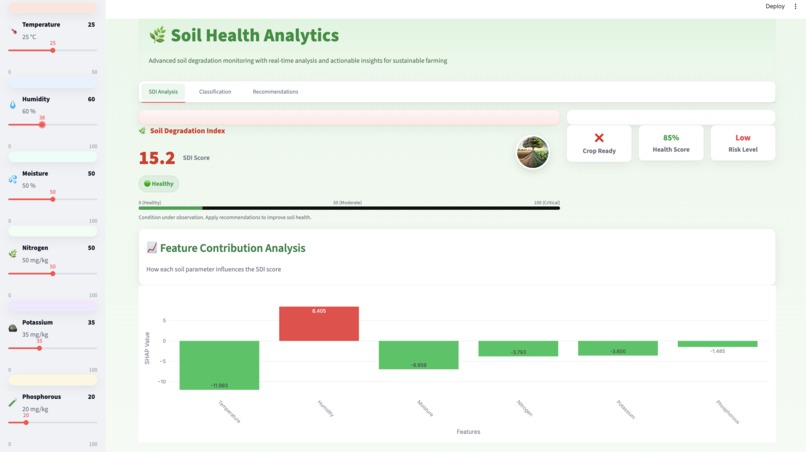
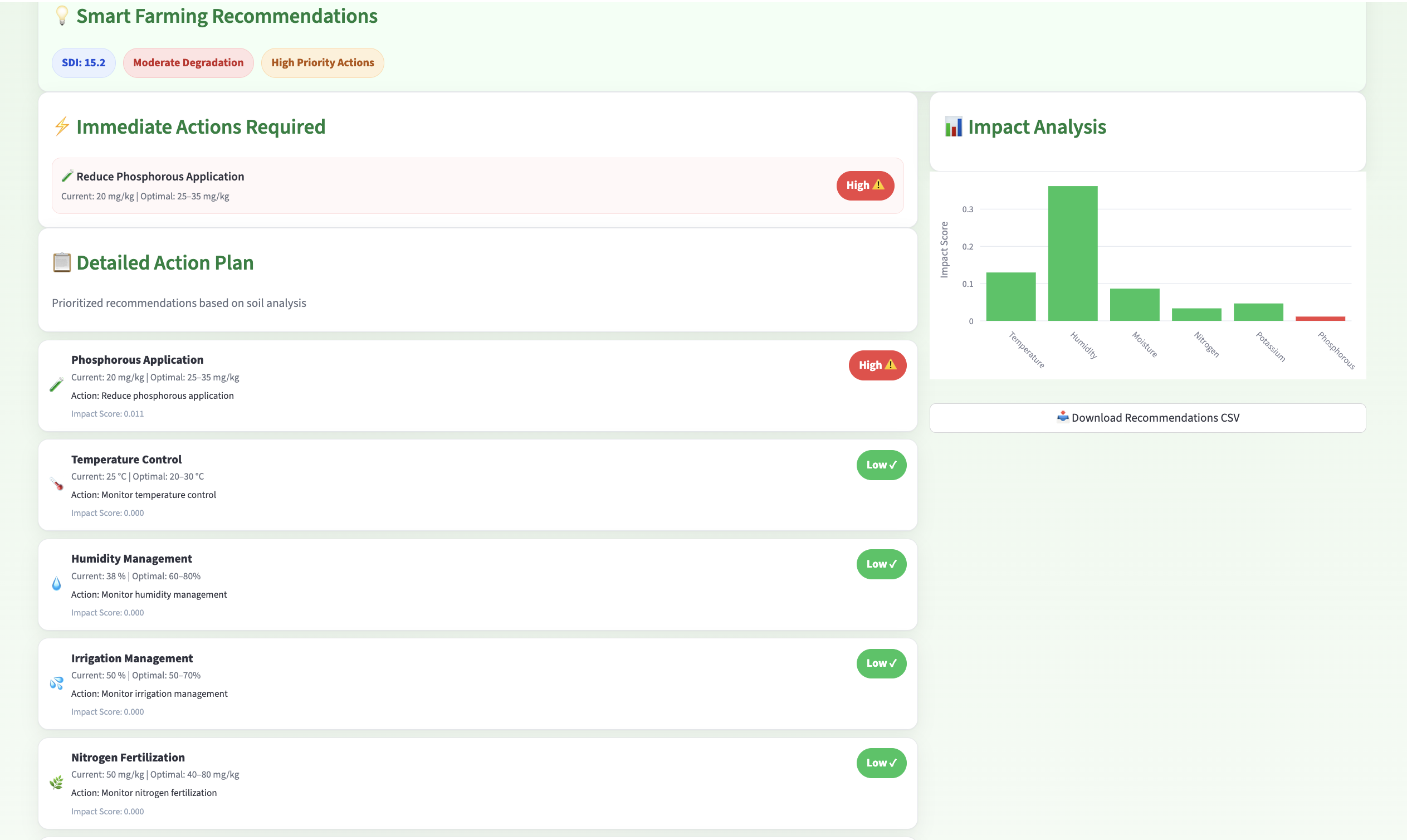
UI for SDI calculation
-
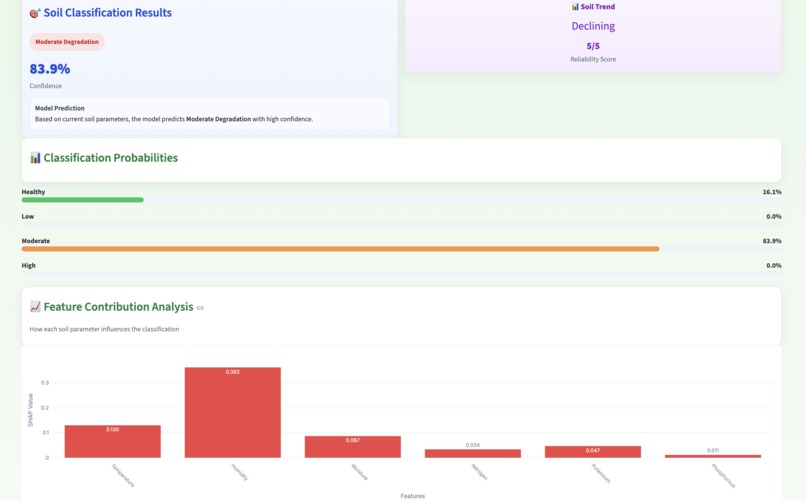
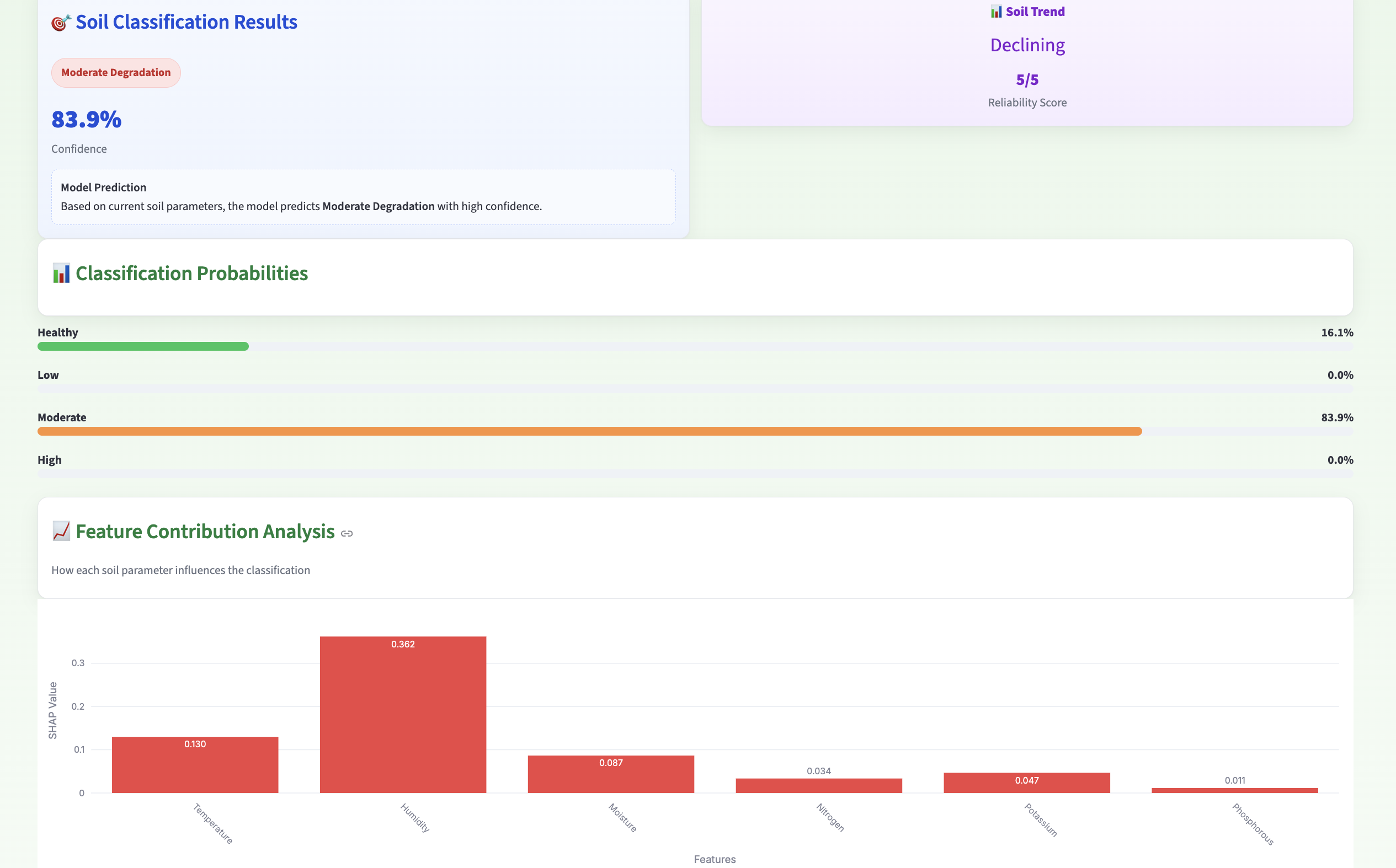
UI for classification
-
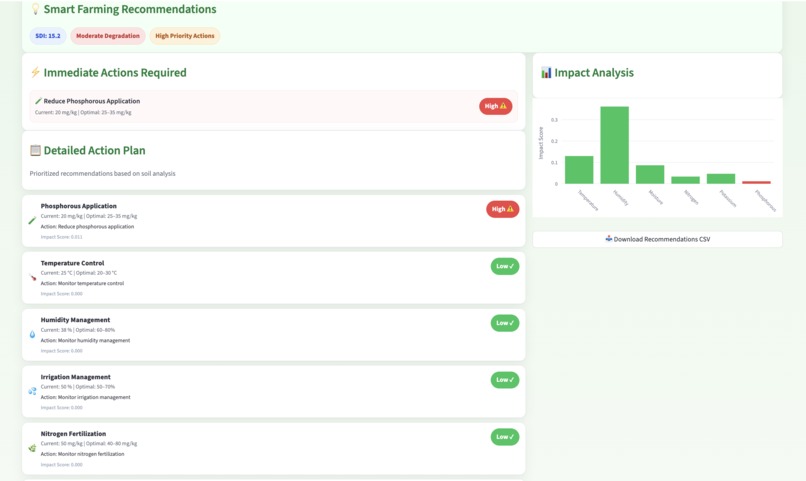
SHAP explanability
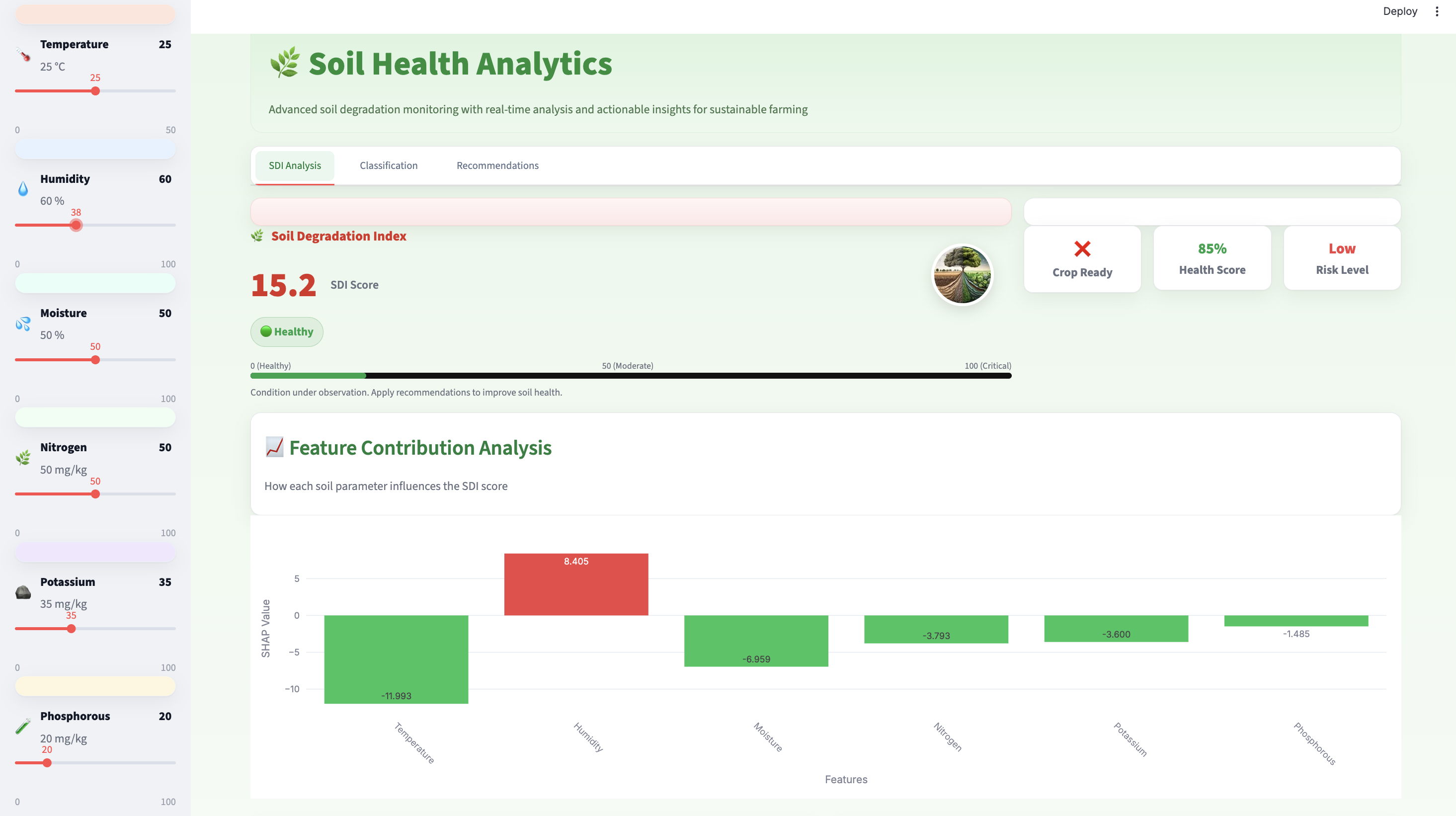
SoilSense
🌱 Inspiration
SoilSense was inspired by the need to address soil degradation and its significant impact on agricultural productivity. With the growing demands for sustainable farming practices and the challenges posed by climate change, we sought to create an AI-driven solution that helps farmers monitor and improve soil health. By leveraging data science and machine learning, SoilSense empowers smarter decisions for better farming practices.
🚜 What it does
SoilSense uses a hybrid machine learning model (XGBoost + Random Forest) to predict soil health and degradation levels. It calculates the Soil Degradation Index (SDI) and classifies soil into four categories:
- 🟢 Healthy
- 🟡 Low
- 🟠 Moderate
- 🔴 Highly Degraded
The platform also uses SHAP (Shapley Additive Explanations) for explainability, providing actionable insights to farmers on which soil parameters need adjustment. The user-friendly dashboard allows real-time updates as input parameters change, enabling farmers to instantly see the impact on soil health.
🛠️ How we built it
We built SoilSense by integrating machine learning models, advanced data analytics, and explainability tools:
- Hybrid Model: We combined XGBoost for gradient boosting and Random Forest for capturing non-linear relationships in soil data.
- Optuna Optimization: Hyperparameters of the models were optimized automatically using Optuna for better performance and accuracy.
- SHAP Explainability: SHAP was used to provide transparency into model predictions and offer farmers actionable insights.
- Streamlit Dashboard: A user-friendly, interactive dashboard was built using Streamlit, providing real-time predictions, insights, and report generation.
⚠️ Challenges we ran into
- Data Availability: Collecting high-quality, diverse soil data for training the models was a challenge, especially for remote areas with limited access to detailed data.
- Model Generalization: Ensuring that the hybrid model worked well across different soil types and environmental conditions required extensive experimentation and fine-tuning.
- Real-time Performance: Integrating real-time adjustments to input parameters while ensuring the dashboard responded swiftly was a key technical hurdle.
- Explainability: Providing meaningful SHAP explanations that were easy for non-technical users to understand took additional effort, especially in making complex model outputs actionable.
🏆 Accomplishments that we're proud of
- Successfully developed a hybrid machine learning model that accurately predicts soil health and degradation.
- Implemented SHAP explainability to offer farmers actionable insights based on model predictions.
- Created a seamless, interactive Streamlit dashboard that allows real-time monitoring of soil health parameters and report generation.
- Generated a synthetic soil dataset for model training and evaluation, ensuring robustness even with limited real-world data.
- Achieved high performance with model metrics: 99.94% classification accuracy and low RMSE for regression.
📚 What we learned
- Data Quality Matters: High-quality, comprehensive datasets are essential for training robust machine learning models. We learned the importance of data preprocessing and feature engineering in improving model performance.
- Interpretable AI: Providing explainable AI models, especially in agriculture, is crucial for building trust among users and helping them take actionable steps to improve soil health.
- Real-time Systems: Building a real-time system that integrates machine learning models with a user interface is challenging but rewarding. We learned the importance of optimizing both the backend (model performance) and frontend (user interaction) for smooth functionality.
- Scalability: Ensuring the solution works for a wide range of soil conditions and geographical locations required constant iteration and feedback.
🚀 What's next for SoilSense
- 🌐 Integration with IoT Sensors: We plan to integrate SoilSense with real-time IoT-based soil sensors to collect live data and provide more accurate and up-to-date soil health predictions.
- 🛰️ Satellite Imagery Integration: Incorporating satellite imagery to enhance spatial soil analysis and expand the reach of SoilSense to larger areas.
- 📱 Mobile Application: Developing a mobile app version of SoilSense to make it more accessible for farmers in rural areas who may not have access to desktop systems.
- 💡 Advanced Model Enhancements: Exploring the use of deep learning and more complex algorithms to further improve the accuracy of soil degradation predictions and recommendations.
- 🌍 Global Expansion: Collaborating with agricultural organizations and government bodies to deploy SoilSense globally and refine the platform based on real-world feedback.
Built With
- css3
- matplotlib
- numpy
- optuna
- pandas
- python
- random-forest
- scikit-learn
- shap
- streamlit
- xgboost

Log in or sign up for Devpost to join the conversation.