-
-
Sohoj Krishok - An AI Agricultural Platform
-
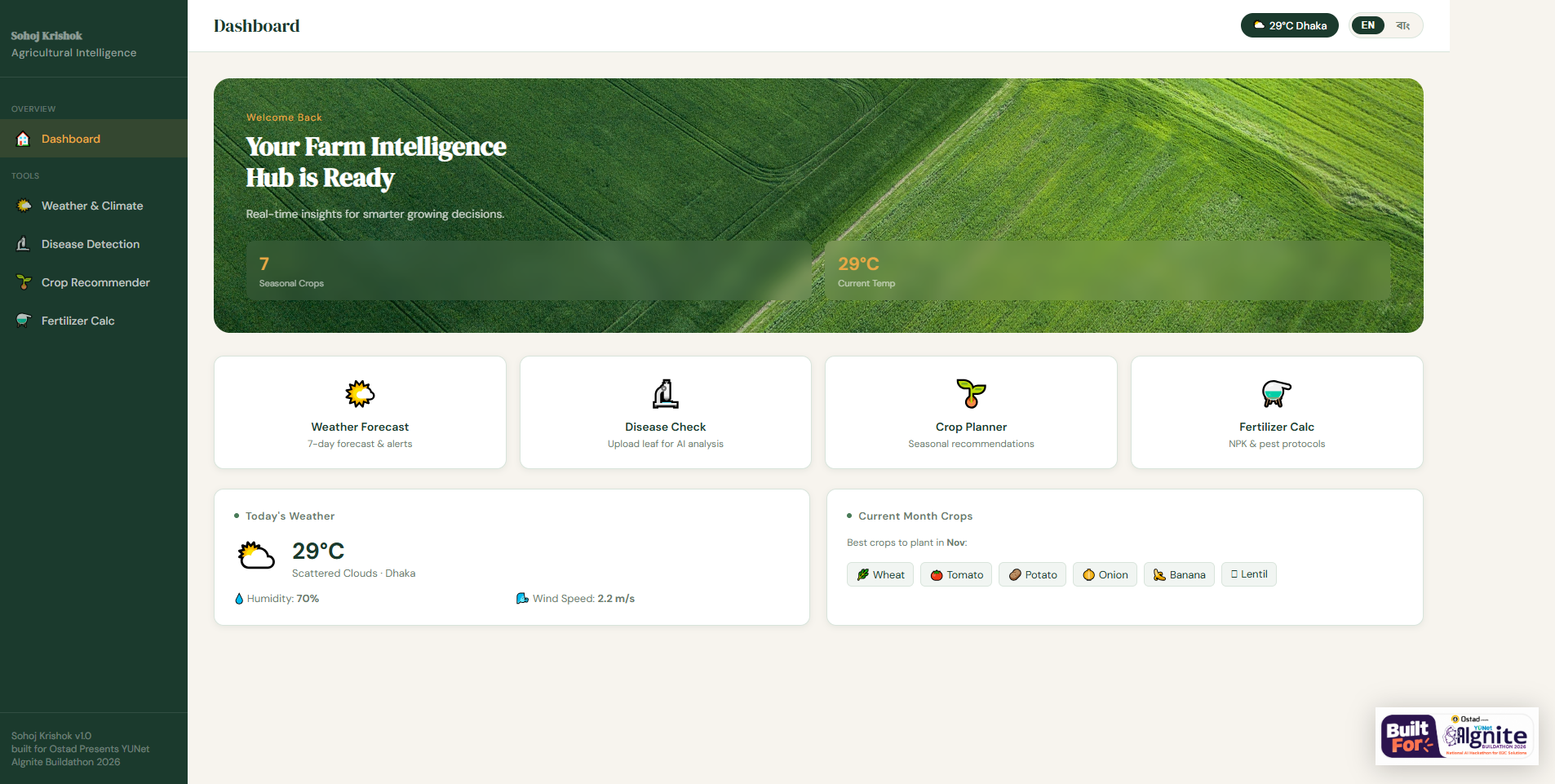
Dashborad
-
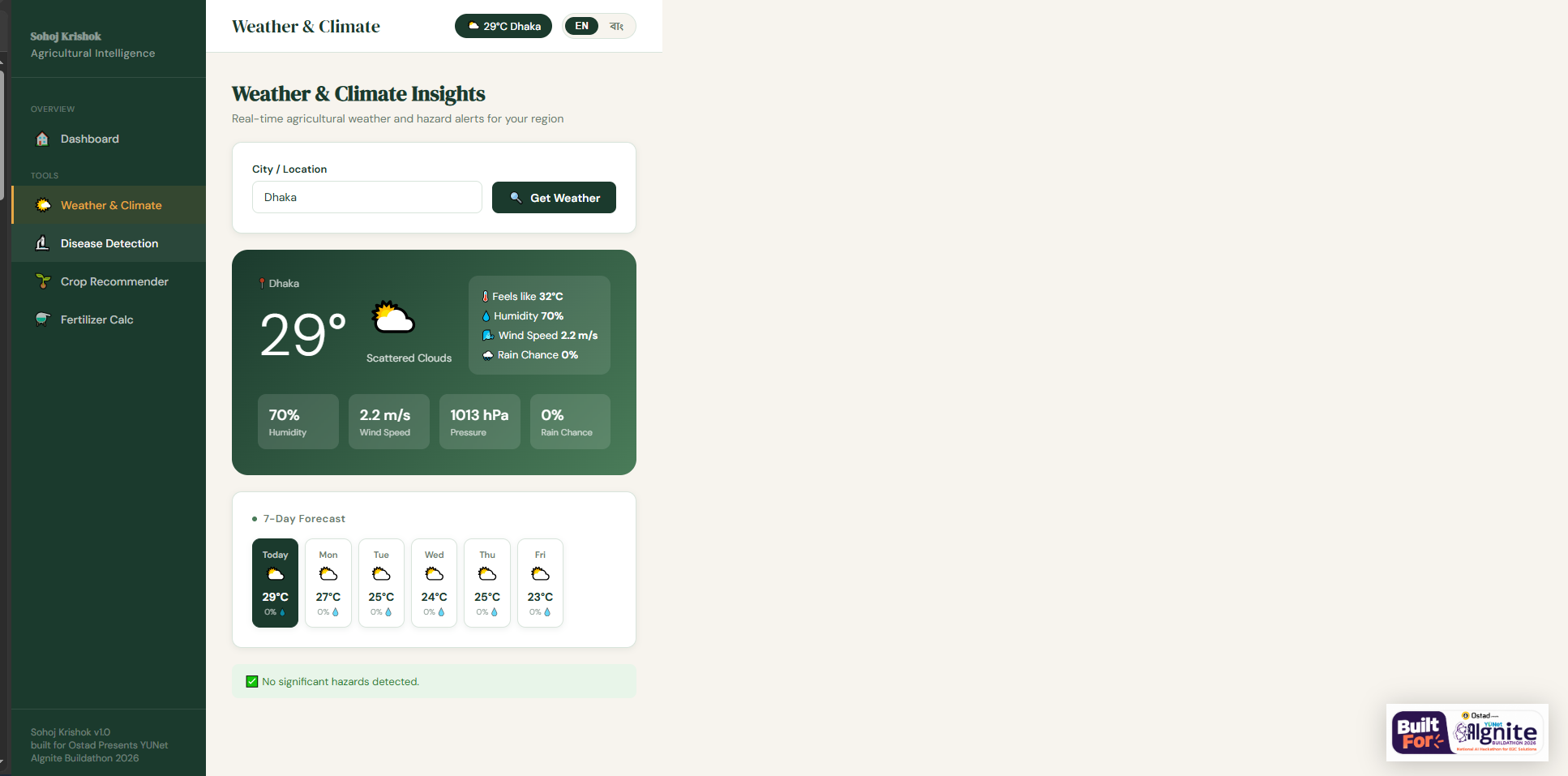
Weather and Climate
-
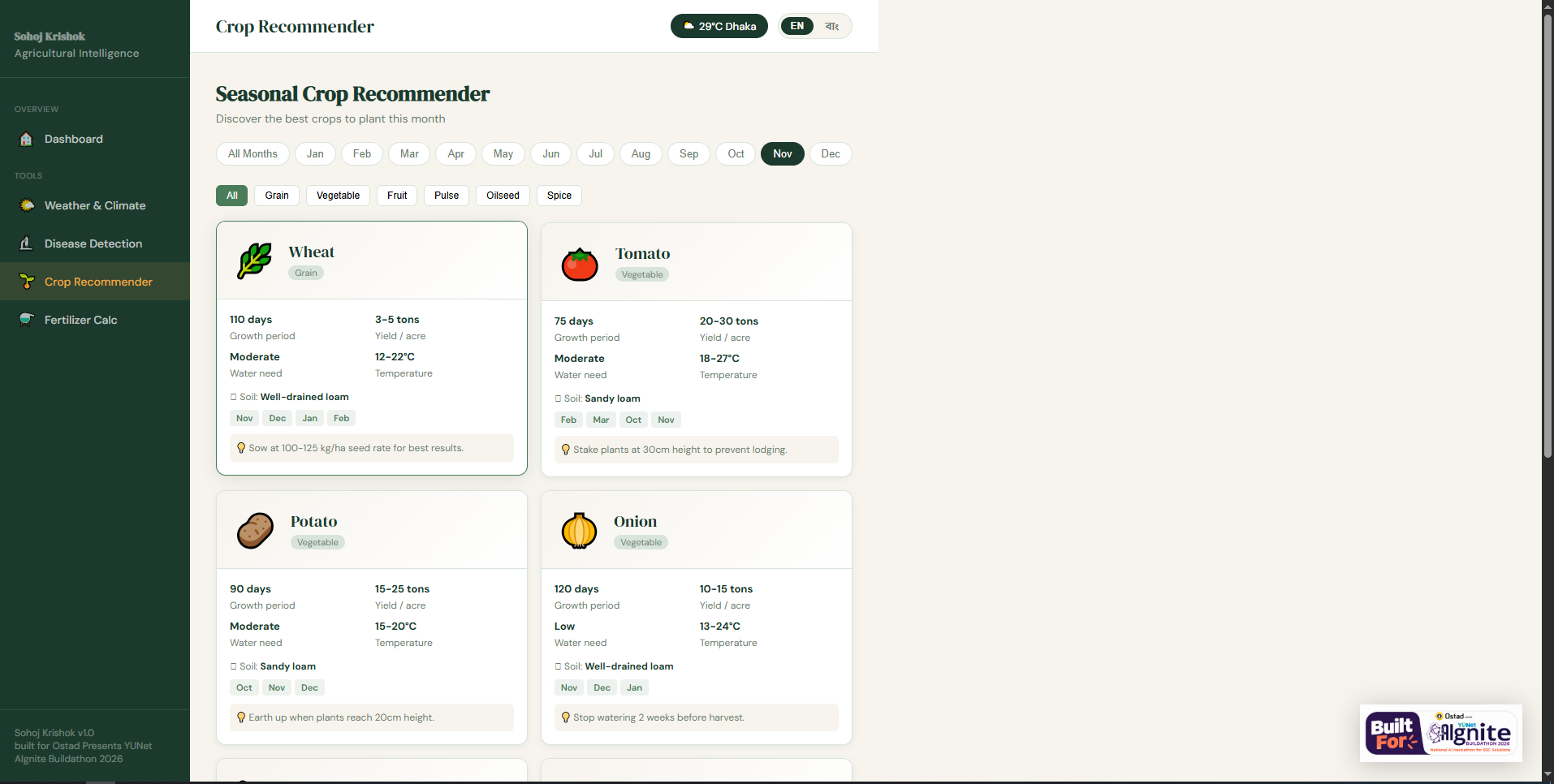
Crop Selection
Sohoj Krishok — AI-Powered Smart Agriculture Platform for Bangladesh
Inspiration
Bangladesh is one of the most agriculture-dependent nations in the world — over 40% of its workforce tills the land, yet the average smallholder farmer has little access to timely, localized, or scientifically grounded guidance. We grew up watching farmers in and around Sylhet make planting decisions based on folklore, seasonal intuition, and word-of-mouth — sometimes losing entire harvests to preventable diseases or mistimed fertilizer use.
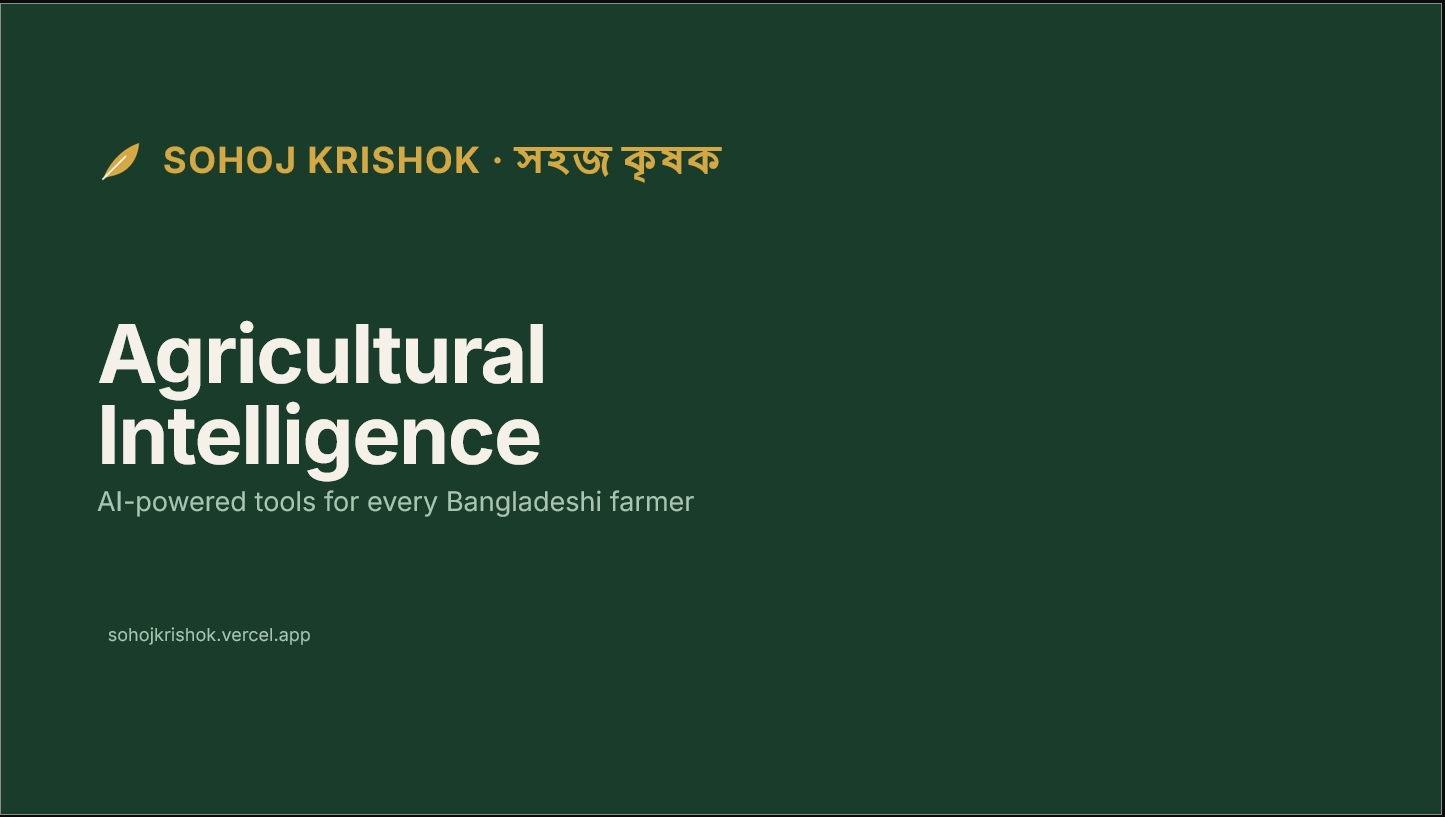
The question that drove us was simple: what if every farmer had an agronomist in their pocket? One that speaks Bangla, understands local soil and climate, and never closes for the night. That question became Sohoj Krishok (সহজ কৃষক) — "The Simple Farmer" — an AI-powered agricultural intelligence platform built for the Bangladeshi context.
What it does
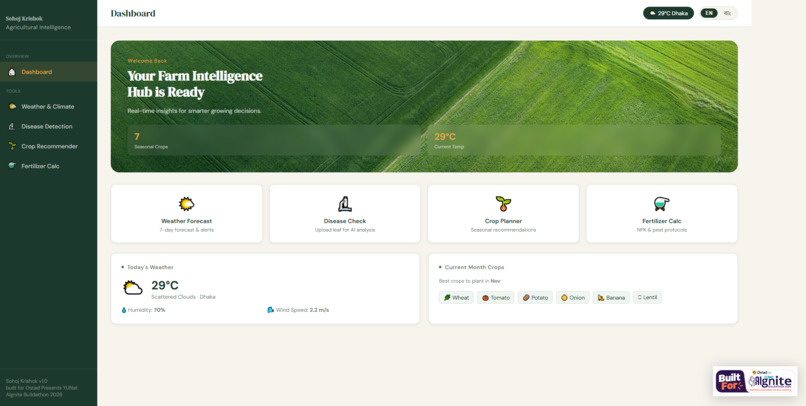
Sohoj Krishok is a bilingual (English + Bangla) web application that gives smallholder farmers four core tools:
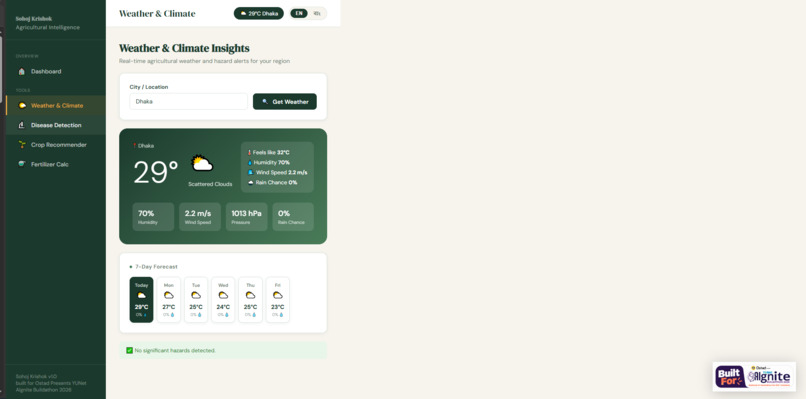
- 🌤️ Weather & Climate Alerts — Hyper-local, real-time weather data with agricultural hazard warnings (flood risk, drought, frost) for any city or region.
- 🔬 AI Crop Disease Detection — Farmers upload a photo of a diseased leaf and our AI model identifies the disease, explains its cause, and recommends treatment — in seconds. Sample leaves (Tomato, Rice, Wheat, Mango, Cucumber, Potato) are provided for demo purposes.
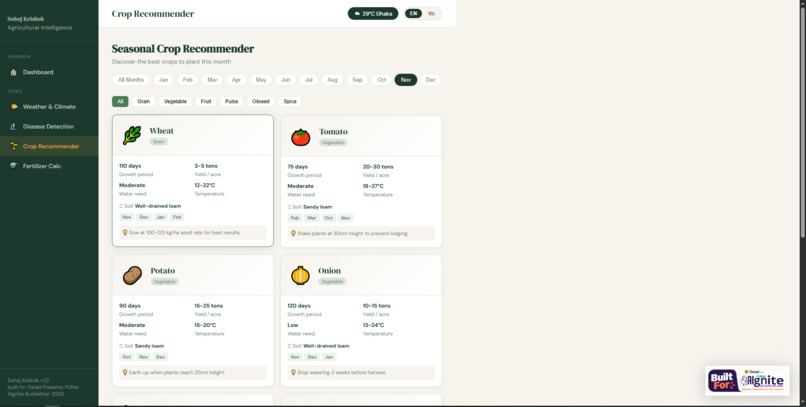
- 🌱 Seasonal Crop Recommender — Based on the current month and local conditions, the system recommends the most suitable crops to plant, helping farmers align with optimal growing windows.
- ⚗️ Fertilizer & Pesticide Calculator — Farmers input their crop type, field area (acres or hectares), soil type (loam, sandy, clay, silt), and irrigation method. The system outputs precise NPK dosage recommendations and pest-management protocols.
All features are accessible in both English and Bangla, making the platform usable without literacy barriers for farmers who navigate interfaces via familiar iconography.
How we built it
- Frontend: A responsive single-page application with a clean bilingual UI, built to work on low-bandwidth mobile connections common in rural Bangladesh. Navigation includes a collapsible sidebar, dark/light theming, and icon-first design for accessibility.
- AI Disease Detection: We integrated a vision-capable AI model via KINDWISE api to analyze leaf images and return structured diagnostic output — disease name, confidence level, causes, and remediation steps.
- Weather Engine: We connected to a real-time weather API, parsing agricultural-relevant signals (temperature, humidity, precipitation probability) and translating them into actionable farm advisories.
- Crop & Fertilizer Logic: We built a rule-based + AI-augmented recommendation engine. Given crop type, soil composition, irrigation method, and field area, it calculates precise fertilizer quantities using agronomic NPK ratios scaled to the farmer's land size.
- Deployment: Hosted on Vercel for fast, serverless edge delivery. The project is built and maintained by student of Sylhet Engineering College. This app was build for Ostad Presents YUNet AIgnite Buildathon 2026.
Challenges we ran into
- Accurate disease detection: It was difficult to detect disese and required treatment without paid model or a model made from scratch until the discovery of free limited api provided by KINDWISE with more than 50 plants and 30000 images model. We implemented the free version and had good result.
- Bilingual UI parity: Rendering Bangla script correctly across browsers while maintaining layout integrity was harder than expected. Many CSS layout assumptions break with mixed LTR/RTL-adjacent scripts.
- Low-connectivity UX: Designing for users on 2G/3G rural networks meant rethinking image upload flows, lazy loading, and graceful degradation when APIs time out.
- Domain-specific AI accuracy: General-purpose vision models needed careful prompting to produce agronomically sound disease diagnoses rather than generic image descriptions. Getting structured, actionable output (not just "this leaf looks unhealthy") required significant prompt engineering.
- Localization depth: Simple word-for-word translation wasn't enough. Agricultural terminology in Bangla varies by region — what farmers in Sylhet call a soil type may differ from Dhaka usage. We consulted local agricultural extension materials to ground our terminology.
Accomplishments that we're proud of
- Built a fully bilingual interface where every label, button, and AI response is available in both English and Bangla.
- Achieved real-time disease detection from a leaf photo in under 5 seconds on a standard mobile connection.
- Designed a fertilizer calculator that accounts for four soil types × four irrigation methods × twelve crops, giving farmers dosage outputs calibrated to their actual field conditions — not generic averages.
- The app is live and publicly accessible at sohojkrishok.vercel.app with zero cost to end users.
What we learned
- Localization is not translation. Building for Bangla-speaking farmers taught us that language is deeply contextual — UI copy, iconography, and even color associations carry cultural weight that a dictionary can't capture.
- AI is most powerful when it's constrained. Giving the model a well-defined task (identify this disease, suggest this treatment) and a structured output format produced far more useful results than open-ended prompts.
- Farmers are not a monolith. Even within a single district, soil types, water access, and crop preferences vary enormously. Good agricultural software has to be parameterized, not prescriptive.
- The importance of building for the constraint, not against it — slower connections, smaller screens, and lower digital literacy are features of the environment to design for, not exceptions to handle.
What's next for Sohoj Krishok
- 📍 GPS-based auto-location for weather and crop recommendations without manual city entry.
- 📸 Offline-first disease detection using a lightweight on-device model so farmers in areas with no connectivity can still get diagnoses.
- 📊 Harvest & yield tracking — letting farmers log past seasons to receive personalized, history-aware recommendations over time.
- 🔔 SMS/WhatsApp alert integration for farmers who don't use smartphones daily but need critical weather or pest outbreak warnings pushed to them.
- 🤝 Extension worker portal — a companion interface for government agricultural extension officers to monitor regional crop health trends aggregated (anonymously) from user data.
- 🌾 Expanding crop coverage from 12 crops to 50+, with district-specific soil and climate profiles across all 64 districts of Bangladesh.
"Sohoj Krishok was built in Sylhet, for every farmer who deserves the same quality of agricultural advice as the largest commercial farm — free, fast, and in their own language."
Built With
- ai
- api
- css3
- express.js
- gemini
- html5
- javascript
- node.js
- rest
- vercel
- weather

Log in or sign up for Devpost to join the conversation.