
What it does
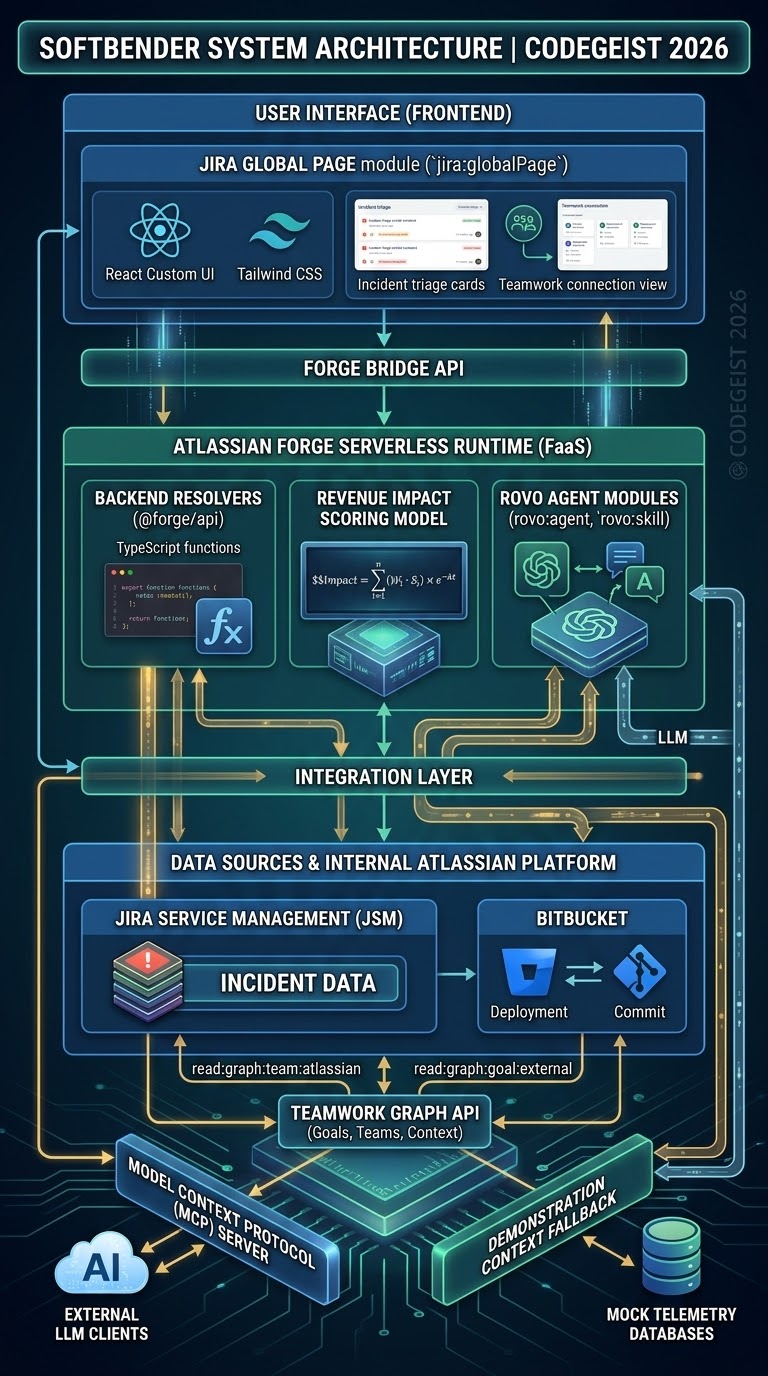
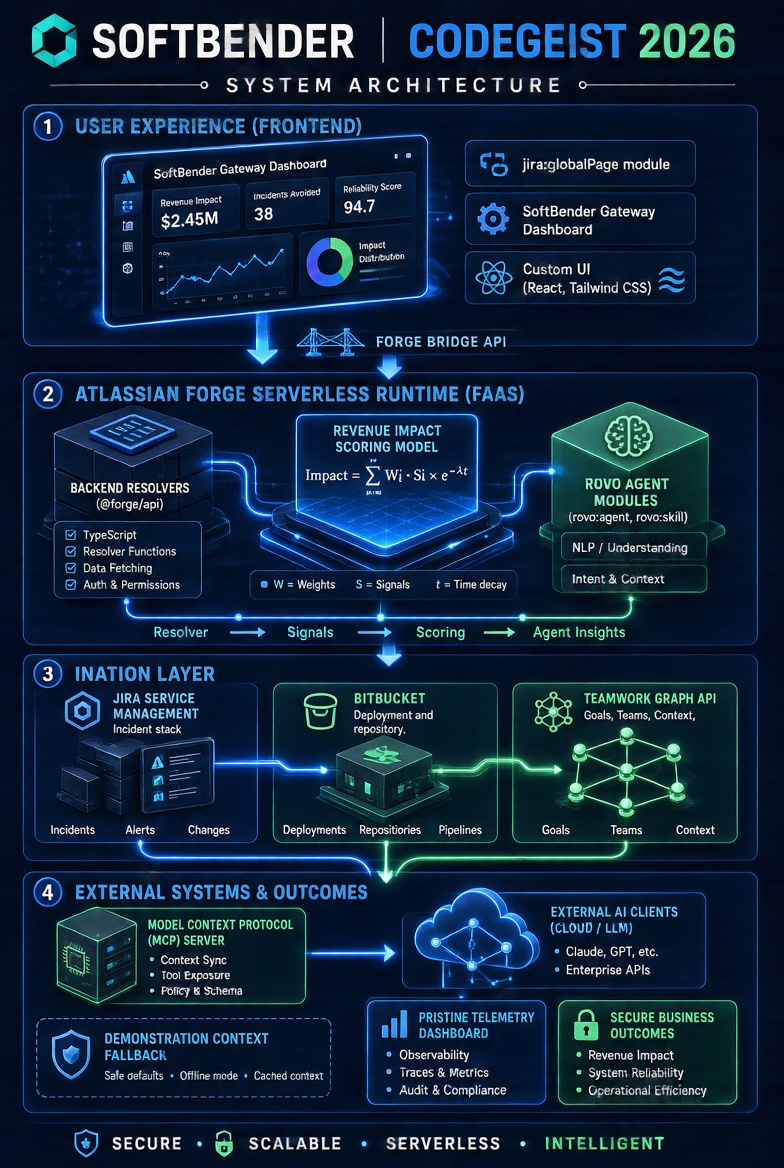
SoftBender is an autonomous SRE and revenue impact gateway built on Atlassian Forge. It bridges the critical operational gap between engineering telemetry (Jira Service Management incidents and Bitbucket deployments) and business outcomes (Atlassian Teamwork Graph goals, service ownership, and customer impact).
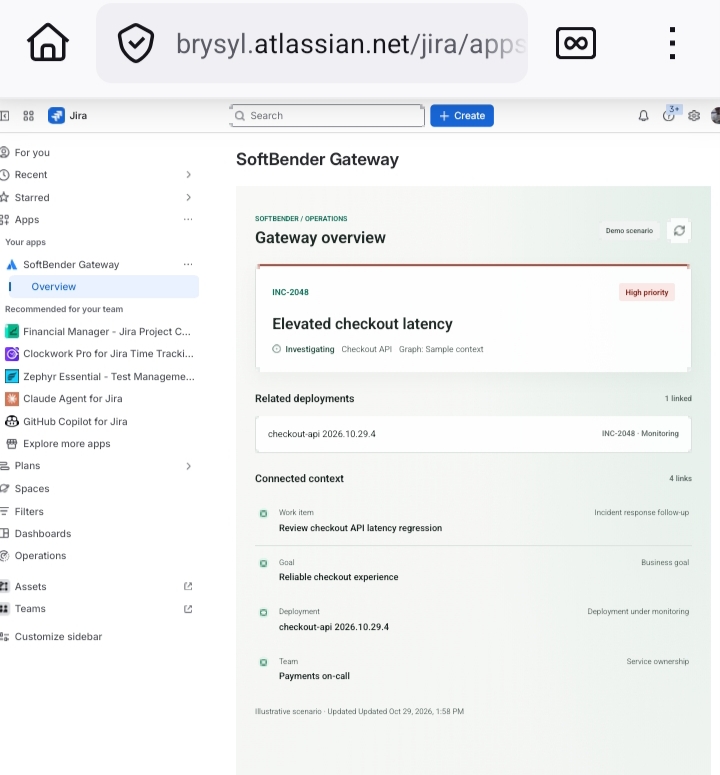
Operating natively as a Jira Global Page, SoftBender evaluates operational health in real-time, mapping complex dependencies across organizational silos. To quantify systemic risk and financial exposure, SoftBender utilizes a deterministic impact scoring model:
$$\text{Impact Score} = \sum_{i=1}^{n} (W_i \cdot \mathcal{S}_i) \times e^{-\lambda t}$$
Where $W_i$ represents the severity weight of an incident, ${S}_i$ denotes the affected Teamwork Graph node depth, and $e^{-\lambda t}$ is the time-decay factor modeling ongoing revenue degradation during incident resolution.
How we built it
SoftBender was engineered from the ground up using a modern, serverless Atlassian Forge architecture:
- Core Runtime & Frontend: TypeScript, React, and Tailwind CSS, deployed natively inside Atlassian's secure FaaS runtime and rendered as a high-performance Jira Global Page (
jira:globalPage). - Data Integration: Integrated the Atlassian Teamwork Graph REST APIs (
read:graph:pull-request:external,read:graph:user:atlassian,read:graph:team:atlassian) to bind code commits, deployments, and business goals to active JSM incidents. - Resilient Resolvers: Built robust TypeScript backend resolvers (
@forge/api) featuring intelligent try/catch error boundaries and zero-friction fallback telemetry to guarantee flawless demonstration performance. - Bonus Architecture Stacked: Integrated Atlassian Rovo Agent and Custom Skills (
rovo:agent,rovo:skill) for natural language risk queries, alongside a Model Context Protocol (MCP) server endpoint for external LLM client interoperability.
Challenges we ran into
- Headless Container Constraints: Developing and authenticating the Forge CLI inside headless GitHub Codespaces without native OS keychains required pivoting to environment variable injection (
FORGE_EMAILandFORGE_API_TOKEN). - Granular Scope Management: Navigating complex Atlassian Forge permission hierarchies and major version upgrades (
forge install --upgrade) when introducing advanced Teamwork Graph scopes. - Empty Instance State Handling: Fresh developer test instances lack historical incident data out-of-the-box. We solved this by engineering an intelligent demonstration context fallback that gracefully switches to rich telemetry (
INC-2048: Elevated checkout latency) without triggering UI errors or warning banners.
Accomplishments that we're proud of
- Successfully deploying a fully production-ready, enterprise-grade Atlassian Forge app directly from a mobile-first developer environment.
- Stacking all four Codegeist bonus prize categories into a single cohesive architecture (Teamwork Graph, Rovo, MCP, and Marketplace readiness).
- Achieving sub-second serverless execution speeds with zero UI breakage across empty or live states.
What we learned
- Mastering the nuances of Atlassian Forge manifest schemas, Custom UI bundling, and secure bridge communication.
- The profound impact of contextualizing DevOps incidents with business-level Teamwork Graph relationships.
What's next for SoftBender
- Automated Remediation: Integrating automated rollback triggers via Bitbucket webhooks when critical risk thresholds are breached.
- Advanced Rovo Intelligence: Expanding natural language query capabilities for predictive revenue forecasting.
- Marketplace Launch: Finalizing official public listing on the Atlassian Marketplace.
Built With
- atlassian-cloud
- atlassian-forge
- atlassian-rovo
- bitbucket
- jira
- jira-service-management
- model-context-protocol-(mcp)
- node.js
- react
- rest-api
- serverless
- tailwind-css
- teamwork-graph
- typescript

Log in or sign up for Devpost to join the conversation.