-
-
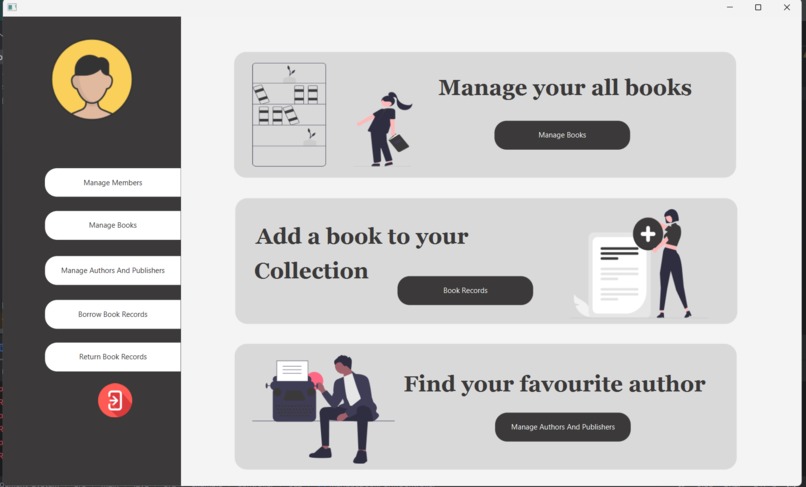
Home -page

Inspiration
The idea for building the Library Management System came from recognizing the need for efficient management of library resources, including books, members, and transactions. Many libraries still rely on manual processes, which can be time-consuming and error-prone. I wanted to create a digital solution to automate these operations and simplify library management.
What it does
The Library Management System is a desktop application that streamlines library operations. It offers user authentication, book and member management, borrowing and returning books, and the ability to manage authors and publishers. The system provides a user-friendly interface, allowing librarians to easily handle day-to-day tasks and keep track of inventory.
How we built it
I built the system using:
- Java as the core programming language
- JavaFX for the graphical user interface (GUI)
- MySQL as the database management system
- CSS to style the user interface and make it visually appealing
- Maven for project management and dependencies
The project is structured into various modules, each responsible for handling different aspects like database connectivity, user authentication, and the GUI.
Challenges we ran into
One of the significant challenges was ensuring seamless communication between the JavaFX frontend and the MySQL backend. Managing concurrent database connections and handling exceptions like SQL injection risks were also complex tasks. Another hurdle was designing a responsive and intuitive interface that could display large datasets efficiently without slowing down the application.
Accomplishments that we're proud of
We are particularly proud of the system's user-friendly dashboard that organizes key library functions. Successfully implementing the book borrowing and returning feature with validation and real-time inventory updates was a major achievement. Additionally, the ability to manage not just books and members but also authors and publishers adds extra value to the application.
What we learned
Through this project, I gained deeper insights into JavaFX for desktop application development and honed my skills in database design with MySQL. I also learned how to effectively manage dependencies and structure projects using Maven. Additionally, I developed a better understanding of handling multi-threading and asynchronous database operations to enhance performance.
What's next for Library Management System
Moving forward, I plan to:
- Implement advanced reporting features for overdue books and popular titles
- Add support for multiple library branches and inter-library loan tracking
- Improve the user interface by making it more dynamic and responsive
- Introduce machine learning algorithms to recommend books based on borrowing patterns
- Extend the system to a cloud-based version to enable remote access and management.

Log in or sign up for Devpost to join the conversation.