Inspiration
We have all played coloring games before. You pick a color, tap, and fill it in. It is easy, but it gets boring fast. We wanted to make something different. What if you could not just pick a color, but you had to make it yourself? And what if making the color was like doing a real chemistry experiment?
That is how we came up with ColorLab. We were inspired by chemistry lessons in school, where two liquids mix and suddenly turn red, or a powder becomes a bright blue pigment. We wanted to turn that magical "wow" moment into a game.
What it does
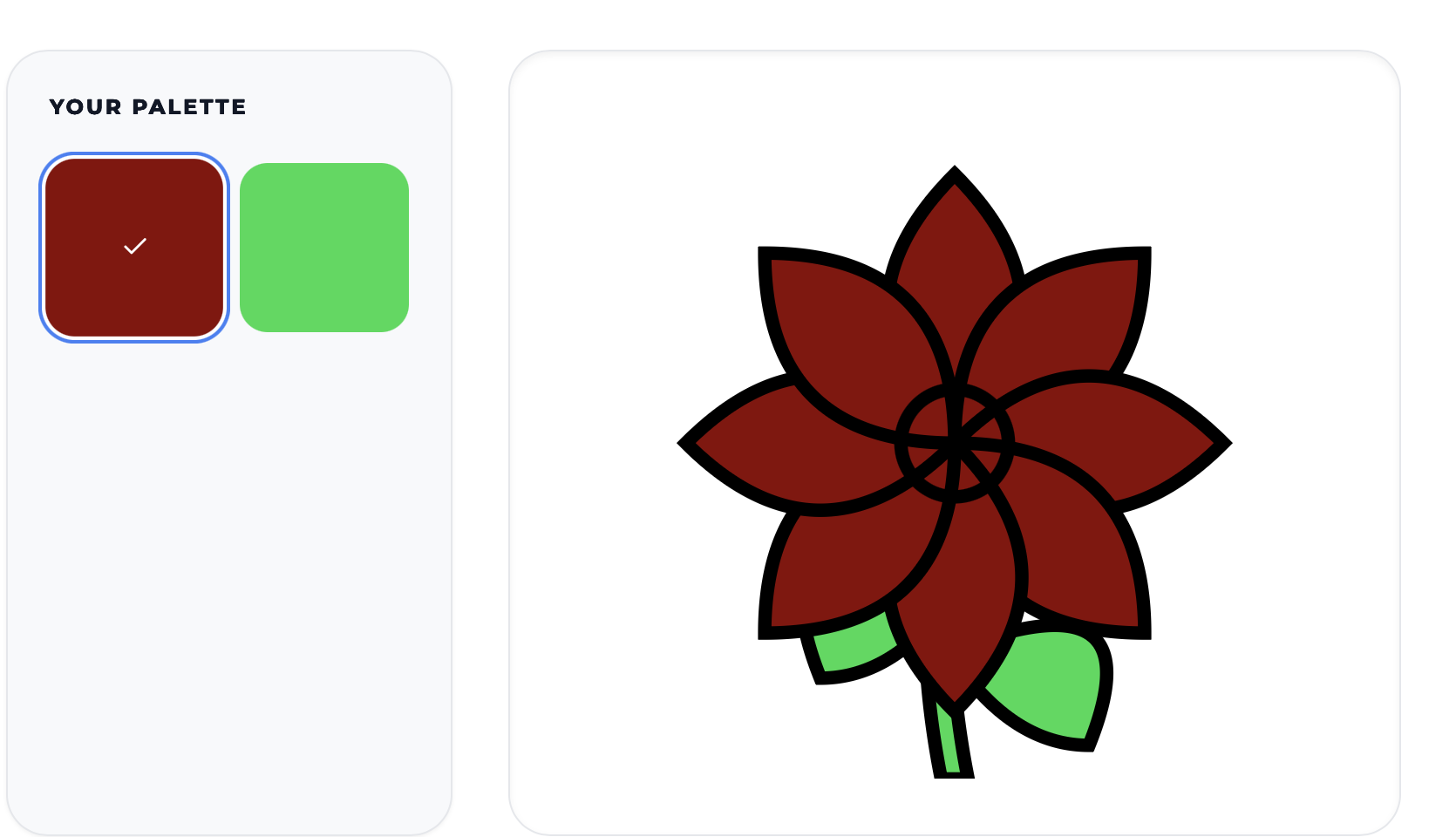
ColorLab is a coloring game with a twist. You cannot just pick colors from a palette. You have to make them yourself by doing small lab experiments.
For example, if you want red, you can mix Fe³⁺ with KSCN and it turns blood red. If you want blue, you can make Prussian Blue. If you want green, you can make malachite. If you want black, you can make magnetite.
Each picture in the game has missing colors. The player has to experiment, mix different things, and figure out the right combination to get the color they need.
How we built it
We designed the app around three main parts:
- The Lab – where players combine reagents and watch the color change. The reactions are based on real chemistry, for example:
$$\text{Fe}^{3+} + \text{SCN}^- \rightarrow [\text{Fe(SCN)}]^{2+} \text{ (blood red)}$$
The Pigment Library – every successful synthesis unlocks a new color that gets saved for the player to use later.
The Canvas – where players use their hard-earned colors to fill in beautiful illustrations.
We also made sure the chemistry feels intuitive and not intimidating, so even players without a science background can enjoy it.
Challenges we ran into
- It was hard to make the chemistry realistic but still fun and easy to understand.
- Designing the mixing system was tricky. We wanted it to feel rewarding when players got the right color, but not too frustrating when they got it wrong.
- We had a lot of pigment ideas but not enough time to add them all, so we had to choose which ones to keep for the hackathon version.
- Making the color changes look smooth and satisfying took more effort than we thought.
What we learned
We learned a lot, not just about coding and design, but also about chemistry and history. Researching old pigments was actually really fun. For example, Prussian Blue was discovered by accident in 1704 by a Berlin paint maker who was trying to create a red dye. Malachite has been used as a pigment in Egyptian tomb paintings for over 4,000 years. We also learned how to plan a project under time pressure and how to work as a team.
What's next for ColorLab
- Adding more pigments and reactions, including organic dyes and natural pigments
- Adding more images, with new themes like underwater worlds, mythical creatures, and fantasy maps
- Expanding the game with complex SVGs like a majestic dragon or a detailed forest landscape for higher levels
- Building a community feature where players can share their finished artworks
- A story mode where each chapter takes place in a different historical era and players discover pigments the way humans actually did
- An AR mode where players can paint real-world objects with their custom colors
- A classroom mode for teachers, with assignments and progress tracking for students
Built With
- claude
- english
- medo

Log in or sign up for Devpost to join the conversation.