Inspiration
In banks and other regulated companies, the person who implements a change must not be the person who approves it (segregation of duties, the "four-eyes principle"; SOX, ISO 27001, PCI DSS and banking regulators all test it). The evidence already lives in Jira — in the status and assignee history of every change ticket — but nobody can see it. Every quarter, engineers and auditors export issues and reconcile "who did the work" against "who clicked Done" by hand. Violations are found months after the change went live.
What it does
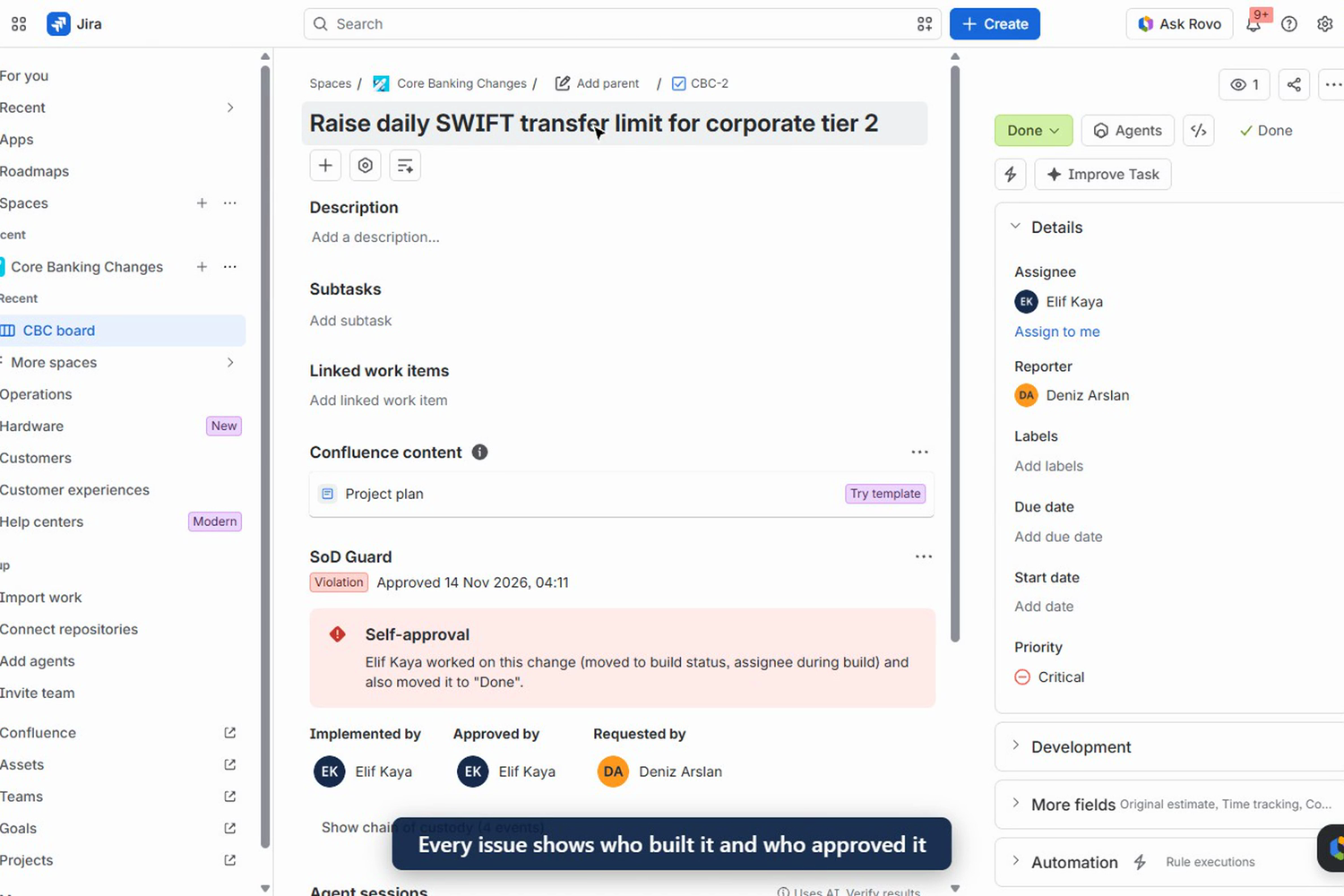
- Chain of custody on every issue. An issue panel reconstructs, from Jira's own history, who implemented the change (everyone assigned while it was being built, and whoever started the work), who approved it and who requested it — and states a verdict: Compliant, Violation or Awaiting approval. The viewer is told up front if they are not allowed to approve it.
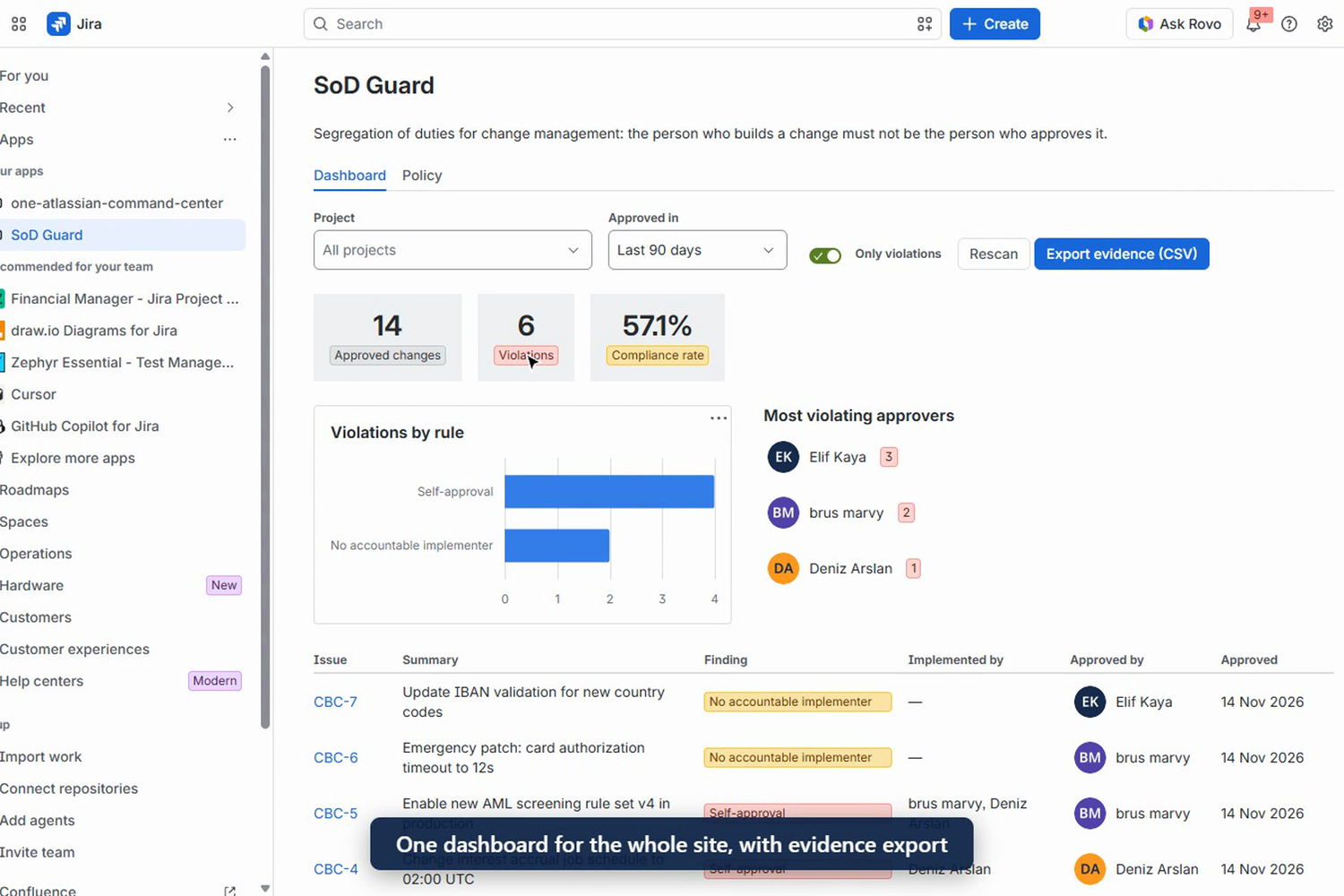
- Compliance dashboard. A global page scans approved work across the site or one project: approved changes, violations, compliance rate, violations by rule, the approvers involved, and a table that links to every issue. One click exports the evidence as CSV for auditors. A daily scheduled scan records the compliance rate for a trend chart.
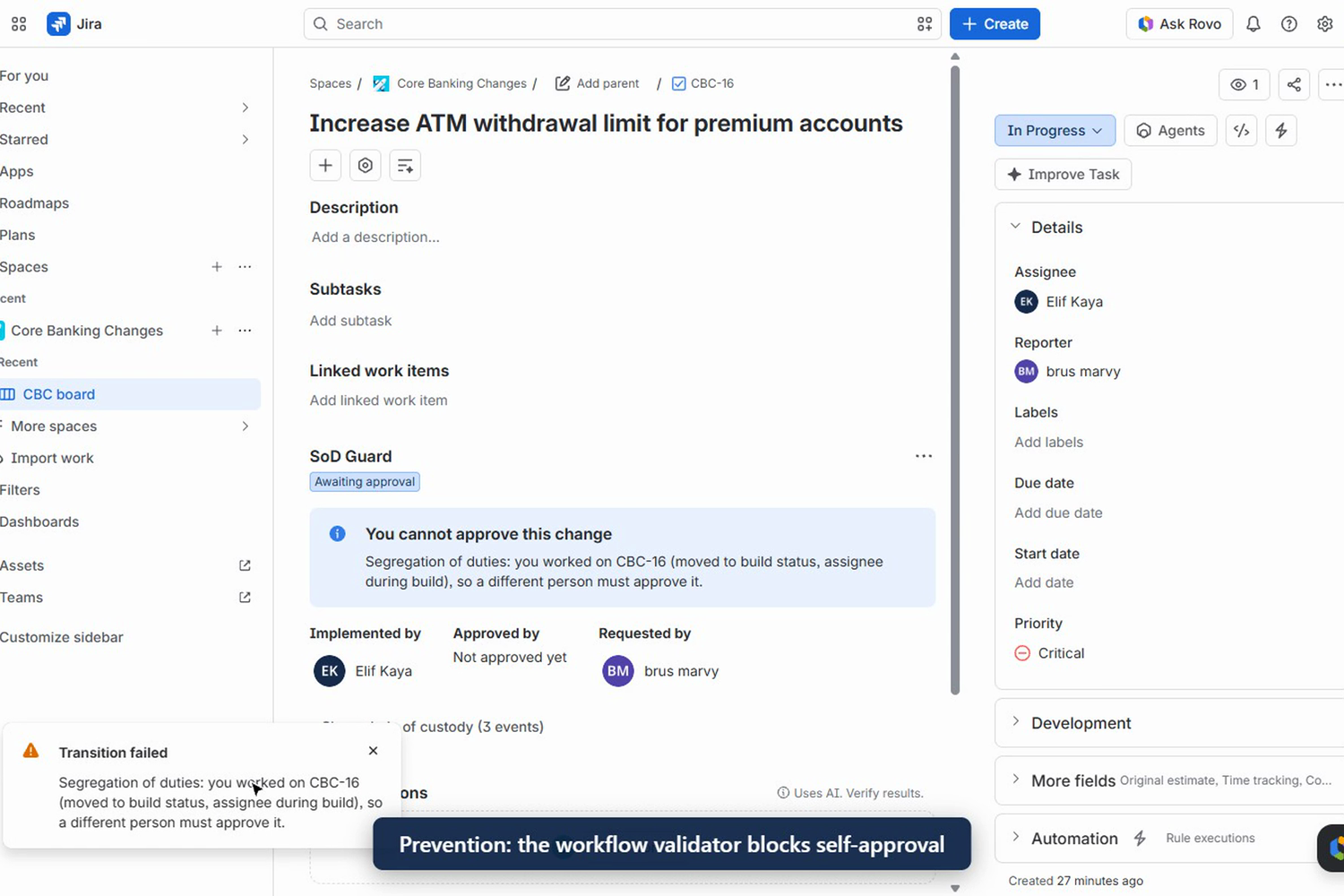
- Prevention, not only detection. A workflow validator ("SoD Guard: block self-approval") can be added to any transition. When an implementer tries to approve their own work, Jira refuses the transition and explains why.
- Configurable policy, zero setup. Out of the box it uses Jira's status categories (In Progress = build, Done = approval), so it works on any site immediately. Admins can choose exact statuses, switch four rules on and off (self-approval, requester approval, no accountable implementer, automated approval), and limit issue types.
- Rovo agent "SoD Auditor". Auditors ask in plain language — "Were there any self-approvals in project CBC in the last 30 days?", "Who implemented and who approved this issue?" — and the agent answers only with facts returned by the app's three actions.
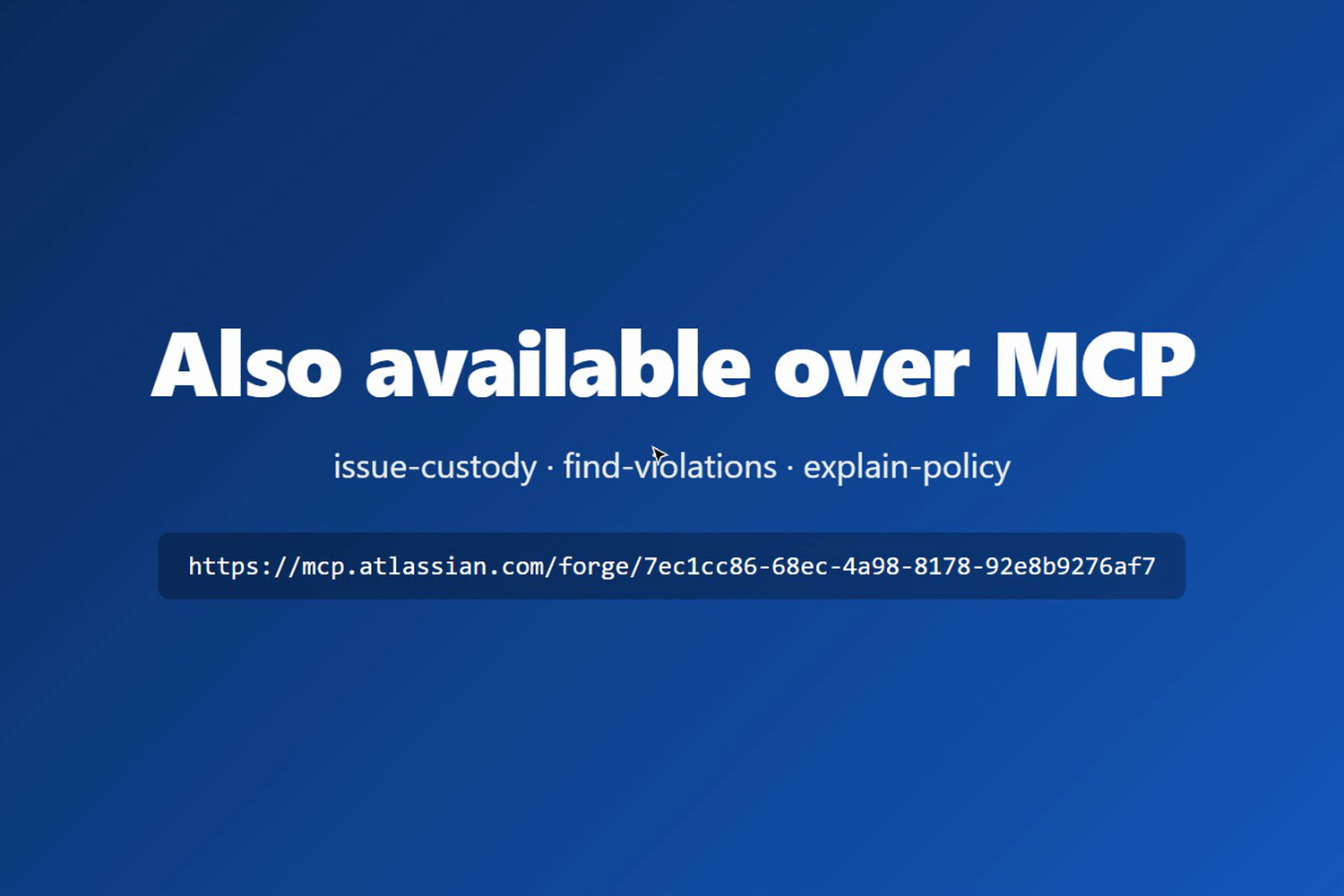
- MCP. The same three actions (
issue-custody,find-violations,explain-policy) are exposed through therovo:mcpmodule, so a compliance team's own AI assistant can query them with each user's Jira permissions.
How we built it
- Forge only, Runs on Atlassian: no egress, no remote backend, no data outside the customer's site. Scopes:
read:jira-work,read:jira-user,storage:app. - Modules:
jira:issuePanel,jira:globalPage,jira:workflowValidator,scheduledTrigger,rovo:agent,rovo:mcp, threeactionmodules, UI Kit front end. - The core is a pure, dependency-free module (
src/sod.js) that replays the changelog — including reconstructing the initial status and assignee, re-opened issues and reassignments made just before approval — and evaluates the policy. The panel, dashboard, validator, scheduled scan, Rovo actions and MCP tools all call the same function, covered by 15 unit tests. - History is loaded with Jira's bulk changelog API filtered to status and assignee, so a 300-issue scan needs a handful of requests.
- User-facing features run
asUser()so nobody sees issues they cannot already see; only the validator and the daily scan run as the app. The validator fails open, so an outage can never freeze a customer's workflow.
Challenges we ran into
- "Who implemented it?" is not a Jira field. Reassigning an issue to someone else just before approving it is the classic way to hide a self-approval, so the implementer has to be derived from the whole history, not the current assignee.
- Jira's changelog only stores changes, so the starting status and assignee must be inferred from the first recorded change.
- Keeping an LLM honest in an audit context: the agent prompt forbids stating anything the actions did not return, treats "pending" as no verdict, and presents findings as evidence rather than accusation.
Accomplishments that we're proud of
It works on a site it has never seen with zero configuration, the same logic drives detection, prevention and the AI agent, and the blocked transition explains itself to the user in one sentence.
What we learned
Rovo actions and MCP tools are the same thing seen from two sides: design the actions as small, factual, permission-aware queries and both the built-in agent and external agents become useful.
What's next
- Teamwork Graph: include pull-request authors and reviewers from Bitbucket/GitHub in the chain of custody.
- Confluence audit pack: publish a signed quarterly evidence page.
- Jira Service Management change requests and approvals as a first-class approval source.
- Marketplace listing.
Built With
- forge
- javascript
- jira
- mcp
- node.js
- rovo
- ui-kit
