-
-
-
-
-
Architecture
-
-
-


Inspiration
I grew up in a small town in India where there was only one school, and quality education, or even a curious adult who could help me explore the world, was a luxury I did not have. Years later, I found myself doing an MBA at one of Europe's top business schools in Barcelona. That contrast never left me.
I kept thinking: what if I had access, even as a child, to someone who could spark my curiosity, introduce me to science, history, space, philosophy, and help me think rather than just memorise? That question became Socratoys.
The technical spark came while exploring Gemini Live APIs for an MBA project on AI-assisted pre-diagnostic tools for Alzheimer's patients. That first voice-interaction experience showed me how powerful and intimate voice AI could be. Around the same time, classmates at my B-school kept asking me: "Where do I even start learning AI?" There was no single platform that could give someone a personalised, conversational path into a subject. I realised the same gap existed for children, at an even more critical stage of life. The best learning companion most kids could have was locked behind access, privilege, and geography.
Socratoys is my attempt to give every child that companion, and to reduce screen time without ever reducing curiosity.
What It Does
Socratoys is a voice-first AI learning companion for children aged 5 to 10. It lives inside a screen-free physical toy with no display, just a natural conversation with a trusted friend.
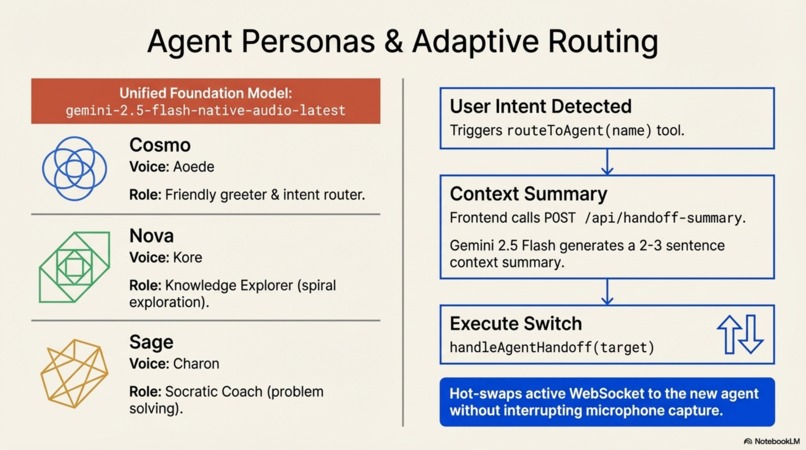
It is powered by three specialised agents:
- Router Agent greets the child warmly, reads their mood and intent, and routes them to the right experience.
- Knowledge Agent explores any topic (science, history, space, philosophy, animals, and more) through stories, open questions, and progressive deep dives. It adapts in real-time to the child's engagement, diving deeper when curious and pivoting to adjacent topics when interest fades, and never just gives answers.
- Brainstorming Agent helps children think through situations (a fight with a sibling, feeling upset at school, a problem they cannot solve) using a Socratic framework: describe the situation, explore feelings, generate options, consider consequences, and arrive at their own next step. The toy guides; it never prescribes.
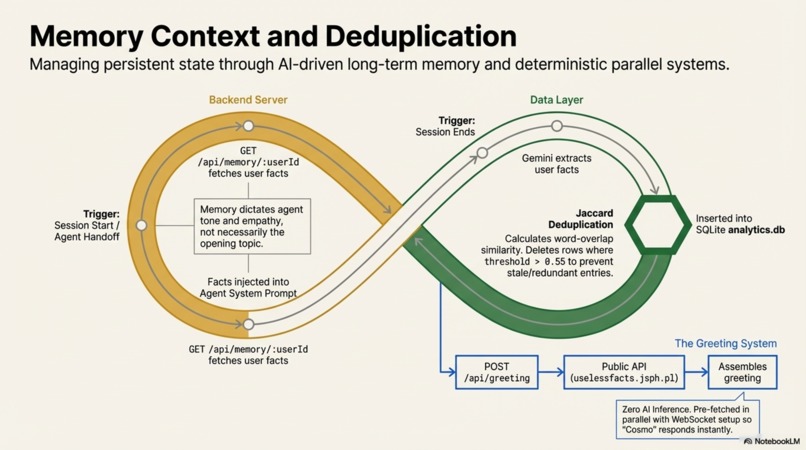
Behind the scenes, parents get a private dashboard that shows their child's interests, thinking and learning patterns, behavioral profiles, topic trends, and sensitive-topic flags, all in plain language and without ever exposing raw conversation transcripts.
How We Built It
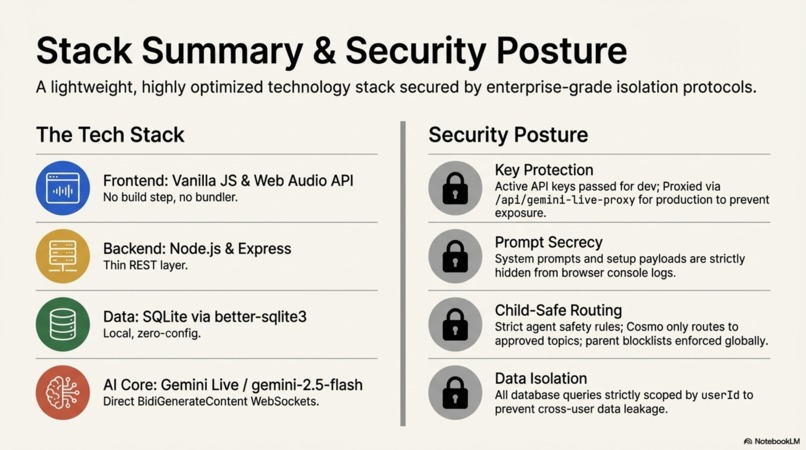
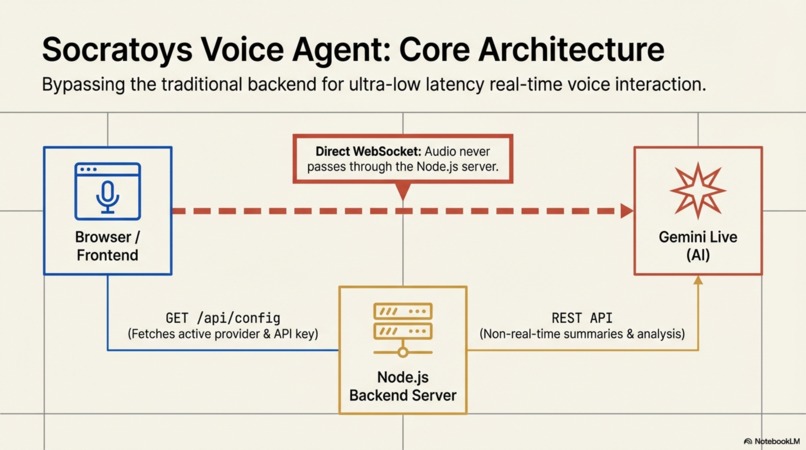
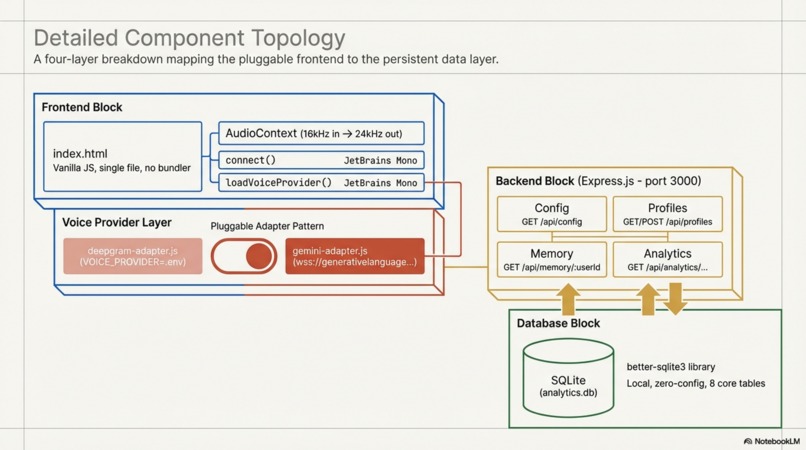
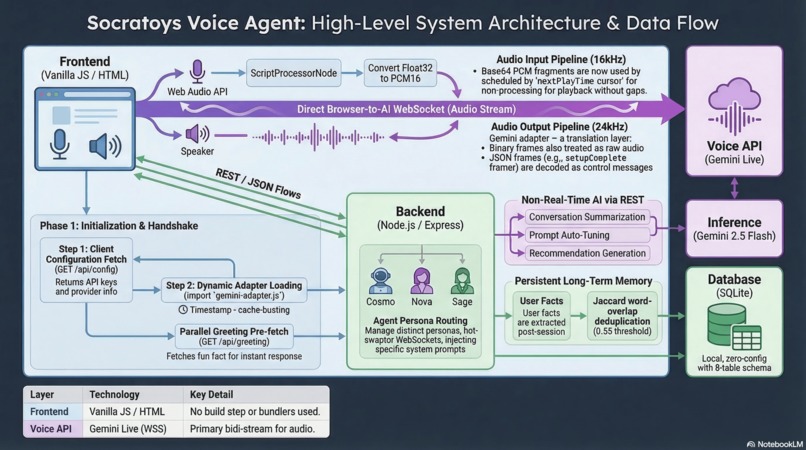
The project was built using Agno as the primary framework for multi-agent orchestration.
Prototyping began with Deepgram's Voice Agent API, which gave a clean starting point for understanding the fundamentals of voice agents for the first time, including inject functions, agent handoffs, context passing between agents, and turn-taking behaviour. Deepgram's documentation was instrumental in making those concepts click quickly.
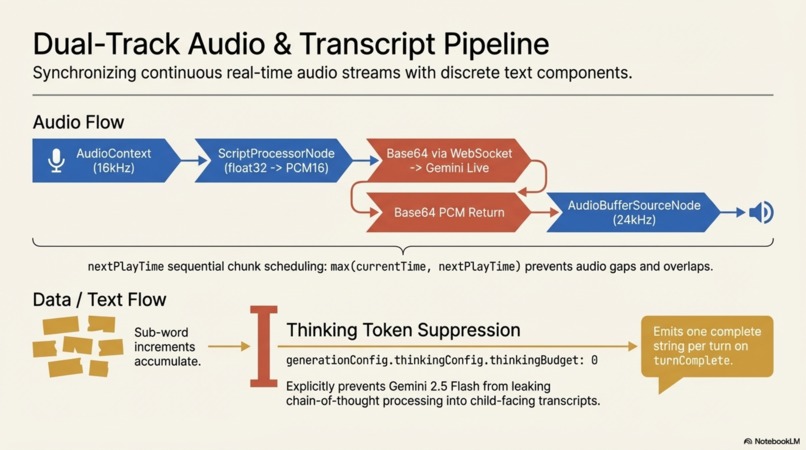
Once the architecture was understood, the system was migrated to Google Cloud's Vertex AI, using available GCP credits to deploy the full agent pipeline. The agents run on GCP, orchestrated via Vertex AI APIs, with carefully crafted system prompts for each agent persona tuned for child-appropriate language, Socratic interaction style, and age-sensitive safety guardrails.
The parent dashboard is a separate lightweight web interface that consumes structured metadata emitted by the agents (topic tags, engagement signals, behavioral pattern flags) and never raw transcripts, surfacing actionable insights in plain language.
Challenges We Ran Into
1. Voice agents were entirely new territory. Understanding how state passes between agents, how handoffs preserve context mid-conversation, and how to structure system prompts that hold up under a child's unpredictable, meandering dialogue took significant research and iteration.
2. Migrating from Deepgram to Vertex AI. There is no 1:1 feature mapping between the two platforms. Re-architecting the agent logic and adapting prompt structures to the Vertex AI framework, while keeping the same child-safe, warm interaction quality, required problem-solving from first principles.
3. Writing prompts that work for children under 10. Standard LLM prompting patterns do not translate to young children. Each agent required careful calibration of vocabulary level, turn length, topic boundaries, and a "never give the answer directly" constraint that still feels natural and encouraging, not robotic.
4. Balancing openness with safety. The Knowledge Agent needs to be wide enough to talk about almost anything a curious child asks, while the Brainstorming Agent must never prescribe solutions. Building reliable sensitive-topic detection that flags genuine concerns without over-triggering on normal childhood emotion was one of the hardest design challenges.
Accomplishments That We're Proud Of
- Built a fully functional multi-agent voice system end-to-end, from routing logic to context-passing to persona design, as a first-time voice agent implementer.
- Designed a Socratic interaction model for children, grounded in educational psychology and child development research, that guides thinking without ever solving problems for the child.
- Created a parent dashboard that translates raw conversation signals into meaningful behavioral, thinking, and learning pattern insights, entirely privacy-preserving with no transcript exposure.
- Successfully migrated a live multi-agent architecture from Deepgram to Vertex AI on GCP, adapting to platform differences without losing interaction quality.
- Designed a system that addresses two problems at once: reducing children's screen time while giving them a richer, more personalised learning experience than any screen-based app.
What We Learned
- How to architect and orchestrate multi-agent voice systems from scratch, covering routing, handoffs, context-passing, and persona design.
- How to write child-appropriate, Socratic system prompts that guide rather than answer, using real frameworks from educational research.
- How Deepgram and Vertex AI differ in their approach to voice agent APIs, and how to adapt an architecture between platforms.
- How to design parent-facing analytics from conversational data, operationalizing concepts like engagement, interest, and thinking patterns into repeatable, machine-detectable signals.
- That the most meaningful products often come from the most personal pain points. This started with a child from a small Indian town who simply wanted someone to help him explore the world.
What's Next for Socratoys
The immediate roadmap includes subject-specific deep-dive agents: when a child shows sustained interest in a domain like philosophy, astronomy, engineering, or art, a dedicated specialist agent is automatically unlocked for them. Parents will be able to manage and customise these agents from the dashboard.
Longer term, the vision is a hardware form factor, a soft, screen-free physical toy with Socratoys running inside it, making the companion tangible, huggable, and present in the child's world rather than just another app.
The ultimate goal is a platform where every child, regardless of where they were born or what school they attend, has a personalised, curiosity-first companion that grows with them.
Socratoys. Know your kid. Grow your kid.
Built With
- bash
- cors
- css3
- deepgram
- docker
- express.js
- gcp
- gcsfuse
- googlesdk
- html5
- javascript
- node.js
- sqlite
- webscokets

Log in or sign up for Devpost to join the conversation.