Inspiration
Most AI tutors are designed to give answers quickly. That is useful, but it can also make learning passive. Students may copy an explanation without truly understanding the idea behind it.
I wanted to build something different: an AI tutor that helps people think, not just receive answers.
That inspired Socratic — an AI learning companion based on the Socratic method. Instead of directly explaining concepts, Socratic guides learners through thoughtful questions, helping them reason step by step and discover understanding on their own.
The goal is simple:
Do not just give learners the answer. Help them build the reasoning that leads to it.
What it does
Socratic is an AI tutor that teaches through questions.
Users can start a learning session by entering any topic or uploading a PDF/document. Socratic then guides the learner with adaptive questions rather than direct answers.
Core features include:
• Topic-based learning sessions
• PDF/document-based tutoring
• Question-first AI tutoring based on the Socratic method
• Adaptive difficulty based on the learner’s responses
• Visual knowledge map
• Concept mastery tracking
• Focus mode
• Voice mode
• Session history
• Exportable session summaries
• Login/register flow
The app’s core identity is:
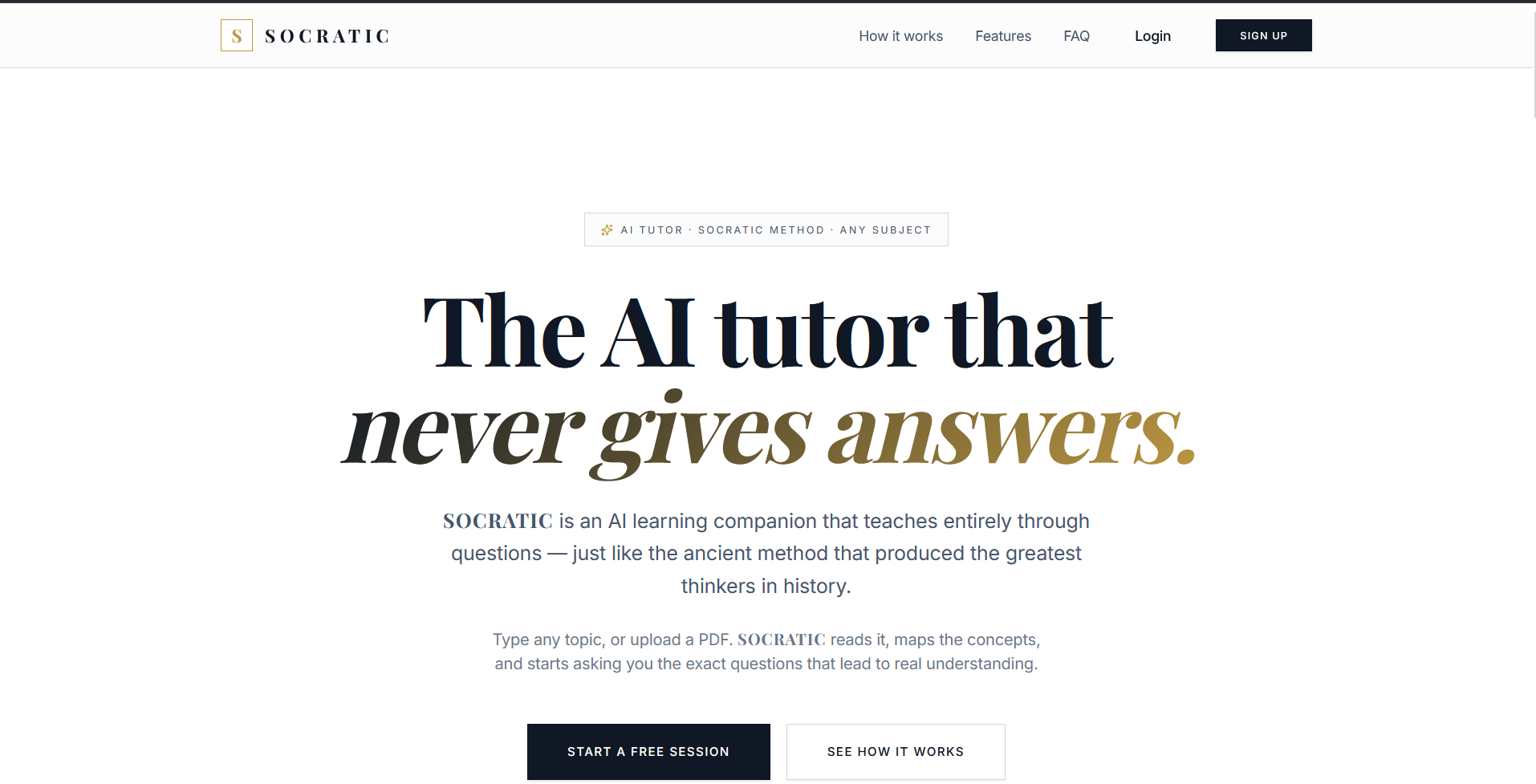
The AI tutor that never gives answers.
Instead of simply explaining gravity, history, programming, or literature, Socratic asks better questions that lead the learner to form their own understanding.
How I built it
I built Socratic using MeDo.
MeDo helped generate the full-stack learning application, including:
• Landing page
• New learning session flow
• Topic input and PDF upload interface
• Socratic conversation experience
• Adaptive tutoring structure
• Visual knowledge map
• Concept mastery states
• Focus mode
• Voice mode
• Session history
• Exportable learning summaries
• Login/register screens
I structured the user journey around active learning:
Choose a topic or upload a PDF
Begin a guided Socratic conversation
Respond to questions
See concepts added to the knowledge map
Track mastery over time
Export a summary for review
This turns the app into a learning companion rather than a simple answer generator.
Challenges
One challenge was making the tutor feel meaningfully different from a normal chatbot. A typical AI assistant tries to answer questions directly, but Socratic needed the opposite behavior: it should guide the learner through questions.
Another challenge was balancing helpfulness with restraint. If the user is stuck, the app should not simply reveal the answer. It should ask a simpler question, provide a hint, or backtrack to a more foundational concept.
A third challenge was making learning progress visible. That is why the app includes a visual knowledge map and mastery states such as introduced, practicing, and mastered. These features help users see their understanding grow over time.
What I learned
This project taught me that great education technology is not always about giving faster answers. Sometimes it is about creating better thinking moments.
I also learned that the Socratic method fits naturally with AI because AI can adapt questions to each learner’s level, topic, and response in real time.
MeDo helped me quickly explore how an educational product could combine conversation, document input, voice, focus mode, mastery tracking, and session export into one learning experience.
Accomplishments that I’m proud of
I’m proud that Socratic has a clear and memorable product identity:
The AI tutor that never gives answers.
The app feels distinct from generic AI education tools because it focuses on active reasoning instead of passive explanation.
I’m also proud of the feature set:
• Socratic questioning
• Any-topic tutoring
• PDF-based learning
• Adaptive difficulty
• Knowledge mapping
• Mastery tracking
• Voice and focus modes
• Session history
• Exportable summaries
Together, these features make Socratic feel like a serious learning companion rather than just another chatbot.
What's next
Future improvements could include:
• More advanced PDF parsing
• Citation-based questions from uploaded documents
• Spaced repetition review
• Personalized learning paths
• Teacher dashboards
• Classroom mode
• Study groups
• Flashcard generation
• Calendar-based review reminders
• Mobile-first voice learning
• More detailed mastery analytics
Long term, Socratic could become a personal reasoning coach for any subject.
Built With
- medo


Log in or sign up for Devpost to join the conversation.