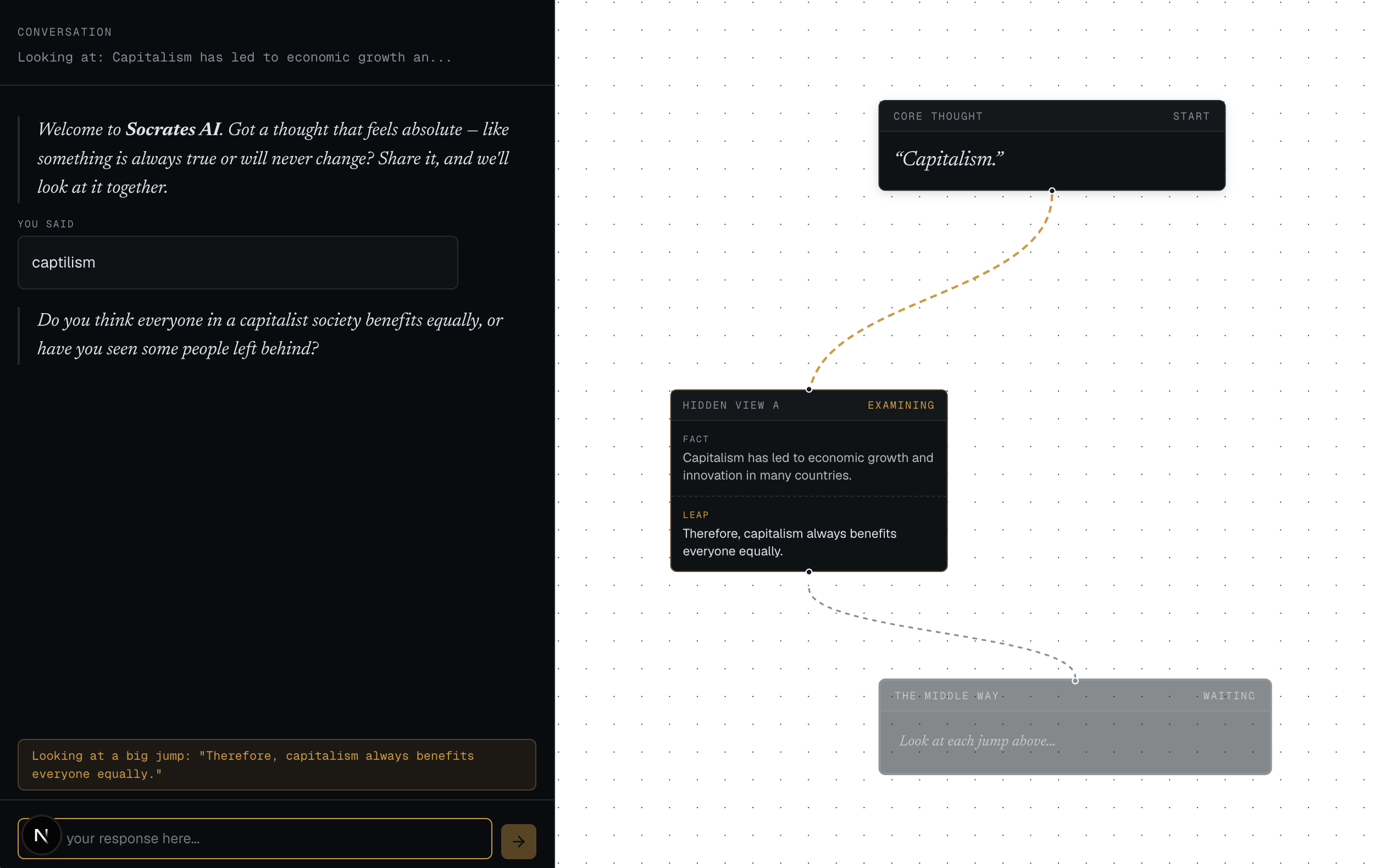
Inspiration I keep seeing this pattern. Someone holds a rigid belief. "I will never be good enough." "Capitalism is pure evil." "My life is over." The exceptions are right there, but they cannot see them. Argue and they dig in harder. Socrates figured this out 2,400 years ago. Do not argue. Ask questions until they find the contradiction themselves. So we built a tool that does that at scale with AI. What it does It is a visual thinking tool. You type in a rigid thought, the AI finds the hidden assumptions underneath it, then walks you through each one in a conversation. As you find exceptions, a live graph shifts from amber to teal. At the end you get a balanced insight. We call it the middle way. No debate or argument. Just questions that help you see your own blind spots. How we built it Next.js 16 app router frontend. OpenAI GPT-5.6 with Structured Outputs for reliable JSON parsing. React Flow for the node graph. Tailwind CSS v4. The AI has three phases. Deconstruct breaks a belief into fact versus leap. Reflect runs a Socratic dialogue per assumption. Synthesize distills into a balanced truth. We built it in about 72 hours for OpenAI Build Week.
Challenges
The hardest part was getting the AI to question without arguing. Default LLM behavior wants to debate and explain, not ask. We rewrote system prompts eight times to kill every trace of lecture tone. Structured Outputs were brittle at first. GPT kept adding extra fields or returning markdown. The progressive node reveal in React Flow took careful state management to avoid visual jumps.
Accomplishments
I am most proud of the fact versus leap card design. Splitting a belief into what is true and where you jumped too far makes cognitive distortions feel tangible. Explaining them never does that. The middle way emergence animation, blur to clear with an ivory glow, genuinely feels like a moment of clarity. We killed every gamification idea we had. Scores, streaks, progress bars, all of it gone. The tool stays quiet and respectful, like a real philosophical conversation.
What we learned
Structured Outputs plus JSON schema is the only reliable way to get AI to follow a format at scale. The Socratic Method maps surprisingly well to a state machine with three phases. Less UI is more. The original spec had five node types. We cut to three: root, assumption, middle way. Design wise, we went with warm ink dark mode and ochre and sage accents instead of the generic AI purple-cyan look.
What is next
Session history so you can track how your thinking shifts over time. Voice input for journaling on the go. A lighter mode for everyday worries versus deep worldview deconstruction. Mobile layout. And eventually custom belief profiles. The AI learns which leaps you tend to make and gets better at spotting them.
Built With
- next.js
- openai-api
- pnpm
- react
- react-flow
- tailwind-css
- typescript
- vercel

Log in or sign up for Devpost to join the conversation.