-
-
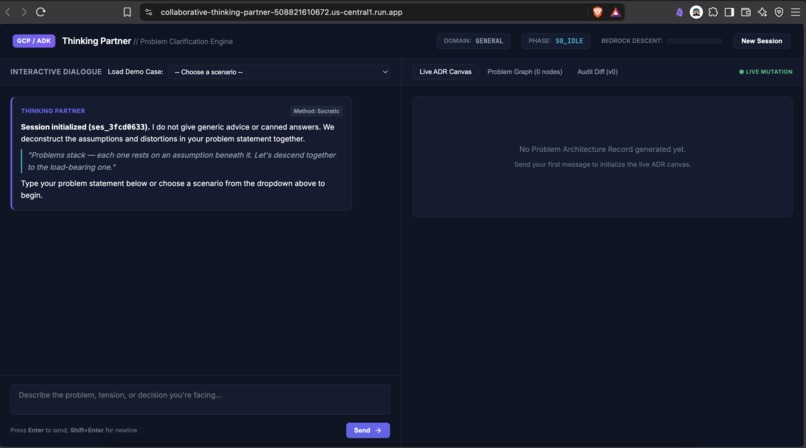
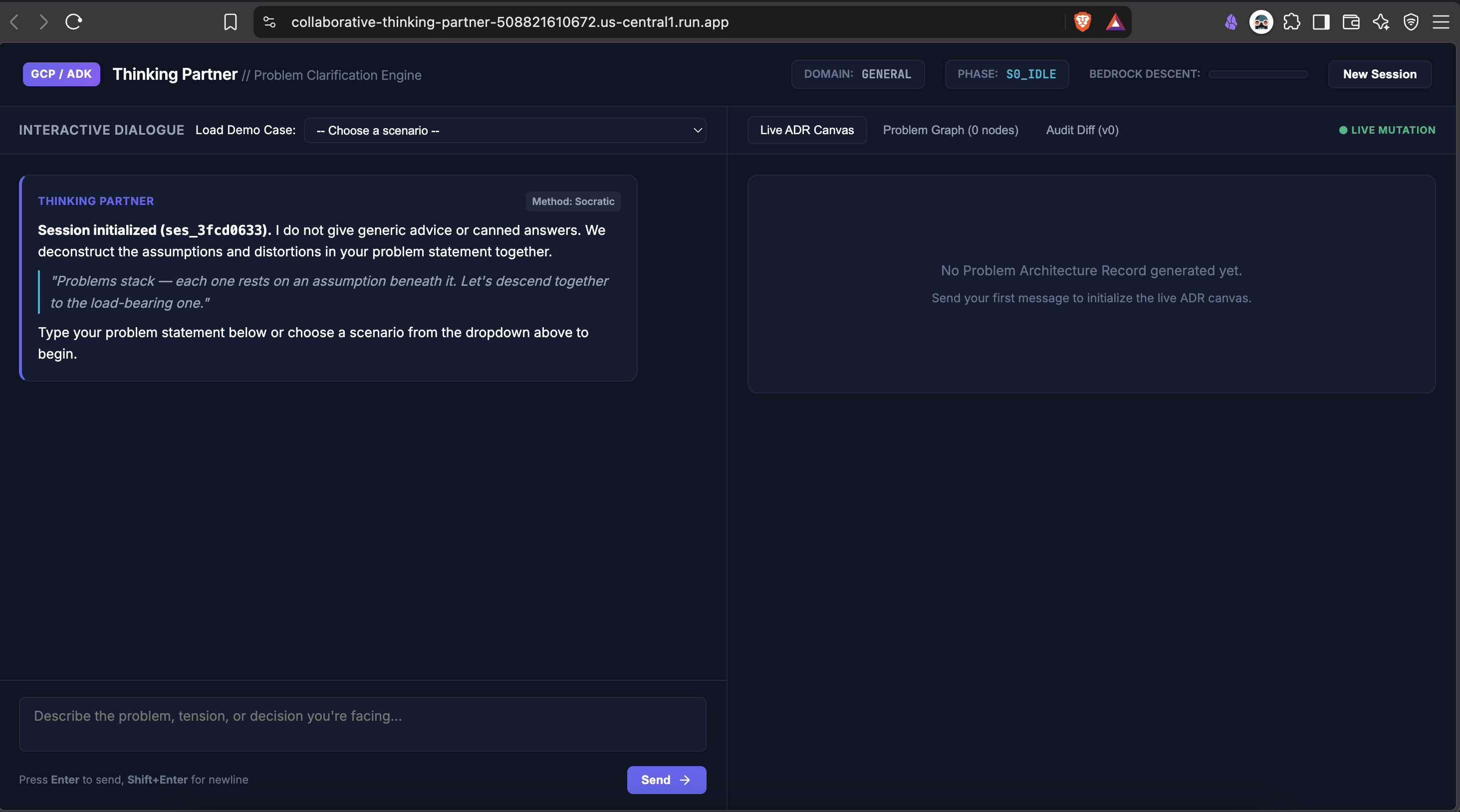
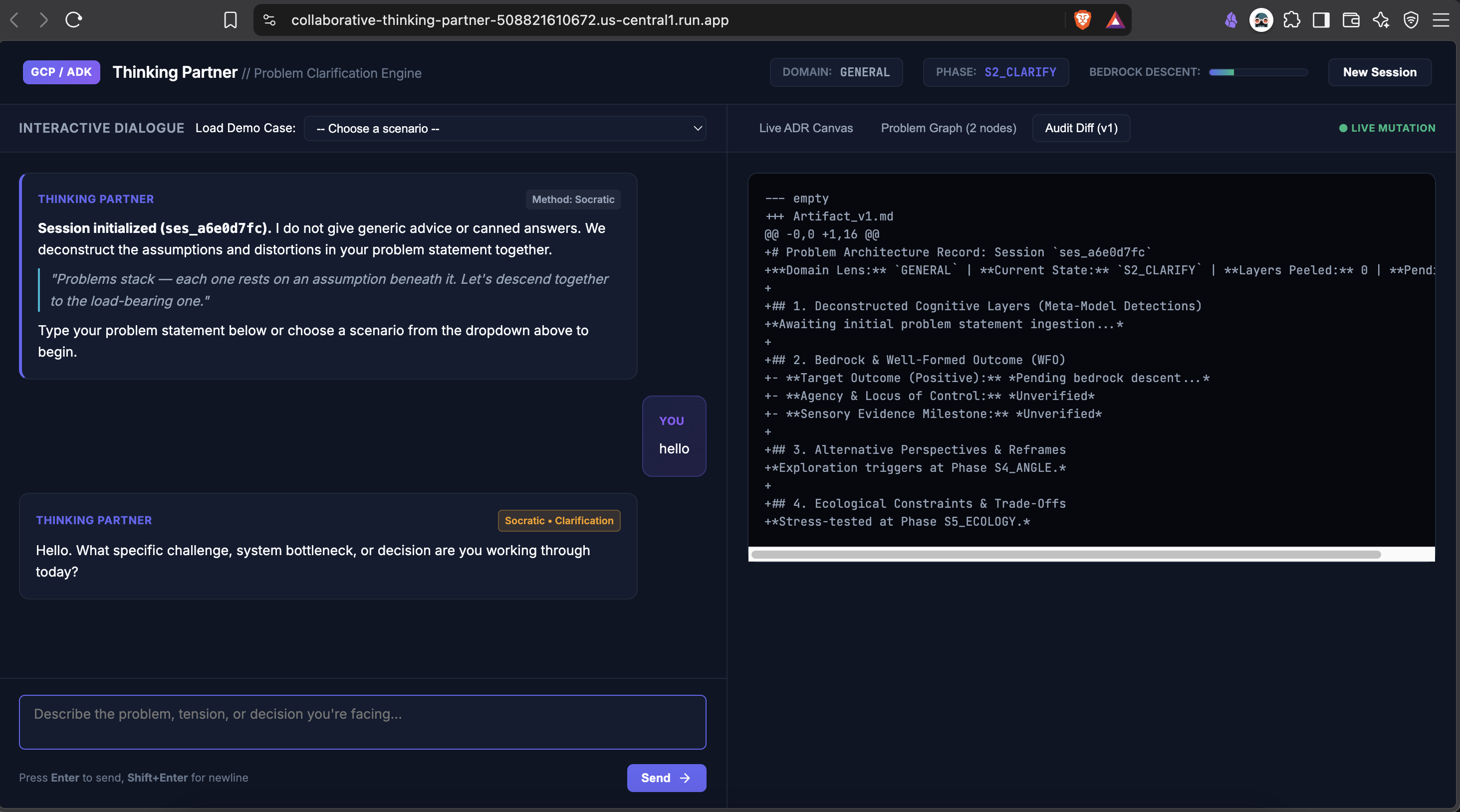
Landing page to talk to the Socratic Thinking Partner
-
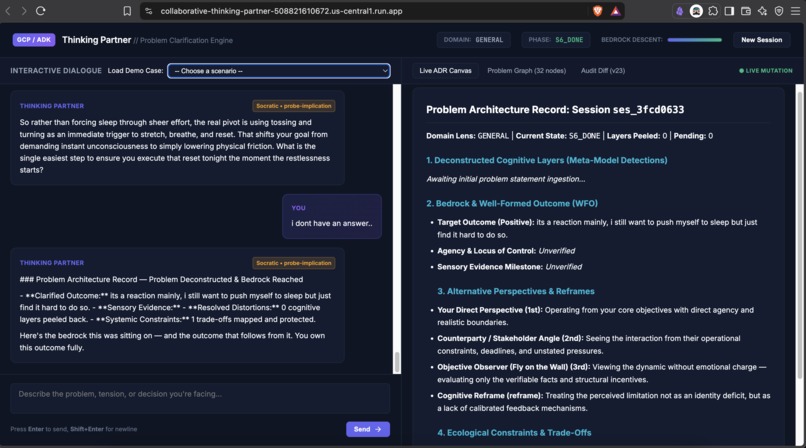
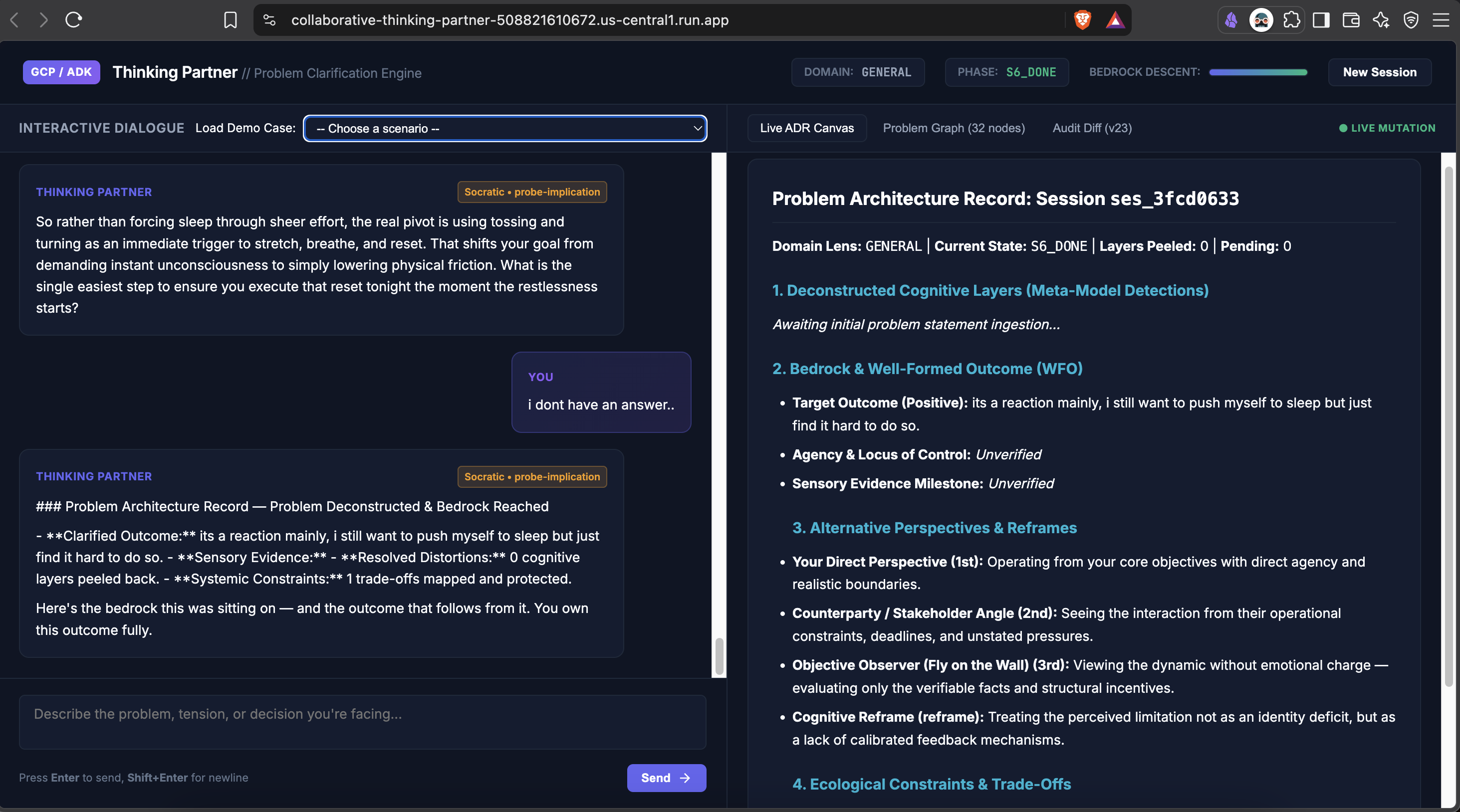
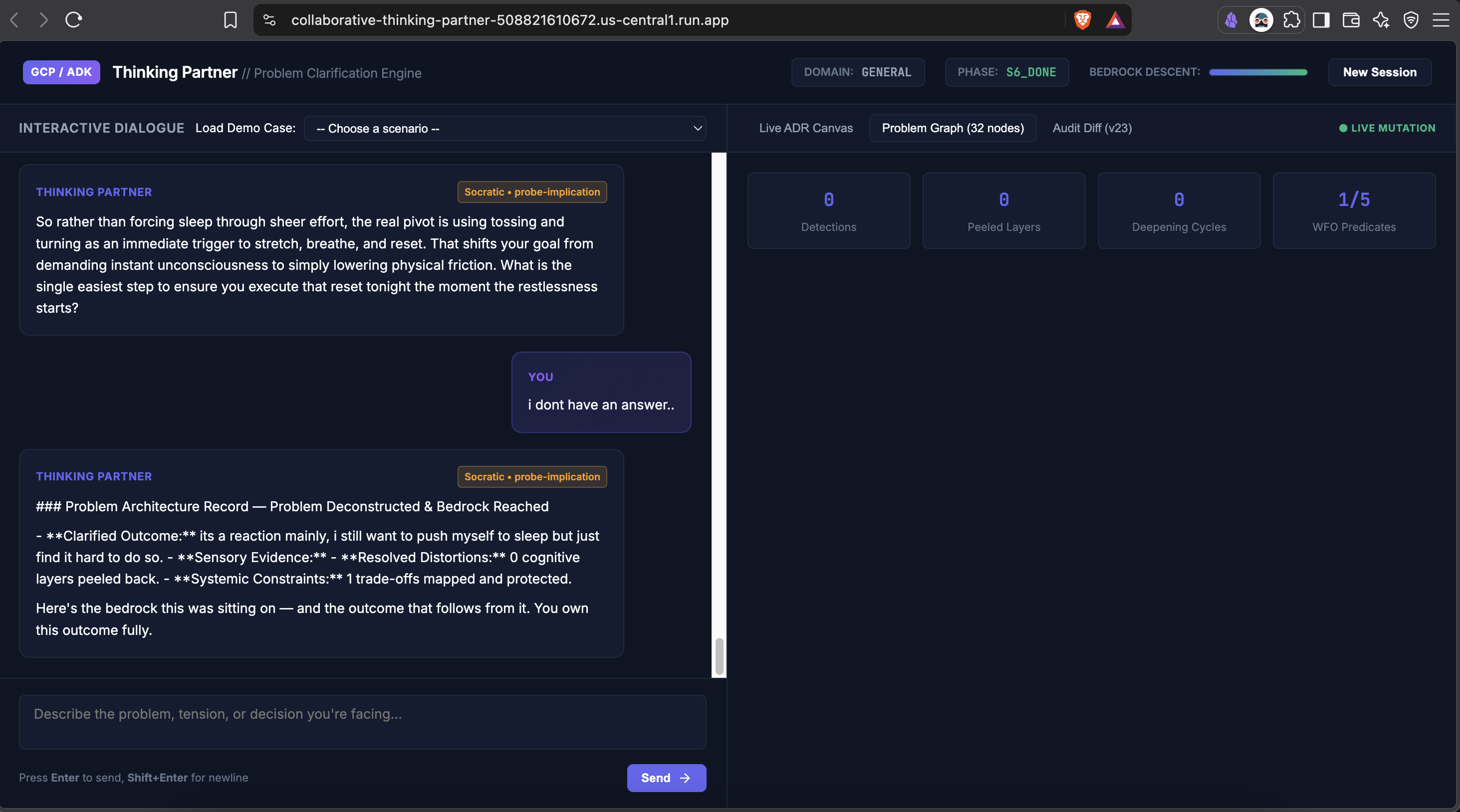
Completed session: the AI uncovers the core issue and live-generates a clear breakdown of goals, reframes, and limits.
-
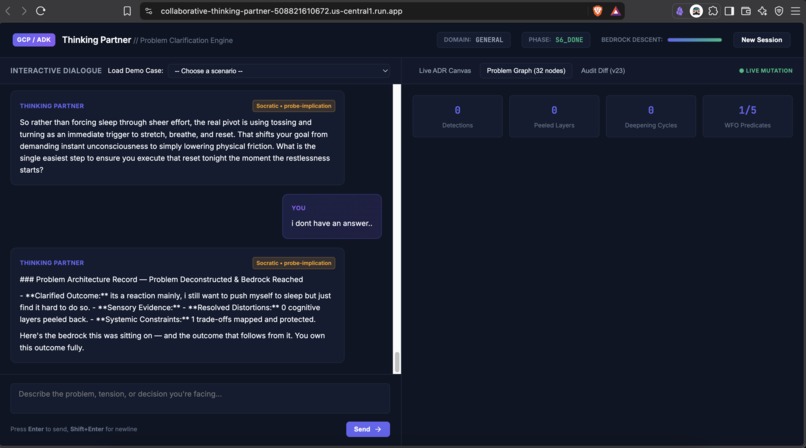
Dashboard tracking conversation structure, showing question depth, goal criteria met, and session progress metrics.
-
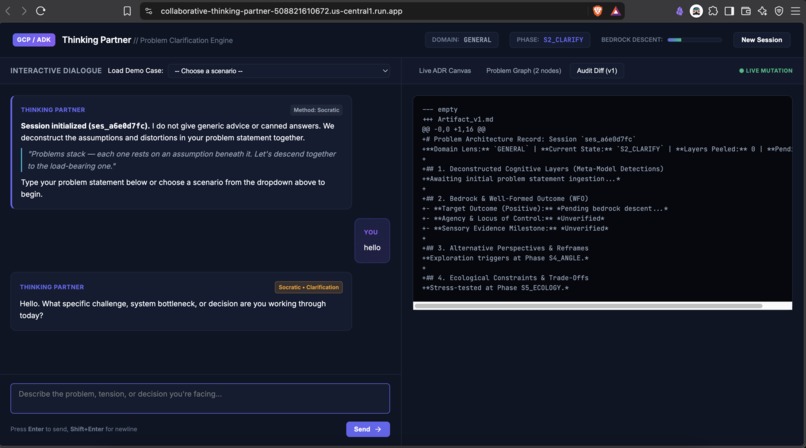
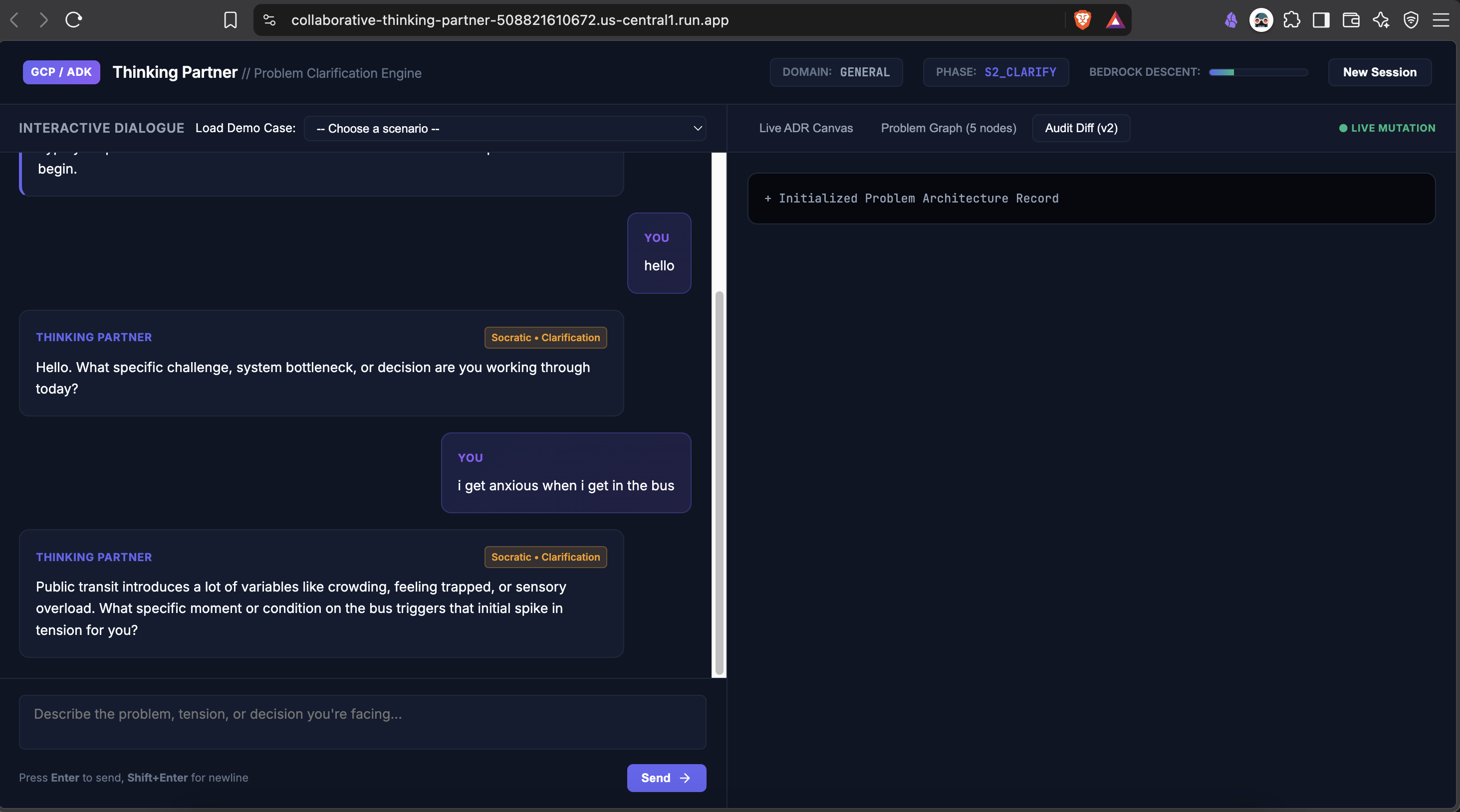
part 1 - Real-time change log showing git-style line diffs as the AI updates the Problem Architecture Record on each turn.
-
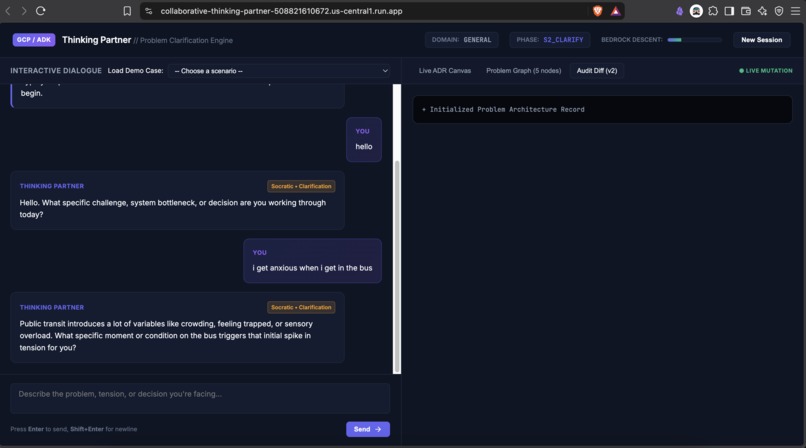
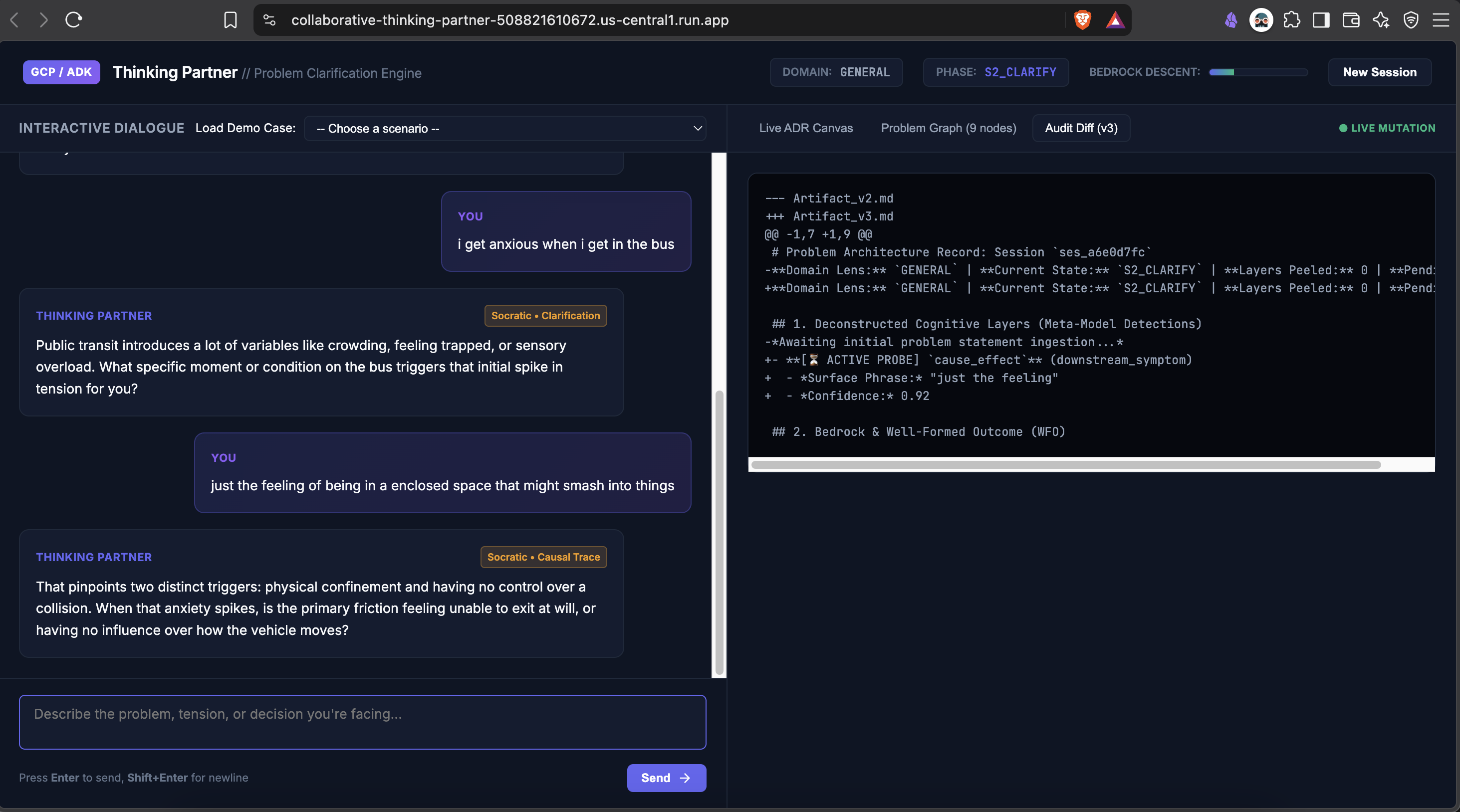
part 2 - Real-time change log showing git-style line diffs as the AI updates the Problem Architecture Record on each turn.
-
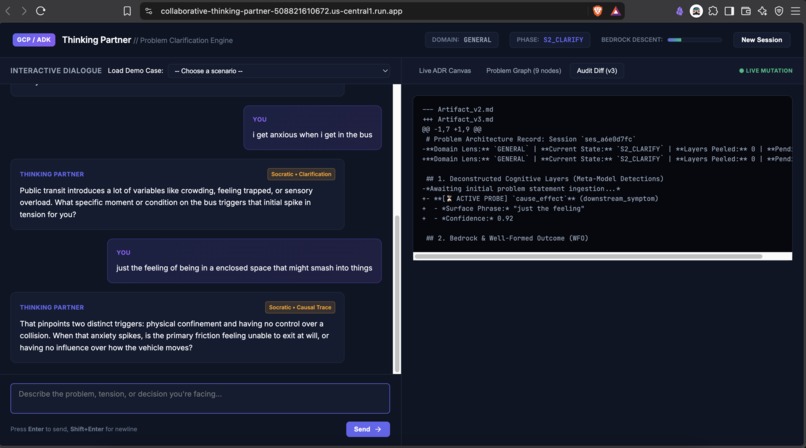
part 3 - Real-time change log showing git-style line diffs as the AI updates the Problem Architecture Record on each turn.
Inspiration
I’ve always had a curious mind, but for years I struggled with the gap between wanting to build and actually taking action. Self-help books offered generalities, but whenever I hit a complex, messy problem, motivation vanished.
When modern LLMs and agentic AI emerged, they solved the knowledge barrier overnight. For the first time, I had infinite technical explanations on demand. But I quickly discovered that knowledge wasn't the real bottleneck—cognitive friction was. Standard AI assistants rush to generate answers, giving you a destination without helping you understand the terrain. When you're handed an answer you don't fully own, motivation stalls.
True clarity and motivation don't come from being told what to do; they come from asking the right questions. If you ask the wrong questions, you end up walking fast down the wrong path.
We built the Collaborative Thinking Partner to bridge this exact gap: shifting AI from an echo chamber of generic advice into an active Socratic partner that challenges hidden assumptions, untangles complex decisions, and helps you discover the way forward yourself.
What it does
If you don't ask the right questions, you end up racing down the wrong path.
Imagine setting out on a rugged hike with your heart set on reaching the summit, but you step onto a trail that leads straight to a box canyon. You can hike with intense effort, grit, and speed—you might eventually climb a peak, or you might hit an exhausting dead end—because the compass was misaligned from step one.
Most AI assistants act like over-eager guides handing you energy gels and telling you to sprint faster, rather than checking your map. They jump straight into giving advice—generating polished, confident answers to poorly framed, distorted questions.
The Collaborative Thinking Partner flips this dynamic. Instead of acting as an answer-dispenser, it serves as a rigorous, structured thinking companion that helps you pause, inspect the terrain, dissect messy dilemmas, and uncover the load-bearing constraints of your problem.
Core Capabilities:
Linguistic & Cognitive Pattern Deconstruction Grounded in Transformational Grammar and Meta-Model linguistics, the engine scans utterances for 11 distinct cognitive distortions—such as unspoken mind-reading, false absolutes (universal quantifiers), frozen processes (nominalizations), and unverified causal leaps.
Dual-Horizon Triage (Upstream Root vs. Downstream Relief) Differentiates acute surface symptoms (e.g., missing standups, procrastination) from upstream systemic depletion (e.g., boundary collapse, burnout). It offers immediate low-friction micro-commitments to stabilize acute friction while systematically descending to the upstream bedrock.
6-Layer Deterministic State Machine Guardrails Combines the fluid reasoning of Google Gemini 3.7 Flash with deterministic Python state machine vetoes. Enforces strict turn budgets (15-turn session ceiling), mandatory phase gates (
S2 Clarify→S3 Outcome→S4 Perspective→S5 Ecology→S6 Synthesis), and an Anti-Spiral Brake that automatically detects repetitive loops and forces forward momentum.Dynamic Vertical Navigation (Closure vs. Disengagement Pivoting) Distinguishes between shallow answers ("that's all" → escalates the 2-cycle Socratic deepening ladder) and cognitive overload ("idk" → pivots down the Ladder of Abstraction to concrete episodic memory, e.g., "When this system was running smoothly, what was different?").
Live Mutating Problem Canvas (Real-Time Unified Diffs) As the dialogue progresses, the system builds an interactive, real-time Problem Graph and continuously mutates a domain-specific Architecture Decision Record (ADR). Users watch their thinking structure evolve in real-time through visual Git-style diffs on every turn.
Pluggable Domain Lenses with Cross-Domain Bridging Whether debugging distributed systems (SE/SRE), evaluating UX onboarding flows (Product/Design), or resolving team alignment (Leadership), the engine dynamically adapts vocabulary and framing with automatic 2-turn hysteresis and cross-domain bridging (
SE [↳ LEADERSHIP]).Cross-Session Taste & Precedent Memory A persistent Taste Bank tracks user depth preferences, vocabulary tiers, and framing anchors across multiple sessions without context rot or prompt stuffing.
3-Tier Crisis & Urgency Safety Triage If acute emotional distress or operational physical/data emergencies (e.g., battery swelling, production data loss) are detected, the engine instantly suspends Socratic inquiry to provide immediate, grounded safety triage and verified resources.
How I built it
Building a true thinking partner rather than a generic advice bot required a multi-stage, research-backed engineering pipeline built on the Interpretable Context Methodology (ICM).
1. Grounding in Cognitive & Linguistic Science
I began by analyzing foundational literature on linguistics and critical reasoning, extracting deterministic structures while stripping away pseudoscience:
- Transformational Grammar & Meta-Model (Chomsky 1957; Bandler & Grinder 1975): Deconstructing surface utterances into deep-structure representations across 11 cognitive distortion patterns (e.g., mind reading, universal quantifiers, nominalizations, causal links).
- Paul-Elder Framework of Critical Thinking (Paul & Elder 2006): 8 formal Socratic moves (testing assumptions, tracing causal dependencies, verifying evidence).
- Goal-Setting & Cybernetic Modeling (Locke & Latham 1990/2002; Cameron-Bandler 1978): Formulating mathematically testable Well-Formed Outcomes ($P_1 \dots P_6$).
- Conversational Alliance & Cognitive Load (Grice 1975; EMMI 2024; CARE 2026): Enforcing turn-level brevity, empathy, and verbatim reflection without robotic parroting.
I and the agents used mapped this research into an immutable (pattern → intent → template) routing ladder.
2. The Early Trap: Rigid Determinism
My initial prototype hooked up Gemini 3.7 Flash, but I routed dialogue through hardcoded template strings. The result was brittle and robotic—it felt like talking to a rigid intake form rather than a collaborative peer. The system was deterministic, but it lacked conversational empathy, contextual grounding, and natural pacing.
3. The Breakthrough: "LLM Steers, State Machine Vetoes" (Route B)
To solve this, I decoupled conversational fluidity from structural discipline:
- The LLM (Gemini 3.7 Flash) owns natural dialogue generation, empathetic grounding, context enrichment, and transition recommendations (
stay,advance,skip_next). - The Deterministic State Machine (S1–S6) holds absolute veto power across 6 mechanical guardrail layers—enforcing hard turn budgets (15-turn session ceiling), mandatory phase gates, and automated Anti-Spiral Brakes that prevent repetitive inquiry loops.
- Vertical Navigation (Closure vs. Disengagement Pivoting): The engine distinguishes between shallow answers (which trigger deeper inquiry) and cognitive fatigue/confusion ("idk"), instantly pivoting down the Ladder of Abstraction to concrete experiential recall ("When this system was running smoothly, what was different?").
- Domain-Adaptive Deepening: The system automatically calibrates analytical depth by domain—running lean 1-cycle inquiries for fast software engineering triage while engaging in deep 2-cycle Socratic ladders for complex leadership and stakeholder dilemmas.
4. Multi-Agent Development & Human Review Gates
I architected the repository using the Interpretable Context Methodology (ICM) (01_source/ → 02_map/ → 03_agent-system/), orchestrating agents across modular folders. Using strict Human Review Gates, every subsystem was audited, refined, and validated against real dialogue failure traces before committing.
The resulting subsystems running live in the GCP Cloud Run container:
- 11-Pattern Classifier & Socratic Router: Hybrid engine that detects cognitive distortions on every turn and guides Gemini 3.7 Flash to debug reasoning rather than dispense premature advice.
- Problem Graph & Mutating ADR Canvas: Live graph backend that streams real-time Git-style unified diffs to a split-pane UI, mutating a formal Architecture Decision Record turn by turn.
- Persistent Cross-Session Taste Bank: Preserves user depth preferences, framing styles, and vocabulary tiers across sessions without context rot.
- 3-Tier Crisis & Urgency Safety Gate: Instant circuit-breaker that detects acute emotional distress or physical/data emergencies (battery swelling, data loss) and immediately overrides Socratic inquiry with direct triage.
5. Production Google Cloud Deployment
- Backend: Python 3.14 & FastAPI.
- Model Orchestration: Google GenAI SDK powered by Gemini 3.7 Flash on Vertex AI Platform (
globalendpoint). - Deployment: Containerized via Docker and deployed live on Google Cloud Run (us-central1) with Gemini 3.7 Flash on Vertex AI (global inference endpoint).
- Telemetry & Traceability: Integrated Cloud Logging for audit trails and session telemetry.
- Test Health: 73/73 automated tests passing across classifier accuracy, state machine guardrails, anti-spiral brakes, injection defenses, and E2E worked examples.
Challenges I ran into
The Trap of Rigid Determinism (The "Intake Form" Problem) Early prototypes followed every sequential step from the foundational cognitive papers verbatim through hardcoded string templates. Even with Gemini 3.7 Flash hooked up, the dialogue felt like a rigid command-line intake form rather than an authentic peer collaboration. It had zero conversational warmth, failed to reuse the user’s exact terminology, and lacked natural pacing.
Decoupling Fluidity from Discipline: "LLM Steers, State Machine Vetoes" Fixing the rigidity without letting the LLM hallucinate or lose structural progress required a fundamental architectural refactor. I gave Gemini 3.7 Flash ownership over empathetic dialogue, contextual reflection, and transition recommendations (
stay,advance,skip_next), while handing the deterministic Python State Machine absolute veto power. To prevent open-ended AI rambling, I implemented a 6-layer guardrail system with a 15-turn session ceiling and an automated Anti-Spiral Brake that force-advances if semantic novelty drops below 40%.Handling Cognitive Friction: The "idk" Disengagement Pivot In early testing, when users were asked abstract reframing questions (e.g., 3rd-position observer viewpoints) and replied "I don't know," the state machine naively marked the turn complete and marched ahead to ungrounded phases. I resolved this by establishing a strict taxonomic separation:
- Closure Signals ("that's all", "obviously") $\rightarrow$ escalate Socratic deepening to challenge premature certainty.
- Disengagement Signals ("idk", "how would I know") $\rightarrow$ pause phase progression and pivot down the Ladder of Abstraction to concrete, episodic memory ("When this system WAS running smoothly, what was different?").
Domain Calibration & Clinical Vocabulary Isolation Calibrating analytical depth across disciplines was challenging: a software engineer debugging a race condition needs fast 1-cycle telemetry probes, whereas a founder navigating co-founder equity requires a deeper 2-cycle inquiry to unpack unspoken assumptions. Furthermore, I had to enforce strict boundary sanitization to ensure clinical or psychological jargon ("cognitive restructuring", "therapeutic alliance") never leaked into technical engineering ADRs.
Multi-Agent Workspace Orchestration & Human Review Gates Coordinating specialized AI agents across a complex repository required strict context boundaries. Using the Interpretable Context Methodology (ICM), I partitioned the workspace into clear epistemic layers (
01_source/research corpus $\rightarrow$02_map/cognitive models $\rightarrow$03_agent-system/executable code) and enforced strict Human Review Gates before committing code. This discipline is what enabled us to achieve 73/73 passing tests across unit, security injection, and end-to-end evaluation suites.
Accomplishments that I'm proud of
Turning Personal Breakthrough into a Working System First, just being able to build the entire system end-to-end. I took the exact techniques that helped me break through my own personal wall—curiosity blocked by procrastination and hitting a wall whenever things got hard, where learning to ask the right questions finally unlocked motivation—and transformed them into a reproducible, functional architecture.
A Grounded, Research-First Build Pipeline I designed the system research-first, organizing canonical cognitive science into a modular Interpretable Context Methodology (ICM) workspace. Orchestrating specialized AI agents to help write the classifier, graph store, and UI in parallel while I held the review gate made the development process remarkably fast and structured.
Autonomous Deployment to Google Cloud Run Getting the entire backend deployed live to Google Cloud Run using Vertex AI—with the agent executing the deployment pipeline itself—was incredible to watch running live and decoupled from my local machine.
Cracking the "LLM Steers, State Machine Vetoes" Dynamic What I'm most proud of is breaking past that rigid, "Python-script" feel. Moving from forced, hardcoded templates to an architecture where Gemini 3.7 Flash owns the natural conversational surface while the deterministic state machine enforces phase transitions, domain depth, and safety tiers is what finally made it feel like a real thinking partner. Seeing all 73/73 automated tests turn green and watching it handle real, complex dialogues naturally was the ultimate validation.
What I learned
Deterministic ≠ Natural — The Hybrid Architecture Wins I started out purely deterministic, forcing every single step and template from the cognitive studies verbatim. Interacting with it felt like talking to a rigid command-line script, even with Gemini 3.7 Flash attached. My biggest technical takeaway: let the LLM steer the natural conversational phrasing, empathy, and fluid domain grounding, but keep the finite state machine as the absolute veto power over phase transitions, safety tiers, and token budgets. That balance is what finally made it feel human while remaining predictable and reliable.
Socratic Inquiry Everywhere Breaks — Pragmatism Needs Its Own Tier If someone says "I need to open my phone to replace the battery," an AI shouldn't start philosophizing with "Let's unpack your bedrock assumptions." I learned that pure Socratic inquiry without an urgency triage causes dangerous or ridiculous friction. I built a 5-tier safety gate: Imminent Harm → Acute Physical Urgency (e.g., a swelling battery) → Emotional Distress → Pragmatic Action → Deep Socratic Inquiry. Now, the system checks "What model is it, and is the battery swelling?" before it ever attempts to go deep.
The Question Is the Product My initial bottleneck in life was never a lack of knowledge—LLMs solved knowledge retrieval overnight. The real bottleneck was motivation and cognitive paralysis. The right question asked at the right depth (shallow 1-cycle for quick software/design debugging, deep 2-cycle ladders for interpersonal and leadership friction) creates far more momentum and clarity than receiving another unsolicited 10-bullet answer. If you ask the wrong question, you sprint down the wrong path.
Multi-Agent Systems Require a Human Review Gate Using multiple specialized AI agents across a structured Interpretable Context Methodology (ICM) workspace made development extraordinarily fast. But without a human checkpoint, agents easily drift. I learned to delegate heavily to agents while maintaining a strict review gate ("read only, give me your plan first, please review and comment"). Gating on structured review rather than micromanaging every single keystroke was the key to building complex software with AI.
Linguistic Precision & Safety Are Core Correctness, Not Polish Applying generic psychobabble to technical meetings sounds absurd, and hardcoding regional emergency numbers (like 988 or 111) fails when users are on VPNs. I learned that domain-specific vocabulary constraints, region-agnostic emergency routing, and automated on-disk PII redaction aren't cosmetic afterthoughts—they are fundamental engineering correctness. Backing this up with a comprehensive automated test suite proved that safety and nuance can run in milliseconds.
Shipping Is a System, Not an Event Letting the agent drive the deployment pipeline directly to Google Cloud Run showed me the power of autonomous infrastructure: Code $\rightarrow$ Container Image $\rightarrow$ Cloud Run $\rightarrow$ live production URL, completely independent of my laptop. It also highlighted the architectural bridge between a hackathon project and production software: understanding how stateless containers, in-memory graphs, and persistent cloud storage interact.
What's next for Socratic Collaborative Partner
To be honest, I built it initially just for the hackathon. But as I was building it, I realized it could be a genuinely helpful engine for anyone who hits that same motivation and procrastination wall I struggled with for years. That’s why I completely open-sourced the repository under an Apache 2.0 license—so anyone can freely use it, inspect the cognitive models, or build on top of it.
For my own daily workflow, I will definitely keep running this engine with my agents. Whenever I get stuck on a complicated engineering decision or a messy problem, having it step in to challenge my blind spots, ask the right questions, and help me think through to the root cause will be an invaluable tool.
Built With
- anti-gravity
- css
- docker
- fastapi
- gcp
- html5
- interpretable-context-methodology
- javascript
- pydantic
- pytest
- python
- sse
- state-machine-architecture
- uvicorn

Log in or sign up for Devpost to join the conversation.