-
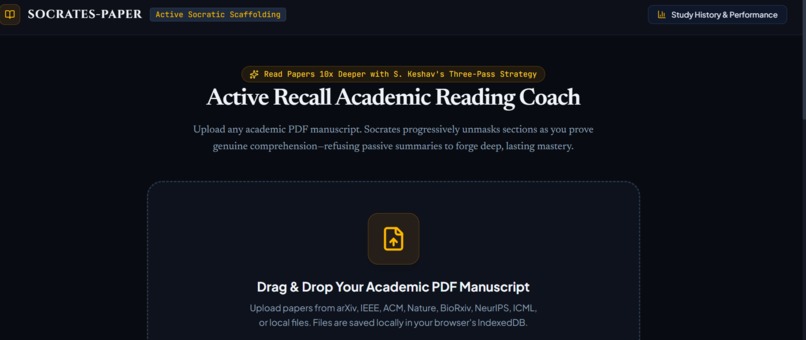
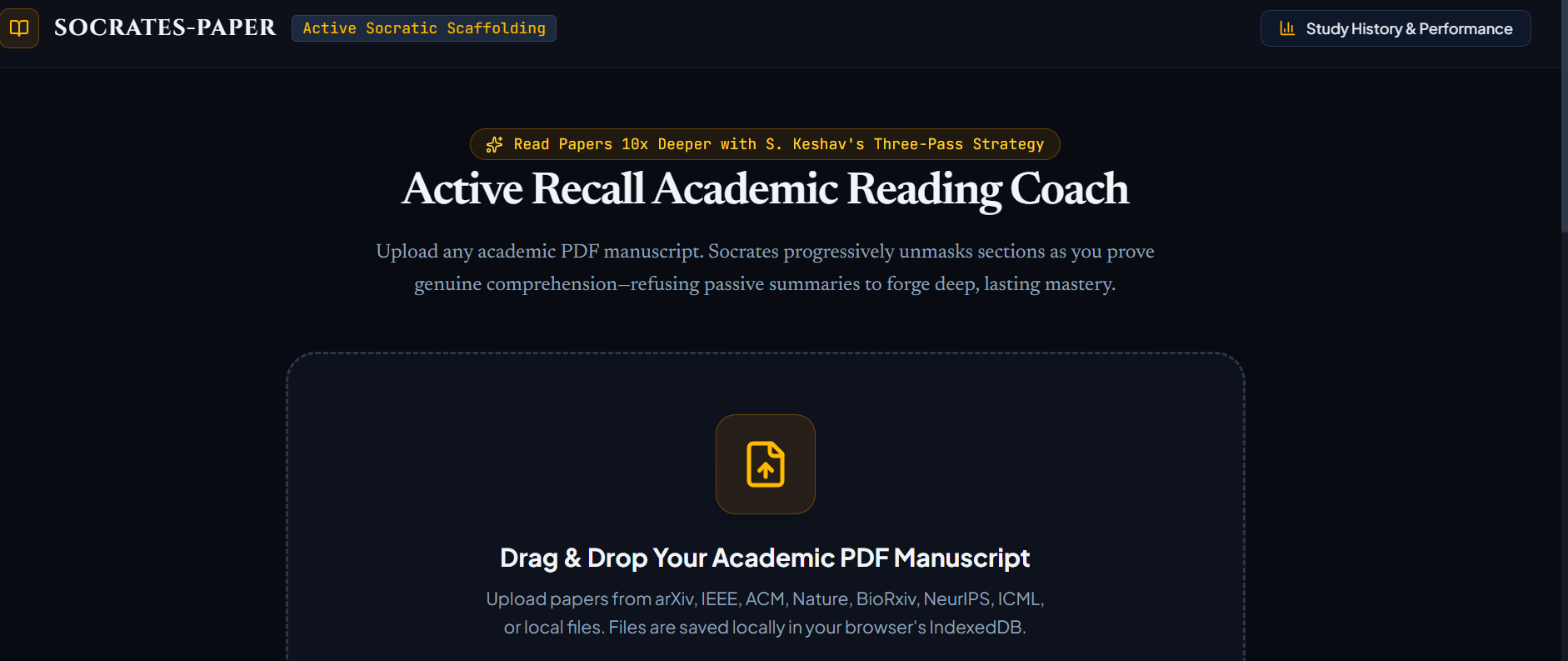
The frontpage of the tool.
Inspiration
Reading academic research papers is fundamental to scientific progress, yet most readers engage in passive skimming. The surge of LLM-based paper summarizers has worsened this problem: users rely on quick summaries, creating an illusion of understanding while missing key methodologies, assumptions, and critical data.
We were inspired by S. Keshav’s classic "Three-Pass Method" to flip the standard AI paradigm. Instead of using AI to summarize papers for the user, we wanted to build a coach that forces active recall, blurring locked sections of a PDF and requiring the user to explain key concepts step-by-step before unmasking the next layer.
What it does
SocratesPDF transforms passive paper reading into an interactive, step-by-step learning workbench using a dual-panel interface.
How we built it
We used this method: PDF Scaffolding Engine: We used Dockerized GROBID to parse PDF structures and extract exact coordinate bounding boxes $(x, y, w, h)$ for headings, abstracts, figures, and formulas. Using PyMuPDF (fitz), we programmatically apply Gaussian blur masks to specific structural regions based on the current reading pass.
Socratic AI Companion: Built on Google AI Studio using the Gemini 1.5 Pro API (google-genai SDK), our system operates under strict Socratic system instructions. It enforces Keshav's 3-Pass sequence:Pass 1 (Bird's-Eye View): Validates the "5 Cs" (Category, Context, Correctness, Contributions, Clarity) using only unmasked headings and abstracts.Pass 2 (Visual Grasp): Unmasks figures and tables, testing data trends and system architecture interpretation.Pass 3 (Deep Re-Implementation): Unmasks full mathematical derivations, challenging the user to spot edge cases and underlying assumptions.
Jailbreak-Proof Guardrails: If a user tries to force the LLM to give away answers or summaries, Gemini triggers fallback modes like Locational Pointers or Spot-the-Error challenges to keep the user engaged.
Challenges we ran into
Coordinate-Level Parsing: Academic papers vary wildly in structure (single-column, double-column, IEEE, ACM, ArXiv). Mapping dynamic text coordinates across layout formats to apply clean CSS/image blur masks required extensive tuning of GROBID TEI-XML parsers.Preventing AI "Spoilers": LLMs are inherently fine-tuned to be helpful assistants that answer questions directly. Designing a system instruction that strictly forces Gemini to maintain a Socratic stance (refusing direct answers even under user pressure) required low temperature sampling ($T = 0.15$) and rigid JSON evaluation schemas.
Accomplishments that we're proud of
Built a Zero-Spoiler Socratic AI: Engineered system instructions for Gemini 1.5 Pro that reliably resist prompt injections and direct demands for summaries, keeping the AI locked in an active coaching role.
Precise Spatial PDF Scaffolding: Successfully integrated Dockerized GROBID with PyMuPDF to extract structural coordinate bounding boxes $(x, y, w, h)$, enabling dynamic, section-by-section PDF blurring across diverse two-column layout templates (IEEE, ACM, ArXiv).
Frictionless Dual-Panel UX: Created a synchronized dual-viewport interface where the Socratic chat companion directly triggers section unmasking events on the PDF rendering canvas in real time.
Pedagogically Sound Scaffolding: Successfully adapted Keshav’s classic "Three-Pass Method" into a functional, automated active recall loop that shifts paper reading from passive skimming to proven step-by-step comprehension.
What we learned
We learned that active recall in AI-assisted education is vastly more effective than automated summarization. By combining spatial document parsing with Socratic prompting, we demonstrated that generative AI can be engineered as an active pedagogical coach rather than a passive shortcut.
What's next for SocratesPDF
Browser Extension for Web-Native Papers: Expand beyond static PDFs by building a browser extension that dynamically injects visual scaffolding overlays directly onto HTML-native paper platforms like Distill.pub, arXiv HTML, and open research blogs.
Institutional & Group Study Rooms: Introduce collaborative reading workspaces where professors or research group leaders can set target scaffolded passes for students and review aggregated comprehension heatmaps.
Adaptive Difficulty & Personalized Hints: Implement an adaptive student model that learns a user's background knowledge over time, offering deeper mathematical scaffolding for beginners while fast-tracking experienced researchers to Pass 3.
Multi-Modal Socratic Dialogue: Leverage Gemini’s native vision capabilities to let users draw or highlight directly on figures and equations during Pass 2 and Pass 3 check-ins.