-
-
-
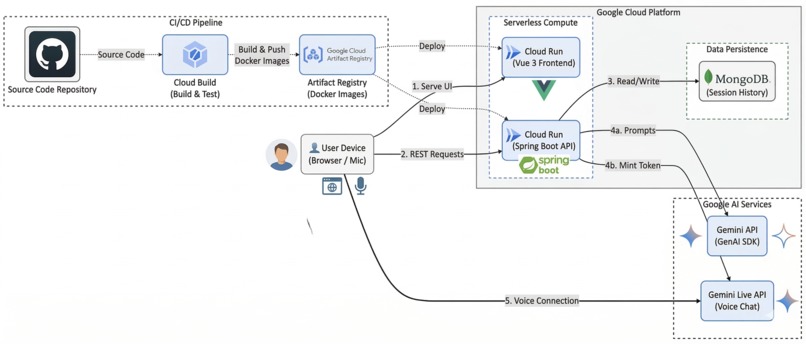
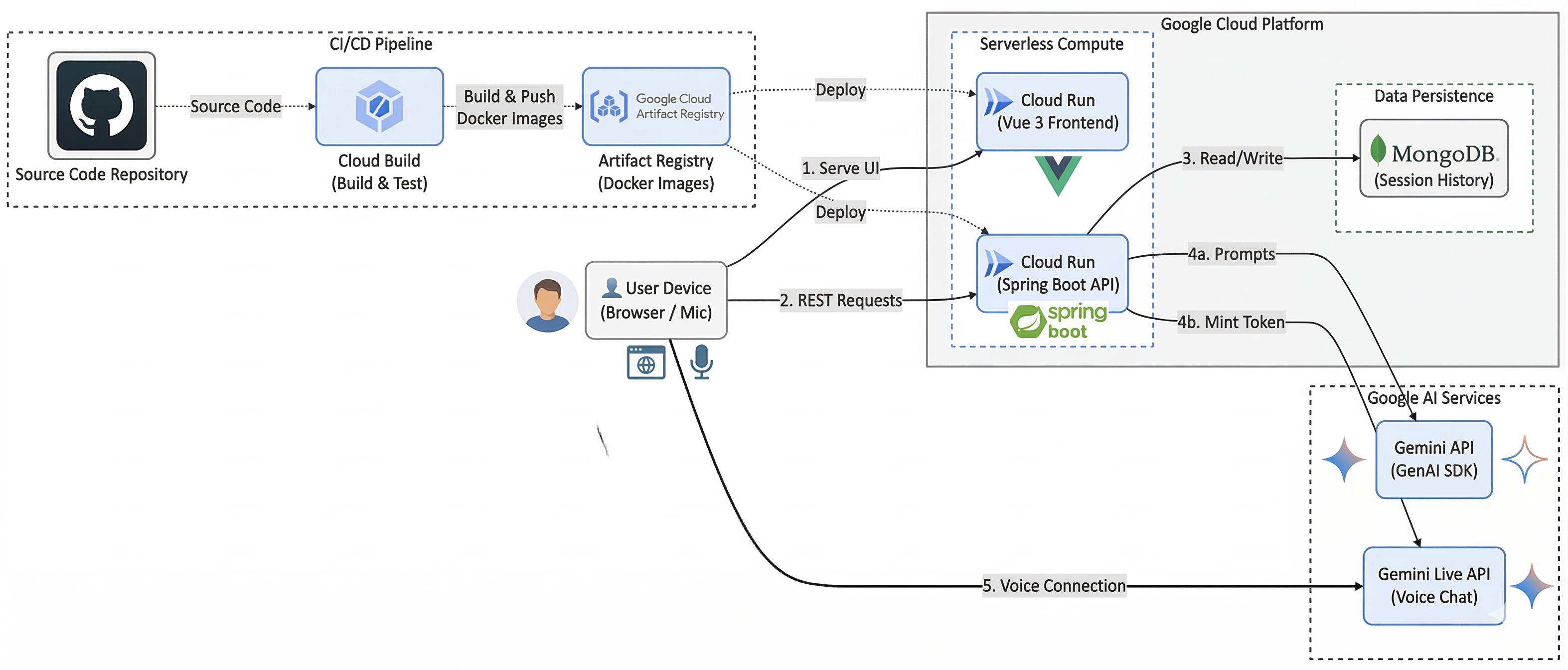
GCP Architecture and Gemini Live Interactions
Inspiration
Socratica was inspired by a problem that many students, professionals, and educators face: most learning today is either passive or solitary. When people study alone, they often fall into memorization without true understanding. At the same time, many AI tools reinforce a similar pattern: the user asks a question, and the AI immediately provides the answer.
While that is efficient, it does not always promote deep, meaningful learning. In many cases, it reduces the amount of critical thinking the learner must do. Instead of struggling productively with a concept, articulating uncertainty, defending reasoning, and refining understanding, the learner is moved too quickly toward a finished answer.
Socratica was created to shift that learning dynamic. Rather than replacing the learner’s thinking, it is designed to activate it. The project draws inspiration from the Socratic method, where learning happens through guided questioning, reflection, and intellectual challenge. Instead of simply telling users what to think, Socratica pushes them to think more carefully, explain ideas in their own words, and improve through active reasoning.
The core pain point behind the project is simple: people often do not have someone available to rehearse with, a teacher, tutor, peer, or mentor who can ask questions, challenge incomplete answers, interrupt weak reasoning, and guide them toward deeper understanding. Socratica is meant to fill that gap with an AI voice-based learning partner that is available at any time.
What it does
Socratica is an AI-powered platform that helps users study, prepare, and improve through interactive dialogue rather than answer delivery.
A key feature of Socratica is AI mentor personalization. Users can configure the personality, teaching style, and interaction behavior of their AI guide. Some learners prefer a calm and supportive mentor, while others benefit from a challenging debate partner that questions every assumption. Socratica allows users to select different mentor archetypes, teaching styles, and behavioral traits, enabling a learning experience that adapts to individual preferences and goals.
Its main function is to transform uploaded material into an active learning session. A user can bring notes, course content, a presentation, a paper, or an interview context, and Socratica engages them with questions, follow-up prompts, and feedback that test both understanding and depth of reasoning.
The platform supports several use cases:
Interactive Study Sessions
Users upload study material, and the AI begins a conversation based on that content. Instead of summarizing everything immediately, it asks conceptual questions, clarification questions, and deeper follow-up questions. If the user starts to derail or reveals a misunderstanding, the AI can intervene, challenge the reasoning, and guide the learner back toward a stronger explanation.
Presentation Preparation
Users can rehearse presentations while the AI evaluates delivery-related signals such as tone, pace, confidence, body language, and eye contact. If a presentation file is uploaded, Socratica can also analyze the slides themselves and assess their clarity, information density, structure, and overall usefulness.
Interview Preparation
Using a job description and company context, Socratica can simulate interview questions and help the user practice responses. The emphasis is not only on giving better answers, but on developing better thinking under pressure.
Teaching Practice
Users preparing to teach a lesson can use Socratica to rehearse explanations and test whether they truly understand the material well enough to communicate it clearly.
Written Evaluation
For essays, papers, reports, or cover letters, users can upload documents and receive feedback on structure, clarity, coherence, writing quality, and argumentation.
At its core, Socratica is designed to move learning away from passive consumption and toward active intellectual engagement.
How we built it
Socratica combines multiple AI capabilities for Gemini 3 Flash and Gemini 2.5 Live into a unified interactive learning experience.
The process begins when the user uploads content such as notes, slides, written documents, presentation material, or job descriptions. The large language models analyze the material, identify its central ideas, and generate structured questions tailored to the content.
The key design principle is that the AI should not default to direct answer generation. To support personalized learning experiences, the system also allows users to configure the AI mentor’s personality and teaching style. These configurations influence how the AI asks questions, how aggressively it challenges reasoning, and how it guides the learning process. For example, some modes focus on patient conceptual building, while others simulate debate or exam-style questioning. This layer of personalization ensures that Socratica adapts not only to the user’s material but also to their preferred learning dynamics.
Voice input and output make the interaction more natural and more similar to a real tutoring or rehearsal session. For presentation and interview scenarios, additional analysis can be applied to evaluate delivery features such as speech tempo, tone, and confidence. Visual analysis can also support feedback on body language, posture, and eye contact.
For slide decks and written documents, the platform evaluates not only content quality but also communication quality based on how effectively ideas are structured and presented.
Together, these components allow Socratica to function not as a conventional chatbot, but as an adaptive practice partner that challenges the user in real time.
Challenges we ran into
One of the biggest challenges was preserving the educational philosophy of the platform at the technical level. Most AI systems are naturally optimized to be helpful by providing immediate answers. Socratica, however, needed to resist that default pattern and instead encourage reflection and struggle where productive learning requires it.
This meant designing interactions where the AI knows when to ask, when to challenge, when to pause, and when to guide. If it gives away too much too early, the learner becomes passive. If it challenges too aggressively, the interaction becomes frustrating. Finding that balance was a central challenge.
Another difficulty was making the questioning feel genuinely intelligent rather than repetitive or scripted. The system needed to adapt to the user’s responses, detect misconceptions, and ask meaningful follow-up questions.
Real-time voice interaction also introduced challenges around latency, natural turn-taking, and maintaining a conversational flow that feels supportive rather than mechanical.
Finally, combining study coaching, presentation analysis, interview preparation, and document evaluation into one platform required designing a system flexible enough to handle very different forms of user input while still preserving a coherent learning philosophy.
Accomplishments that we're proud of
One of our proudest accomplishments is that Socratica does not simply provide information, but it changes the way AI participates in learning.
In a landscape where many AI tools optimize for speed and direct answers, Socratica offers a different model: one in which AI helps users become stronger thinkers instead of more dependent users. It encourages people to arrive at better understanding through their own reasoning, with guidance rather than substitution.
We are also proud that the platform can support multiple forms of preparation, such as studying, teaching, presenting, interviewing, and writing, while remaining grounded in the same core principle of active learning.
Most importantly, Socratica shows that AI can be used not only to answer questions, but to cultivate discipline, clarity, confidence, and critical thinking.
Lastly, we are also proud of building a system where users can personalize their AI mentor’s personality and teaching style, making the learning experience feel closer to working with a real tutor rather than interacting with a generic AI assistant.
What we learned
Building Socratica taught us that educational AI should not be evaluated only by how well it answers questions, but also by how well it helps users think.
We learned that there is an important difference between assistance and intellectual replacement. A tool that simply provides answers may save time, but a tool that develops reasoning can create lasting understanding.
We also learned that active learning requires a careful interaction design. Challenge must feel constructive, not punitive. Guidance must feel timely, not intrusive. Good educational AI is not only about intelligence at the model level, but also about pedagogy at the product level.
Finally, we learned that combining language, speech, and presentation analysis creates a much richer learning experience than text-only systems.
What's next for Socratica
Future directions include:
- adaptive questioning based on user performance
- session memory that tracks progress over time
- gamification for user achievements based on progress that would make the platform more engaging.
In the long term, our goal is for Socratica to help redefine the role of AI in education. Instead of an engine that simply delivers answers, it can become a system that teaches people how to reason, communicate, and understand more deeply.
Built With
- google-cloud-run
- google-gemini-live-api-(@google/genai)
- google-oauth
- java-(spring-boot)
- mongodb
- typescript
- vite
- vue-3


Log in or sign up for Devpost to join the conversation.