Inspiration
Honestly, our inspiration came straight from the hackathon's For Humanity theme. We were struck by the statistic that nearly half the world's languages could vanish this century. We imagined a linguist, deep in a remote area with just a laptop, and thought: what if we could give them a powerful AI partner that works completely offline? That's how EchoScribe was born, from the idea of using this incredible open source tech to give ancient, spoken traditions a new, written future.
What it does
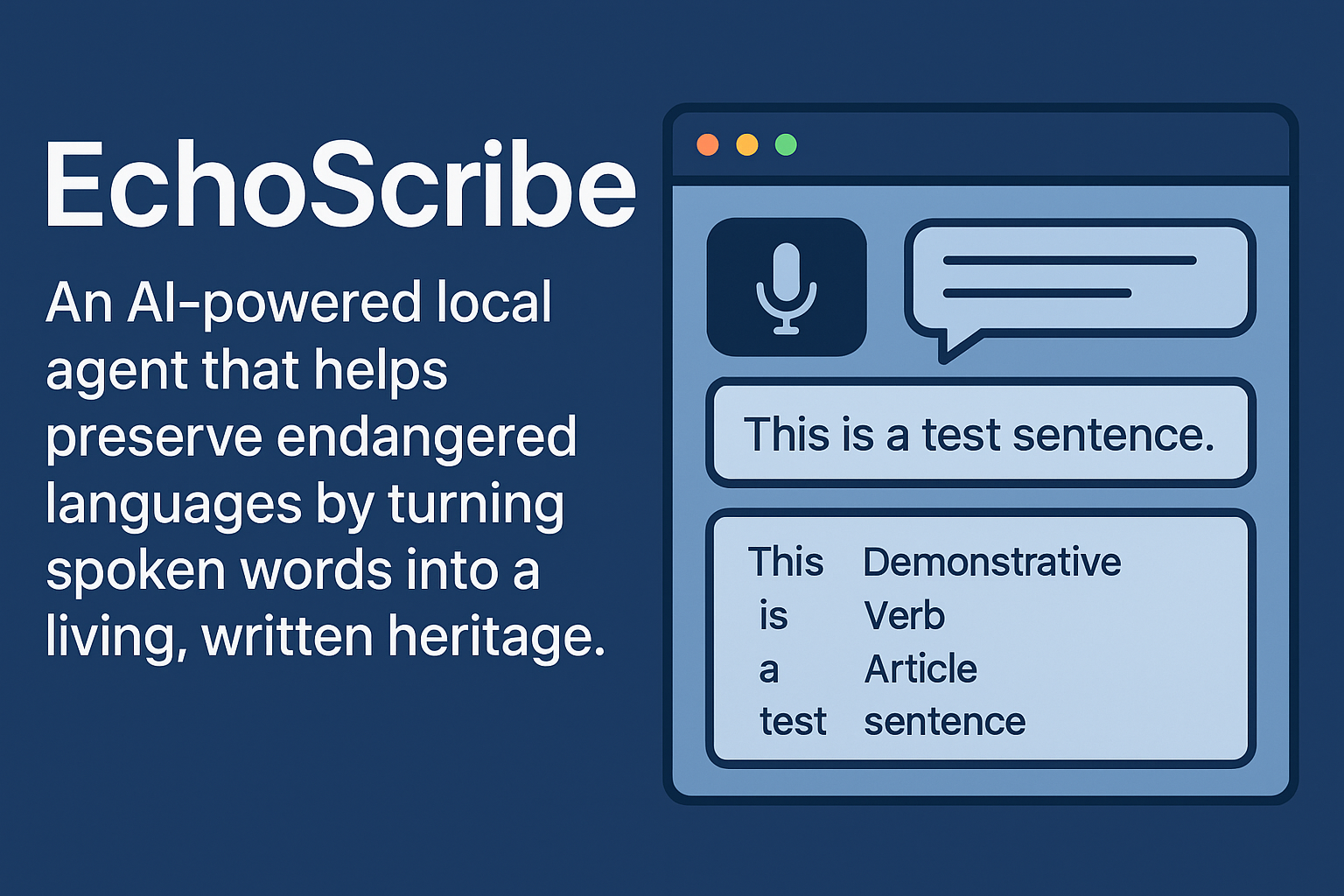
EchoScribe is basically a 'linguist-in-a-box' that runs on your laptop. You speak a sentence, and the app springs to life. First, it uses the Whisper model to instantly transcribe your words. Then, it hands that text to a powerful local language model, Llama 3, which acts like a creative analyst. It provides a smart, hypothetical breakdown of the grammar, helping to piece together the language's rules. The best part? It's all 100% offline and private.
How we built it
We built this thing piece by piece, like putting together a puzzle. We started with Python and got Ollama running to serve the Llama 3 model locally. Then, we built two tiny test scripts: one to prove we could talk to the AI, and another to prove we could record and transcribe audio. Once those two 'proofs' worked, we stitched them together into a single backend. From there, we used CustomTkinter to build a simple, clean interface. The final magic trick was connecting the UI to the backend with threading so it wouldn't freeze, and then using PyInstaller to wrap it all up into a single .exe file.
Challenges we ran into
Oh, the challenges were real. For a while, it felt like we were debugging the entire internet. We battled everything from PowerShell security policies that wouldn't let us activate our environment, to the ollama command just vanishing from the system PATH. We discovered our audio script was failing silently because of a bizarre sample rate mismatch with the microphone. And just when we thought we were done, our final .exe file crashed because a progress bar library (used by Whisper) had no console to write to! Every step of the way, we hit a new, unexpected wall, and had to systematically break the problem down to get past it.
Accomplishments that we're proud of
Honestly, we're just incredibly proud that it works. We went from a simple idea to a fully functional, standalone desktop AI app that runs completely offline. Integrating two complex local models (Whisper and Llama 3) into a GUI that anyone can use feels like a huge win. More than the code, we're proud that we built something with a real, human centric purpose.
What we learned
This project was a crash course in what it really takes to build local AI. We learned that your development environment is everything, and that debugging is 90% of the work. We learned that hardware can be finicky in ways you don't expect, and that packaging a Python app is its own special kind of puzzle. But our biggest takeaway is just how accessible and powerful these open source models are. You don't need a massive cloud server to build something meaningful; you can do it right on your own machine.
What's next for EchoScribe
This is just the beginning for EchoScribe. We envision it growing into a full fledged linguistic toolkit. Imagine a feature that saves your work to a local database, building a searchable corpus of the language over time. Or an interactive tool to help you design an alphabet. We'd love to add a feature to generate bilingual flashcards and stories to help teach the language to kids. The ultimate goal is to enable fine tuning a model on the new language itself, turning EchoScribe into a true expert and guardian of that culture.

Log in or sign up for Devpost to join the conversation.