-
-
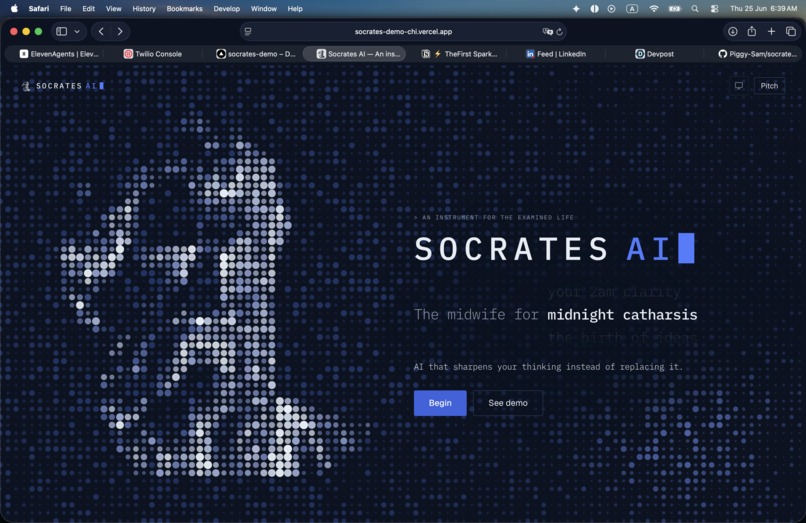
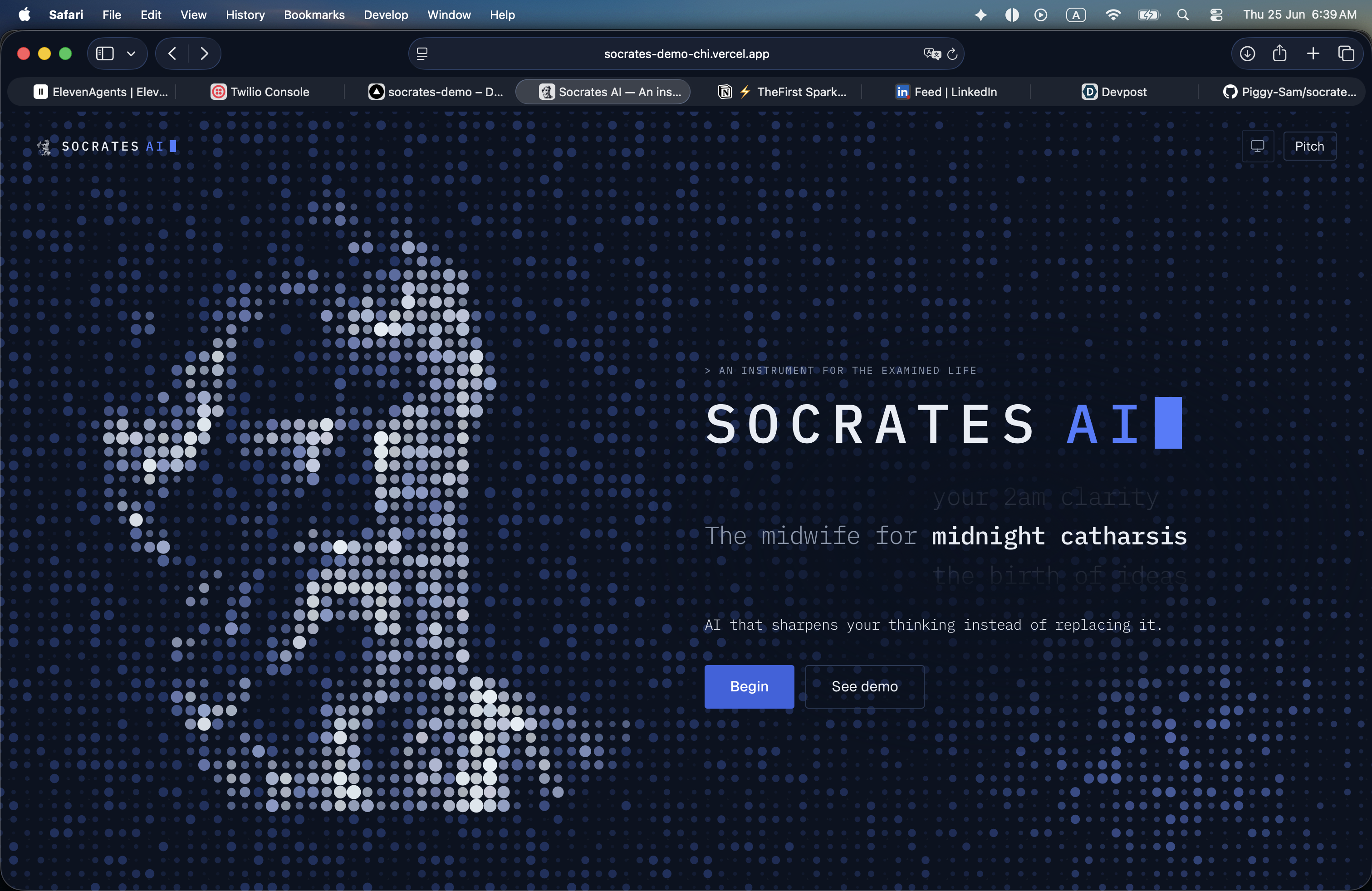
Landing page
-
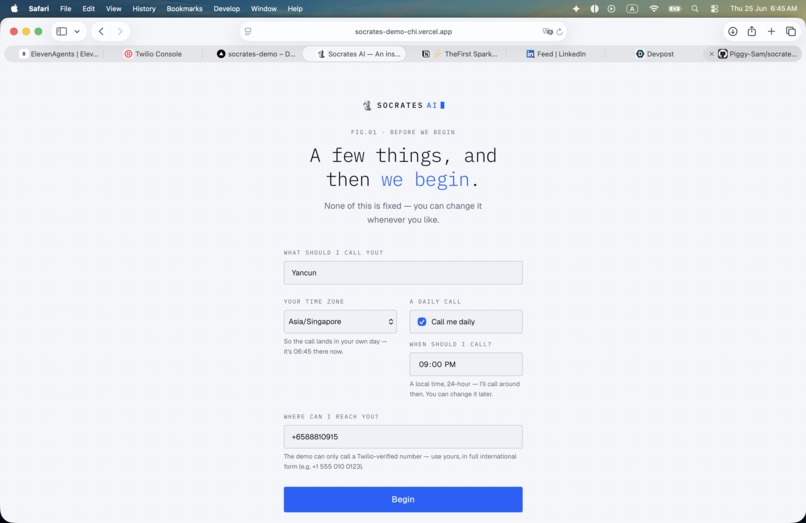
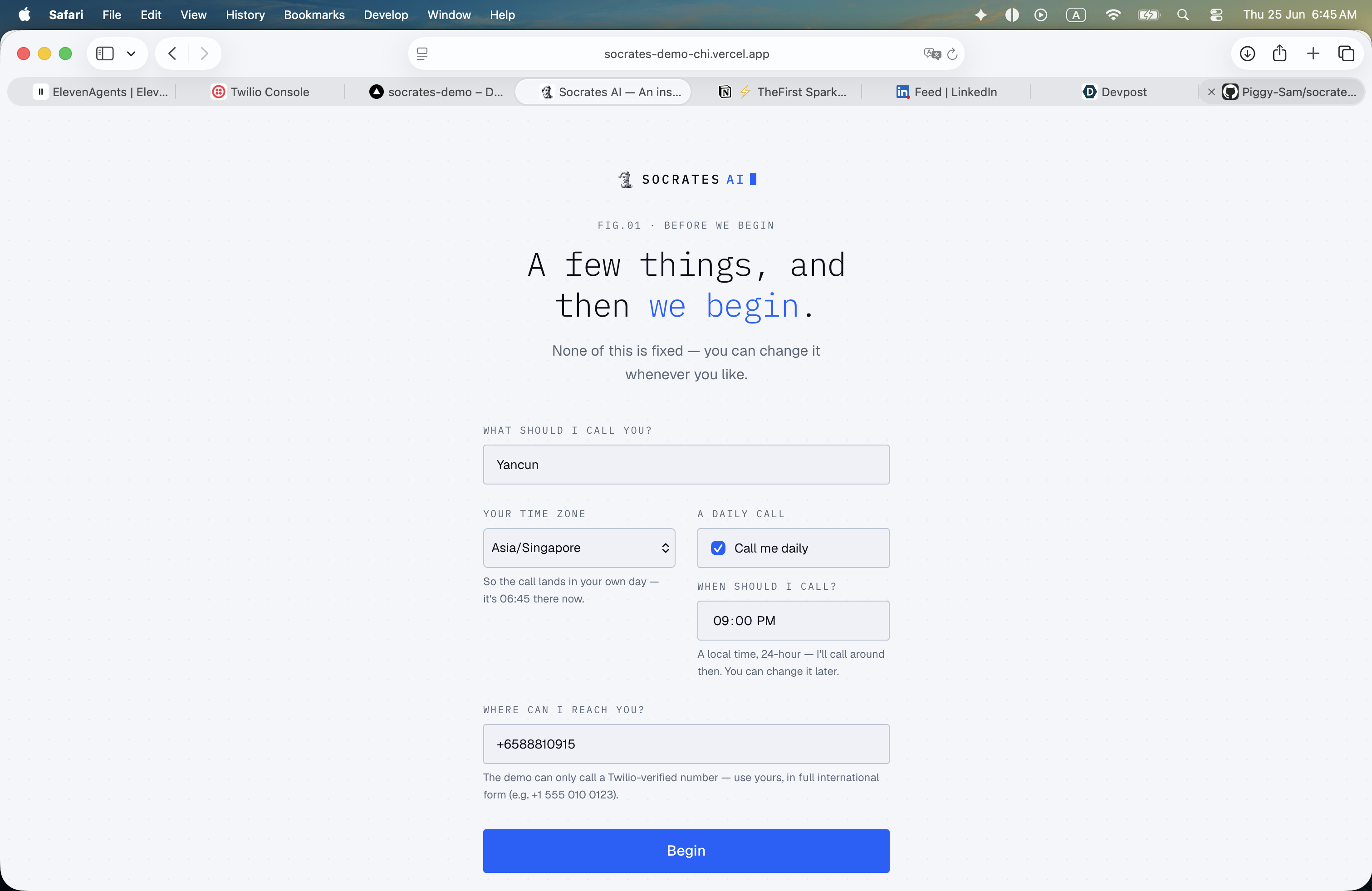
Onboarding
-
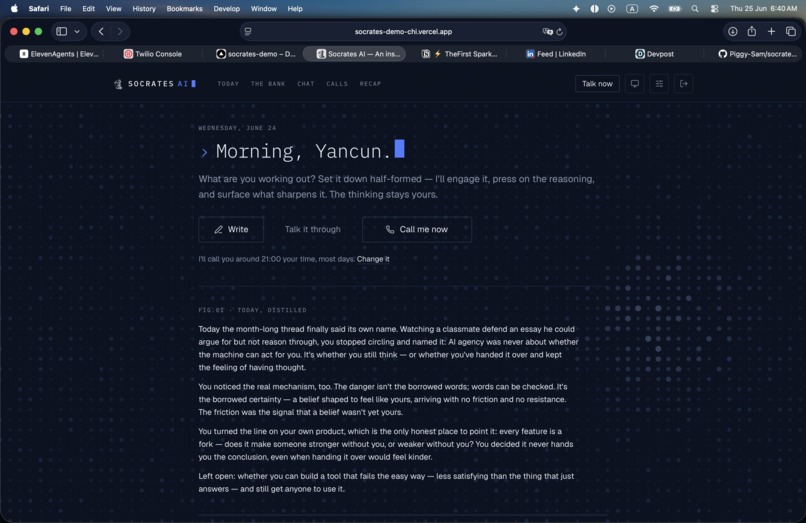
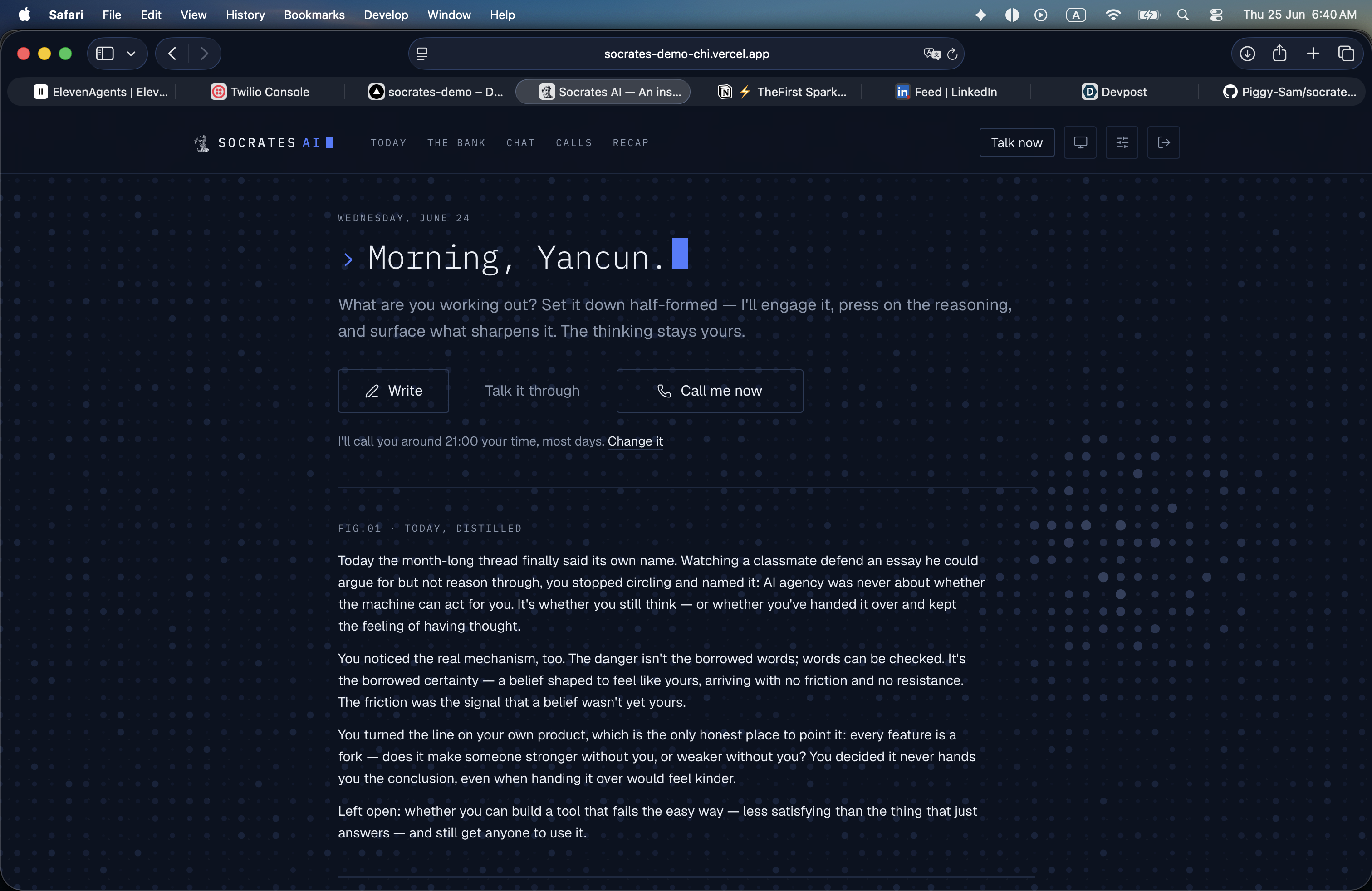
"Today" view
-
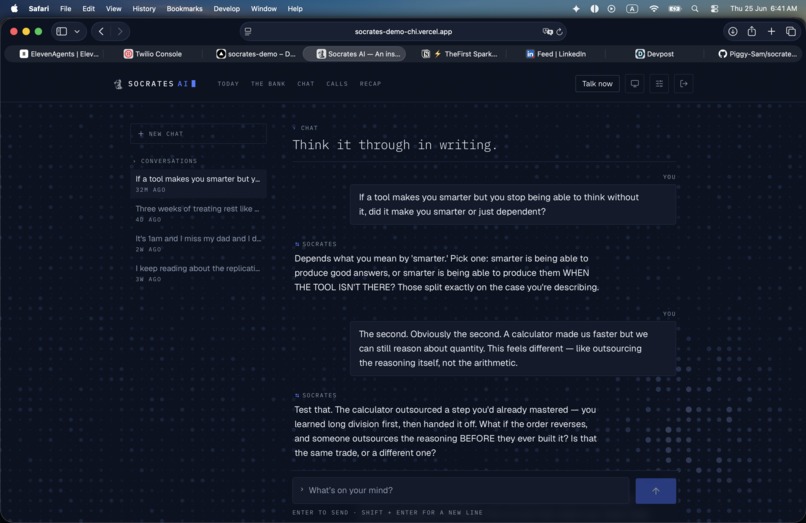
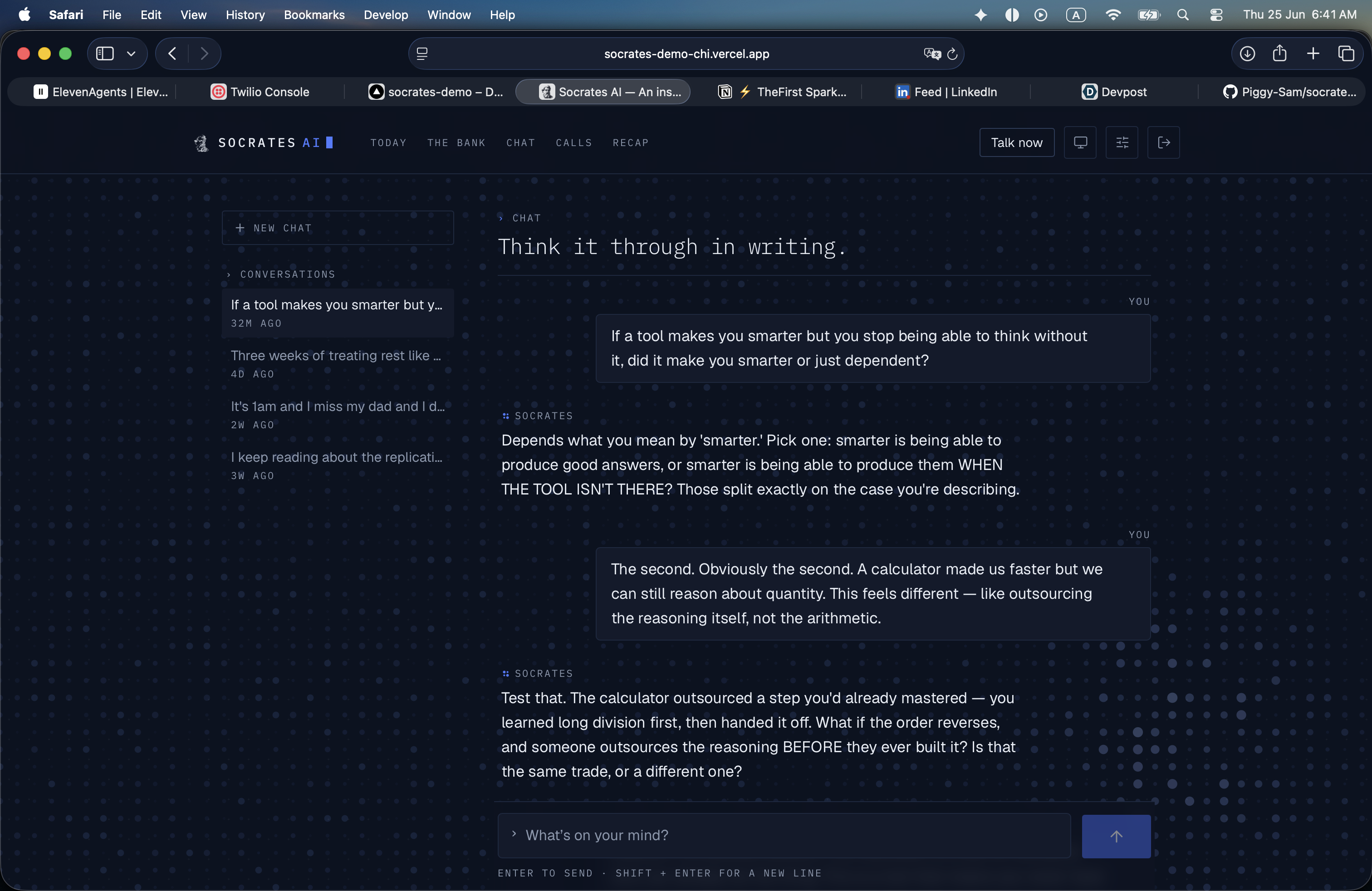
"Chat" view
-
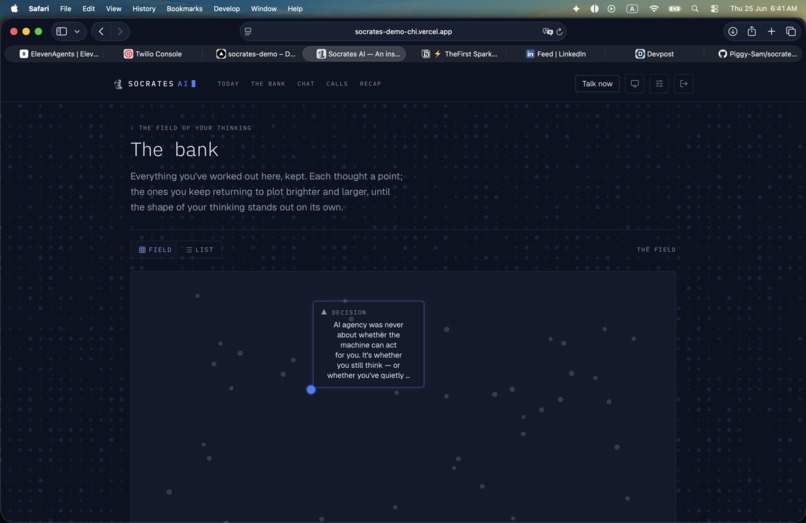
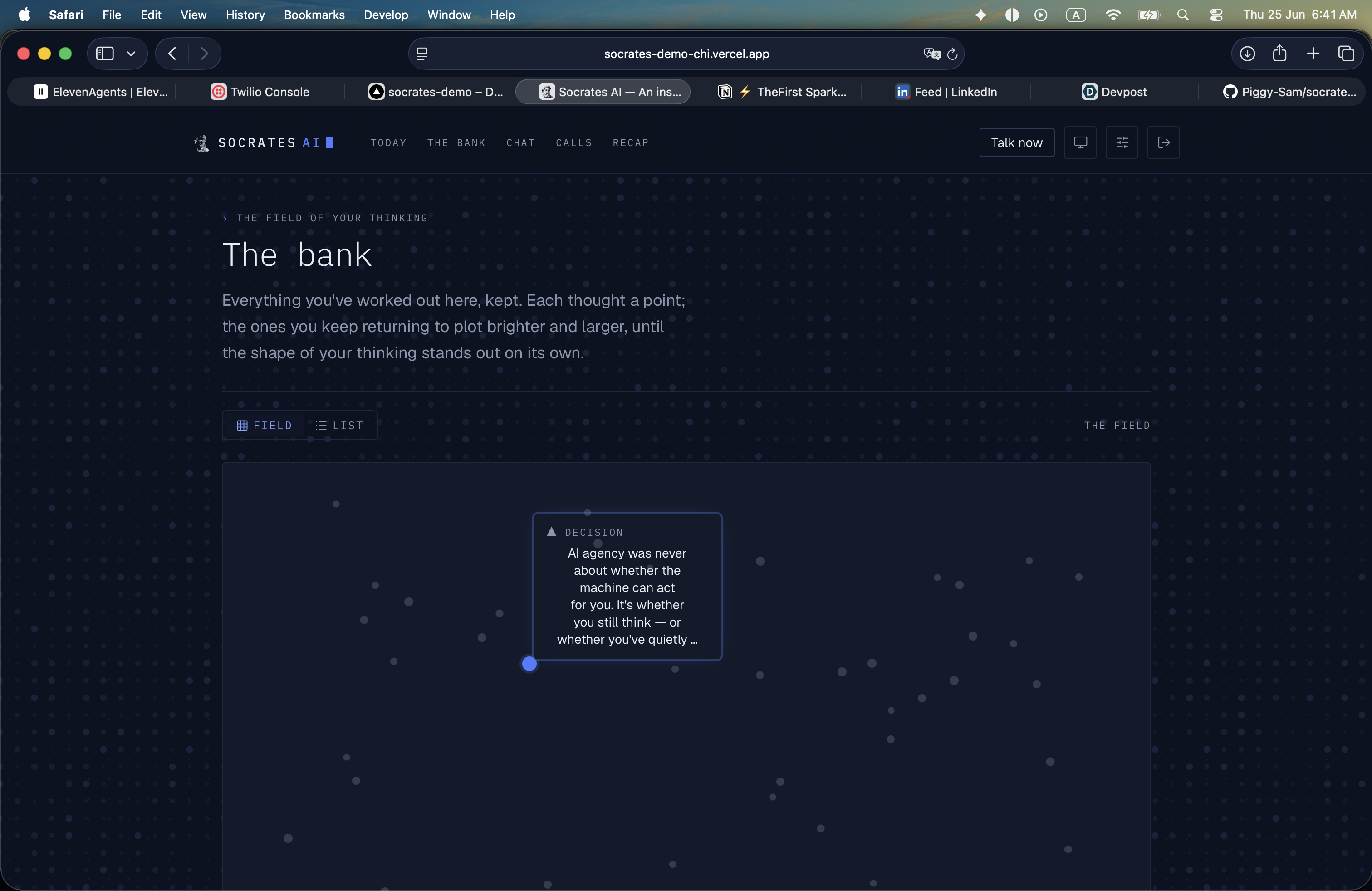
The knowledge bank
-
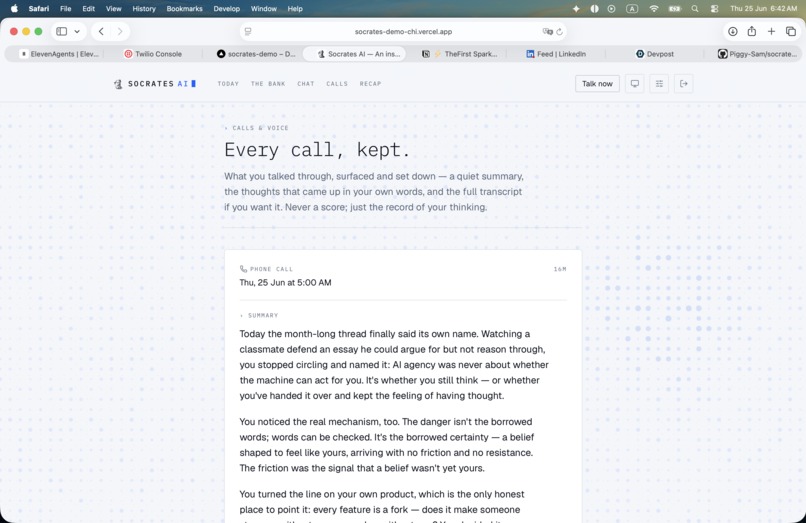
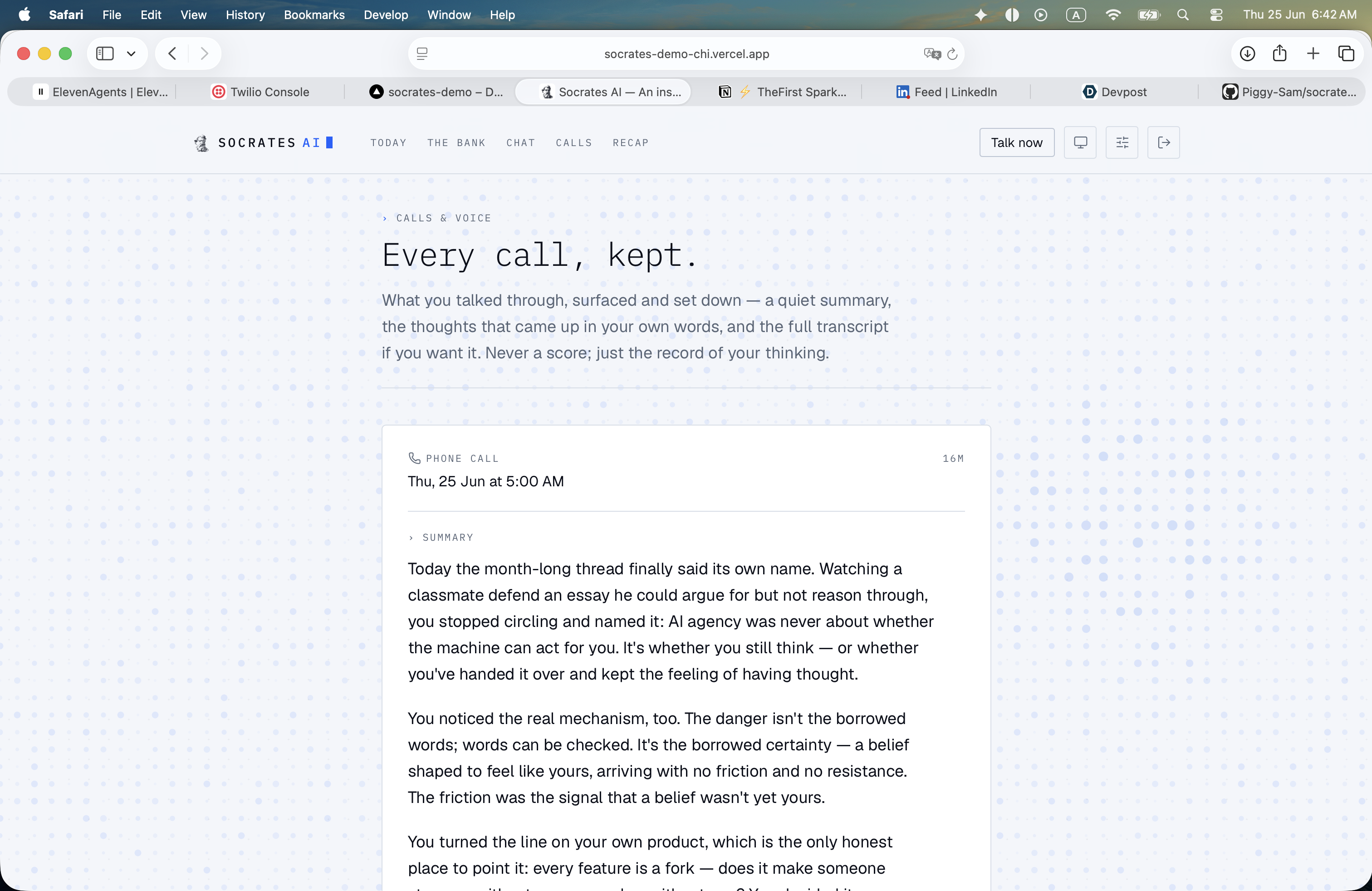
Call histories with Socrates AI, organised and summarised.
-
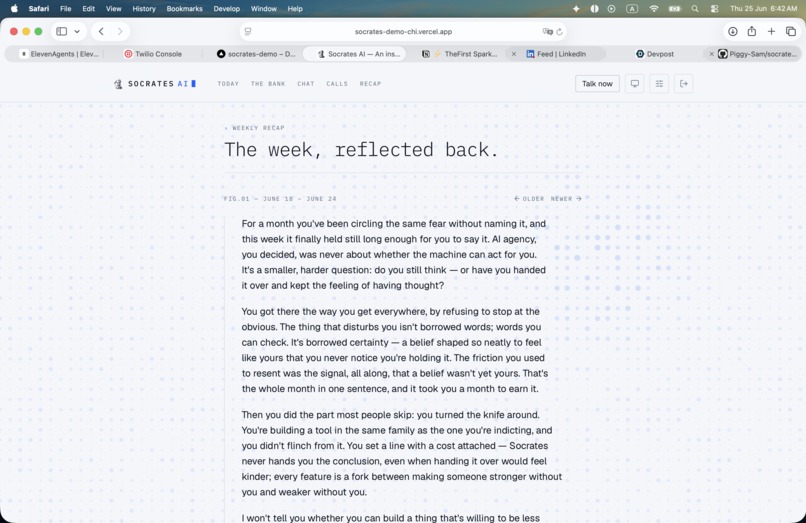
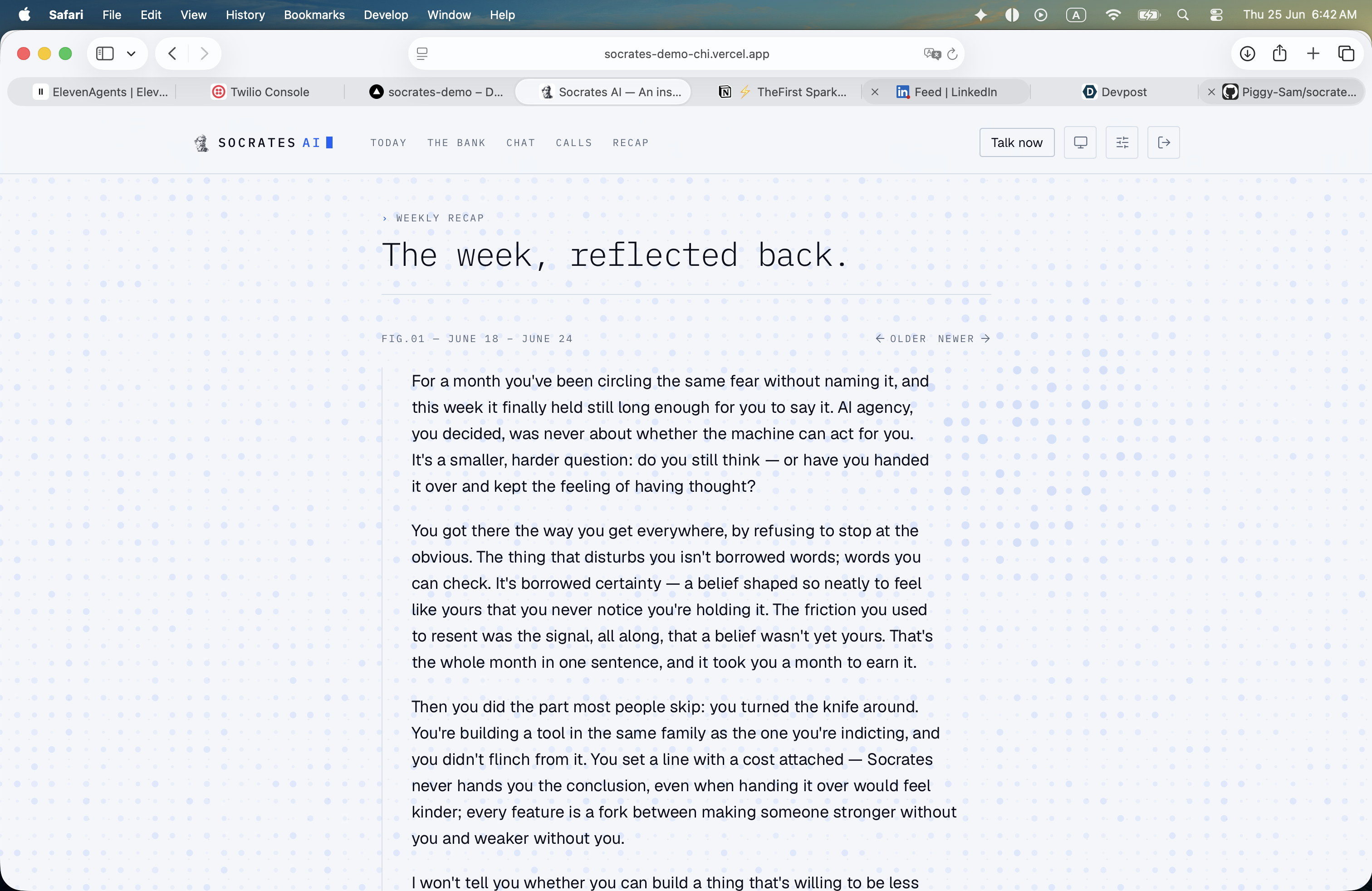
Weekly recap
-
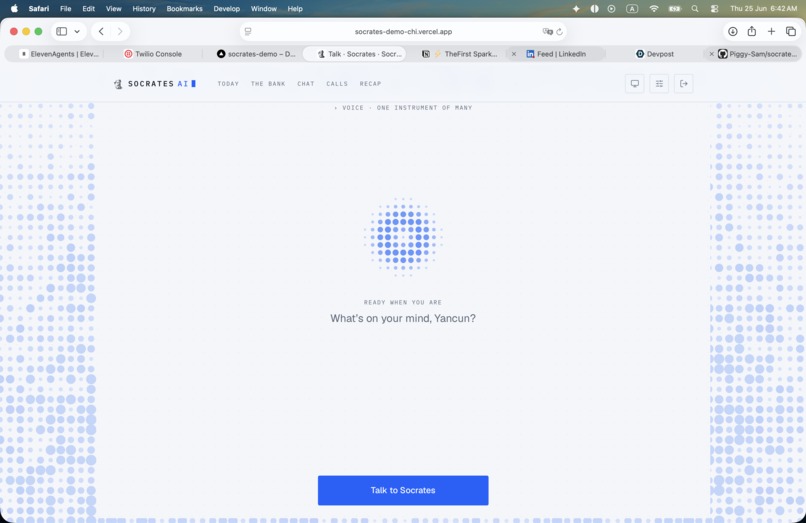
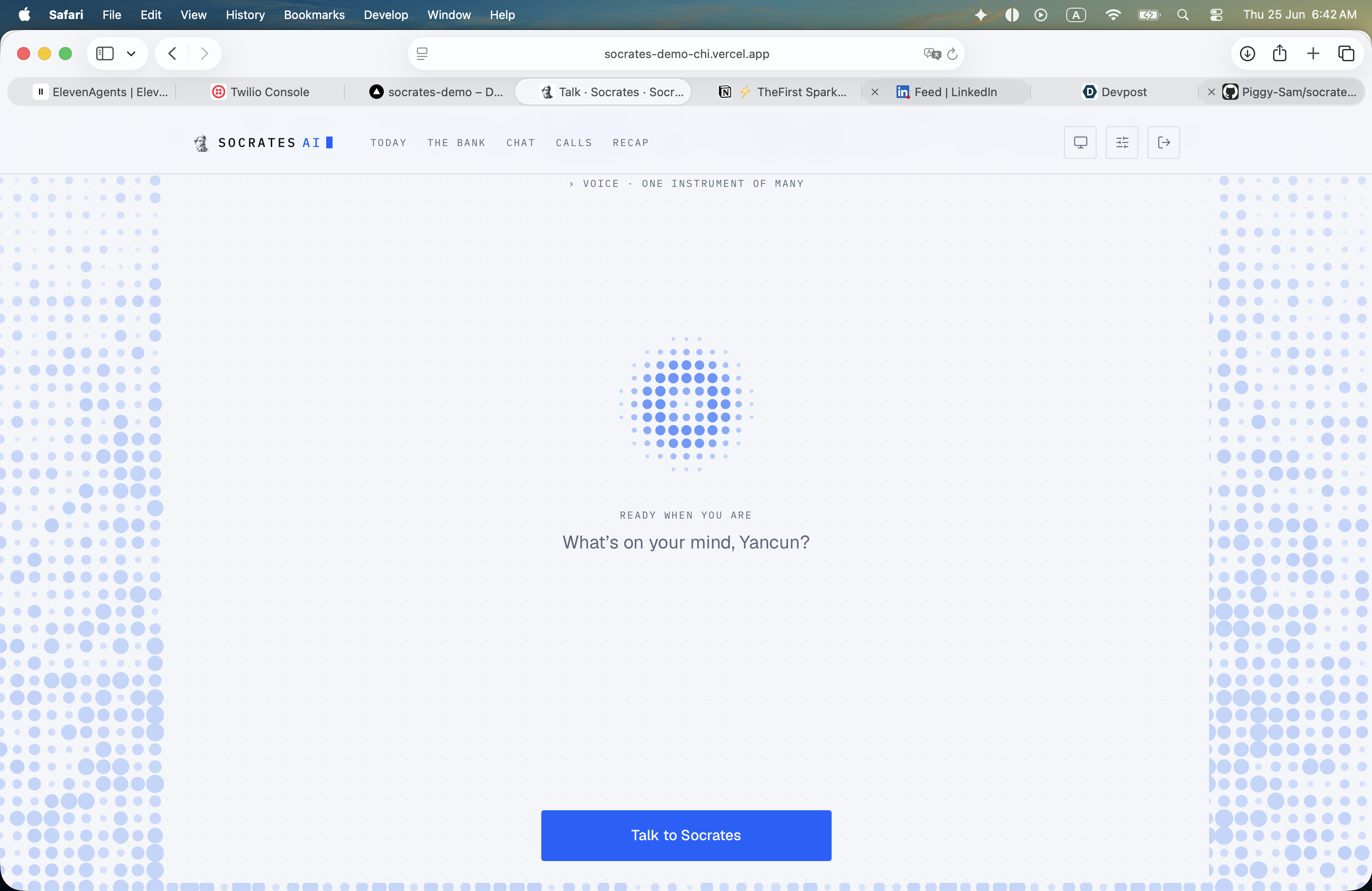
Speak to Socrates AI
-
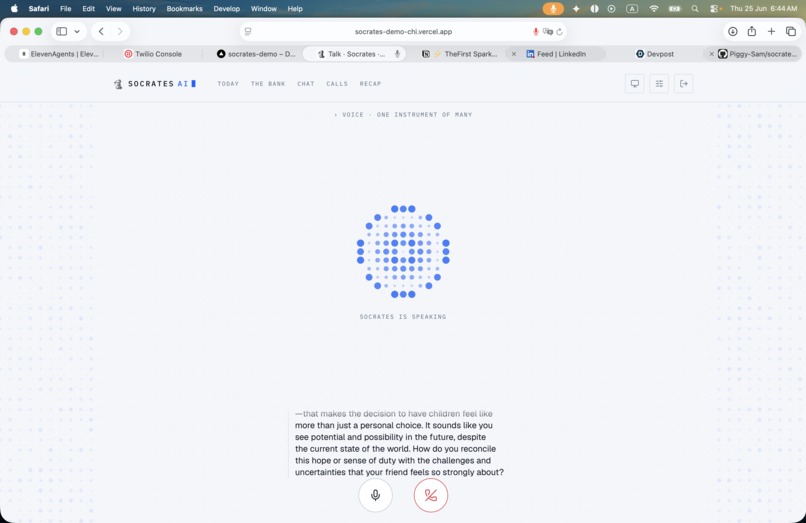
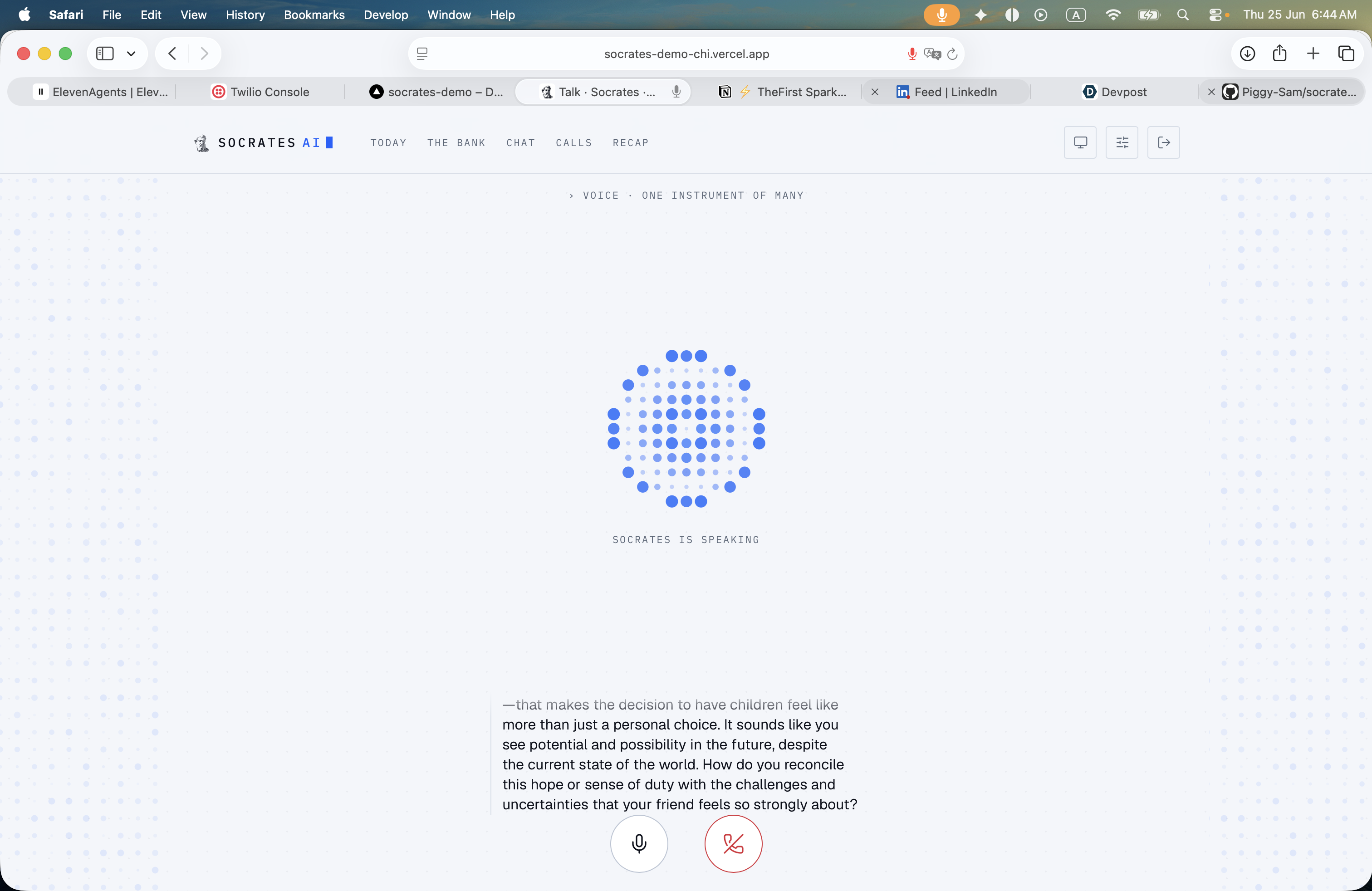
Call in progress
-
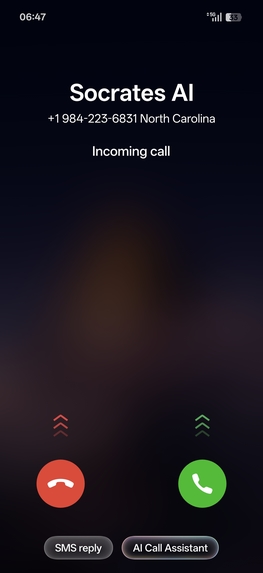
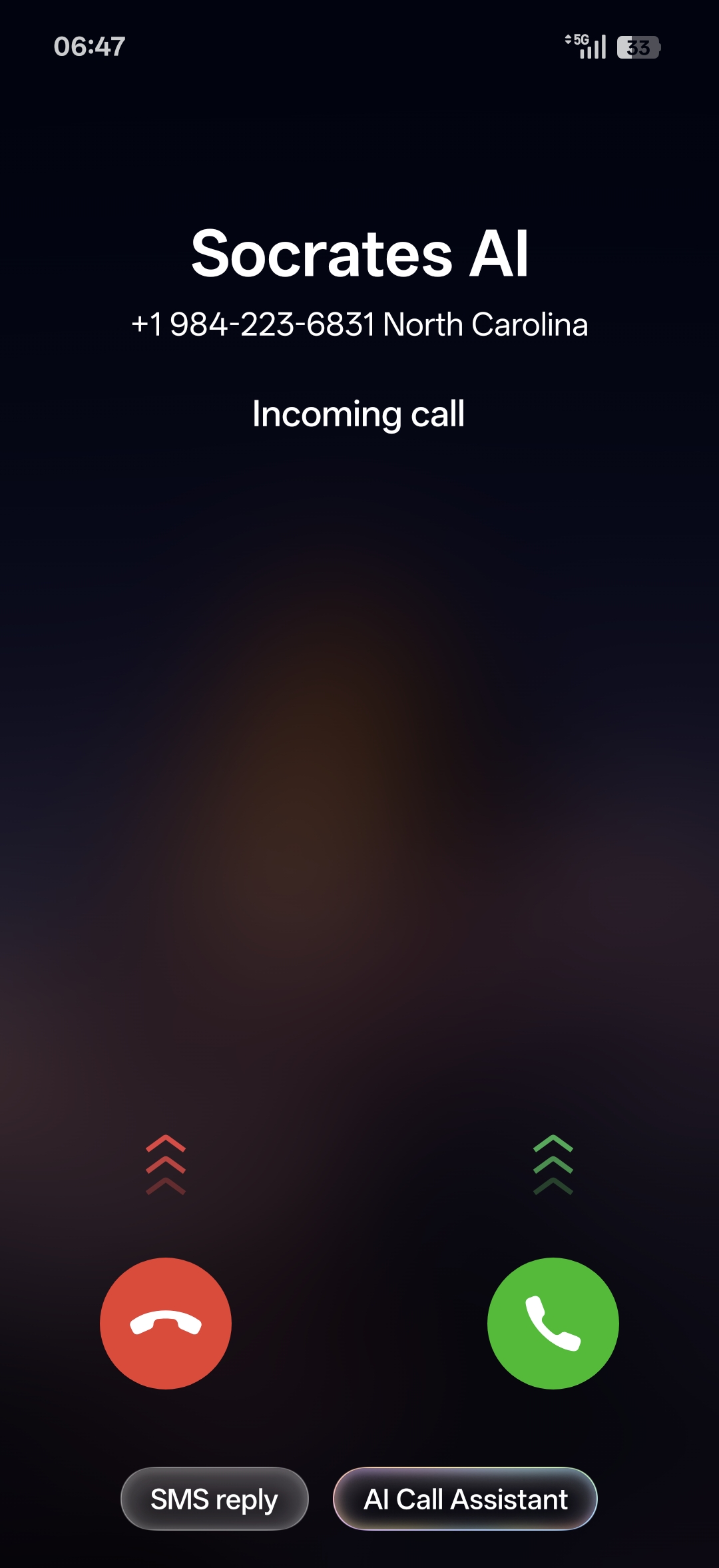
Socrates AI can schedule calls with you daily.
Summary
Socrates AI is a voice-and-text thinking partner that refuses to do your thinking for you. Instead of handing you answers, it presses your reasoning, keeps the record of ideas you actually worked out yourself, and resurfaces them over time - so AI sharpens human cognition instead of quietly replacing it.
Challenge statement
A.3 Human agency in AI-mediated decisions - How might we help people understand, override, and shape AI-mediated decisions in everyday life?
Target user
Socrates AI serves two groups who share one belief - that AI should make you sharper, not do your thinking for you. The first is individuals: people who want a private place to think ideas through, document their own cognition, and resist offloading the hard parts to a machine. The second is education: institutional buyers - schools, programs, boards, and parents - who want AI-literacy that protects and develops student thinking rather than eroding it. Both come to Socrates not for answers, but to do the thinking themselves - better.
Inspiration
I judged a case competition recently and watched sharp students defend theses they'd never actually thought through - the AI wrote the argument, and they defended it on reflex. That unsettled me. The challenge (Theme A.3) asks how we help people understand, override, and shape AI-mediated decisions - but you can't shape a decision you've stopped thinking about. The real bottleneck isn't the model; it's our relationship with it. A generation that outsources its hard thinking gets weaker at thinking - and research like brainonllm.com is starting to measure exactly that cognitive offloading. Socrates AI is the deliberate opposite: a tool built to make you think more, not less.
What it does
Socrates AI is a voice-and-text thinking partner that refuses to do your thinking for you. Instead of handing you answers, it asks before it answers, presses your reasoning, names your hidden assumptions, and never flatters. Everything you work out becomes a point in your Bank - the shape of your own mind over time. It distills each session into your Today view, surfaces recurring tensions as patterns "worth returning to," and hands the movement of your thinking back to you in a weekly Recap. The most natural way in is voice: it can call your phone and open with "what's on your mind?", remembering exactly where you left off. It's deliberately anti-metric - no streaks, no scores, the one space with no one watching.
How we built it
A Next.js (App Router) app on Vercel. The Socratic "brain" is a custom OpenAI-powered endpoint that serves the system prompt plus RAG over your own entries (pgvector) and an always-on standing-context memory. Voice runs on ElevenLabs Conversational AI pointed at that custom brain, with outbound phone calls via Twilio and a dynamically generated, personalized opener. Finished conversations are distilled into typed entries (idea / opinion / feeling / observation / question / decision), aggregated into themes, surfaced as patterns, and folded into daily and weekly recaps. Storage and auth are on Supabase (Postgres + pgvector). A read-only "See demo" mode lets anyone explore a fully populated account where every write no-ops, plus an in-site pitch deck at /pitch with a live on-stage call. Built with OpenAI and ElevenLabs (sponsors), Supabase, Vercel, Twilio, and Next.js.
Challenges we ran into
- Resisting the easy path. Every instinct in AI product design pushes toward resolving faster; building something that deliberately withholds answers - while still feeling helpful - took constant restraint in the prompt and the UX.
- Voice memory and latency. Giving the agent rich, real-time memory (RAG + standing context) without blowing the per-turn voice budget meant fetching context concurrently under tight timeouts with graceful fallbacks.
- Custom-LLM plumbing. ElevenLabs doesn't forward request headers to a custom LLM, so authenticating the voice brain (and threading user identity/memory through) required a URL-path-secret approach and careful dynamic-variable routing.
Accomplishments that we're proud of
- A live phone call from Socrates that opens by remembering where you left off - the integration genuinely feels like talking to something that knows your thinking.
- A coherent product loop: think → it presses → it's kept → it resurfaces, across voice, text, the Bank, patterns, and recaps.
- An anti-metric design language ("the Instrument") that makes the philosophy visible - and a no-sign-up demo so anyone can feel it in seconds.
- Reframing the challenge from first principles rather than building yet another vertical AI wrapper.
What we learned
The hardest part of human–AI agency isn't a better "override" button - it's keeping the human's cognition in the loop in the first place. Technically, we learned how much of a good Socratic experience lives in restraint: prompts that refuse to flatter or resolve, memory that surfaces your patterns without interpreting them for you, and an interface with no metrics to perform for. And we learned that "make the AI think with you, not for you" is as much a design and values problem as an engineering one.
What's next for Socrates AI
- Education pilots with schools and programs that want AI-literacy which protects and develops student thinking - institutional buyers who share the anti-offloading thesis.
- Deeper resurfacing: connecting today's thought to the older ones it brushes against, so reasoning compounds instead of evaporating.
- Richer pattern detection (contradictions, abandoned threads) and shareable recaps.
- A personal tier for people who want a private place to flesh out, document, and organise their own cognition - built, always, to be outgrown.
Built With
- elevenlabs
- next.js
- openai
- supabase
- twilio
- vercel
