-
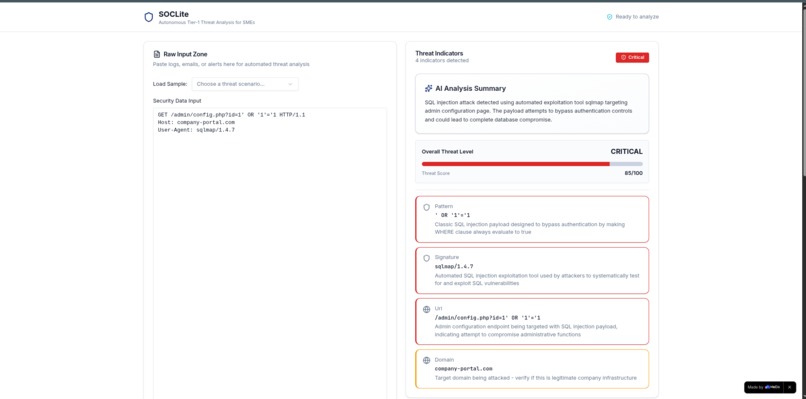
AI analysis
-
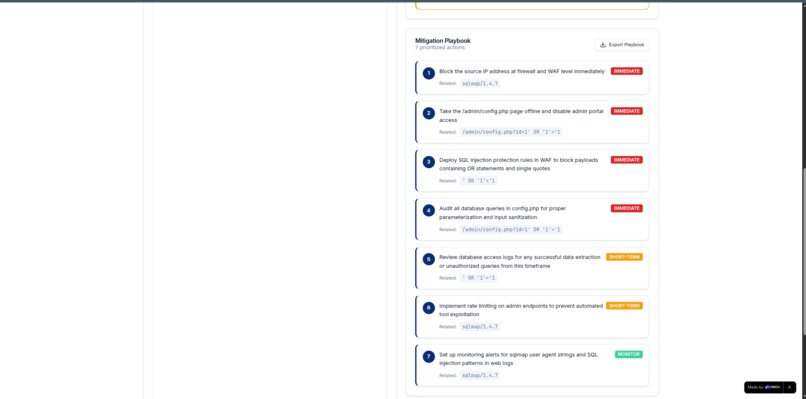
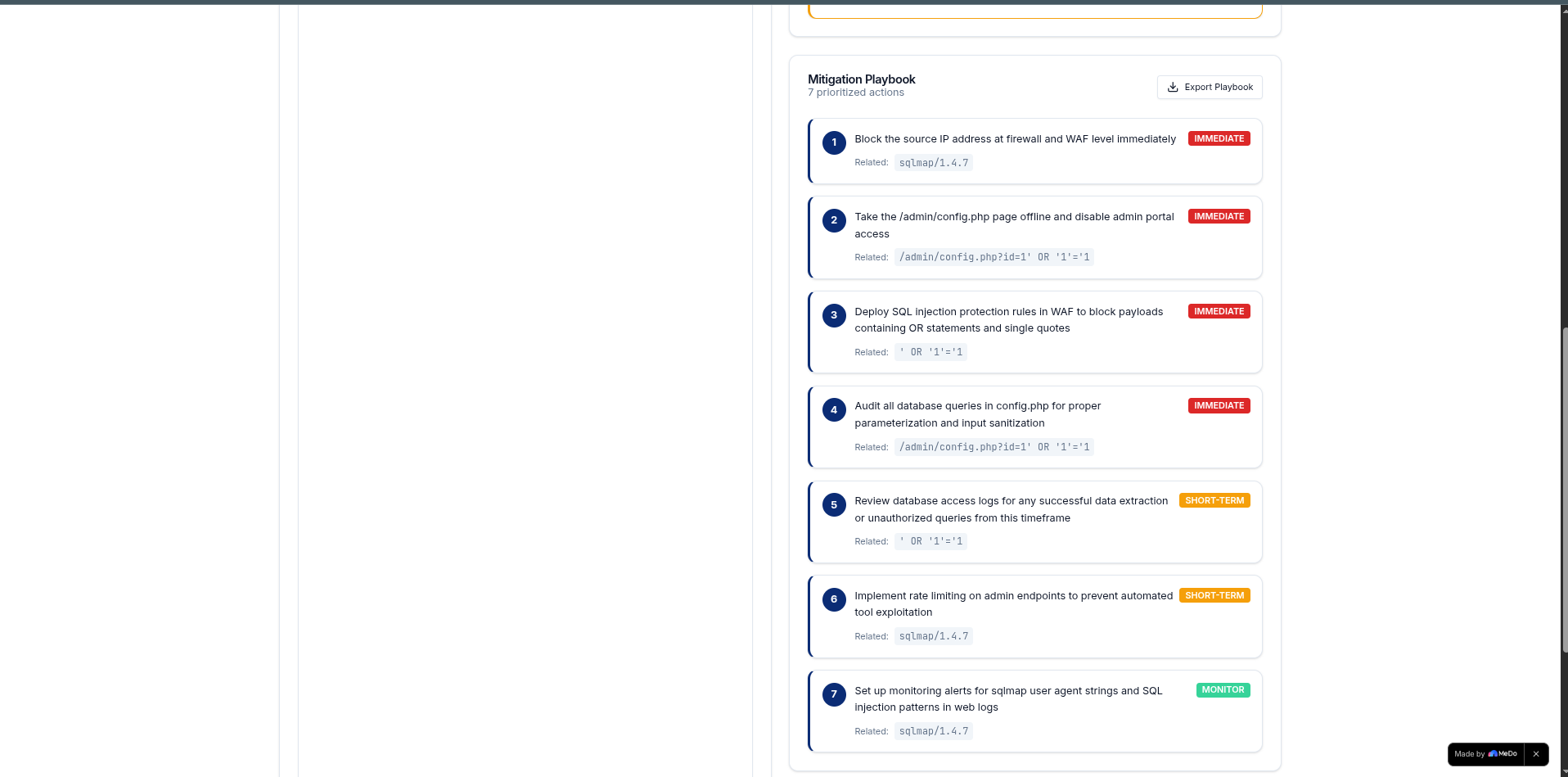
Mitigation Playbook
-
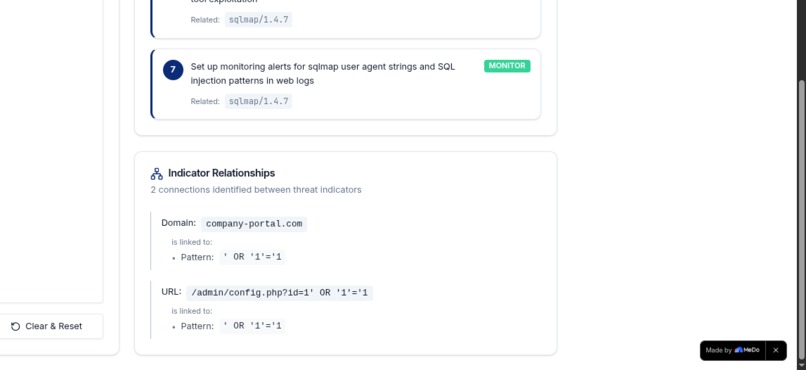
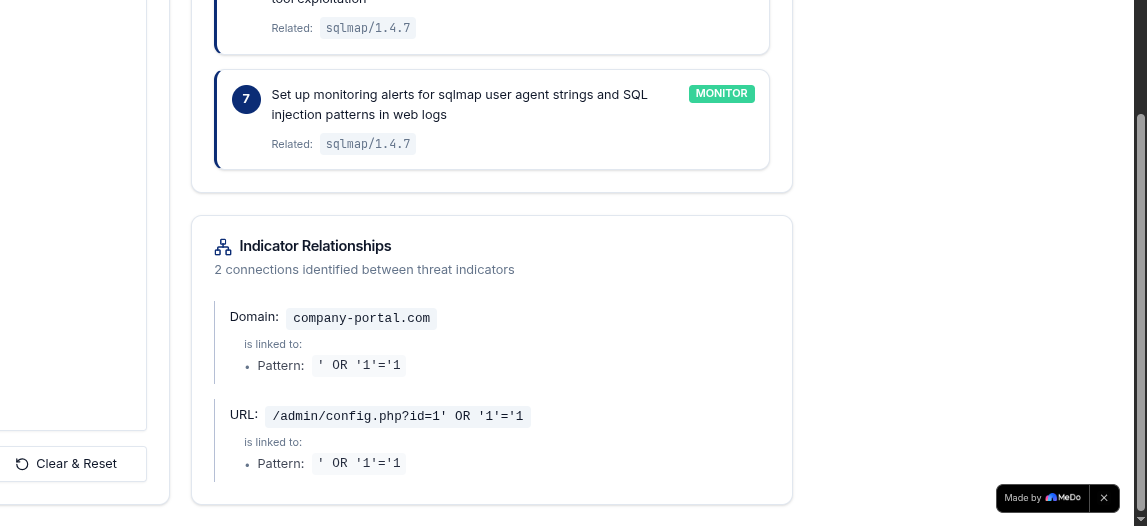
Indicator Relationships
Inspiration
Inspiration
Every 39 seconds, a small business gets hit by a cyberattack. Most SMEs have no security team, no SIEM tool, and no way to interpret the alerts their systems generate. When a server log lights up at 2 AM, the typical response is panic or silence - both equally dangerous.
I wanted to give a small business owner the same first-response capability as a trained Tier-1 SOC analyst. Without requiring them to be one.
What It Does
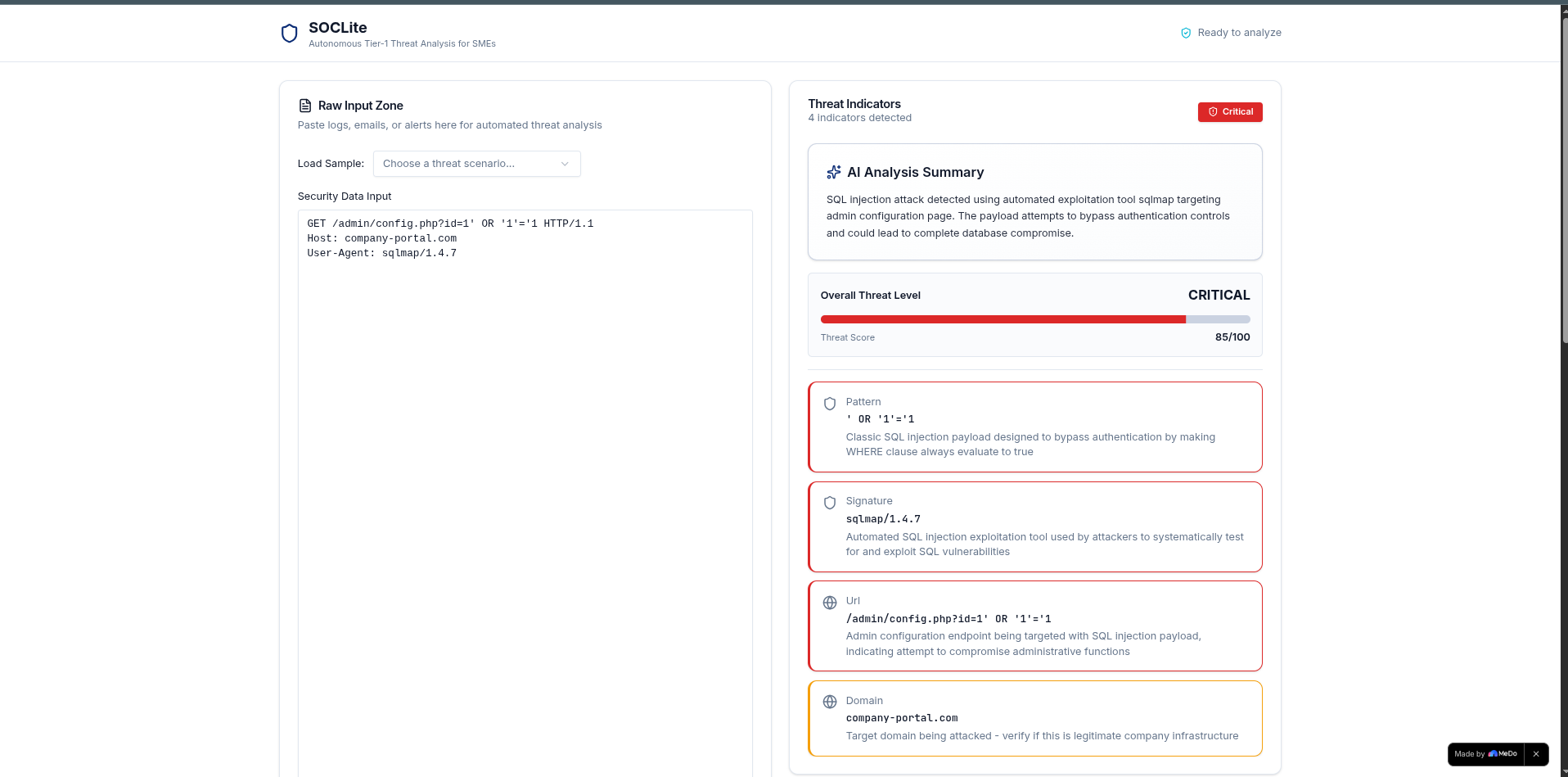
SOCLite is an autonomous Tier-1 SOC analyst built entirely on MeDo. Paste raw security data - server logs, phishing emails, network alerts - and SOCLite instantly:
- Identifies threat indicators: IPs, ports, domains, and attack patterns
- Scores severity from 0–100 with CRITICAL, MEDIUM, or LOW classification
- Detects log tampering - flags impossible conditions like private IPs claiming foreign geolocations
- Generates a prioritized mitigation playbook with specific, numbered, actionable steps
- Exports a timestamped incident report for insurance claims or security providers
No configuration. No onboarding. No expertise required.
How I Built It
Built entirely through natural language prompts on MeDo, zero manual coding. The approach was architecture-first:
- PRD - problem, persona, user journey, and hard constraints before any UI was generated
- Data Model - ThreatSubmission, ThreatIndicator, MitigationAction, PlaybookReport
- **Design System - cybersecurity-grade palette, monospace typography, severity colors, strict UX rules
- Phased Build - layout → logic → playbook → polish
- AI Integration - Claude API via Supabase Edge Functions for secure server-side threat analysis
The result: a production-grade React + TypeScript app with Supabase backend and AI-powered threat intelligence built without writing a single line of code.
Challenges
Severity accuracy - early pattern matching scored a complete RCE kill chain (wget + chmod + execute) as MEDIUM. Fixing this required moving to genuine AI reasoning with strict scoring overrides enforced in the system prompt.
Secure API keys - an AI key exposed in a React frontend is a critical vulnerability. Solved with a Supabase Edge Function as a server-side proxy, the key never touches the client.
Accomplishments
- AI correctly scores complete RCE kill chains CRITICAL 100/100
- Log tampering detection, absent from most enterprise tools
- Tested across 9 attack scenarios: SSH brute force, SQL injection, phishing, ransomware, reverse shell, credential stuffing, DNS exfiltration, ARP spoofing, insider threat
- Production-grade security architecture with zero code written
What I Learned
The ceiling for no-code platforms is much higher than most people assume, if you approach the build with engineering discipline. A PRD and design system before touching the builder is the difference between a polished product and a prototype.
Prompt architecture is engineering. The difference between a tool that misclassifies a live RCE attack and one that scores it CRITICAL 100/100 is entirely in how you structure the AI's instructions.
What's Next
- Batch log file analysis
- Threat history and pattern tracking
- MITRE ATT&CK technique mapping
- Webhook alerts to Slack or email
Built With
- claude-api
- medo
- react
- react-router
- supabase
- supabase-edge-functions
- tailwind-css
- typescript

Log in or sign up for Devpost to join the conversation.