-
-
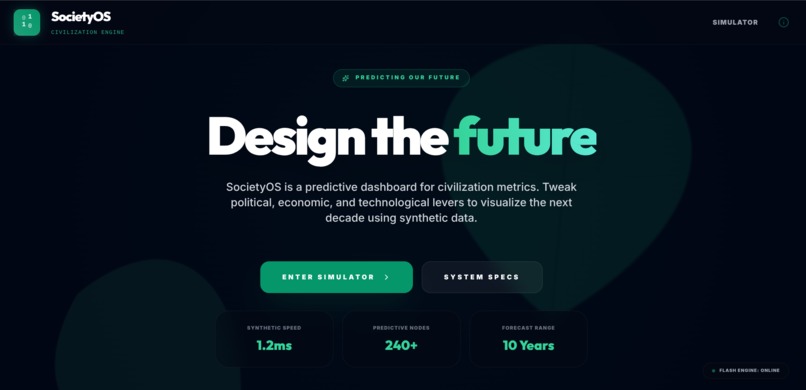
Homepage
-
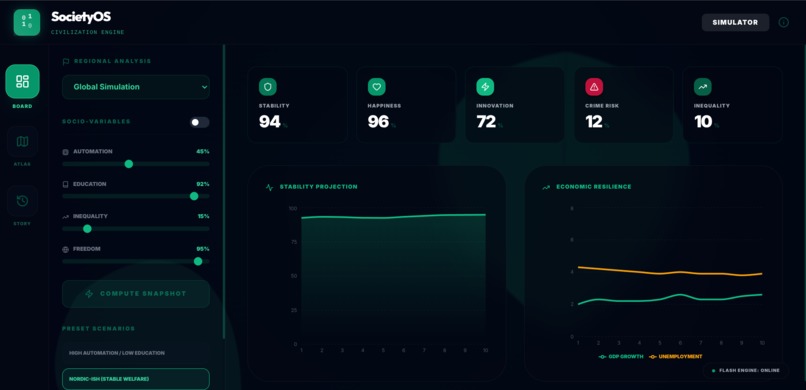
Dashboard
-
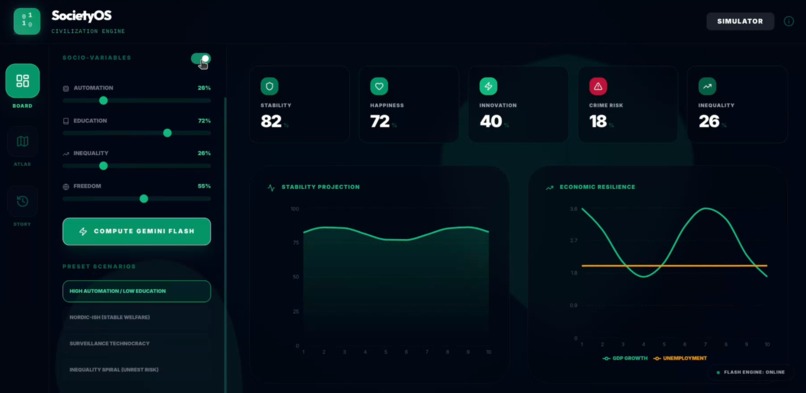
API connection
-
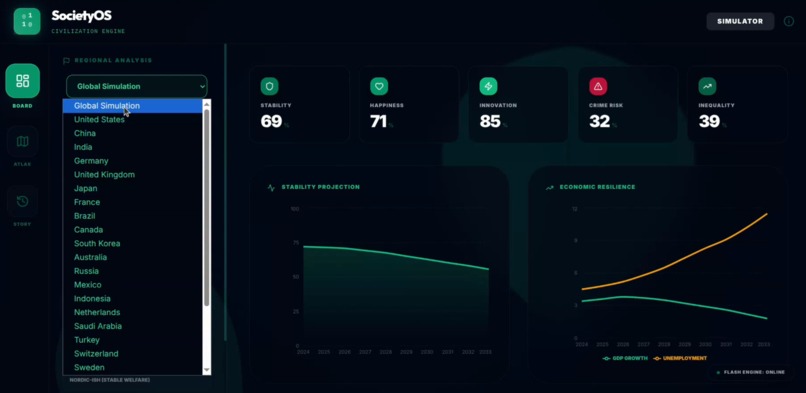
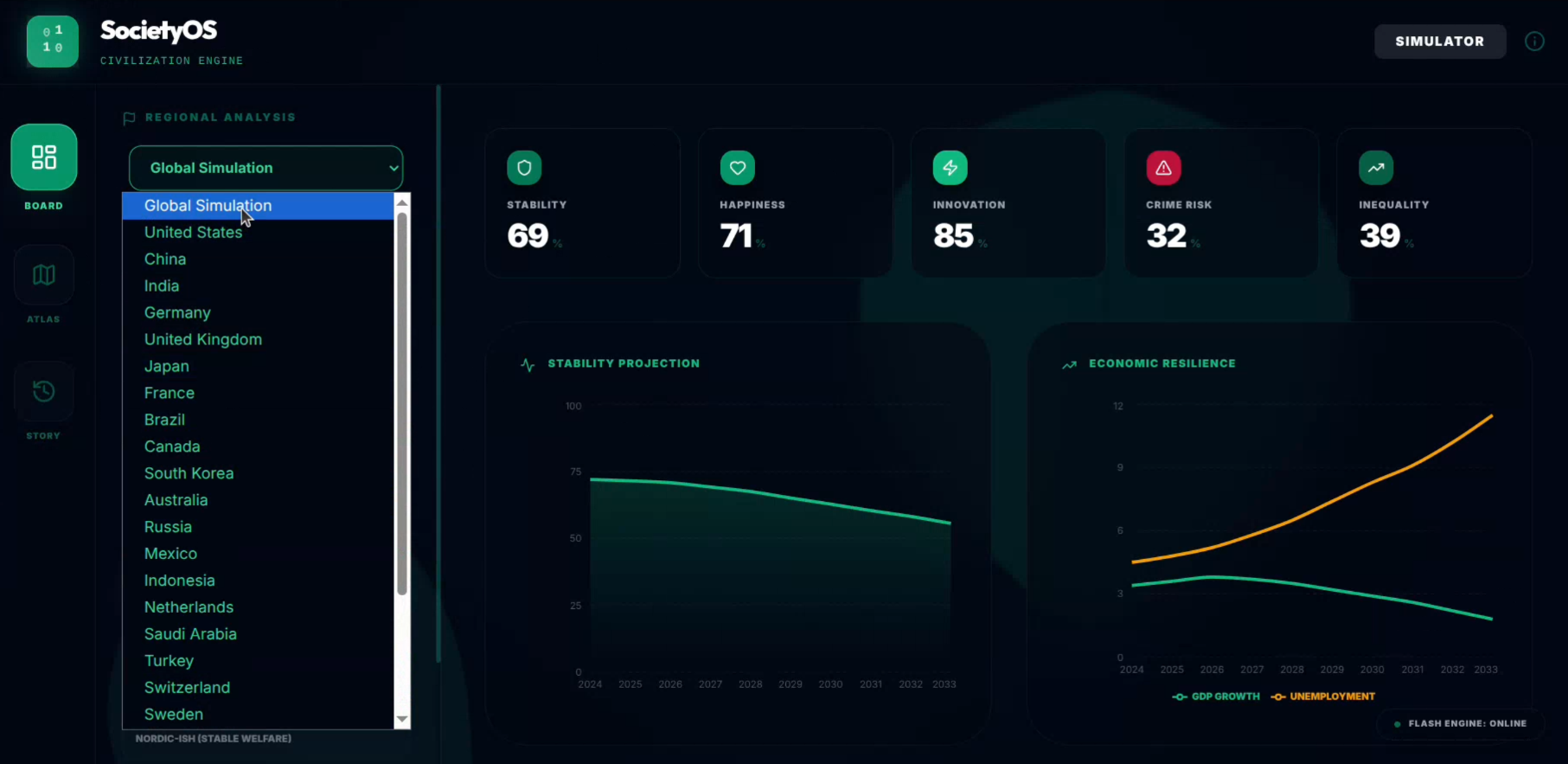
Country selection
-
-
Inspiration
Growing up in Bangladesh, we’ve seen how societal progress is shaped by constant trade-offs — rapid population growth, uneven access to education, rising automation, economic pressure, and persistent inequality. Decisions made today often affect society years later, yet these impacts are usually discussed through static reports or abstract policy debates that feel disconnected from everyday life. We wanted to explore what would happen if these structural factors could be modeled dynamically, allowing people to experiment with societal choices and immediately see their long-term implications. Bangladesh, as a developing nation navigating modernization, resilience, and social balance simultaneously, became a natural reference point for this idea and inspired the foundation of SocietyOS.
What it does
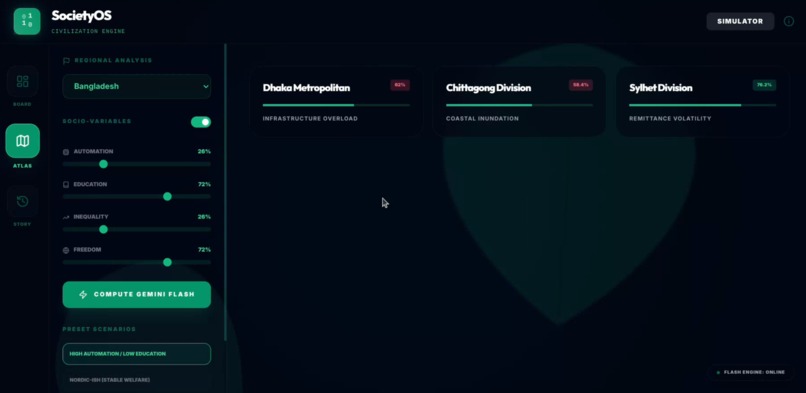
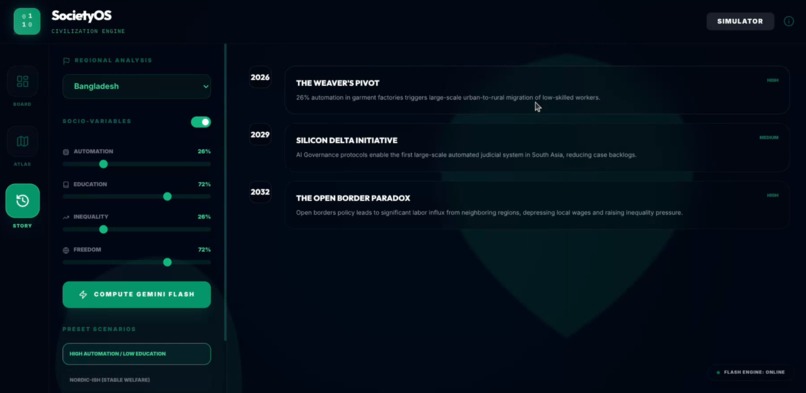
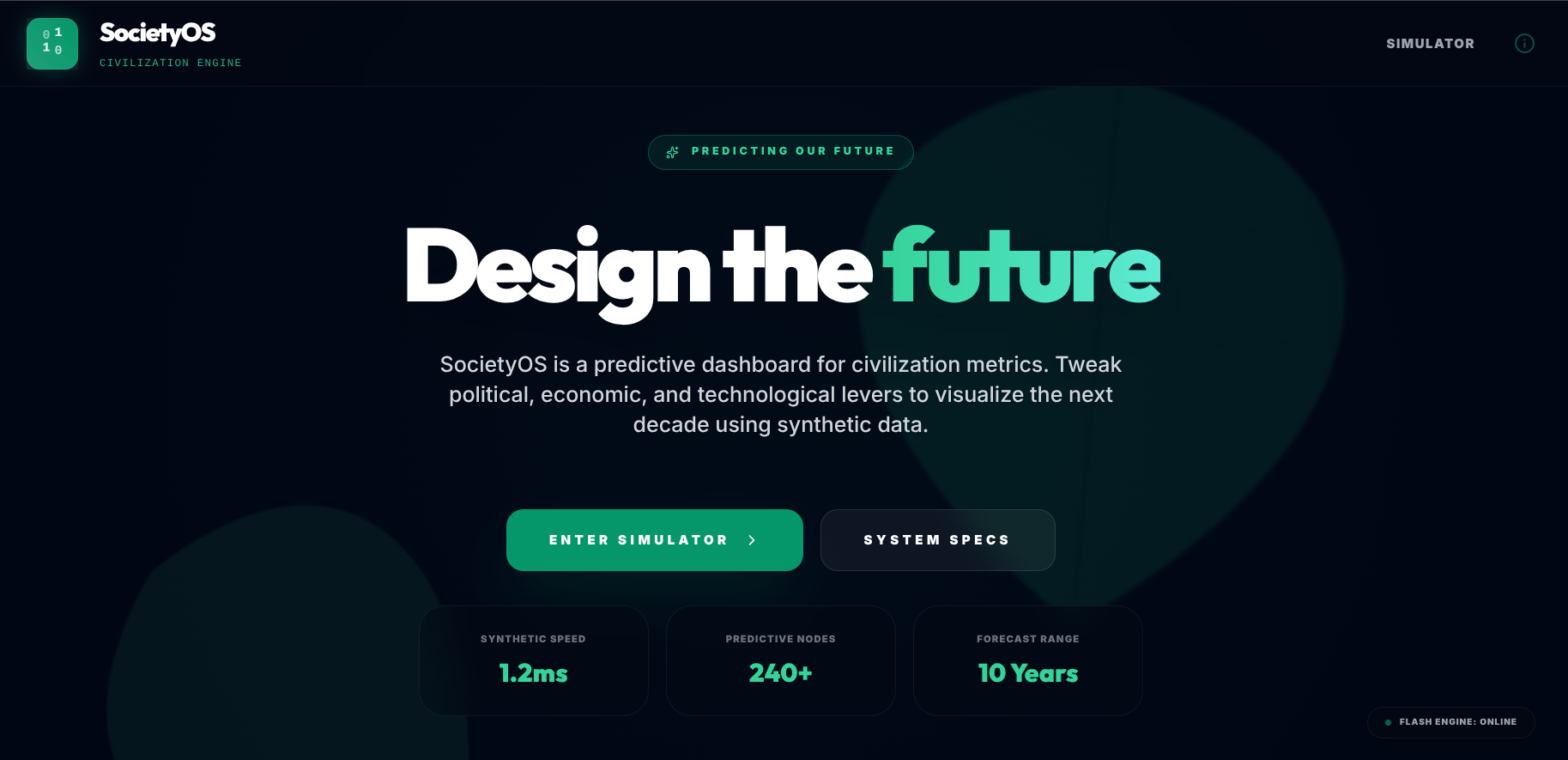
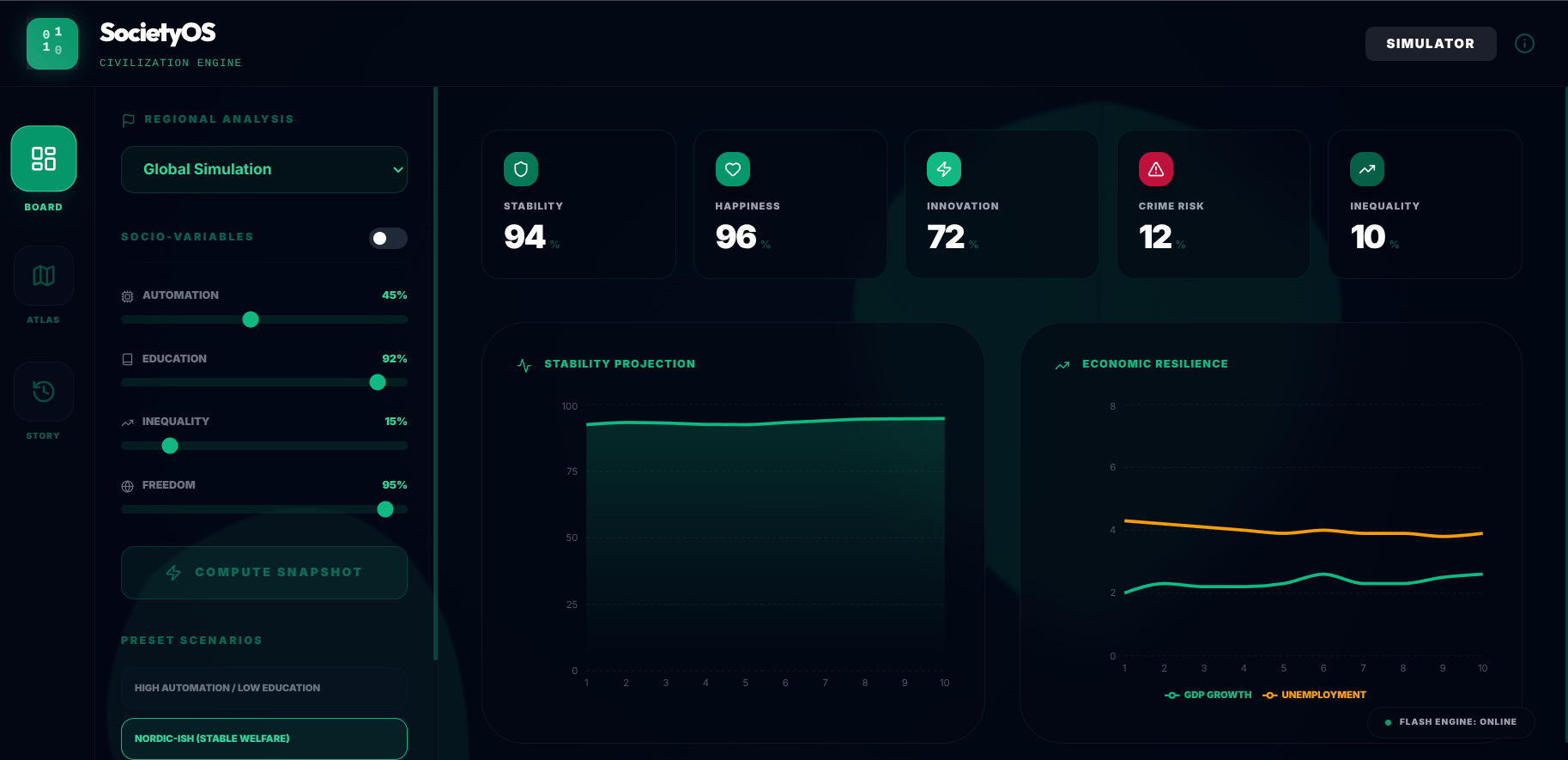
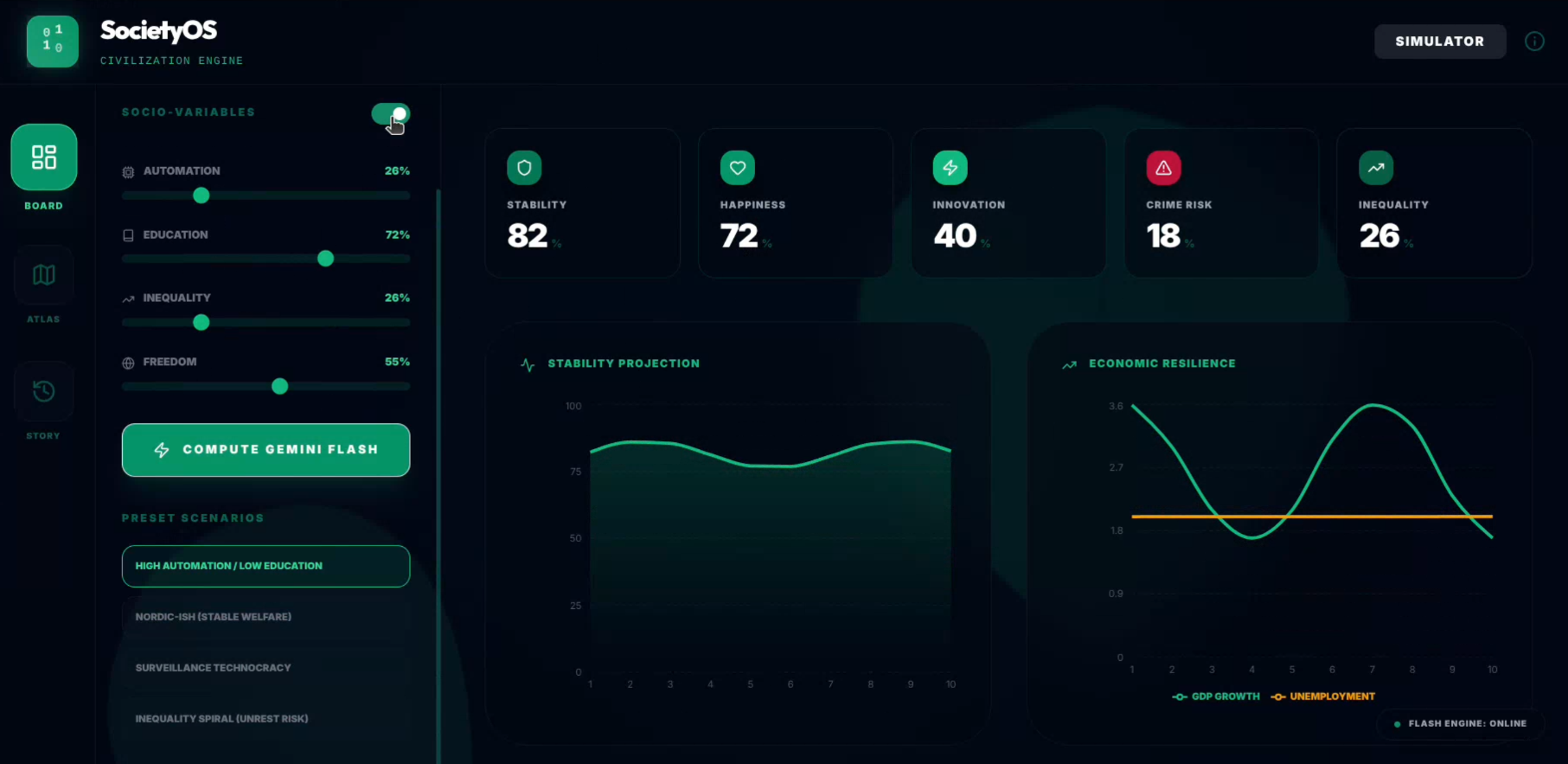
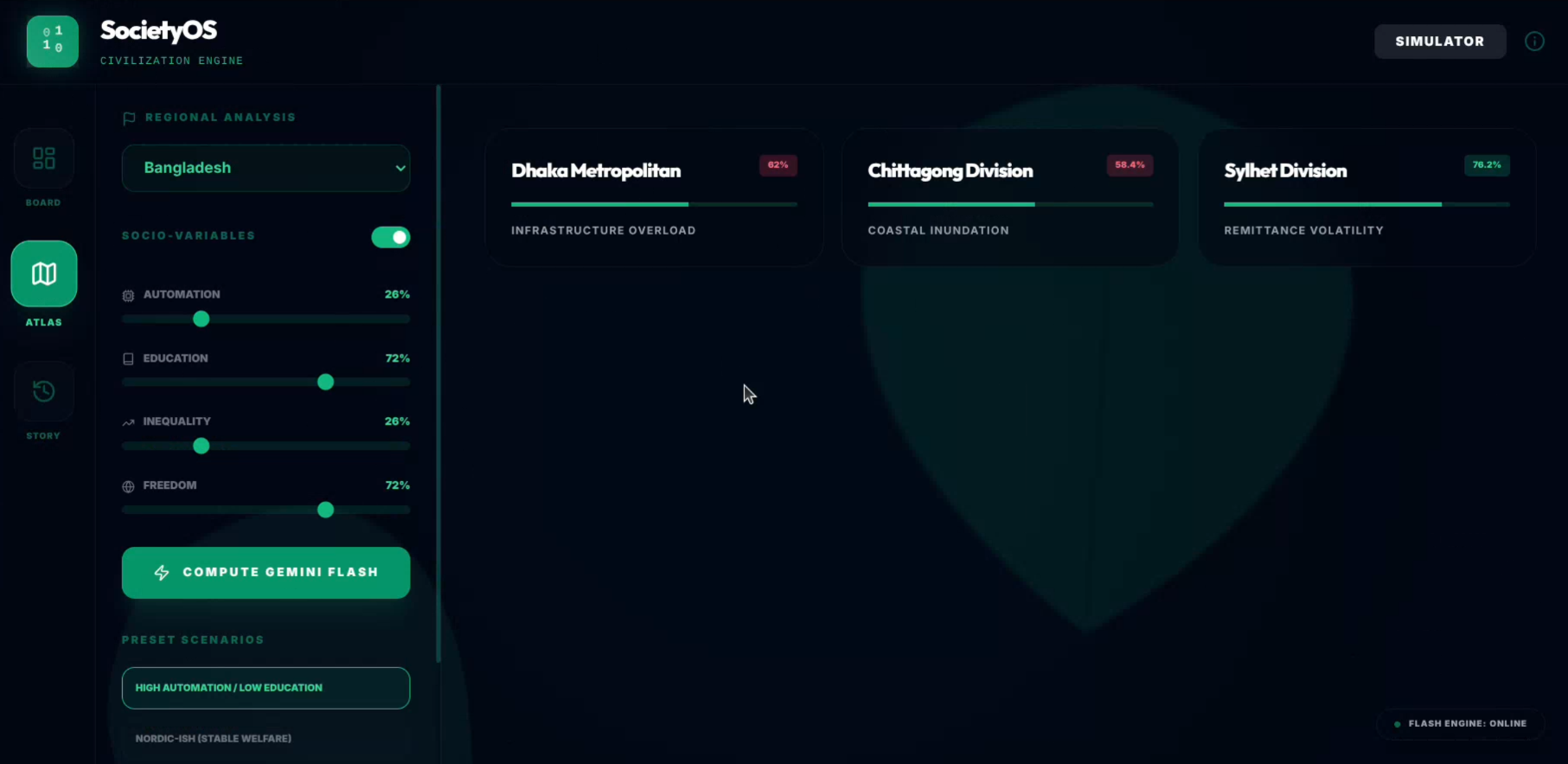
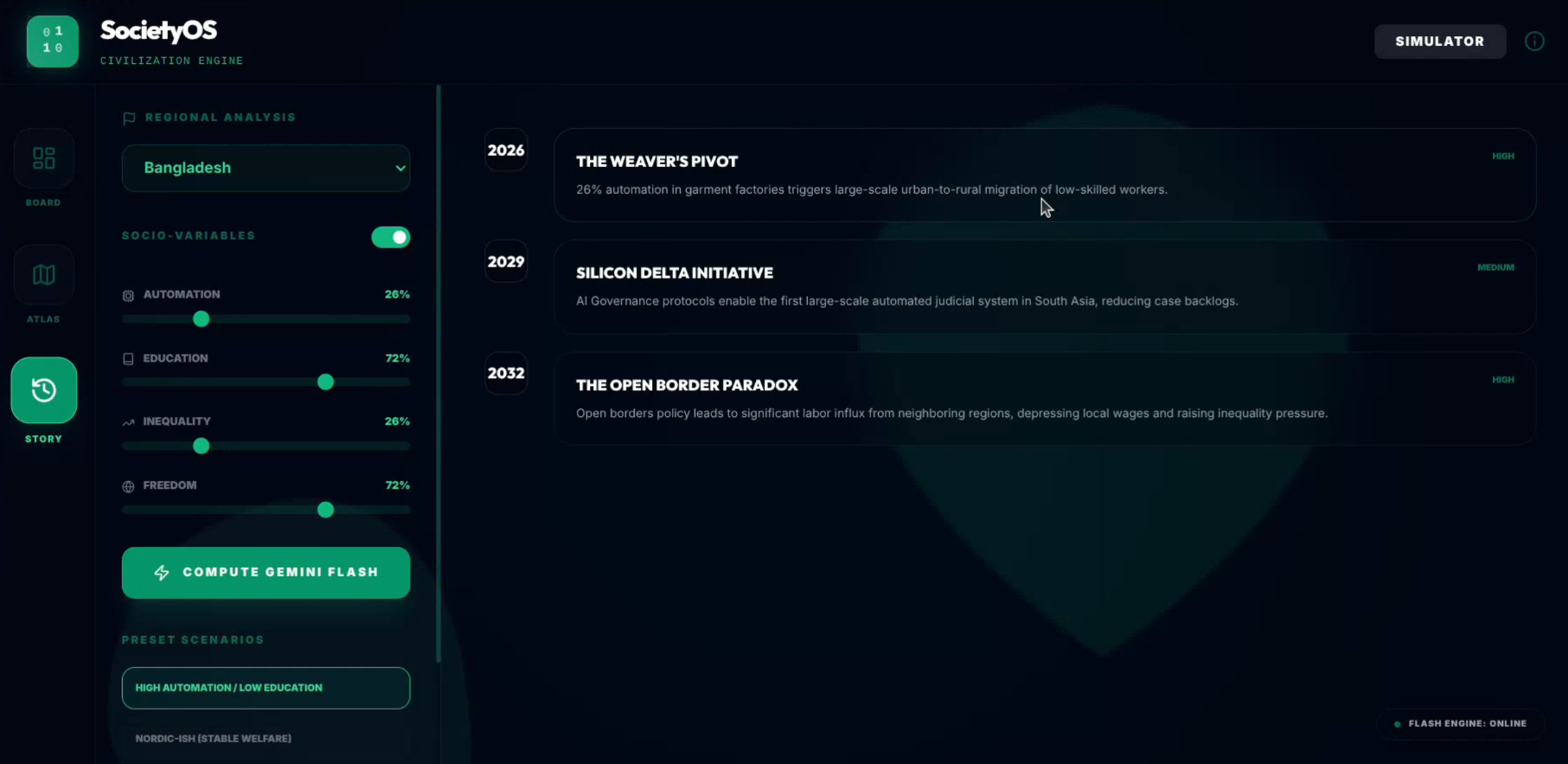
SocietyOS is an interactive societal simulation engine that models socio-economic dynamics at both global and country-specific levels. Users can configure structural variables such as automation, education, inequality, and civil freedom, and run simulations that generate adaptive projections across stability, happiness, innovation, crime risk, and economic resilience. Beyond numerical outputs, the platform provides higher-level interpretation through the Atlas layer, which offers strategic structural insights, and the Story layer, which contextualizes these outcomes into an understandable narrative of societal evolution.
How we built it
We built SocietyOS using a modern web-based frontend focused on clarity, interaction, and real-time feedback. The core intelligence layer integrates directly with Gemini Flash via API, which acts as the computational backend of the platform. When a simulation is executed, the selected socio-structural configuration is transmitted to Gemini Flash, where projections are generated dynamically based on contextual inputs rather than predefined rules. Interactive visualizations were then used to present stability trends and economic resilience over time, creating a balance between analytical depth and usability.
Challenges we ran into
One of the biggest challenges was ensuring that the system felt structured and coherent rather than purely generative. We needed the outputs to reflect the selected socio-variables in a way that made logical sense, not just sound plausible. Managing real-time API interaction while keeping the interface responsive was another challenge, especially during simulation processing. Designing a smooth flow between configuration, computation, and interpretation required multiple iterations and careful tuning of both data flow and presentation.
Accomplishments that we're proud of
We are proud of building a simulation engine that dynamically recalibrates projections based on regional context and structural inputs. The successful integration of Gemini Flash as a real-time intelligence backend allowed us to move beyond static modeling and into adaptive simulation. We are especially proud of the Atlas and Story layers, which elevate the platform from displaying raw metrics to offering meaningful strategic and contextual understanding.
What we learned
This project taught us how powerful AI can be when used as part of a structured system rather than as a standalone text generator. We learned the importance of architectural clarity when integrating large language models into applications that require consistency, interpretability, and contextual reasoning. The experience also deepened our understanding of how real-time AI computation can support exploratory modeling and scenario-based analysis.
What's next for SocietyOS
Moving forward, we plan to expand SocietyOS with comparative multi-country simulations, historical baseline anchoring, and more granular policy-level variables. We also aim to improve scenario saving, versioning, and long-term projection controls. Our long-term vision is to evolve SocietyOS into a scalable platform that supports research exploration, educational experimentation, and structured policy scenario planning.


Log in or sign up for Devpost to join the conversation.