-
-
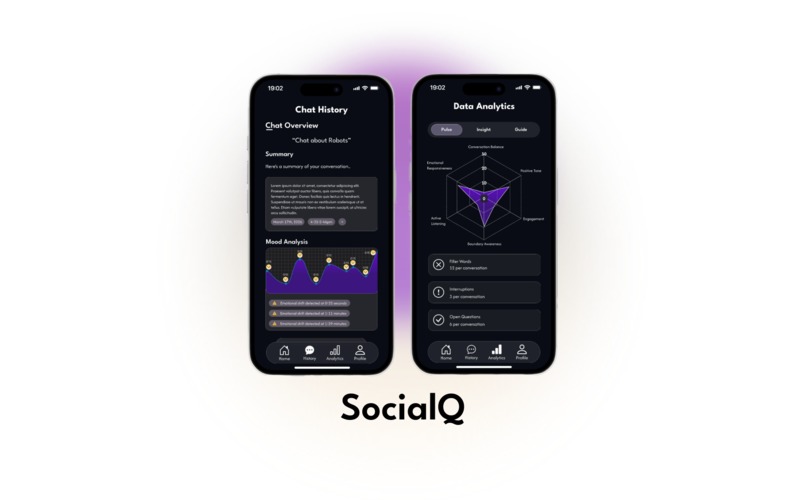
Post SocialQ session synthesized within the app.
Inspiration
We were inspired by home tech, meta glasses and their UI, gaming UI especially because they display detailed bits of information in a digestible fashion. Our aim was to embody some parts of the sci-fi aesthetic while also maintaining some minimalism for the sake of the smart glasses and to prevent information overload for the user.
What it does
Personalized onboarding:
- Users can select what they want support with: social anxiety
- Difficulty reading facial expressions, understanding tone, or sarcasm
- Sensory sensitivities in social environments
How we built it
We started the project by researching
Challenges we ran into
One of the main challenges was balancing helpful feedback with privacy and ethical considerations, since analyzing facial expressions and tone raises important concerns about consent and data usage.
One of the challenges we faced was that not all team members were present at the start of the project, which made it harder to move quickly from research into the design phase. While we started strong, our time management became more challenging toward the last two days of the hackathon, especially on the final day.
Although we created a design system early on, not everyone on the team was fully familiar with how to use it. As a result, we weren’t able to fully benefit from the speed and consistency a design system typically provides. Some time was spent figuring out how to implement it properly and adjusting certain flows instead of focusing entirely on our core features.
Because of these time constraints, we weren’t able to complete a few things we originally planned, such as adding animations for the smart glasses interface, building a fully polished prototype of the companion app, and gathering more footage for our demo video. Despite this, we were still able to develop and present the core concept behind SocialQ and its potential impact.
Accomplishments that we're proud of
One thing we’re especially proud of is coming up with a strong concept that has real potential to make an impact. Our idea explores how wearable technology and AI could help people better understand tone, emotions, and social cues during conversations. We believe this concept has meaningful real world application for people who may be struggling socially.
We’re also proud of how we were able to take this idea and quickly translate it into a clear product vision during the hackathon. In a short amount of time, we defined the core experience, designed the interaction modes (Pulse, Insight, and Guide), and created visual concepts for both the smart glasses interface and the companion app. This helped us communicate not just what the technology could do, but how it would actually feel to use in real conversations.
Even though we ran into time constraints, we’re proud that we were able to develop a thoughtful concept that balances accessibility, emotional awareness, and emerging technology. The project helped us explore how design and AI could work together to support better communication and stronger social connections.
What we learned
We learned how to utilize our strengths and improve where our gaps may lie in skill level by taking the initiative to learn design stuff outside of our comfort zone.
What's next for SocialQ
The future of SocialQ includes:
- Refining the real-time conversation interface shown in the smart glasses
- Improving how emotional tone and conversational shifts are visualized
- Exploring more advanced AI-assisted social feedback systems
- Conducting user testing with neurodivergent communities to better understand their needs
Built With
- figma

Log in or sign up for Devpost to join the conversation.