-
-
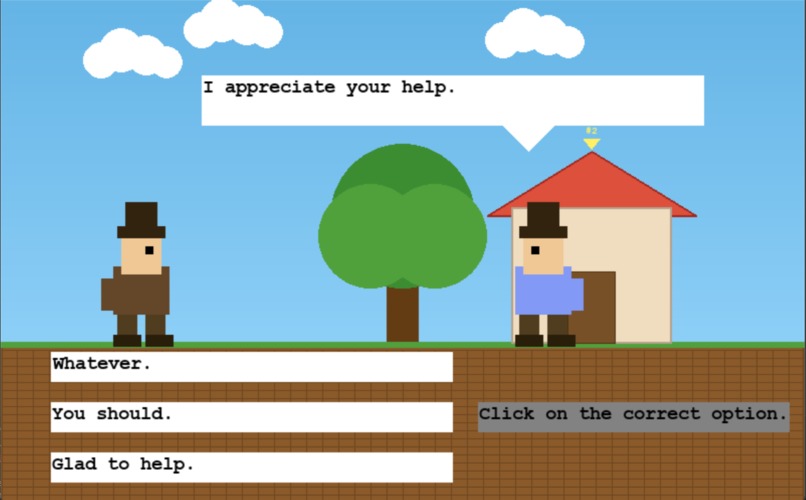
Social Interaction Part
-
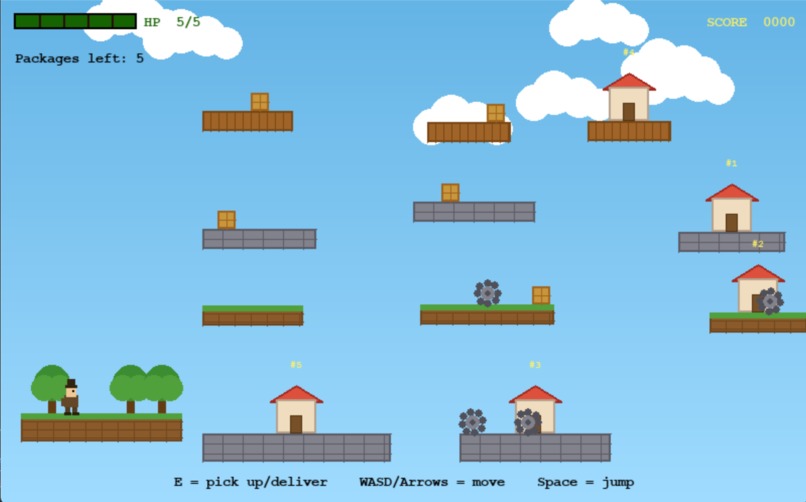
Platformer Part
Inspiration
Social XP was inspired by the idea of helping autistic children (specifically ages 5 - 10 years old) practice everyday social interactions in a safe and engaging environment. Many social situations involve choosing an appropriate response, which can sometimes be difficult to learn through traditional teaching methods alone.
We wanted to create something interactive that allows players to practice social decision-making while playing a game. By combining a 2D platformer with short dialogue scenarios, the game turns social learning into an activity that feels fun and rewarding rather than instructional.
What it does
Social XP is a single-player 2D platformer game where players deliver parcels to houses across a randomly generated map.
Players must navigate obstacles such as rolling balls and gaps in the terrain, which cost a life if hit. The player starts with five lives.
When a parcel is delivered to the correct house, the player receives a message from the resident and must choose between three possible responses. Only one response is socially appropriate.
Choosing the correct response allows the player to continue and awards points.
Choosing an inappropriate response removes a life and shows the correct answer.
Each successful delivery adds 100 points to the score. Once all parcels have been delivered, the player wins the game. If the player loses all lives, a game over screen appears.
The game is designed as a prototype to explore how gameplay can help teach social appropriateness.
How we built it
Social XP was built using Python and the Pygame library to create a 2D platformer experience.
The game includes several key systems:
-A randomly generated map containing houses and parcels
-Platformer movement and obstacle mechanics
-A parcel pickup and delivery system
-A dialogue system that presents three response options to the player
-A life and score system
-Game over and win states
Pygame was used to handle rendering, player input, collision detection, and game logic, allowing us to rapidly prototype gameplay during the hackathon.
Challenges we ran into
One challenge was combining platformer gameplay with social interaction mechanics. We needed a way to smoothly transition from movement gameplay to dialogue choices when a delivery occurs.
Another challenge was implementing random map generation while ensuring the level still remained playable and reachable for the player.
Time constraints during the hackathon also meant we had to focus on building a working prototype, prioritizing core mechanics such as parcel delivery, dialogue choices, and scoring over additional features.
Accomplishments that we're proud of
We are proud that we were able to create a working prototype that combines action gameplay with social learning within the limited time of a hackathon.
Some highlights include:
A fully playable platformer built in Python using Pygame
A dialogue system that tests socially appropriate responses
A randomly generated game map
A clear win/lose gameplay loop
Most importantly, we created a concept that shows how games can be used as tools to practice social skills.
What we learned
During the project we learned more about:
Rapid prototyping in Pygame
Designing gameplay systems that support a learning objective
Creating simple procedural map generation
Balancing game mechanics with educational goals
We also learned how important it is to design interactions carefully when building tools for neurodiverse users, ensuring the experience is clear and accessible.
What's next for Social XP
In the future, we would like to expand Social XP beyond a prototype by adding:
More levels and environments
A larger set of social scenarios
Better feedback explaining why responses are appropriate or inappropriate
Difficulty scaling for different skill levels
Improved visuals and user interface
Potential progress tracking or learning analytics
Ultimately, the goal is to develop Social XP into a more complete experience that can help autistic children practice and build confidence in social interactions through play.

Log in or sign up for Devpost to join the conversation.