-
-
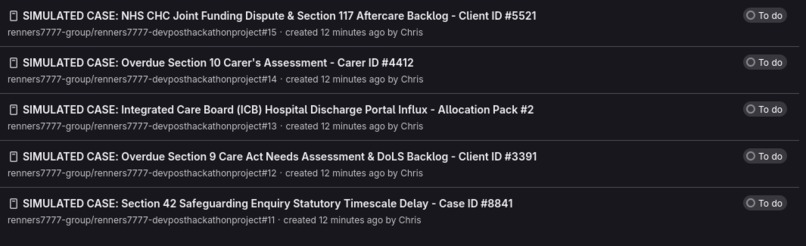
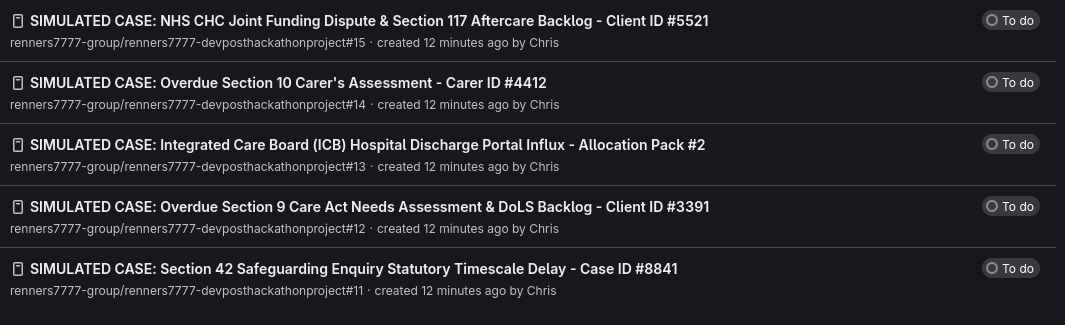
GitLab Work Issues
-
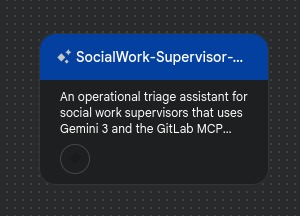
Vertex AI Agent
-
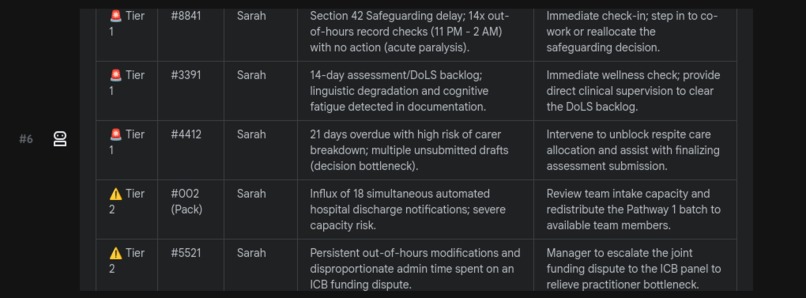
Output created by Agent
Inspiration
As a full-time social work manager, I see the immense pressure on frontline practitioners every single day. In social care, workforce burnout isn't just an HR problem—it is a systemic risk that directly impacts the safety of vulnerable individuals.
When a dedicated case worker becomes completely overwhelmed, they don't just stop caring; they hit action paralysis. They might open a volatile case file dozens of times late at night, agonizing over a decision, but fail to submit a report because of sheer cognitive fatigue. Traditional management tools only look at lagging indicators, like a completed case count. I was inspired to build this project to create a proactive, behavioral early-warning system that alerts supervisors before a crisis occurs, allowing them to step in and support their team.
What it does
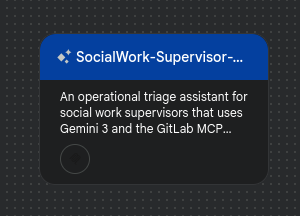
Social Work Triage Agent acts as an organizational health monitor that reads behavioral signals, identifies operational friction, and surfaces workforce risk.
Note to Evaluators: Because the Vertex AI Agent Builder simulator sits securely inside my Google Cloud project console, I have put together a comprehensive video walkthrough in the media section above. This video demonstrates the live agent connecting across our Model Context Protocol (MCP) bridge, actively querying the GitLab repository API, and generating the real-time worker stress and burnout diagnostics.
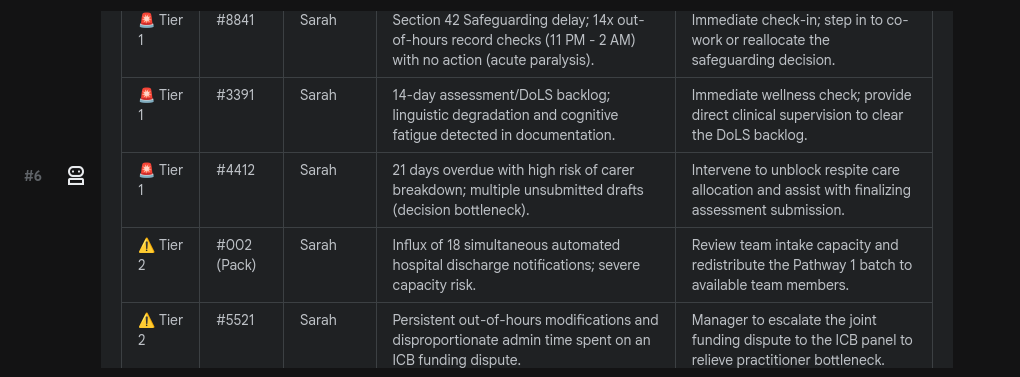
By connecting directly to a team's workspace (staged here via GitLab issues) using the Model Context Protocol (MCP), the agent analyzes live issue telemetry. Instead of just listing cases, it reads raw narrative descriptions and system metadata to detect indicators of severe worker stress. It flags:
- Action Paralysis: Identifying when high-risk files are accessed repeatedly out-of-hours with zero progress saved.
- Quality Degradation: Spotting sudden drops in documentation standards, like fragmented notes or missing mandatory statutory declarations or breaching statutory timescales under the Care Act due to fatigue..
- Systemic Volume Flooding: Warning supervisors when automated allocation algorithms overload a single worker past safe operating ceilings.
It then translates these patterns into an actionable, priority-ordered supervisory intervention blueprint.
How we built it
The architecture of this project bridges advanced LLM reasoning with live, production-grade enterprise infrastructure:
- Frontend Orchestration: Built using Vertex AI Agent Builder, leveraging Gemini's complex reasoning and native tool-calling capabilities.
- The Protocol Bridge: Implemented a custom Model Context Protocol (MCP) server. Because the platform requires absolute compliance with the JSON-RPC streaming protocol, I engineered a serverless bridge deployed as a 2nd-Gen Google Cloud Function.
- Cloud Run Infrastructure: The backend automatically wraps the Python code into an isolated container layer on Cloud Run, natively handling scaling, security, and HTTPS protocol handshakes.
- Live Integration: The Cloud Run backend handles incoming MCP initialization handshakes, executes secure, token-authenticated requests to the GitLab API, fetches live issue data, and structures it seamlessly for the agent.
Challenges we ran into
The road to a working deployment was full of steep technical hurdles:
- Network Isolation: Moving from a local testing environment to a cloud-accessible sandbox required overcoming rigid local environment restrictions and setting up secure tunneling hooks during early prototyping.
- Strict Protocol Compliance: Vertex AI’s inline simulator enforces incredibly strict, low-level HTTP and JSON-RPC compliance. Standard Python web frameworks repeatedly threw syntax errors due to the unique way the simulator streams data. I bypassed this by engineering a custom stream interceptor socket routing system locally, which I successfully refactored into a clean HTTP payload map inside Google Cloud Functions.
- Data Alignment: Ensuring the test cases inside GitLab perfectly reflected realistic, non-obvious human behaviors (rather than generic code bugs) required carefully structuring the data to provide the agent with a meaningful narrative to analyze.
Accomplishments that we're proud of
- Production-Grade Architecture: Successfully moved the entire framework off a local laptop environment and deployed a live, permanent, serverless infrastructure on Google Cloud that scales to zero when idle.
- Authentic Live Integration: Creating a true, end-to-end integration where Vertex AI actively calls a custom cloud API to query real-time data from GitLab via the MCP protocol.
- A Meaningful Use Case: Shifting the conversation of Generative AI away from generic marketing chatbots and applying it to a high-impact, human-centric solution that addresses real-world public service burnout.
What we learned
This project was an incredible masterclass in serverless architecture and protocol engineering. I deeply explored the mechanics of the Model Context Protocol (MCP), learning how to translate raw, persistent streaming requirements into stateless cloud environments.
On a human level, I learned how powerful Generative AI can be when applied to complex pattern recognition in behavioral data. Seeing an LLM accurately diagnose workforce stress simply by reading between the lines of text descriptions and system timestamps proved how much latent value exists in everyday operational metadata.
What's next for Social Work Triage Agent
The immediate next step is scaling this system across dedicated case management ecosystems to track caseload distribution effectively. By monitoring these operational and behavioral metrics continuously, agencies can build intelligent, multi-agent networks that automatically detect when a staff member is reaching a critical threshold. This will allow systems to dynamically intercept incoming emergency crisis referrals and reallocate them to other queues, completely preventing automated queue flooding and safeguarding both frontline workers and the communities they serve.
Built With
- gemini-1.5-pro
- gitlab-api
- google-cloud
- google-cloud-run
- model-context-protocol
- python
- vertex-ai

Log in or sign up for Devpost to join the conversation.