-
-
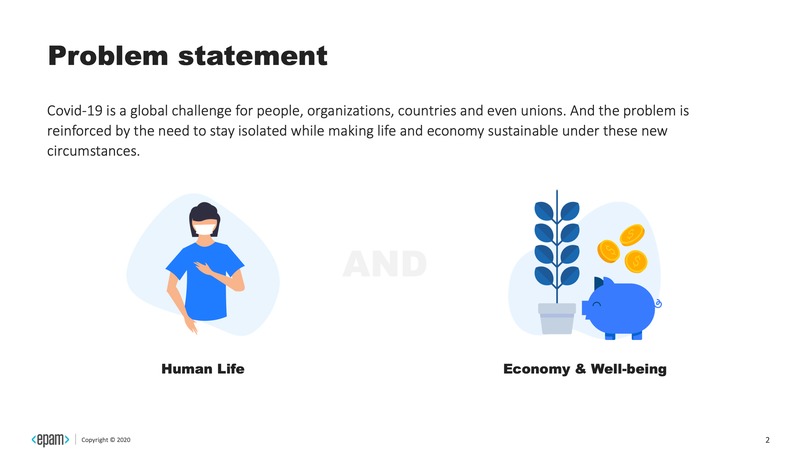
Problem statement
-
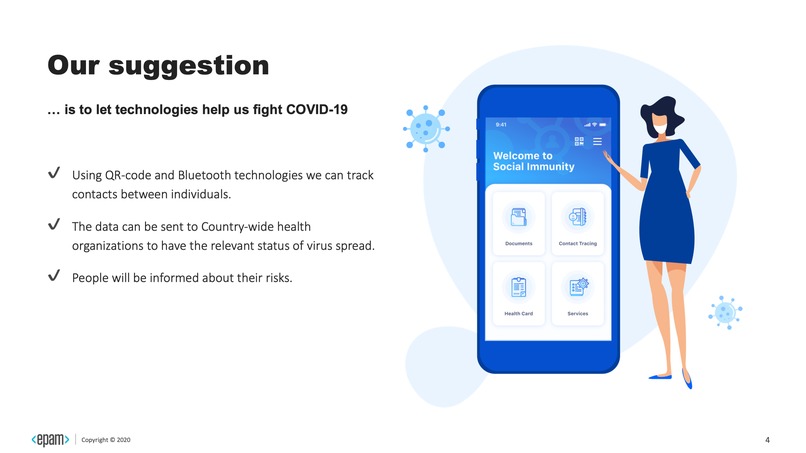
Our Suggestion
-
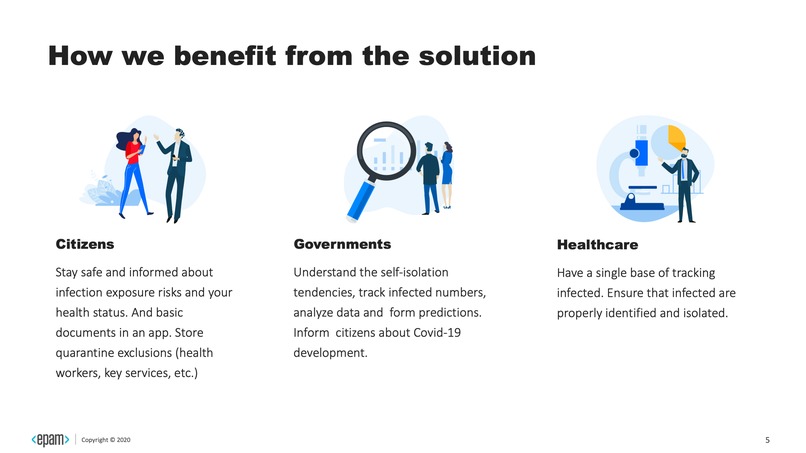
Benefits
-
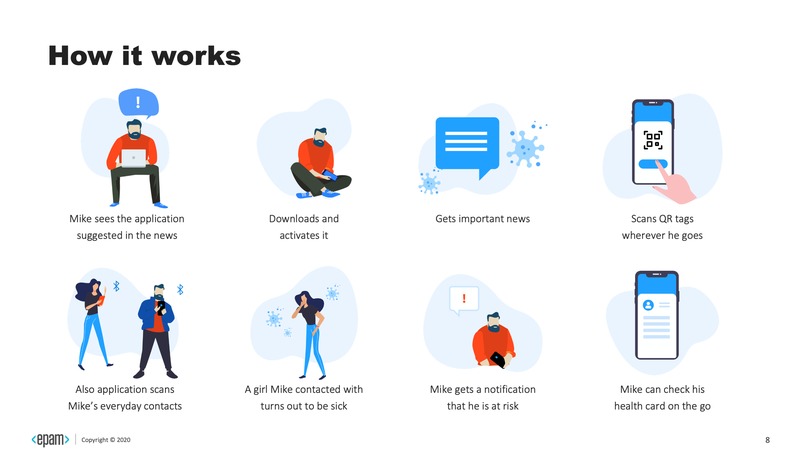
How it Work
1. The problem your project solves
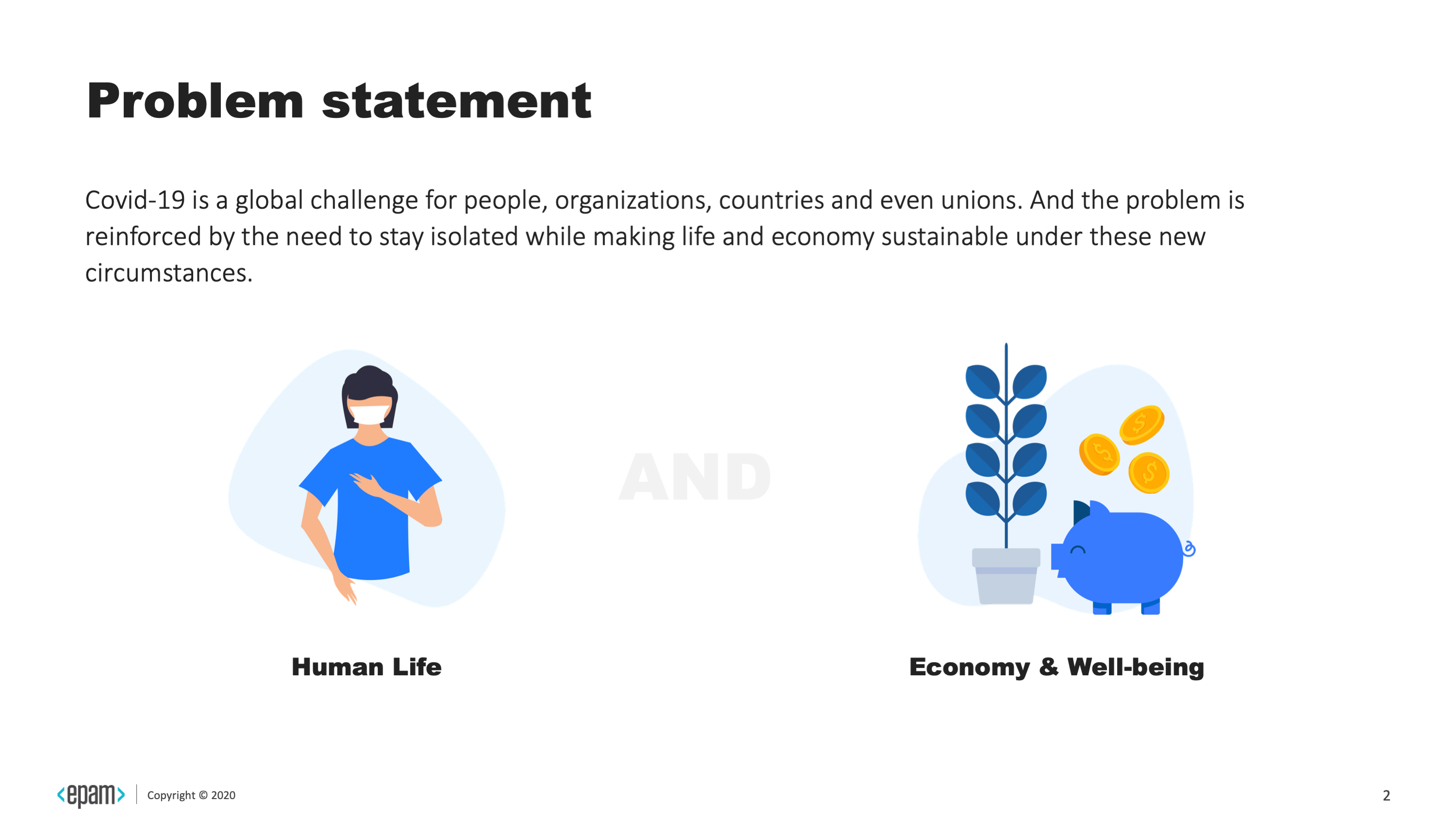
Covid-19 is a global challenge for people, organizations, countries and even unions. The problem is reinforced by the need to stay isolated while making life and economy sustainable under these new circumstances. And often our choice nails down to either economy priority when we keep living normal life but lose people lives, or social priority when we save lives but lose economy and well-being. So, our team aimed to help and resolve this dilemma.
And the problem we address is disease spread in societies and the level of control from government on the data regarding the disease.
2. The solution you bring to the table (including technical details, architecture, tools used)
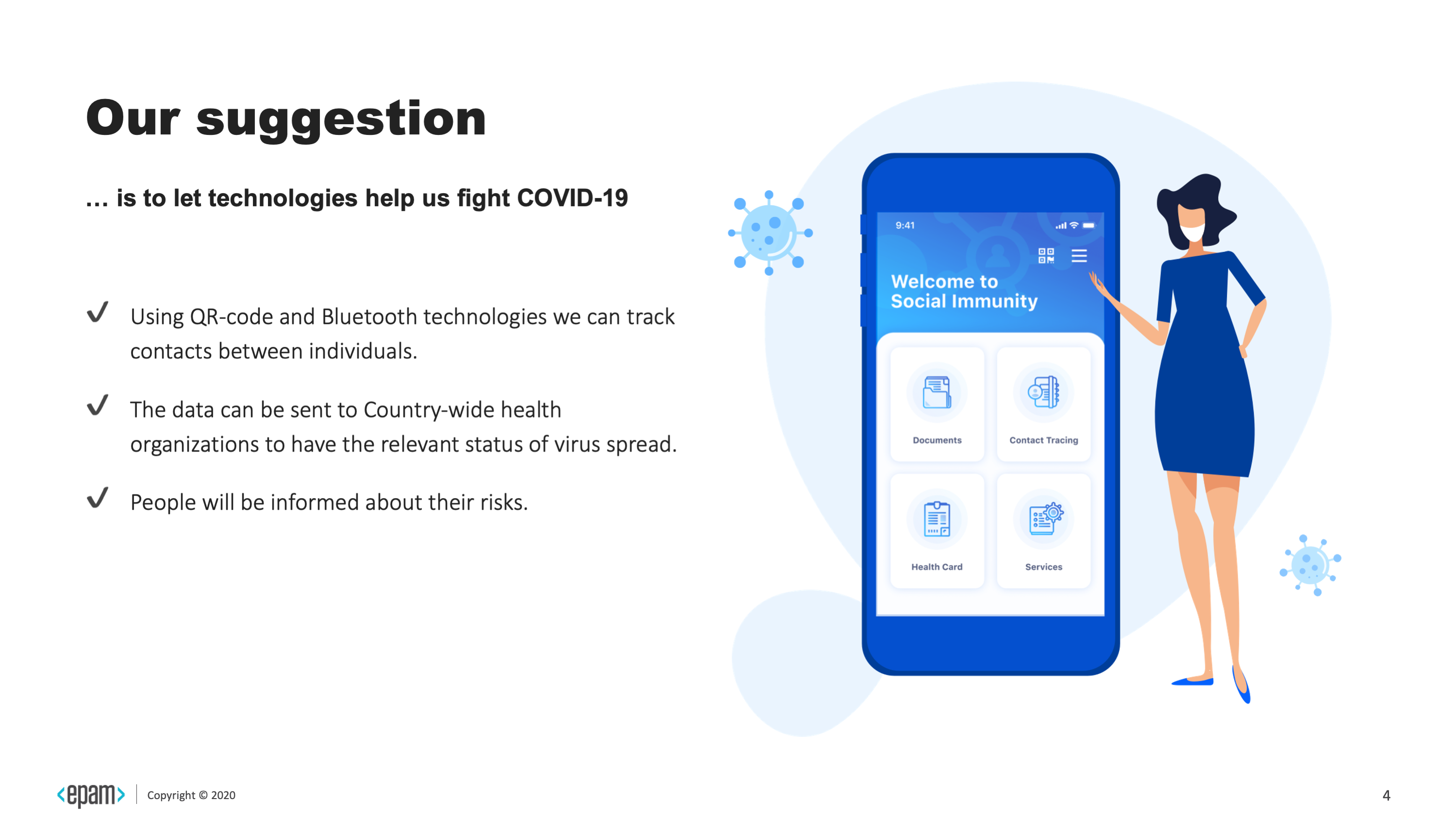
Our suggestion is to let technologies help us fight COVID-19:
- Create a new digital platform that enables capabilities to build e-society applicable for normal life and pandemic crisis;
- Create a mobile app to simplify access of users to information and share their data;
- Provide users access to their documents and government services available at the specific region to make application useful every day;
- Integrate with national ministries of health and clinics systems to be ready for current and possible pandemics in the future;
- Focus on the features that help to fight Covid-19:
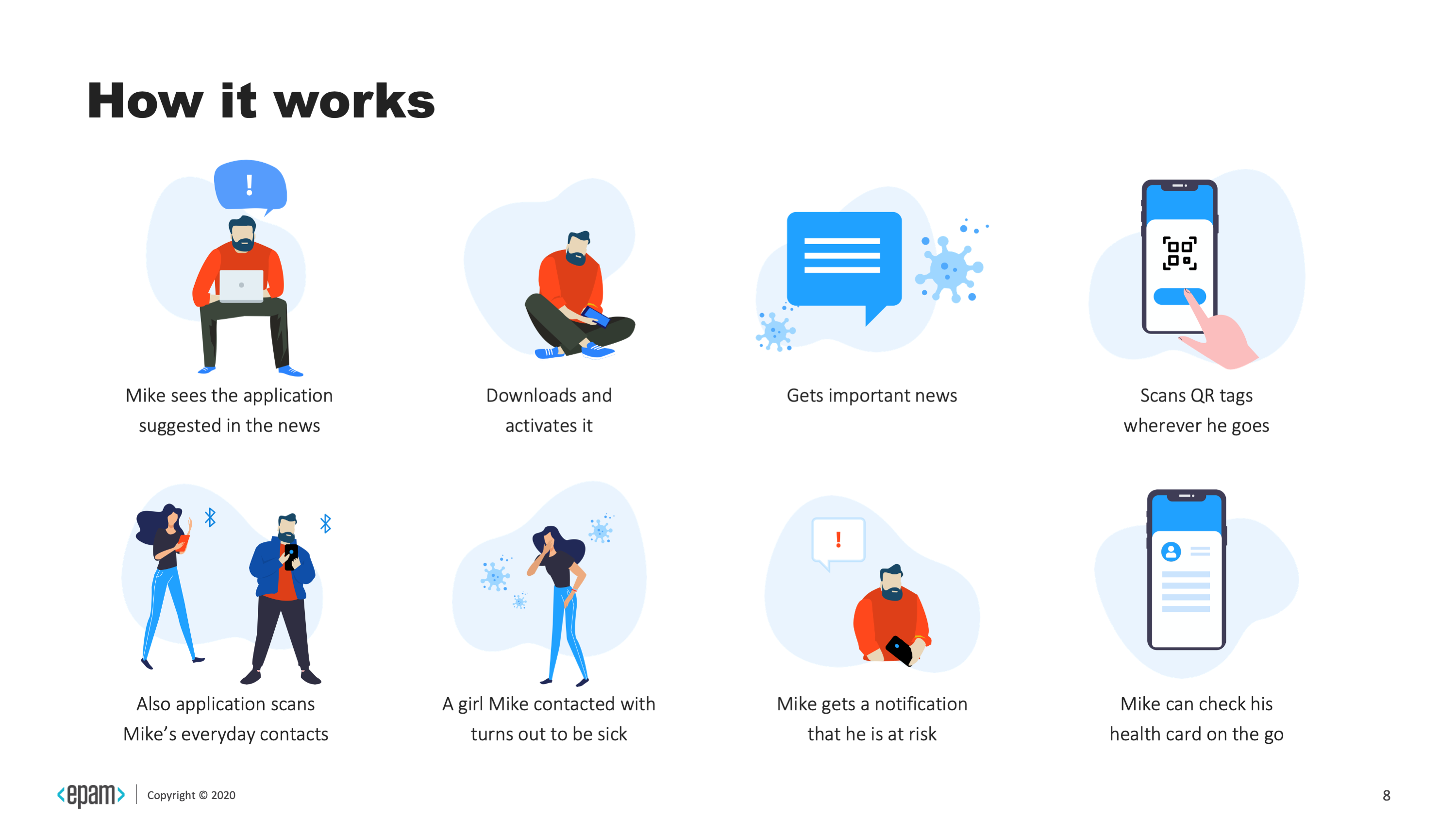
- Using QR-code and Bluetooth technologies we can track contacts between individuals.
- Health status will be updated basing on the trustful information from relevant data feeds (e.g. Ministry of Health register, or clinics testing register)
- The data can be sent to country-wide health organizations to have the relevant status of virus spread.
- People will be informed about their risks.
Technical details:
- Native applications for Android and iOS
- Infrastructure agnostic backend based on Kubernetes to run all business services
- API Gateway specific to infrastructure (managed gateway in Cloud, or Kong for on-premise installations)
- Polyglot backend using microservice architecture style
- Persistence layer:
- Postgres to keep transactional data
- Graph database to run complex analytics to define users at risk
- Secured interaction between data sources using similar to X-Road approach.
3. What we have done during the weekend
Our team has shaped the idea in detail and considering the fact that we are mostly UX designers/Architect/BA team we’ve created 3 main artifacts for the submission:
1. Detailed Presentation of our approach and solution
2. An interactive prototype showing how our application does its job
3. A video recording of our problem, solution along with the story on how to use the application we are proposing
4. The solution’s impact to the crisis
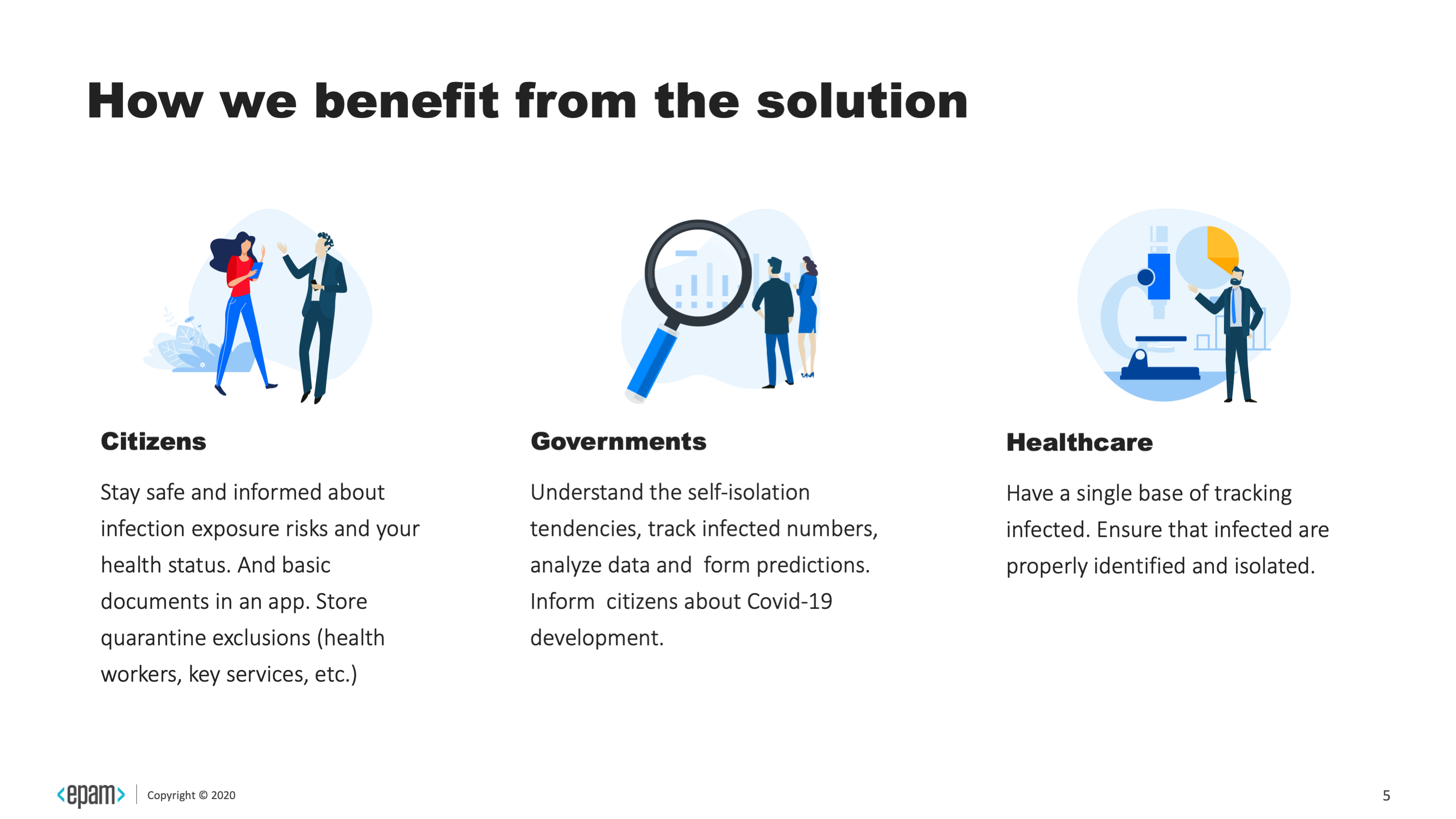
The main goal of our Social Immunity application is to be able to control such a crisis by data and digital approaches. When the problem is visible – it is much easier to solve it. And our application makes social contacts visible and helps to manage risky contacts and people who are out of the risk to enable economic sustainability and citizens' well-being. Ideally, when the next pandemic/crisis arrives – we will be able to control and stop its spread by using our application.
So our solution will enable, from one side - limitation of spreading the disease by informing users of their risks and helping them to manage dangerous contacts, from another – for people who either have immunity or are working in the key areas that need to be sustained – the app provides a way to control the exceptions from quarantine or to assure that this person can be safe in public. This again allows moving gradually to the regular way of living.
5. The necessities in order to continue the project
The main necessity for our team would be having a clear stakeholder who is interested in implementing the solution on a countrywide levels. As we already have experience in creating such a solution for Ukraine – we will be effective in delivering it.
6. The value of your solution(s) after the crisis
As mentioned, our solution will keep bringing value after the crisis in multiple ways:
- Any potential pandemic or epidemic can be tracked via our solution, thus helping to prevent the global spread of diseases
- In-depth data analysis can be done basing on the anonymized data gathered by our application allowing to create prognoses and refine models on how to best approach pandemic fighting efforts
- Simplify access of citizens to official personal documents, specifically health information in order to provide actual data regarding a person's immunity while traveling inside the country and all over the world
Inspiration
Our team already has experience in building the COVID-preventive app for the Ukrainian Government within the Diia application. So we wanted to expand the idea, make it reusable and available for the largest audience to save as many lives as possible and ideally based on the data and people vigilance fight off the pandemic.
What it does
Our solution aims to track contacts between individuals and understand disease spread by using QR-code and Bluetooth technologies and including the integration with Country-wide health organizations to deliver the relevant status of the infected people. While keeping individuals informed about their risks. If the solution is country-wide adapted it'll allow for additional Data Analysis.
How we built it
We decided to concentrate on User experience and architecture for future solution during the hackathon. We invested major efforts in elaborating major use cases, simplifying of usage which resulted in the creation of a clickable prototype showing capabilities of the new application. Another focus was devoted to the architecture of the whole system including frontend and backend. Major attention was paid for the processing of personal data and secured integration with national healthcare systems.
Challenges we ran into
- Vast adoption among citizens. According to the latest researches, it is needed to have more than 60% of the population in the region using the same application
- Processing of personal information of users including data and interactions to prevent possible misuse of collected information
- Integration with national healthcare systems to deal only with valid data regarding pandemics
- Simple and smooth experience for tracking user contacts using manual (QR-tags) and automated (Bluetooth) means
Accomplishments that I'm proud of
- Features valuable for the pandemic situation and normal life to be ready for the next challenges that might appear
- Capability to combine different ways of tracking user contacts in one app like QR-tags and Bluetooth
- Data-driven analytics capabilities we included to backend layer
What I learned
- To face global/nationwide challenges society needs a trusted global/nationwide platform, which can help to understand how big the risk is and mitigate it effectively
- Trust and security are most critical for such platforms
- Platform should be valuable and beneficial for a user during normal life and pandemics
What's next for Social immunity
- Bespoke mobile application covering major aspects of digital society
- Secured channel for transferring data between mobile and backend
- Scalable and robust platform enabling easy onboarding of new business service
- Reference architecture implementation and adoption for country specifics
- Built-in security for processing personal data and user documents
- Secured integrations with authorized sources if data
- Low-code approach based on BPMN, dynamic forms for administrative services module
- Data drive decisions based:
- BI and Data analytics
- Machine learning capabilities for scientists to analyze virus spread
- Rollout new government service on time
- BI and Data analytics
- Cross-government interoperability
Built With
- kubernetes
- native
- polyglot
- postgresql
- react
- sql
- swift



Log in or sign up for Devpost to join the conversation.