Inspiration
AI especially ChatGPT has become a strong partner in all our activities. Unfortunately this Large Language Model has the problem of hallucinating, i.e. to generate fake data. Especially when it comes to urls that the model provides. It is highly difficult for us to find out the sources from where the model took its data and differentiate the facts and valid urls. Hence to fasten our daily interactions with AI we require a better solution.
What it does
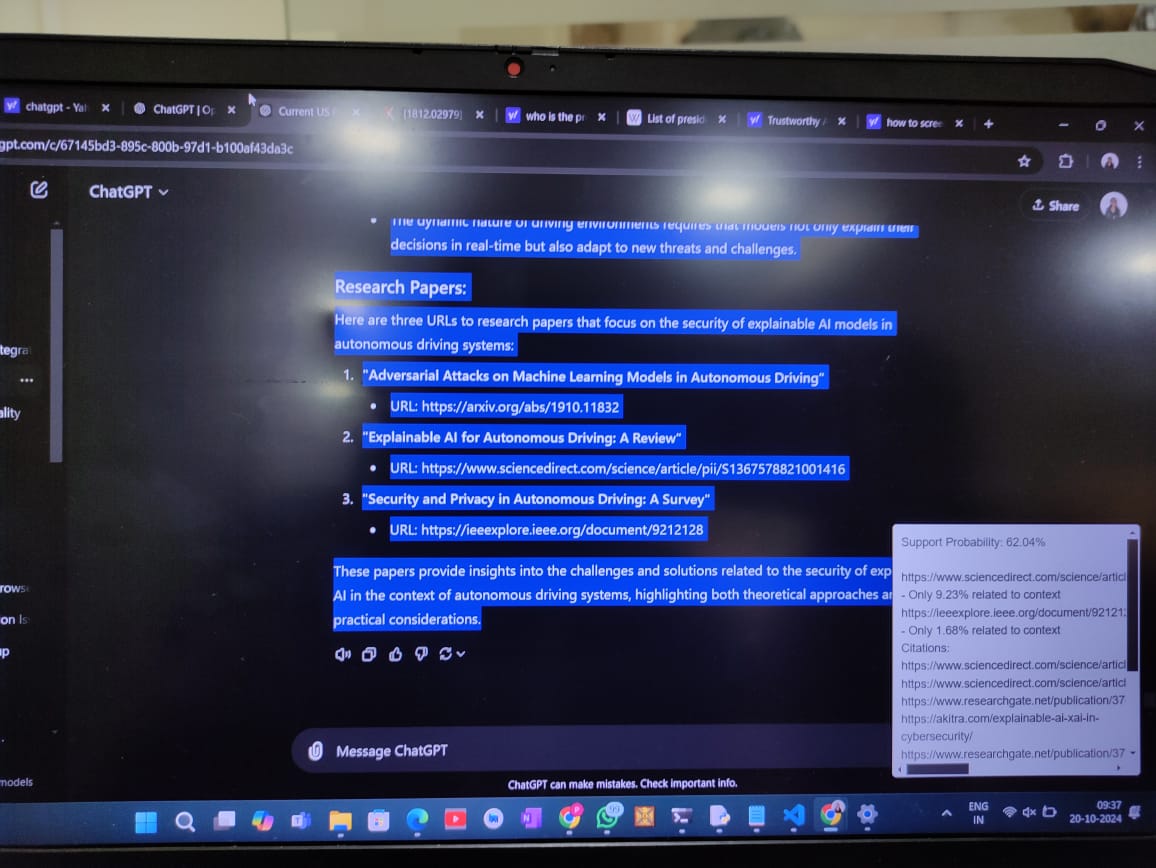
SochFacts is a web extension that aids to validate the correctness of AI generated data. The extension takes in the prompt and output given to the AI and highlights quantity and portion of the AI generated content which are expected to be hallucinated. It also highlights all the urls in the content that are invalid or having no relation to the content. The level of similarity of URLs are also displayed alongside. In addition, the extension also lists out a few of the sources from which the generated content would have been taken.
How we built it
The extension is built in javascript and python. Javascript handles the web extension displays and requests while python handled the machine learning and computation parts. The hallucinated portions are identified using the Ollama's Bespoke-Minicheck. Web scraping is used to find the citation and context dependency of the prompt. Each URL is chosen from the text and is checked for semantic similarity based on which it decides the relevance of the url.
Challenges we ran into
We had difficulty to determine tools that support our aims. We also had to try different models and approaches for detecting hallucination context.
Accomplishments that we're proud of
We are happy that we could try our best and produce a well suited web extension, which was quite different from the other projects we have done earlier.
What we learned
We learned multiple things from hallucinations in llm models to web extension creation.
What's next for SochFacts
We are highly interested to take this project further improving the model and possibly expecting to build a more accurate hallucination detection model.

Log in or sign up for Devpost to join the conversation.