-
-
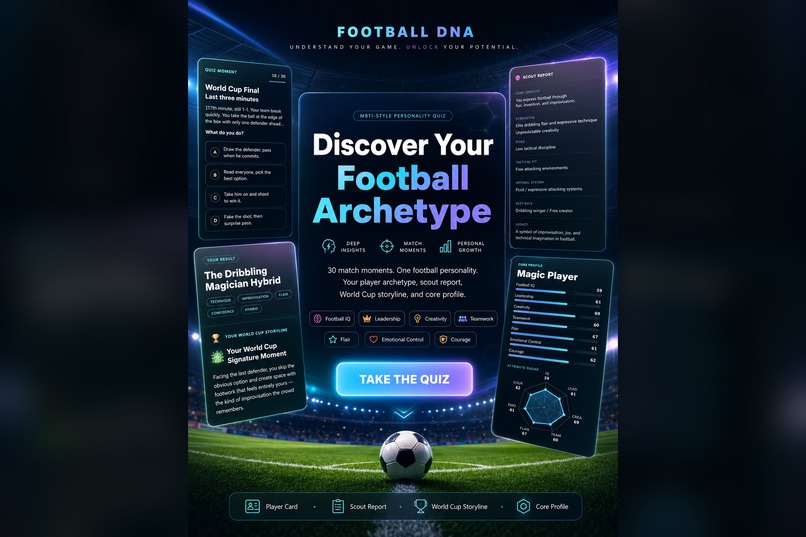
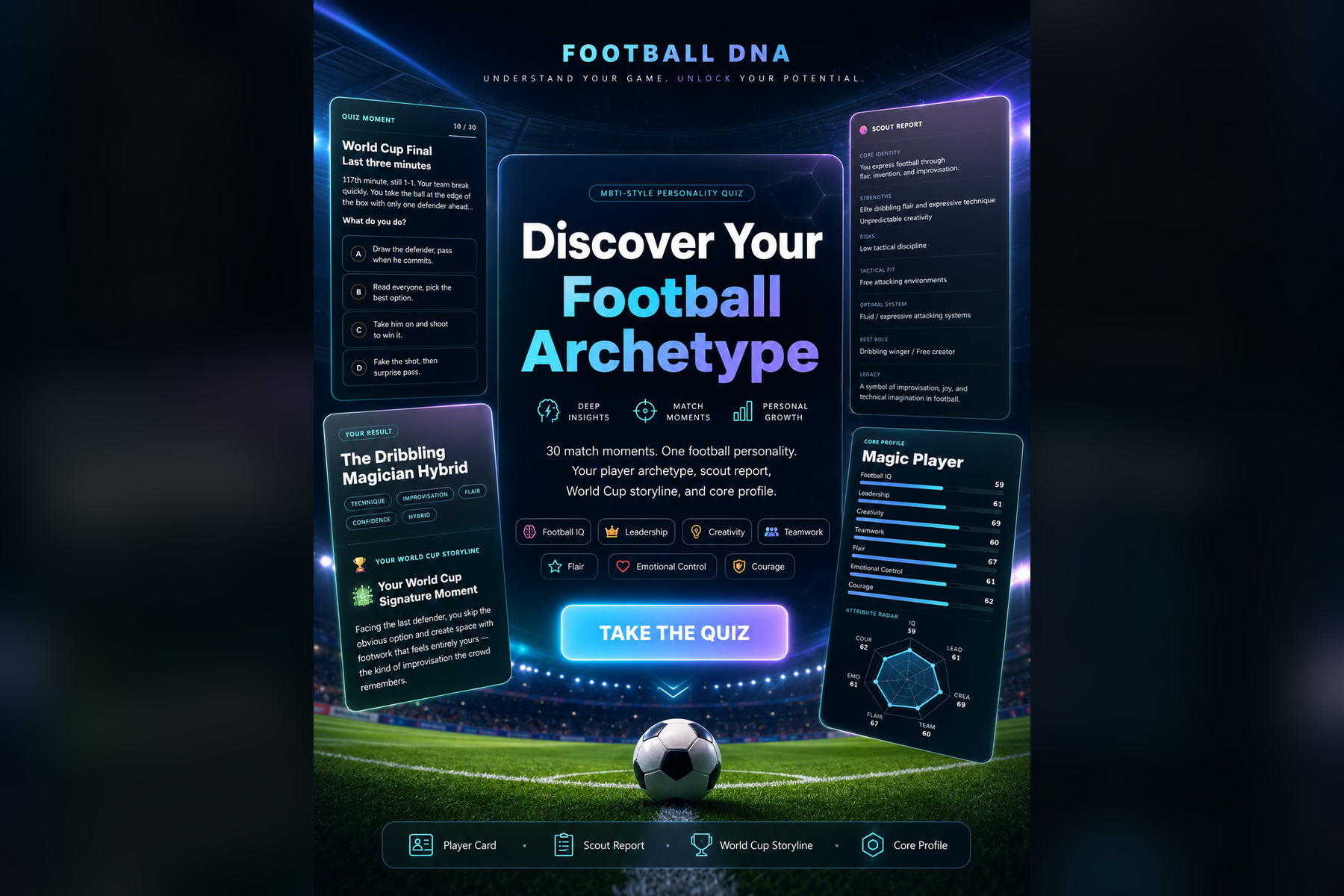
Football DNA Cover
-
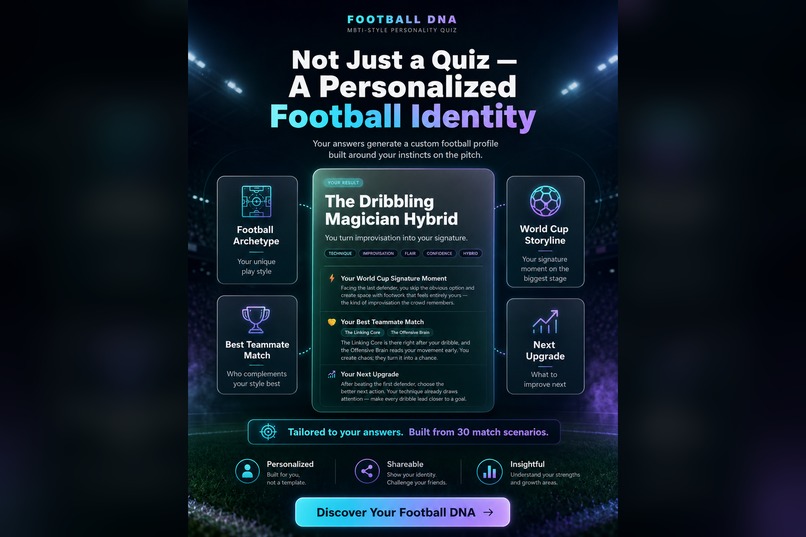
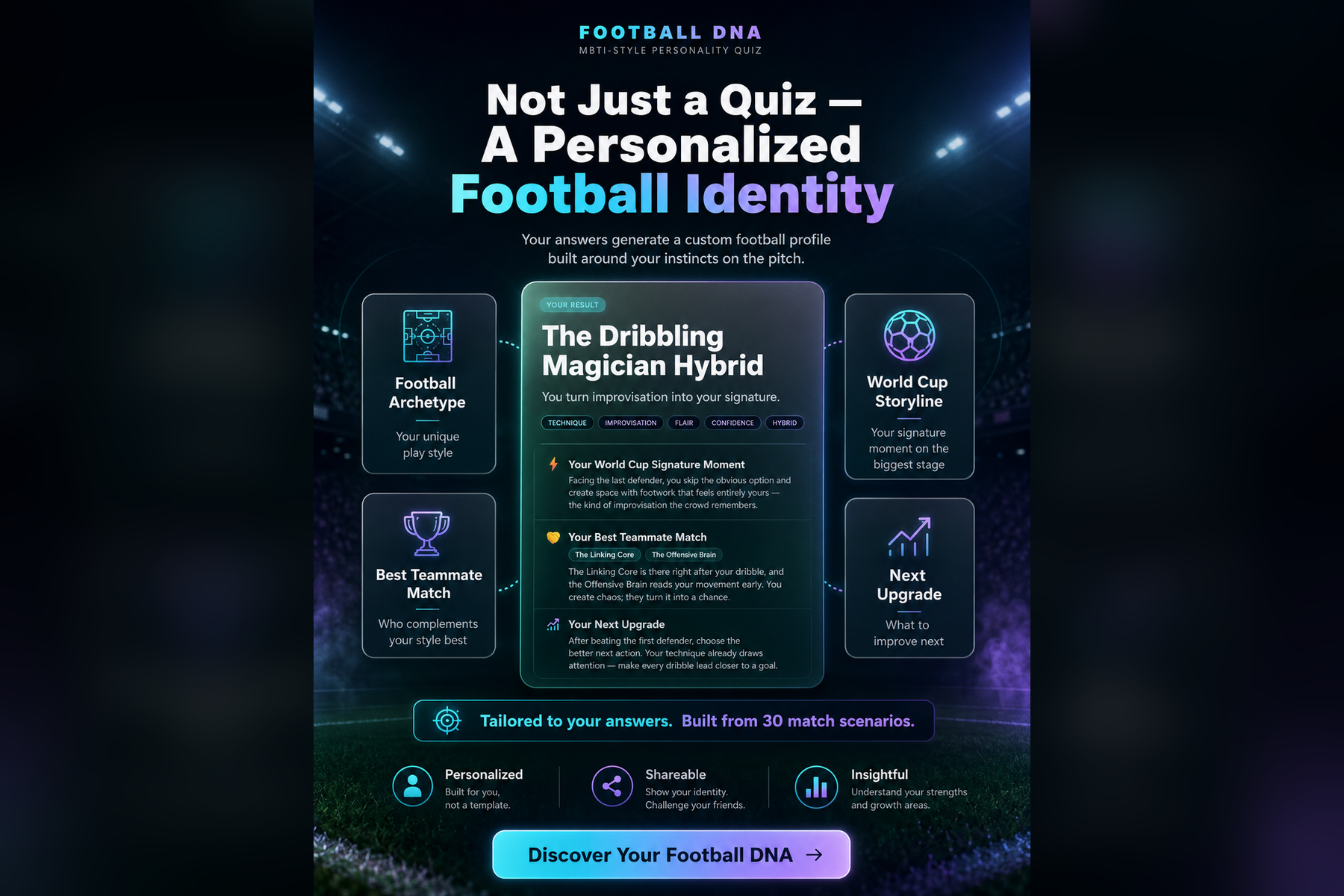
Football DNA Personalized Identity
-
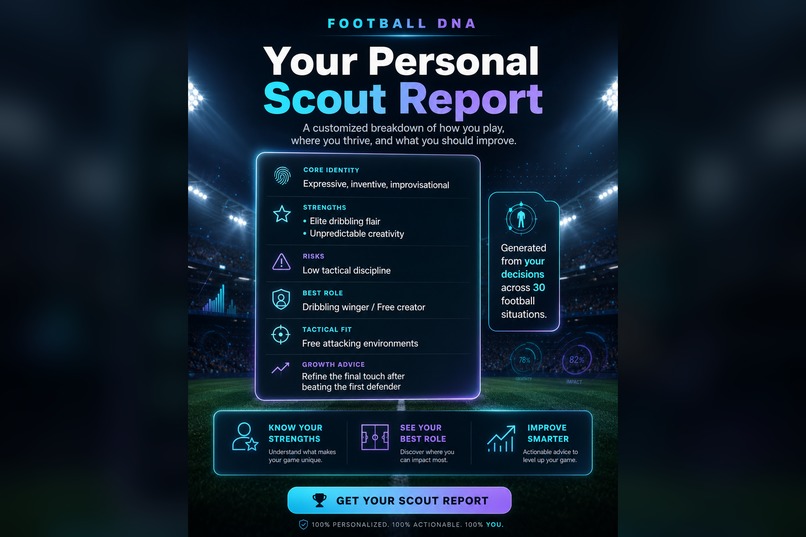
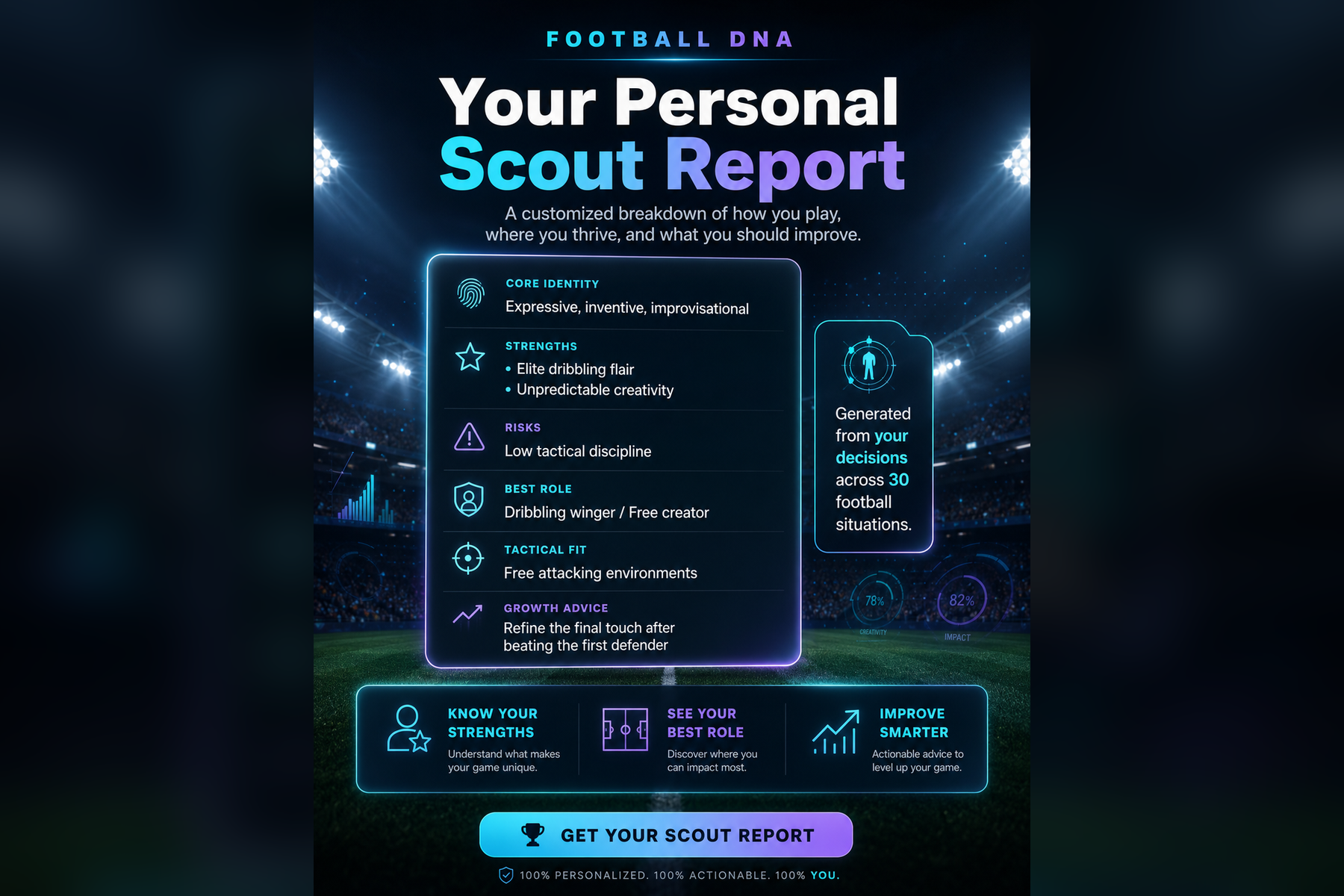
Football DNA Scout Report
-
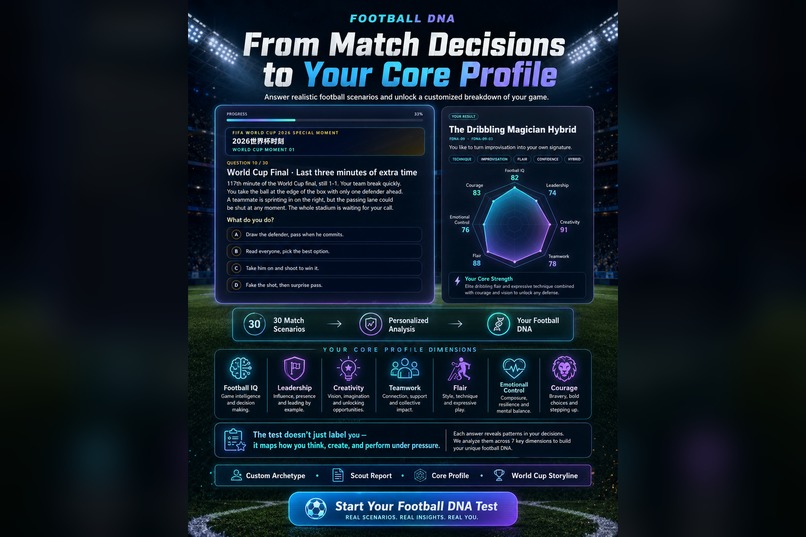
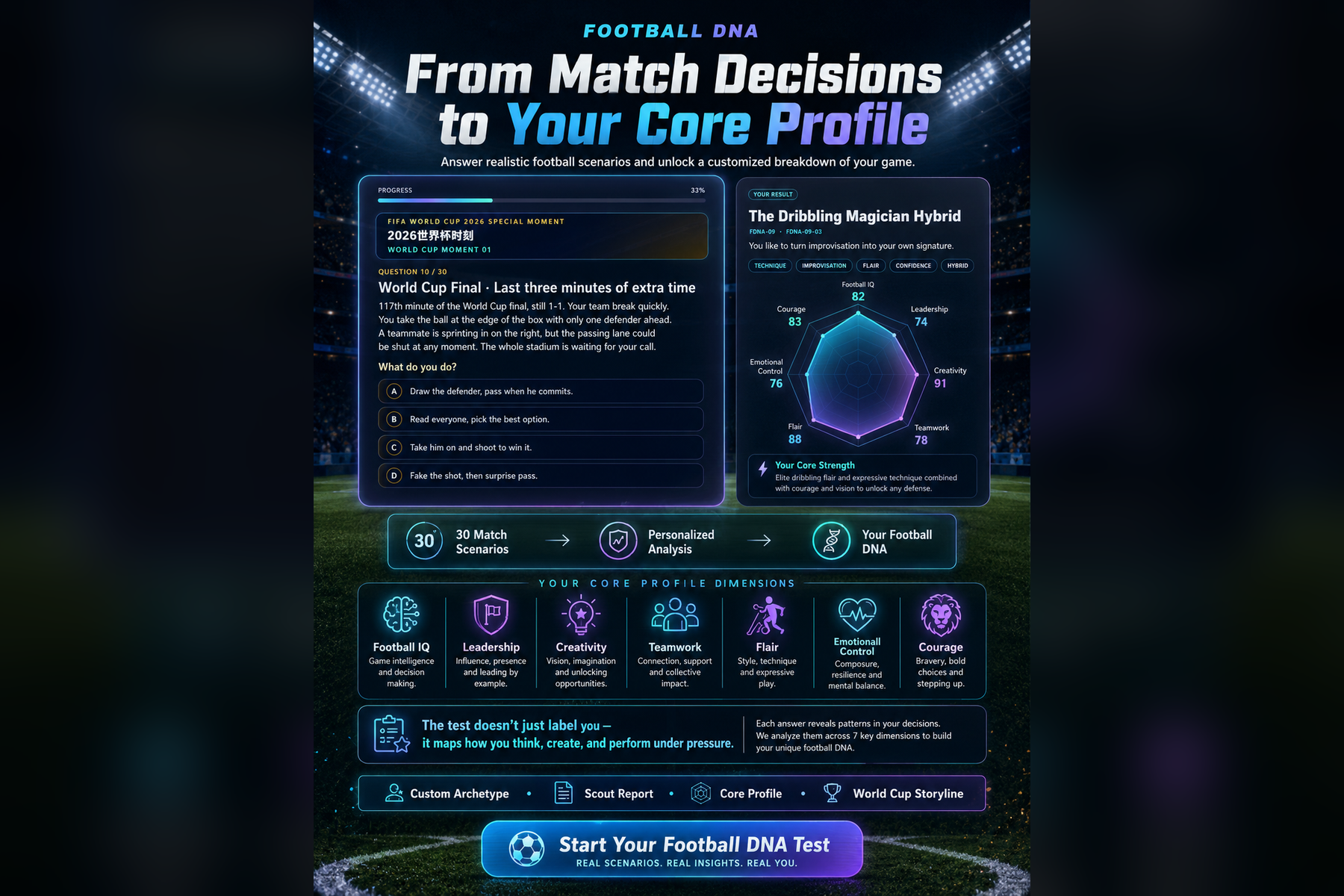
Football DNA Core Profile
Inspiration
Football (Soccer) players are often described using positions, statistics, or physical attributes, but those labels do not fully capture how someone thinks and behaves on the pitch.
Two players in the same position may approach the game completely differently. One may constantly search for space and create opportunities for others, while another prefers to control the tempo, take responsibility, or disrupt the opponent’s rhythm. I wanted to create a more engaging way for players and fans to understand these differences.
That idea became Soccer DNA: an AI-powered football identity experience that transforms a user’s decisions, motivations, and playing preferences into an original football archetype.
Rather than simply attaching traditional personality labels to soccer, Soccer DNA was designed around situations that happen in the game: responding to pressure, communicating with teammates, taking risks, making decisions, and influencing a match.
What it does
Soccer DNA guides users through a football-focused personality quiz and analyzes their responses across several dimensions of on-field behavior.
After completing the quiz, each user receives:
- One of 30 original Soccer DNA archetypes
- A personalized explanation of their football identity
- Key strengths and potential blind spots
- Recommended positions and tactical roles
- Insights into their communication and teamwork style
- Suggestions for compatible teammate archetypes
- A personalized development plan generated with GPT-5.6
The results are organized into multiple levels so users can quickly understand their main identity while also exploring more detailed characteristics.
The goal is to make the experience enjoyable for casual fans while still providing useful reflection for amateur players, youth athletes, and members of school or community teams.
How I built it
The project was built as a responsive web application with separate layers for the quiz experience, scoring logic, archetype system, and AI-generated analysis.
I first designed the underlying Soccer DNA framework. This included defining the behavioral dimensions measured by the quiz, writing scenario-based questions, developing the scoring relationships, and creating 30 distinct football archetypes.
The application processes the user’s answers through a deterministic scoring system to identify the most relevant archetype. The scoring layer is kept separate from the generative AI layer so that users with similar responses receive logically consistent identities.
GPT-5.6 then receives structured information including the user’s archetype, dimension scores, playing preferences, strengths, and development goals. It uses this context to generate a personalized report rather than a generic description.
I used Codex throughout Build Week to help:
- Refactor the existing quiz architecture
- Connect the scoring system to the AI analysis pipeline
- Design structured prompts and output schemas
- Improve error handling and loading states
- Build reusable result-page components
- Test edge cases across different answer combinations
- Improve the responsive user interface
The generated responses follow a defined structure so that the content can be displayed consistently across the result page.
Challenges I faced
One of the biggest challenges was balancing consistency with personalization.
A fully generative system could produce creative results, but it might also assign inconsistent characteristics to users with similar answers. On the other hand, a completely predefined result system would be reliable but would not feel truly personal.
I addressed this by using a hybrid architecture. The quiz and archetype assignment are deterministic, while GPT-5.6 expands the structured result into a personalized interpretation and development plan.
Another challenge was designing archetypes that felt meaningfully different from one another. It was not enough to change their names or descriptions. Each archetype needed a recognizable combination of decision-making style, risk preference, communication behavior, tactical role, and emotional response.
Prompt design was also an important challenge. The model needed to be encouraging without making every user sound perfect. I created constraints that require the report to include both strengths and realistic areas for improvement while avoiding unsupported claims about professional ability.
Finally, the experience needed to work for both experienced players and people who primarily enjoy watching soccer. The language therefore had to remain accessible without removing the tactical depth that makes the results interesting.
What I learned
This project taught me that AI is most useful when it builds on a clear product system rather than replacing one.
The quality of the generated report depended heavily on the quality of the structured context supplied to the model. Clear archetype definitions, normalized scores, output schemas, and explicit writing constraints produced much more useful results than an open-ended prompt.
I also learned how important it is to separate identity, interpretation, and recommendation. The scoring engine determines the user’s core Soccer DNA, while GPT-5.6 explains what that identity may mean and turns it into actionable guidance.
Working with Codex made it easier to iterate across both product and engineering tasks. It helped me move from an existing quiz concept toward a more complete AI-powered experience while keeping the codebase organized.
Accomplishments that I am proud of
I am especially proud that Soccer DNA is more than a novelty quiz.
It combines an original system of 30 football archetypes with a functional scoring engine, a polished visual experience, and personalized AI-generated guidance. The project turns abstract personality traits into situations and language that football players can immediately recognize.
I am also proud that the experience can serve different purposes: self-reflection, entertainment, team discussion, player development, and social sharing.
What is next for Soccer DNA
The next step is to develop Soccer DNA from an individual quiz into a broader football identity platform.
Future features may include:
- Team compatibility analysis
- Coach dashboards for aggregated player profiles
- Archetype comparison between friends or teammates
- Position-specific development programs
- Multilingual reports
- Shareable Soccer DNA player cards
- Progress tracking as a player’s style develops over time
My long-term goal is to help people understand not only how they play, but also how they make decisions, connect with teammates, and contribute to the game.
Built With
- chatgpt-5.6
- codex
- generative-ai
- javascript
- next.js
- node.js
- openai
- react
- web-design


Log in or sign up for Devpost to join the conversation.