Inspiration
Important documents such as academic certificates, professional credentials, identity records, and organizational documents are increasingly digital, but verifying whether they are authentic can still require contacting the original issuer or trusting a centralized database.
At the same time, uploading sensitive documents to cloud-based AI systems creates privacy concerns.
SnowVault explores a different approach: combine local AI with cryptographic verification and Web3 so that documents can remain private while their authenticity can still be independently verified.
What it does
SnowVault is a privacy-first document intelligence and verification platform.
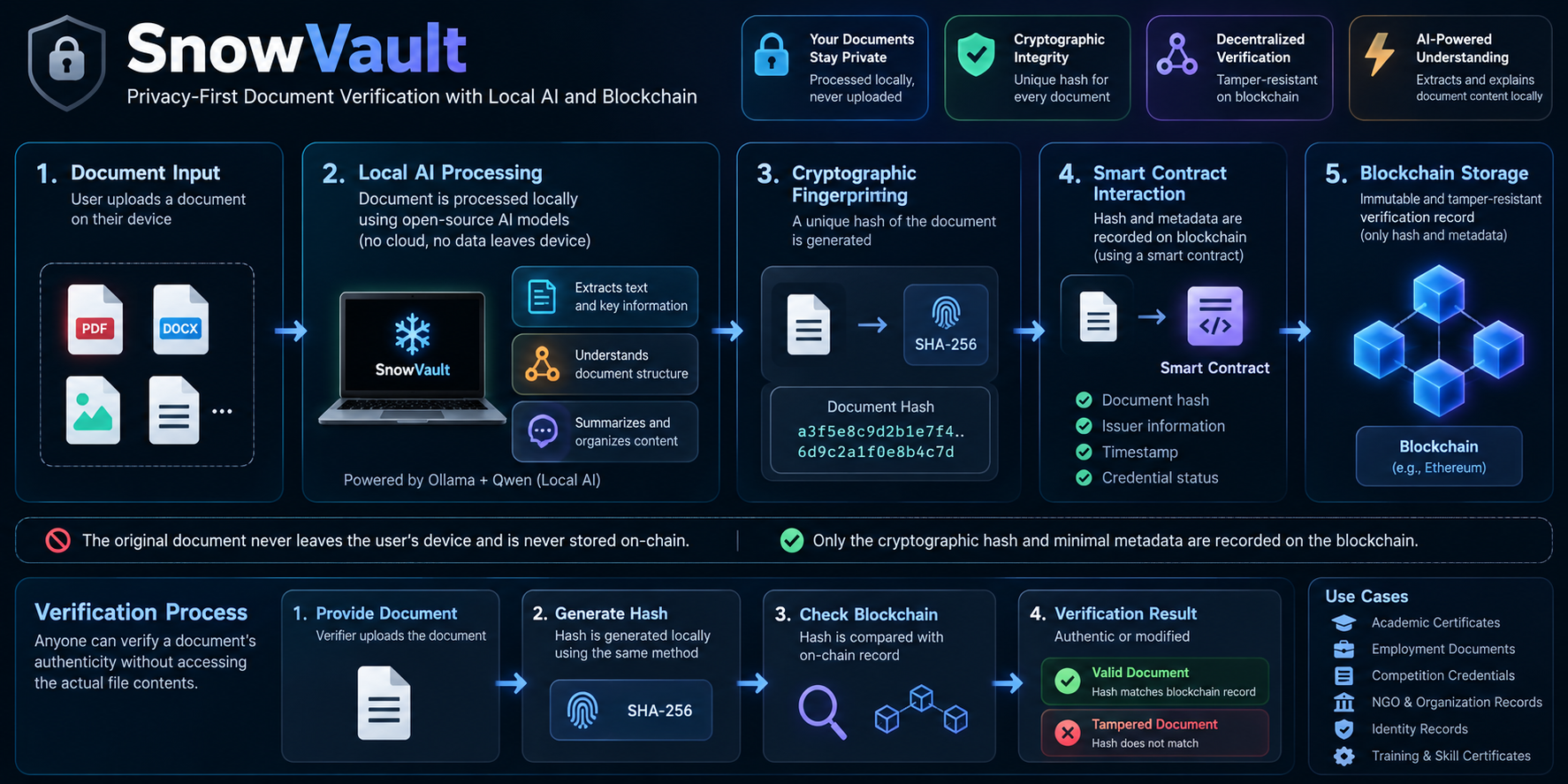
A document is processed locally rather than being sent to a cloud AI provider. The system can extract and understand its contents while a cryptographic fingerprint (hash) of the document is generated.
Instead of storing the private document on-chain, SnowVault stores only the verification proof.
This creates a simple workflow:
Document → Local AI Processing → Cryptographic Hash → Blockchain Proof
A verifier can later provide the document again. SnowVault calculates its fingerprint and compares it against the blockchain record.
If the document has been modified, even slightly, its cryptographic fingerprint changes and the verification fails.
Why Web3?
A normal centralized database could store document hashes, but it would still require users to trust the organization controlling that database.
SnowVault uses blockchain infrastructure to provide an independently verifiable and tamper-resistant record of issued credentials.
The blockchain never needs to contain the sensitive document itself.
Core Features
- Local AI-powered document understanding
- Sensitive files remain on the user's device
- Cryptographic document fingerprinting
- Blockchain-based verification records
- Credential issuance and verification
- Document tampering detection
- Credential revocation support
- Simple verification interface
- No requirement to upload private documents to a cloud AI service
Architecture
SnowVault follows a hybrid Web2 + Web3 architecture.
Local Intelligence Layer Processes documents locally and extracts useful information without exposing the original files to external AI services.
Cryptographic Layer Generates a unique hash representing each document.
Web3 Layer A smart contract records document proofs, issuer information, timestamps, and credential status.
Verification Layer Recomputes the document hash and checks the blockchain record to determine whether the submitted document matches the originally issued credential.
Privacy by Design
SnowVault does not place private documents directly on a blockchain.
Only cryptographic proofs and the minimum metadata required for verification are recorded, while the original document remains under the user's control.
Potential Impact
SnowVault could be used for academic certificates, competition credentials, employment documents, training certificates, NGO records, and other documents where authenticity matters.
The goal is to make digital verification more trustworthy without forcing users to sacrifice the privacy of their documents.
Development Plan
The initial MVP will focus on the complete verification pipeline:
- Upload/select a document locally
- Process the document
- Generate its cryptographic fingerprint
- Register the verification proof through a smart contract
- Verify a document against the blockchain record
- Detect modified or revoked credentials
Future versions could expand the system with decentralized identity, issuer dashboards, selective disclosure, QR-based verification, and additional local AI capabilities.
Challenges
The main design challenge is balancing three goals that often conflict: privacy, verifiability, and usability.
Storing documents directly on-chain would create serious privacy and scalability problems. Keeping everything centralized would weaken the benefits of Web3.
SnowVault therefore separates the architecture into local document intelligence, cryptographic proofs, and decentralized verification.
Built With
- eact
- ethereum
- ethers.js
- express.js
- javascript
- local-ai
- node.js
- ollama
- qwen
- sha-256
- smart-contracts
- solidity
- web3

Log in or sign up for Devpost to join the conversation.