Inspiration
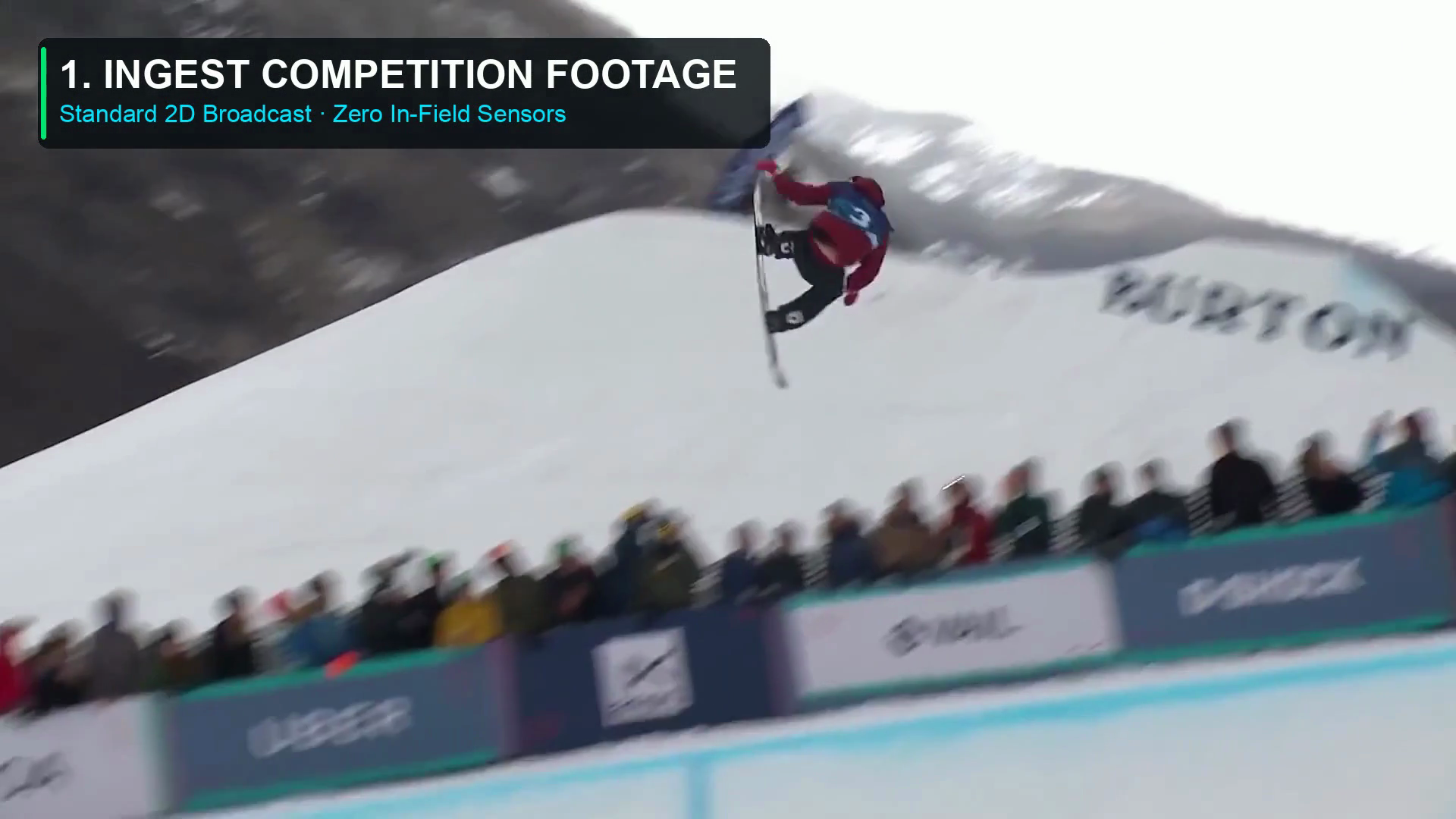
At the Winter Olympics and X Games, snowboarders launch 30 feet high executing triple and quadruple corks with up to 2160° (6 full rotations). Judging and broadcast analysis still rely on subjective visual estimates from distant 2D monitors:
- Human Eye Limits: Distinguishing 180° differences or subtle off-axis cork tilts in real time may be inaccurate.
- Camera Ego-Motion: Rapid telephoto camera panning masks or exaggerates an athlete's physical rotation.
- Zero Sensor Suits: Athletes cannot wear cumbersome IMUs, suits, or optical markers in competition.
Snow VAR extracts ground-truth 3D biomechanics, isolates true rotation in world space, and provides automated trick classification and Olympic judging directly from standard 2D broadcast video.
What It Does
- Scouting & Ingest: Automatically detects scene cuts and ranks super-slow-motion replay clips where the athlete is sharpest.
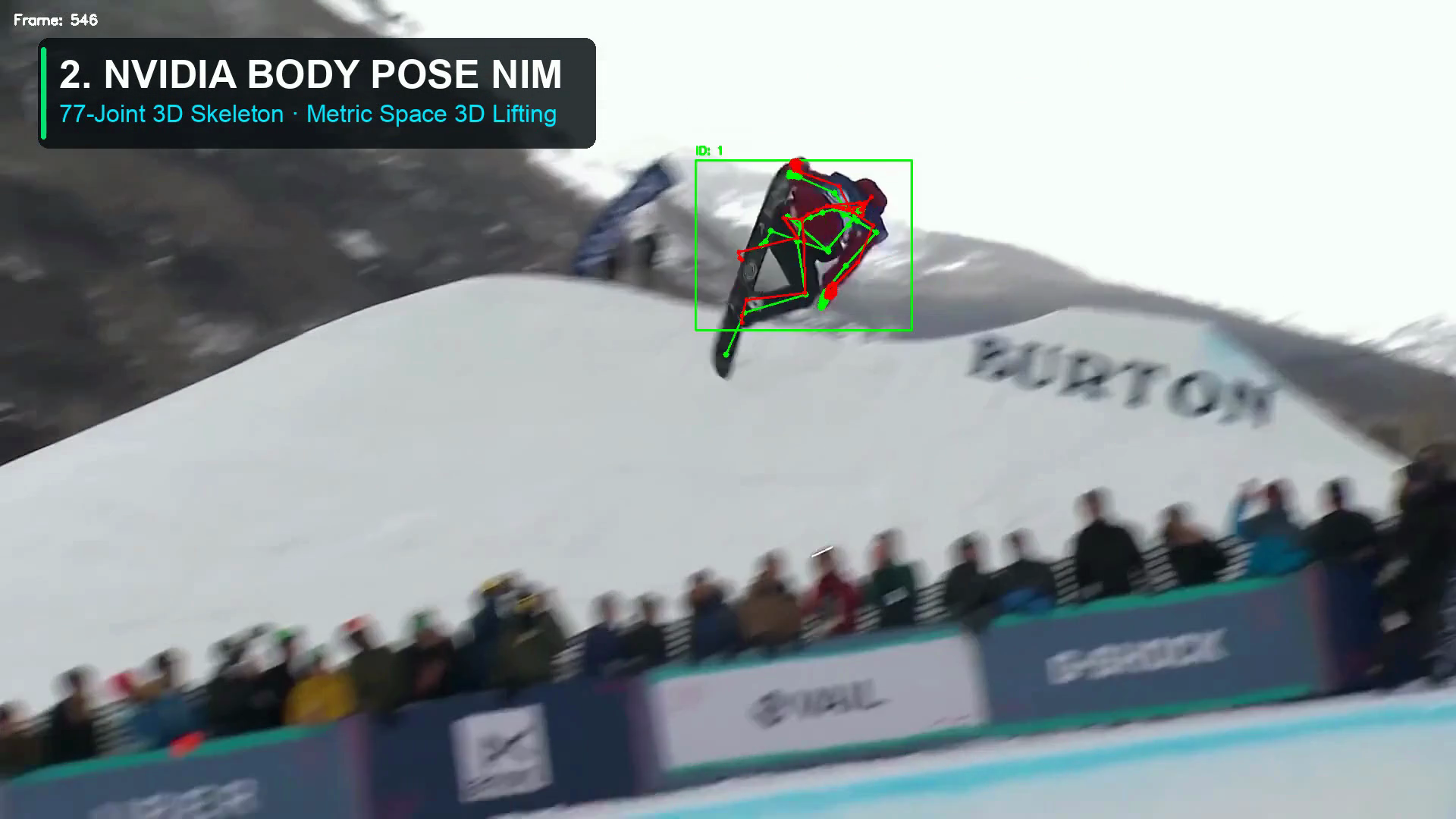
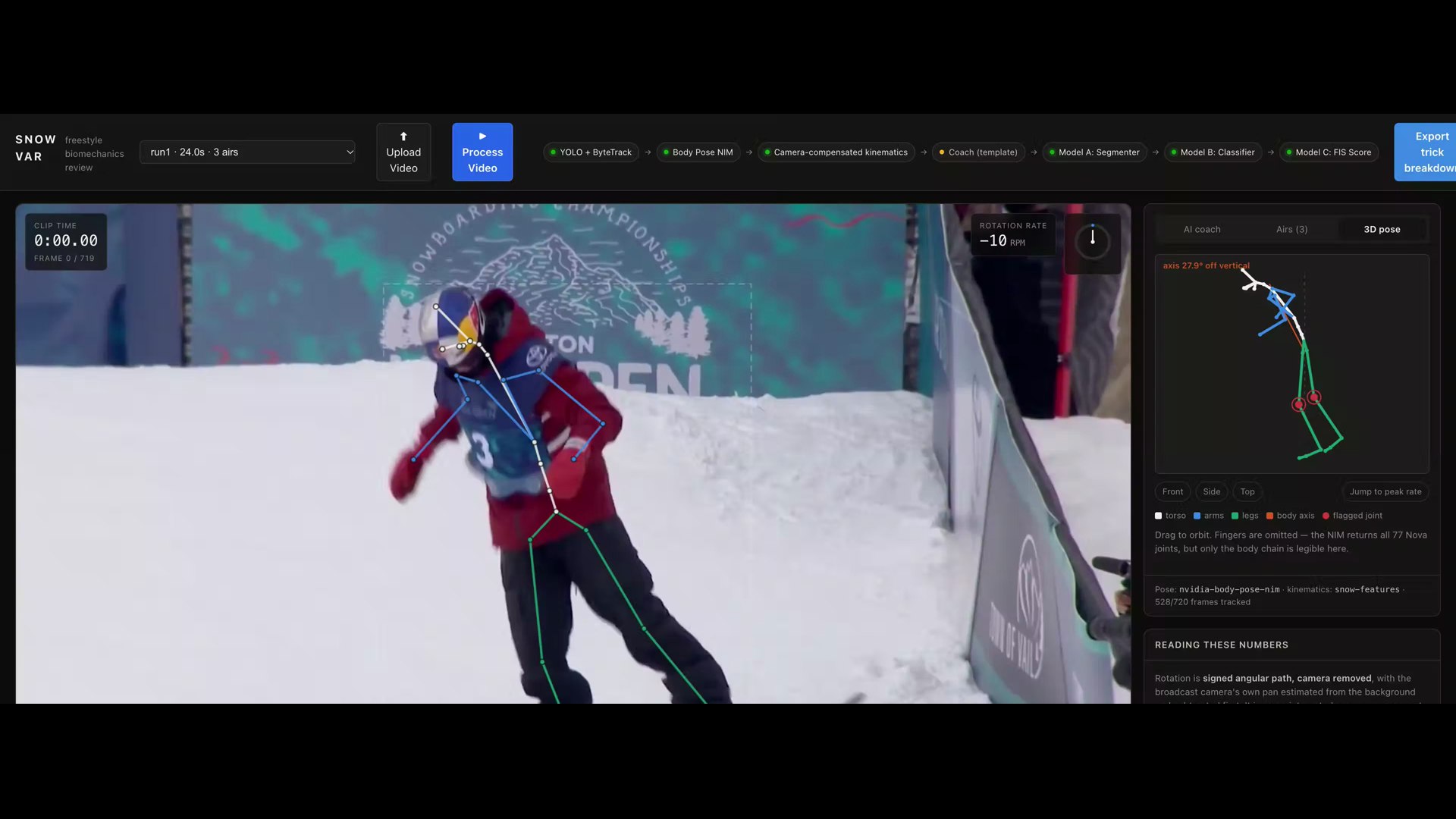
- Sensorless 77-Joint 3D Pose: Tracks the athlete (YOLO11 + ByteTrack) and calls the NVIDIA 3D Body Pose NIM to reconstruct a full 77-joint Nova skeleton in 3D camera space—with zero markers or wearable hardware.
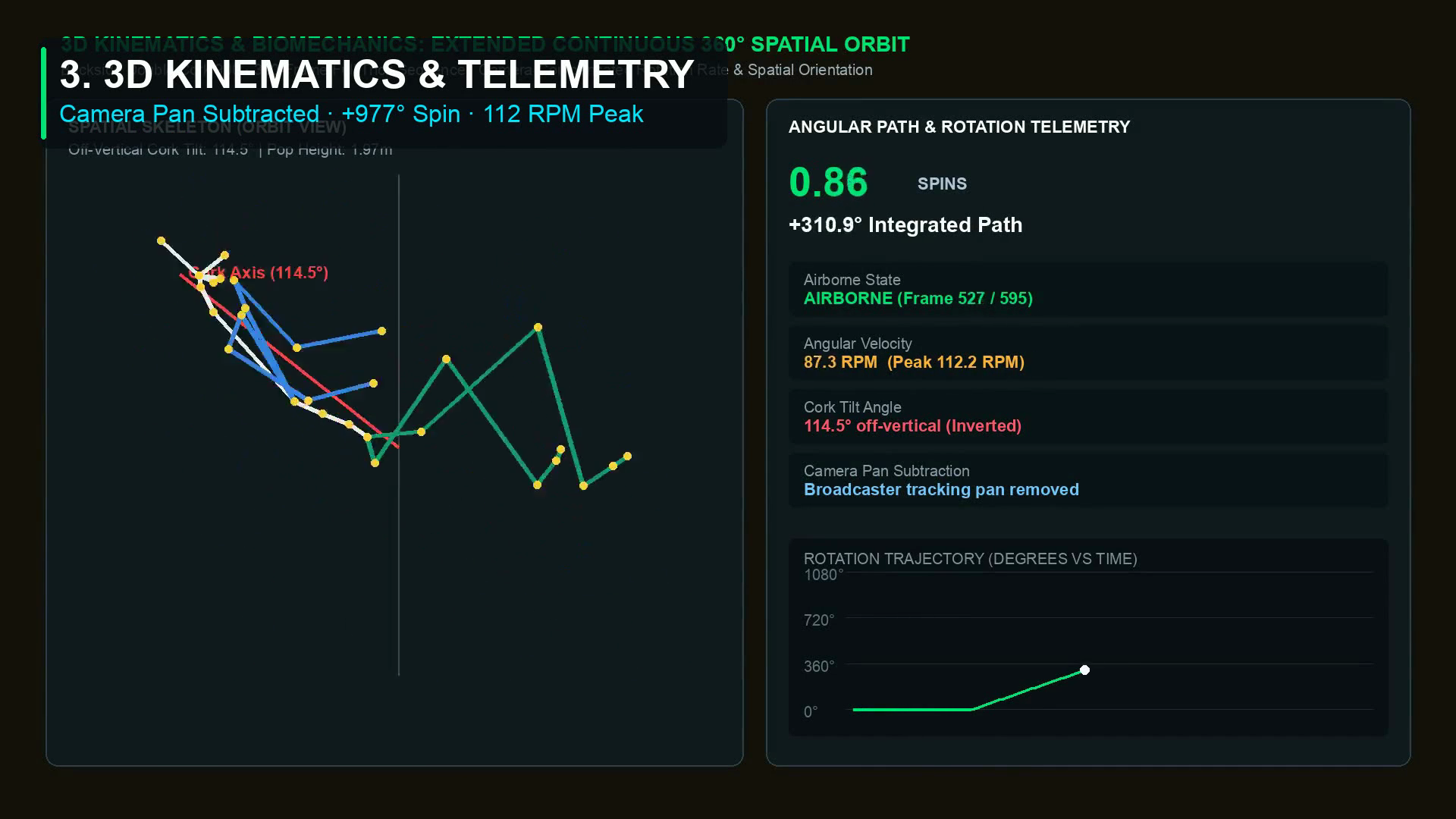
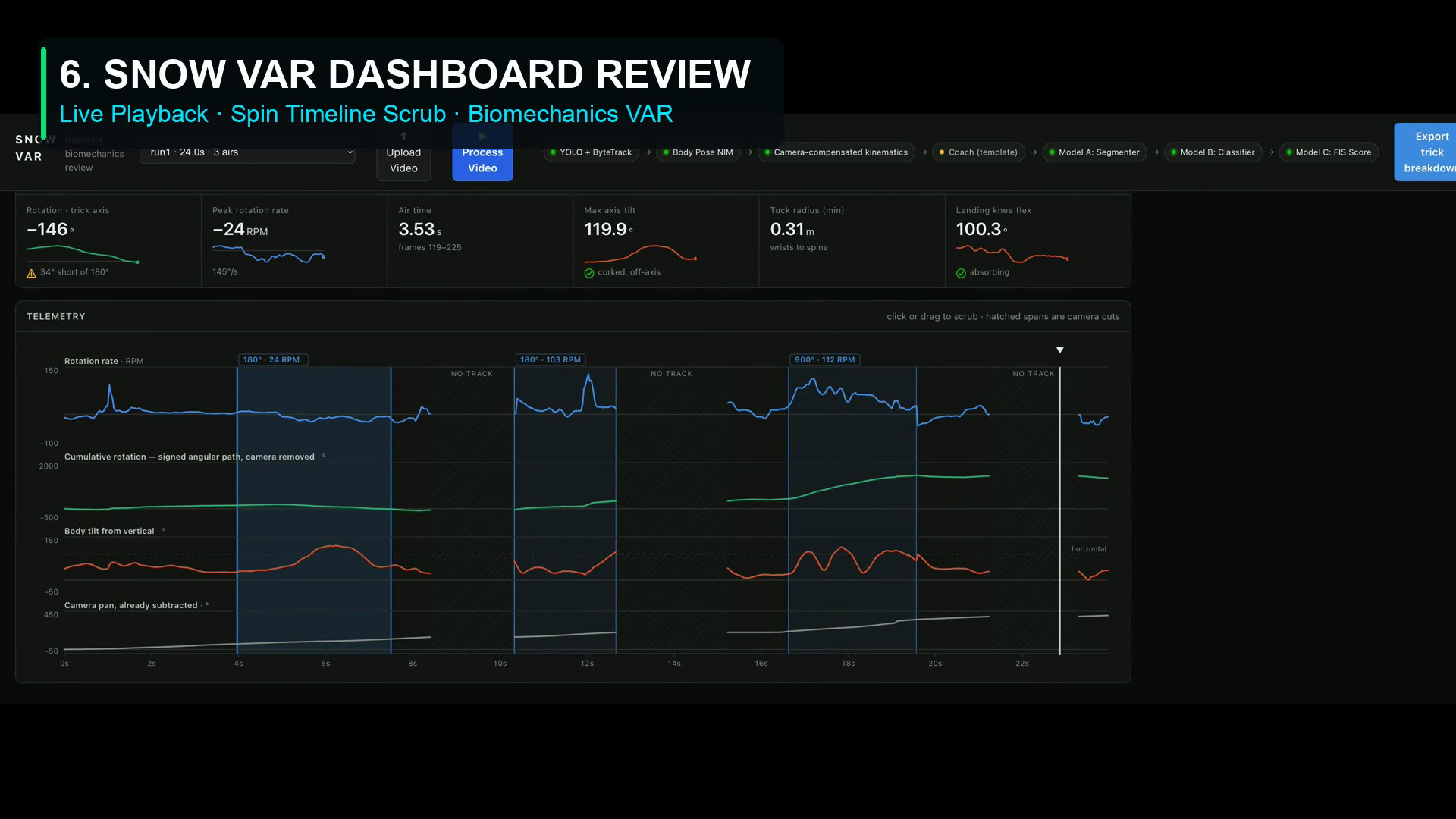
- Camera Ego-Motion Subtraction: Computes inter-frame background homographies to cancel the broadcast camera's pan, tilt, and zoom, isolating the rider's true physical rotation in world space.
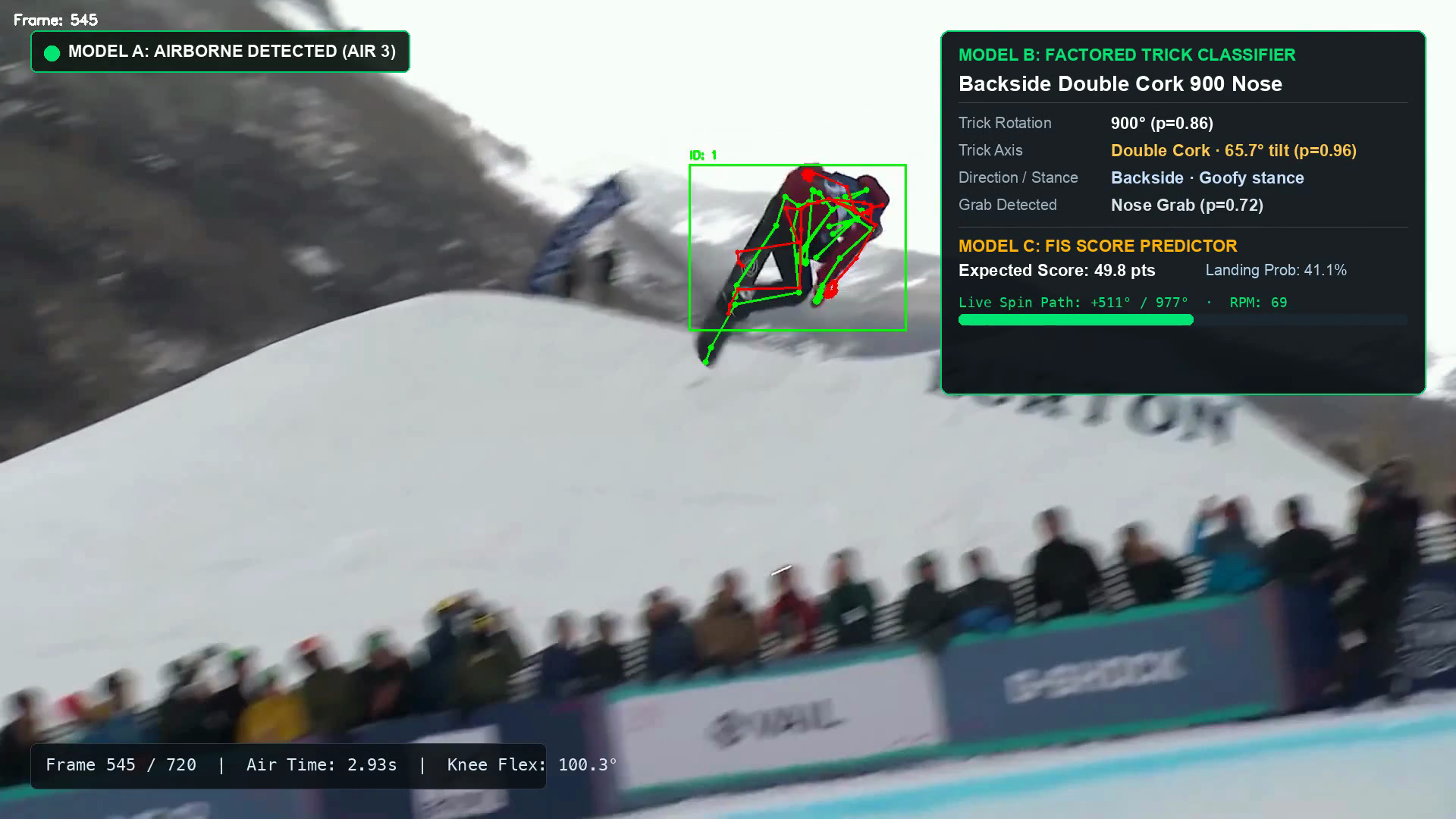
- Airborne Segmenter (Model A): Uses a temporal 1D CNN to find exact takeoff and landing timestamps.
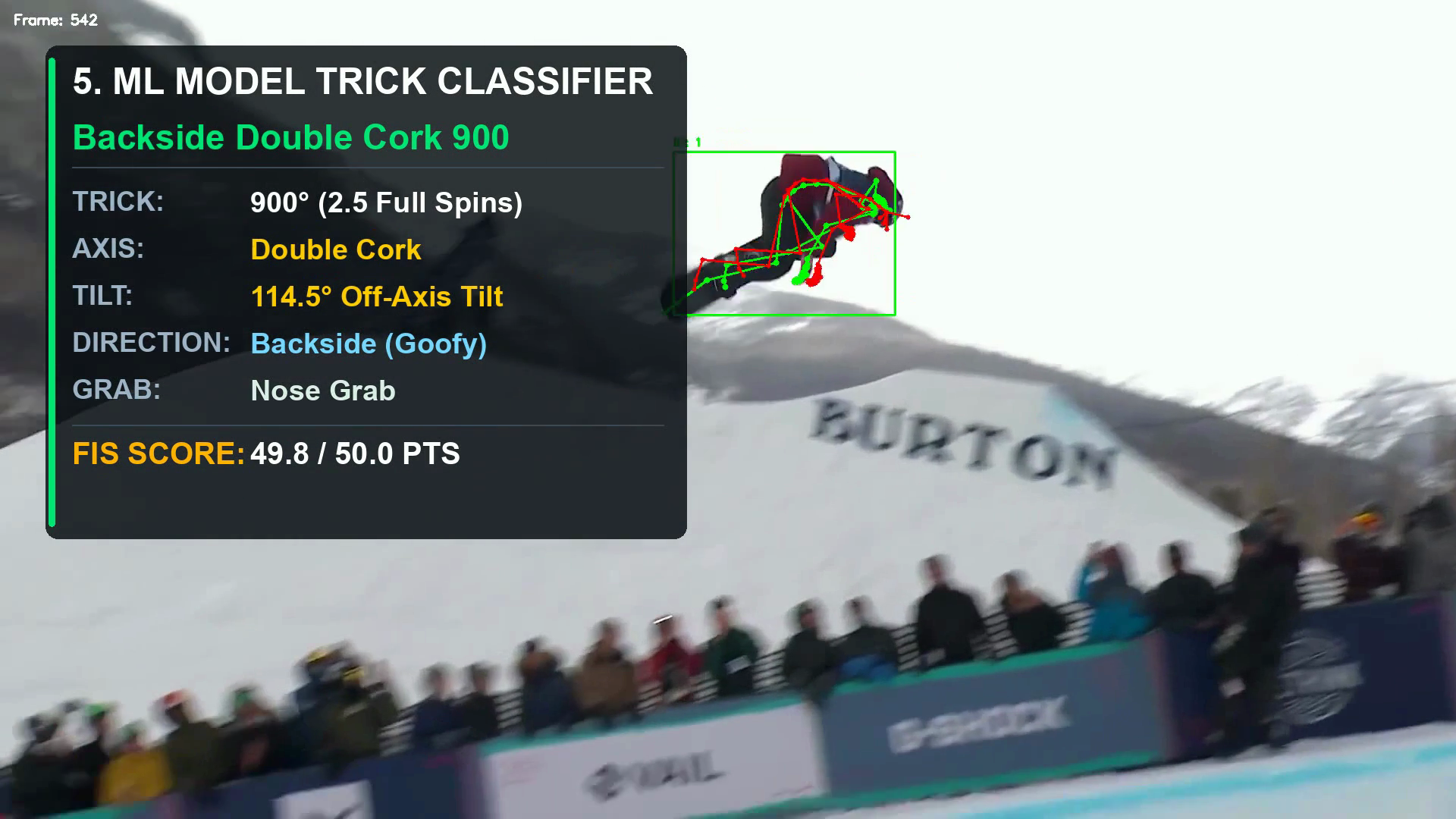
- Factored Trick Classifier (Model B): Decomposes complex aerials across 5 decoupled heads: spin magnitude (180°–1800° +), sense (CW/CCW), stance (regular/goofy), axis (flat/cork/double cork), and grab (indy, mute, melon, etc.).
- Olympic FIS Score Prediction (Model C): Evaluates trick difficulty against 4,995 real World Cup and Olympic jumps (543 official FIS score sheets), predicting landing probability and judge panel marks (0–100, 7.8 MAE).
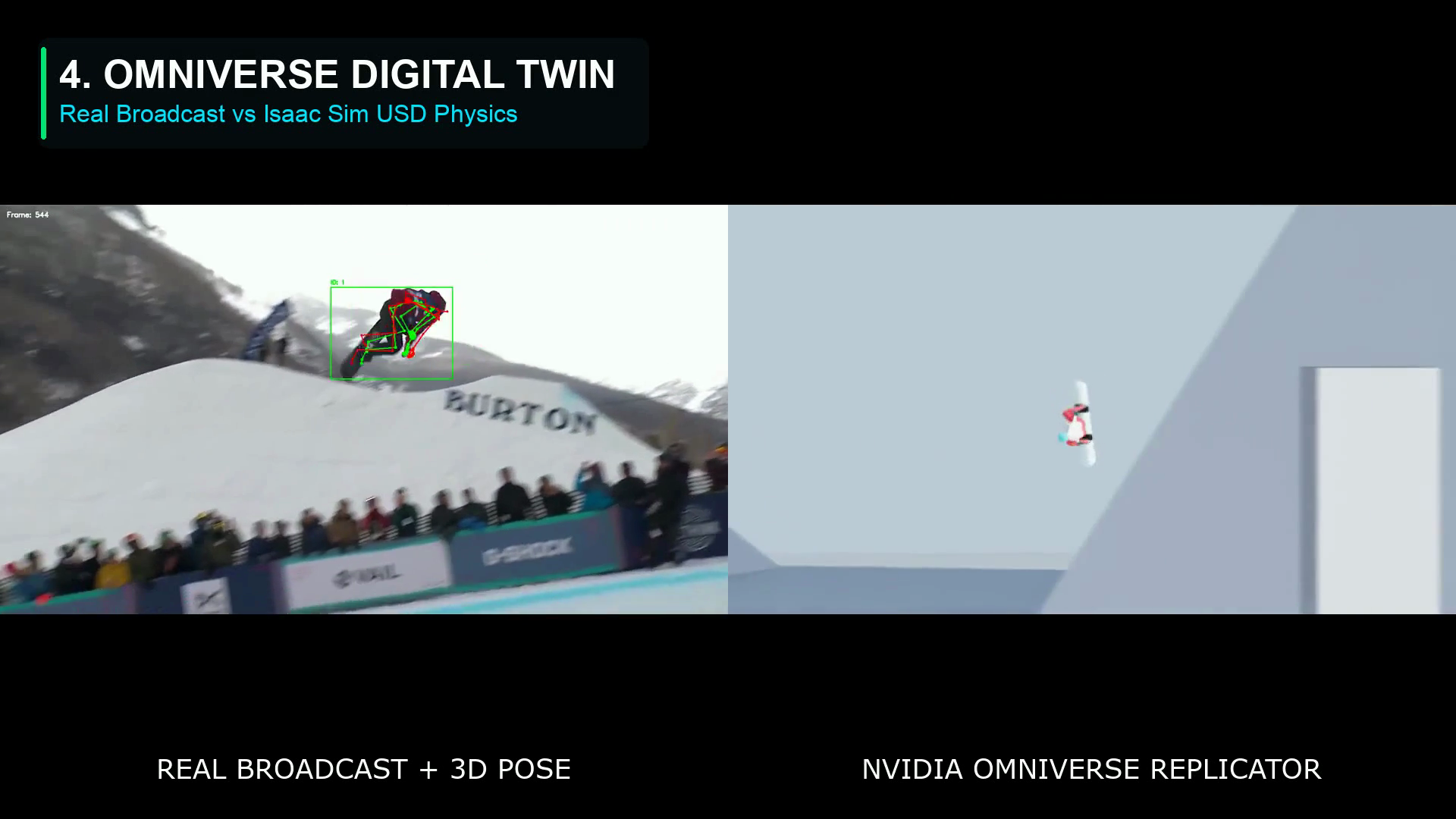
- Omniverse USD Digital Twin: Exports camera-compensated skeleton motion directly into text USD (.usda), running natively in NVIDIA Omniverse, Isaac Sim, and Blender.
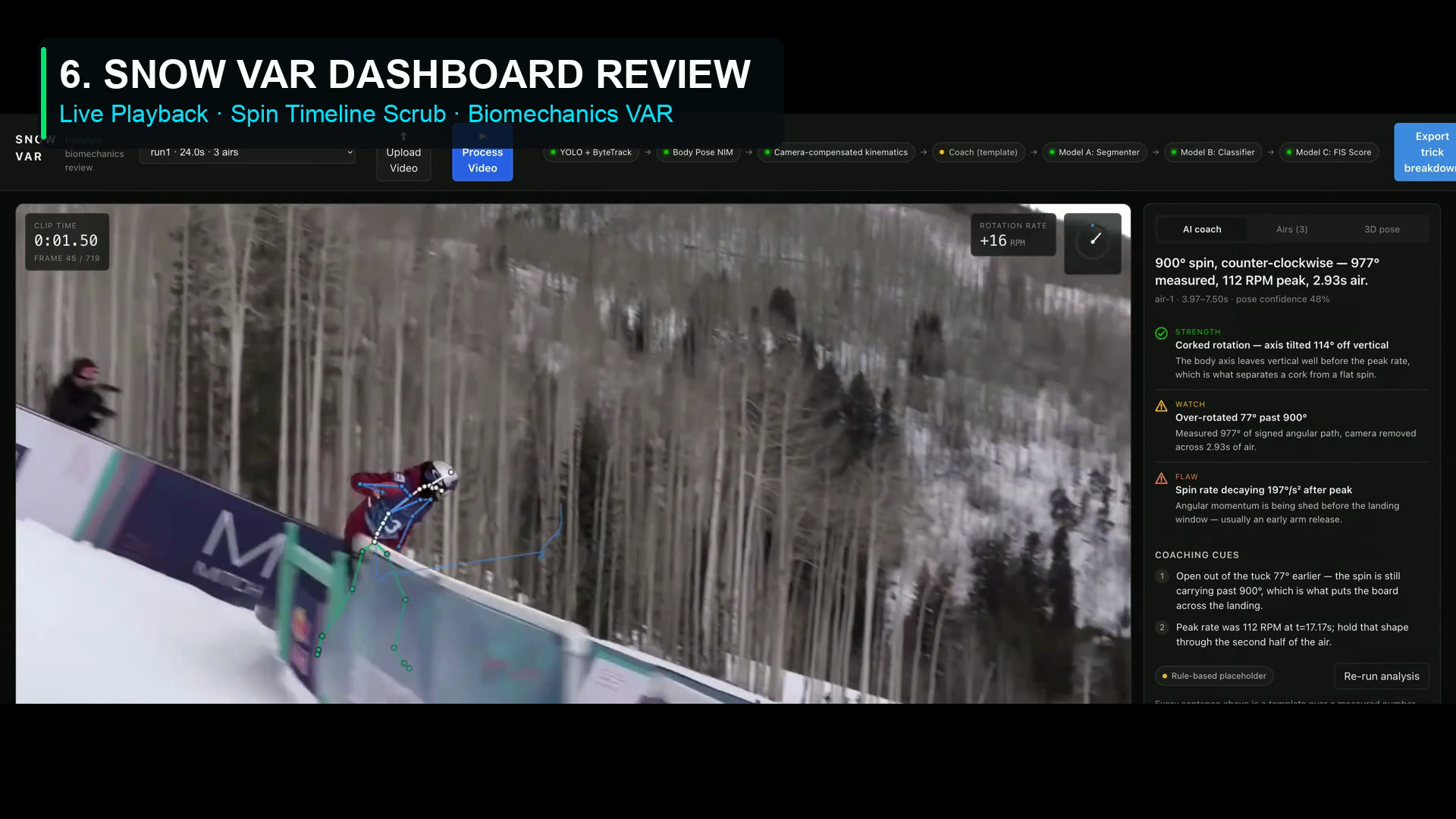
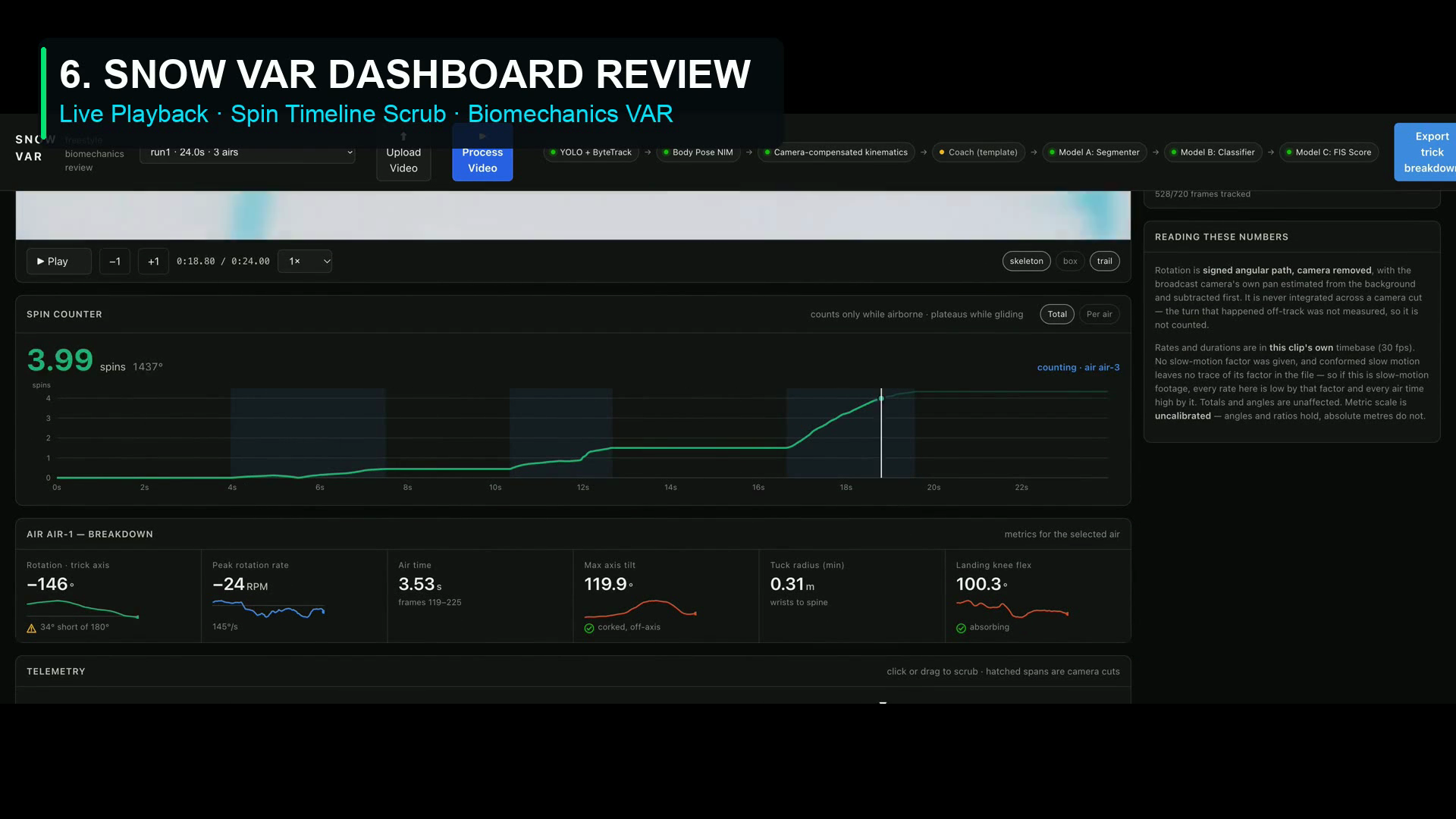
- Interactive VAR Dashboard & Nemotron Coach: A React/Three.js console with synchronized 4K video scrubbing, 3D orbitable skeleton inspection, telemetry curves (RPM, rotation accumulation, knee flexion), and an AI reasoning coach powered by NVIDIA Nemotron-3 Ultra (550B).
How We Built It
- NVIDIA 3D Body Pose NIM: Monocular 2D-to-3D pose estimation returning 77 Nova joints via gRPC on NVCF / self-hosted GPU.
- NVIDIA Nemotron-3 Ultra (550B): Generates structured biomechanical coaching reports (nvidia/nemotron-3-ultra-550b-a55b via NVIDIA API) validated by a strict runtime JSON schema.
- NVIDIA Omniverse & Isaac Sim: Parametric synthetic trick generation with Omniverse Replicator and Blender 4.3 (MPFB 2.0 Nova-77 rig) to establish ground-truth physics benchmarks.
- Universal Scene Description (USD): Generates text .usda files conforming to UsdSkelAnimation, validated via USD's skinning resolver.
- Computer Vision & Kinematics: YOLO11, ByteTrack, OpenCV homography ego-motion cancellation, and quaternion-based SO(3) rotation integration.
- ML & Serving Stack: PyTorch, scikit-learn, FastAPI, React 18, Vite, TypeScript, Canvas 3D, and Nebius Cloud GPU instances (NVIDIA L4).
Key Challenges & Breakthroughs
- Camera Pan Distortion: Telephoto pans induce massive false rotation. We isolate background feature points to invert camera motion (𝐑{world} = 𝐑{cam}⁻¹𝐑_{rider}) while preventing rotation accumulation across camera cuts.
- Conformed Slow-Motion: 120+ fps footage saved into 30 fps broadcast containers distorts velocity. We normalized all ML features by timebase and torso proportions to make classification independent of video frame rate.
- Avoiding "Confident Wrong Numbers": 3D pose estimators can produce smooth yet inaccurate output. We built snow synth (a synthetic physics benchmark) and snow label (a frame-by-frame human annotation tool) to publish verified error margins.
Accomplishments
- Zero-Hardware 3D Kinematics: 77-joint metric poses extracted from standard broadcast clips without athlete suits or markers.
- Sub-2° Rotation Accuracy: Verified on synthetic ground-truth benchmarks.
- Olympic Contest Scoring: Trained on 4,995 real FIS contest jumps, predicting judges' panel marks within 7.8 MAE.
- Omniverse Ready: One-click generation of camera-compensated .usda digital twins.
- Robustness: 105 automated unit and integration tests running with zero network or GPU dependencies.
What's Next
- Edge Deployment: Run real-time inference on NVIDIA Jetson AGX Orin for on-mountain terrain park setups.
- Multimodal Commentary: Combine visual tokens with 3D joint telemetry for automated natural- language play-by-play.
- Action Sports Expansion: Extend from snowboarding to skateboarding, freestyle skiing, surfing, and BMX.
Built With
- amazon-web-services
- computer-vision
- kinematics
- nemotron
- numpy
- nvidia-isaac-sim
- nvidia-nim
- nvidia-omniverse
- omniverse
- opencv
- pose-estimation
- python
- pytorch
- react
- scikit-learn
- scipy
- snowboarding
- sports-analytics
- three.js
- typescript
- universal-scene-description-(usd)
- yolo11


Log in or sign up for Devpost to join the conversation.