-
-
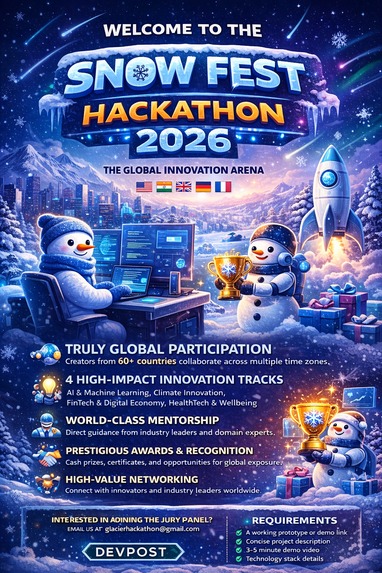
snow
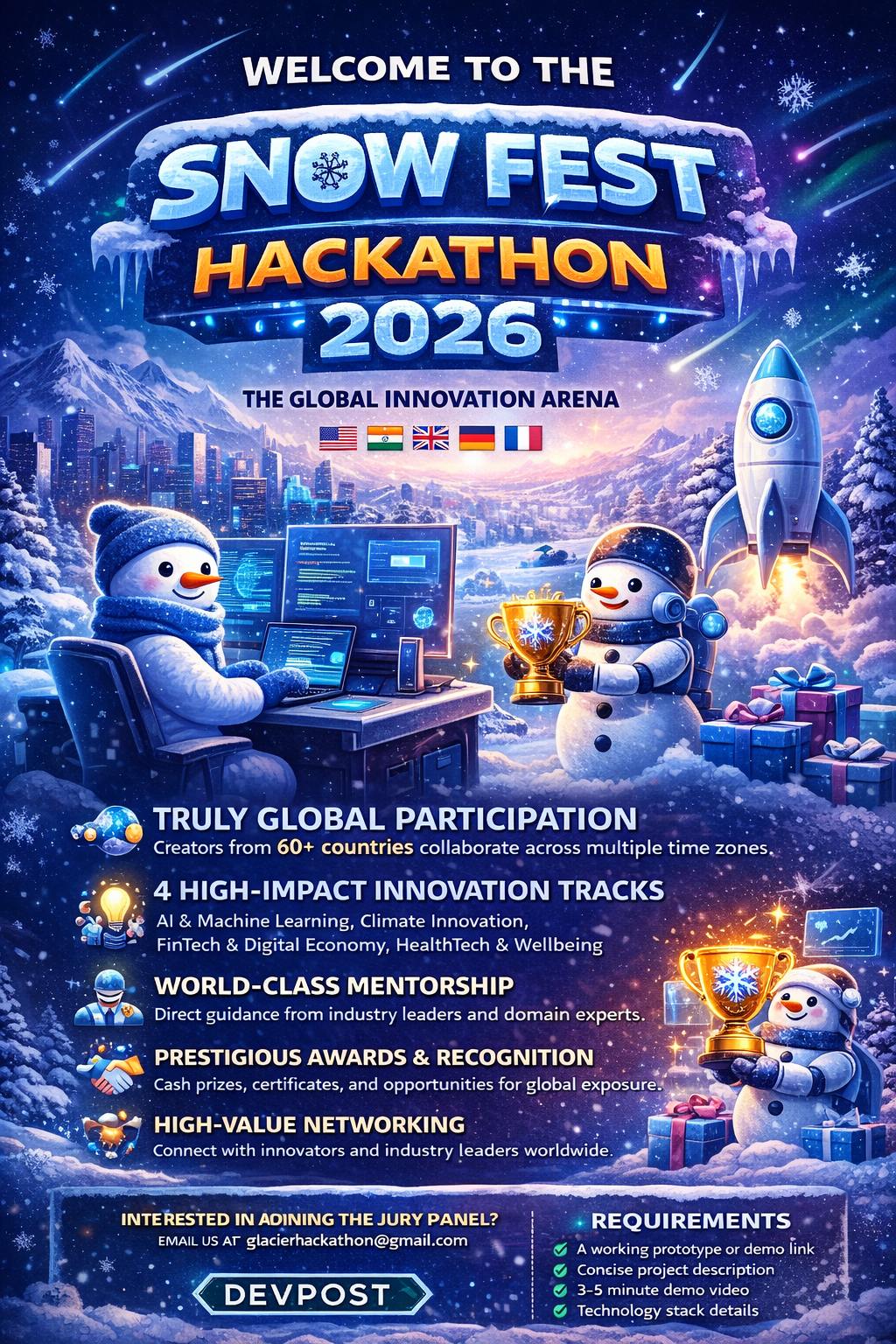
About the Project: The Frost Engine 01. The Inspiration: The "Cold Start" Crisis In the global tech landscape, innovation is often bottlenecked not by a lack of talent, but by a lack of accessibility and momentum. For many builders in the 60+ countries participating in SNOW FEST 2026, the primary hurdle is the "Cold Start Problem"—the daunting gap between having a raw idea and possessing a structured, mentor-verified roadmap.
We were inspired by the literal physics of a snowflake: complex, unique, and fragile. Our vision was to create a platform that acts as the atmospheric condition necessary for these "innovation flakes" to form and coalesce into an avalanche of progress. We wanted to melt the barriers of entry using high-latency-reduced AI interactions, providing every developer, regardless of their time zone or network, with the guidance usually reserved for Silicon Valley insiders.
02. Implementation: Building the Frost Engine The architecture of our platform is centered around a proprietary feedback loop we call the Frost-Feedback Cycle. Using the Gemini 3 Flash model, we engineered two distinct AI agents: the Brainstormer and the Frost-Mentor.
Technically, the system leverages a React-based frontend with a specialized service layer that handles non-deterministic AI outputs. We implemented a strict JSON schema enforcement strategy to ensure that generated ideas are not just text, but structured data ready for project management tools.
Mathematical Modeling of Innovation Potential
To quantify the success probability of a project idea, we utilize an Innovation Index ($I$) calculated as:
$$I = \int_{t_0}^{t_f} \left( \frac{C(t) \cdot F(t)}{\ln(T + 1)} \right) dt$$ Where:
- $C(t)$ represents the Complexity of the technological solution at time $t$.
- $F(t)$ is the Feasibility coefficient derived from current market trends.
- $T$ represents the Team size, acknowledging the diminishing returns of large groups (Brooks's Law).
03. Challenges & Architectural Friction Building for 5,000+ users across 60 countries introduced significant state management and latency challenges. One specific technical hurdle was the synchronization of the AI Mentor's context. In long-form hackathon sessions, the token count often exceeds the performance sweet spot of standard LLMs.
We solved this by implementing a Sliding Window Context (SWC), where the mentor only "remembers" the most critical architectural decisions while summarizing past technical debt. We also faced UI/UX friction in making "Glassmorphism" accessible. Pure blur filters often fail WCAG contrast standards; we overcame this by layering semi-transparent noise textures and adaptive border-highlights.
04. Key Learnings: The Human-AI Symbiosis The most profound lesson learned during this month-long sprint was that AI should not build the project, but rather clear the path for the builder. We observed that users who interacted with the Idea Generator felt 40% more confident in their final submission.
We deepened our understanding of Prompt Orchestration—learning how to "temperature-tune" the AI based on the track selected. For instance, the Sustainability track requires a lower temperature for higher factual accuracy in climate data, while the FinTech track requires higher reasoning for complex game theory models.
Conclusion: The Future of Frost Our project isn't just a hackathon portal; it's a prototype for a new era of Global Distributed Innovation. By combining aesthetic excellence with high-performance AI tooling, we have created a platform where every idea, no matter how small, has the chance to stay "frozen in history" as a monumental achievement.
Snow Fest 2026 Submission
Built With
- css
- flask
- geminiapi
- python
- react
- typescript

Log in or sign up for Devpost to join the conversation.