-
-
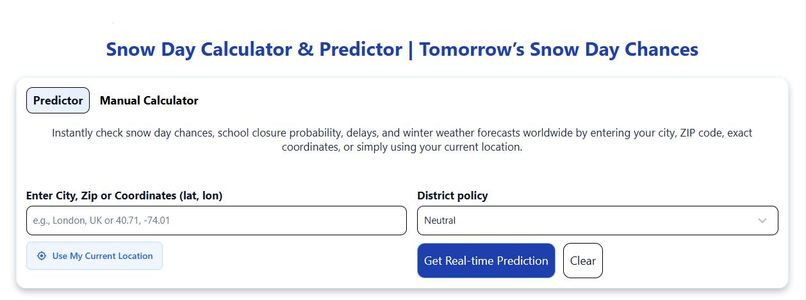
snow-day-calculator-web-view
Inspiration
What it # Snow Day Calculator
Inspiration
Every winter, students, parents, and teachers ask the same question: Will there be a snow day tomorrow? While weather apps provide forecasts, they don't explain what those forecasts actually mean for school closures. People are often left comparing snowfall totals, temperatures, and local news reports to make their own guesses.
We created Snow Day Calculator to bridge that gap by turning weather data into a simple, understandable prediction that helps people prepare ahead of time.
What it does
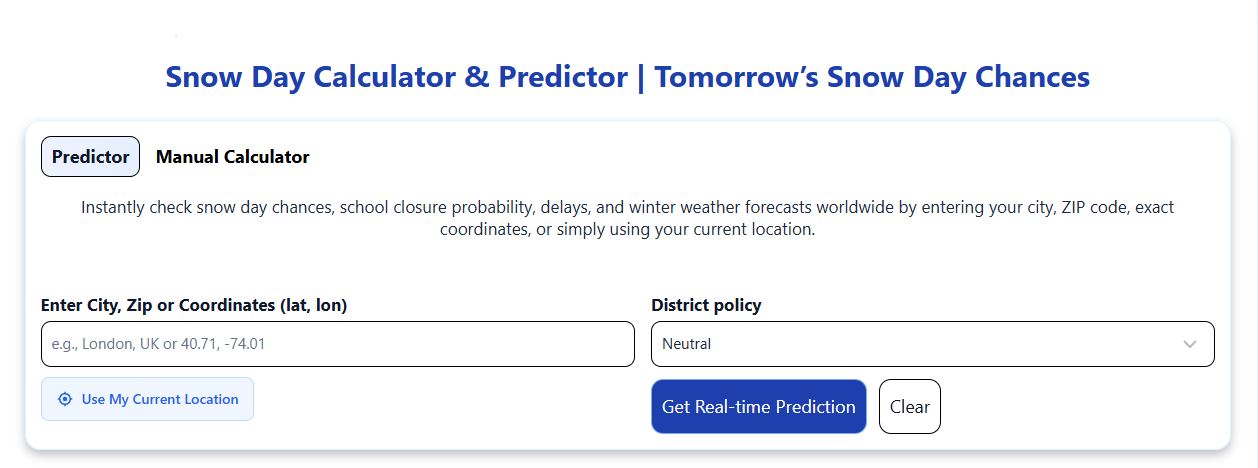
Snow Day Calculator estimates the likelihood of school closures by analyzing real-time winter weather conditions for a selected location.
Users can search by:
- City or town
- ZIP or postal code
- Latitude and longitude
- Automatic location detection
The platform retrieves current weather forecasts and evaluates conditions such as snowfall, temperature, precipitation, wind speed, visibility, and freezing conditions to generate an easy-to-understand snow day probability.
How we built it
The project was built as a lightweight web application focused on speed, usability, and accessibility.
The frontend was developed using HTML, CSS, and JavaScript with a responsive interface that works across desktop and mobile devices.
The backend communicates with weather and geolocation services, processes forecast information, validates user locations, and generates prediction results. Browser geolocation was integrated to allow one-click location detection, while geocoding services convert user searches into geographic coordinates for localized forecasts.
Performance optimization, responsive design, semantic HTML, and search engine optimization were incorporated throughout development to create a fast and user-friendly experience.
Challenges we ran into
One of the biggest challenges was combining weather information from different sources into a consistent prediction. Forecasts vary by location, and handling different search formats—including cities, postal codes, coordinates, and GPS detection—required careful validation and error handling.
Another challenge was building a prediction system that produces meaningful estimates while remaining fast enough for real-time use.
Accomplishments that we're proud of
- Built an intuitive snow day prediction platform.
- Added worldwide location support.
- Implemented automatic location detection.
- Created a responsive interface that works across devices.
- Developed a fast prediction workflow using live weather data.
- Optimized the platform for performance and SEO.
What we learned
Throughout the project we gained experience working with weather APIs, geolocation services, browser location permissions, responsive web development, API integration, and performance optimization. We also learned how important user experience is when presenting complex weather information in a simple and actionable way.
What's next for Snow Day Calculator
Our roadmap includes improving prediction accuracy, supporting more weather data sources, introducing school-specific predictions, expanding international coverage, adding historical weather insights, and developing mobile applications to make the platform even more accessible.does
How I built it
Challenges I ran into
Accomplishments that I'm proud of
What I learned
What's next for Snow Day Calculator
Built With
- api
- cloudflare
- css3
- html5
- javascript
- mysql
- php
- schema.org
- seo
- wordpress

Log in or sign up for Devpost to join the conversation.