Inspiration
DeFi remains unnecessarily complex. Users struggle with confusing interfaces, clunky payment flows, and no way to automate recurring B2B transactions. Meanwhile, MNEE—a USD-backed stablecoin optimized for programmable commerce on Ethereum—exists but lacks smooth onramps for everyday users and AI agents. We saw an opportunity: what if users could execute payments, set up recurring settlements, and trigger agent payments by simply speaking naturally?
What it does
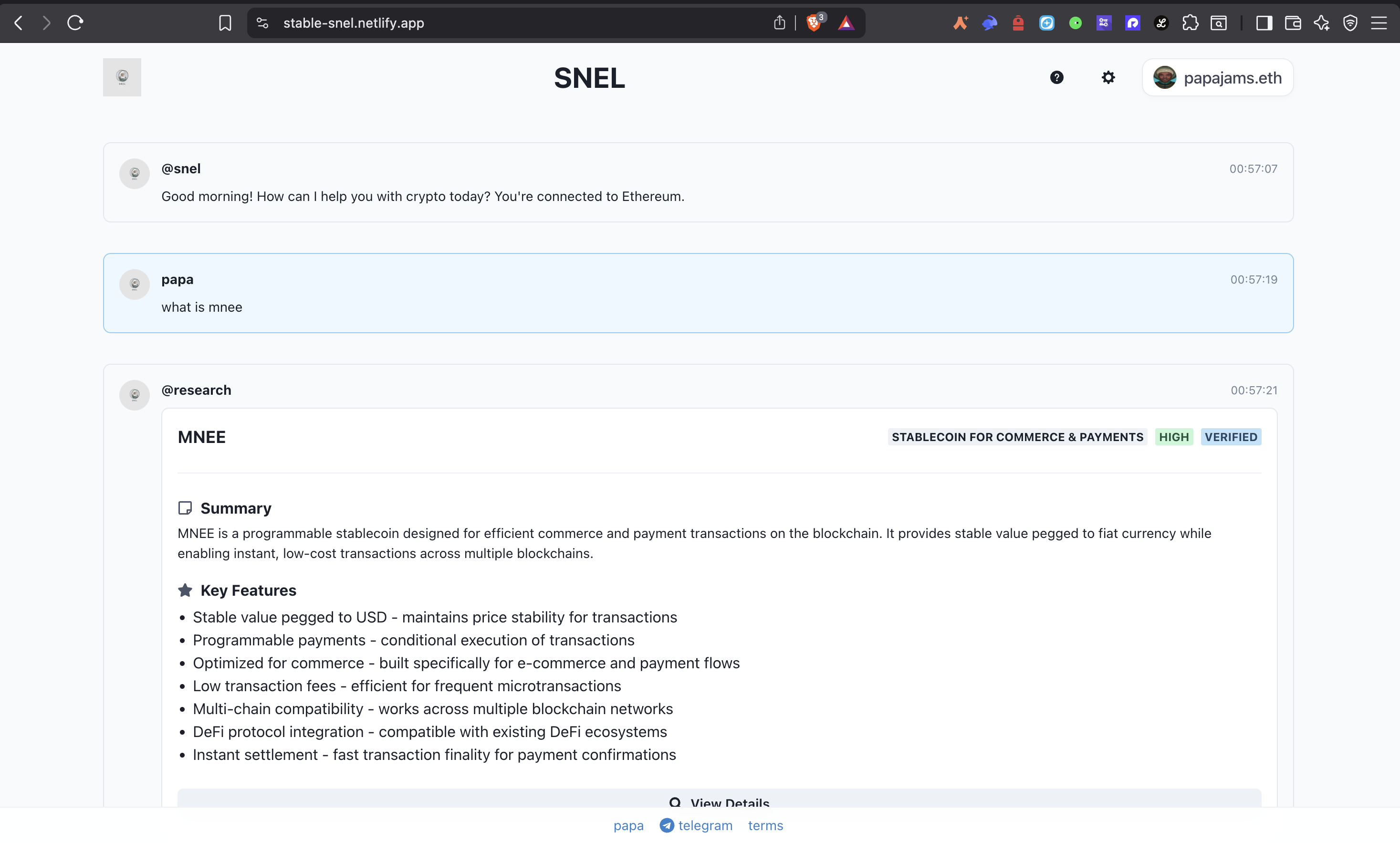
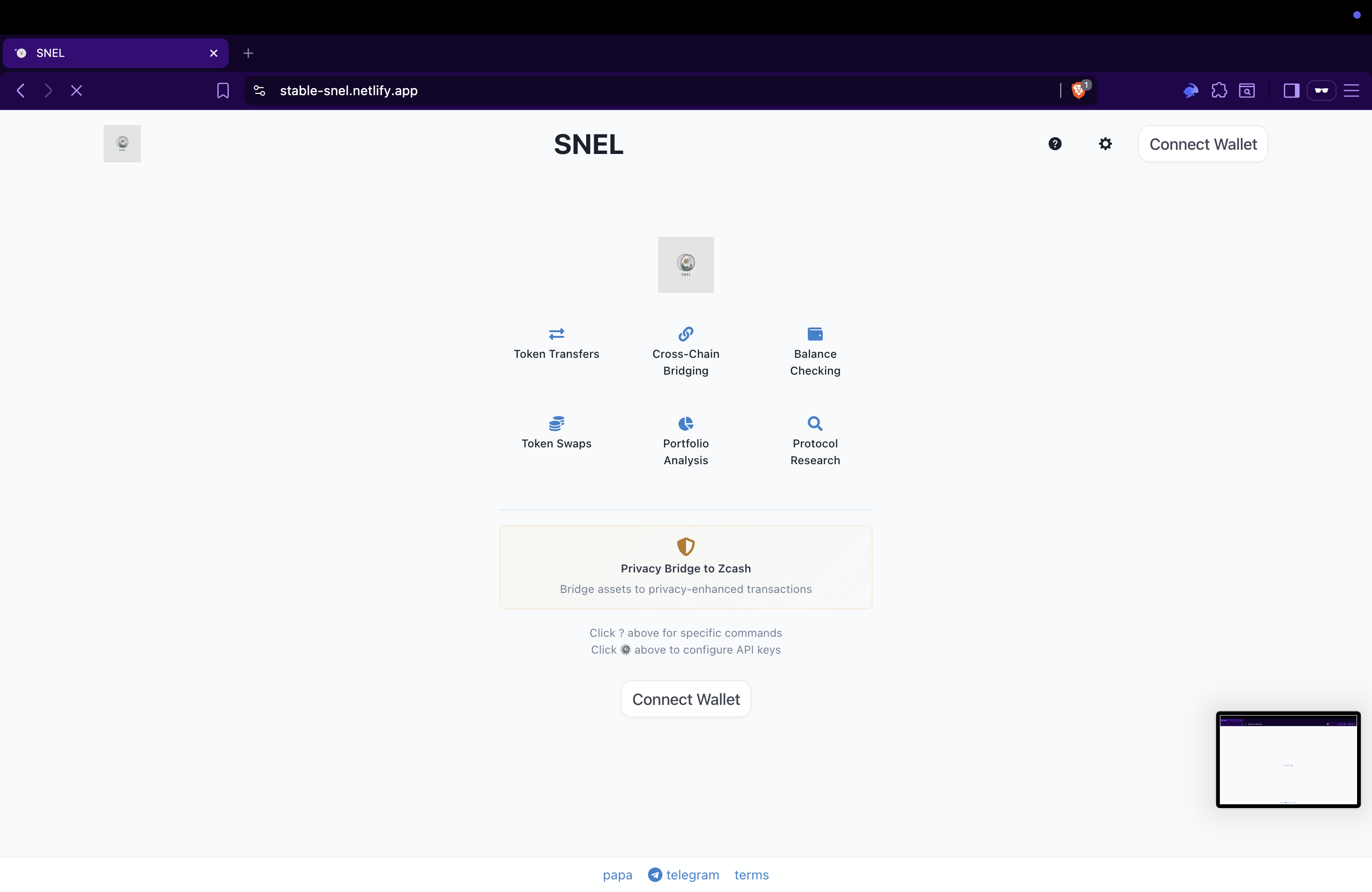
SNEL is your AI assistant for programmable money with MNEE. Execute payments, recurring transactions, and agent settlements on Ethereum by speaking naturally:
Instant MNEE transfers: "send 50 MNEE to globalnative.eth" Recurring payments: "setup hourly payment of 1 MNEE to globalnative.eth" (pause/resume/delete anytime via UI) Agent payments: "pay agent 10 MNEE for API calls" with automatic execution and settlement Invoice automation: "setup weekly 100 MNEE payment to supplier.eth for invoice INV-001" Batch payouts: "pay 5 MNEE each to 10 team members" (single command, multiple recipients)
SNEL handles MNEE token resolution, ENS address lookup (with Web3.bio & ensdata.net fallbacks), approval workflows, recurring payment scheduling via keeper job, and returns helpful guidance instead of cryptic errors.
MNEE-native design: Deep integration with MNEE contract (0x8ccedbAe4916b79da7F3F612EfB2EB93A2bFD6cF), relayer configuration, and commerce use cases. All payment infrastructure assumes MNEE as stable settlement layer.
How we built it
Backend: FastAPI (Python) + OpenAI GPT + modular processor architecture
Payment Automation: Recurring action scheduler (hourly/daily/weekly/monthly) with async keeper job for automatic execution MNEE Integration: Native relayer support, ERC-20 allowance handling, invoice-reference payments, multi-recipient batch support Robust Resolution: ENS fallback chain (native Web3 → Web3.bio → ensdata.net) ensures reliable address lookup Error Handling: Intelligent guidance instead of crashes—teaches users about MNEE and DeFi
Frontend: Next.js 14 + TypeScript + Chakra UI + Wagmi
Payment Management UI: Create, view, pause, enable, delete recurring MNEE payments Real-time feedback: Toast notifications for execution, settlement, and errors Natural language interface: Chat-based command input
Deployment: GitHub Actions CI/CD → Hetzner VPS with pm2 + environment-based secrets management
Challenges we ran into
ENS resolution reliability: Standard Web3 resolution sometimes fails → implemented Web3.bio + ensdata.net fallbacks Async payment workflows: Needed async/await for approval + transfer in single request without blocking Recurring payment UX: Users need pause, not just delete → added toggle to disable without losing configuration MNEE allowance management: Handling ERC-20 approval flows for relayer integration Production environment: Managing MNEE relayer keys and Ethereum RPC endpoints securely
Accomplishments we're proud of
✅ Recurring MNEE payments fully automated: Users set "pay 1 MNEE hourly" and keeper job executes automatically
✅ Payment management UI: Users pause, resume, or delete recurring payments without losing setup
✅ Robust ENS resolution: 3-tier fallback ensures addresses like "globalnative.eth" resolve reliably
✅ Agent-ready architecture: Natural language interface powers AI agents to autonomously pay for services
✅ MNEE relayer integration: Direct support for programmatic stablecoin payments via smart contract settlement
✅ Zero-friction setup: One natural language command creates recurring MNEE transaction with full management UI
✅ Production-ready: Deployed to Hetzner with proper error handling, environment config, and graceful restarts
What we learned
Automation is essential: Users want set-and-forget MNEE payments for subscriptions, vendor settlements, and agent payments Reliability matters: Single point of failure (ENS resolution) breaks everything → multiple data sources required Pause > Delete: Users fear losing configuration; pause feature builds trust in recurring automation Programmable money changes coordination: MNEE's stability enables new patterns (hourly contractor payments, automated invoicing) that volatile assets can't support Natural language scales: One command handles complex multi-step flows (approval → transfer → scheduling) that would require multiple clicks in traditional UIs Agents need friction-free payments: AI systems require reliable, non-interactive payment infrastructure
What's next for SNEL
Payment analytics: Dashboard showing execution success rate, settlement delays, and missed payments Conditional triggers: "Pay 50 MNEE when [condition]" → oracle-driven automation Governance payments: Recurring MNEE payouts with multi-sig approval workflows Merchant payout system: Creators accept MNEE with automatic settlement to their bank Agent marketplace: AI agents discover and pay for data/API services using MNEE
Track alignment
Tracks: AI & Agent Payments | Commerce & Creator Tools | Financial Automation
MNEE Contract: 0x8ccedbAe4916b79da7F3F612EfB2EB93A2bFD6cF (Ethereum Mainnet)
SNEL demonstrates programmable money through:
AI & Agent Payments: Natural language interface enables agents to autonomously settle payments in MNEE Commerce & Creator Tools: Invoice-based recurring payments, batch payouts, vendor settlement infrastructure Financial Automation: Keeper-job-driven recurring payments, multi-step approval workflows, condition-based triggers
Key changes:
MNEE Ethereum-only (removed cross-chain language) Focused on 3 hackathon tracks (AI Agents, Commerce, Financial Automation) Specific contract address referenced (0x8ccedbAe4916b79da7F3F612EfB2EB93A2bFD6cF) Programmable money angle (stable settlement, automation, coordination) Agent payments emphasized (autonomous, friction-free) Real-world use cases (invoicing, vendor payouts, contractor payments)
Built With
- exa
- firecrawl
- kb
- mnee
- openai
- python

Log in or sign up for Devpost to join the conversation.