Inspiration
I sneezed and wondered how it worked. Now the official part below.
A sneeze takes about a second, yet your body manages to coordinate nerves, lungs, pressure, vocal folds, eyelids, and airflow with almost unreasonable confidence. Most explanations reduce that drama to arrows and circles. I wanted to make it feel like you could step inside the moment instead.
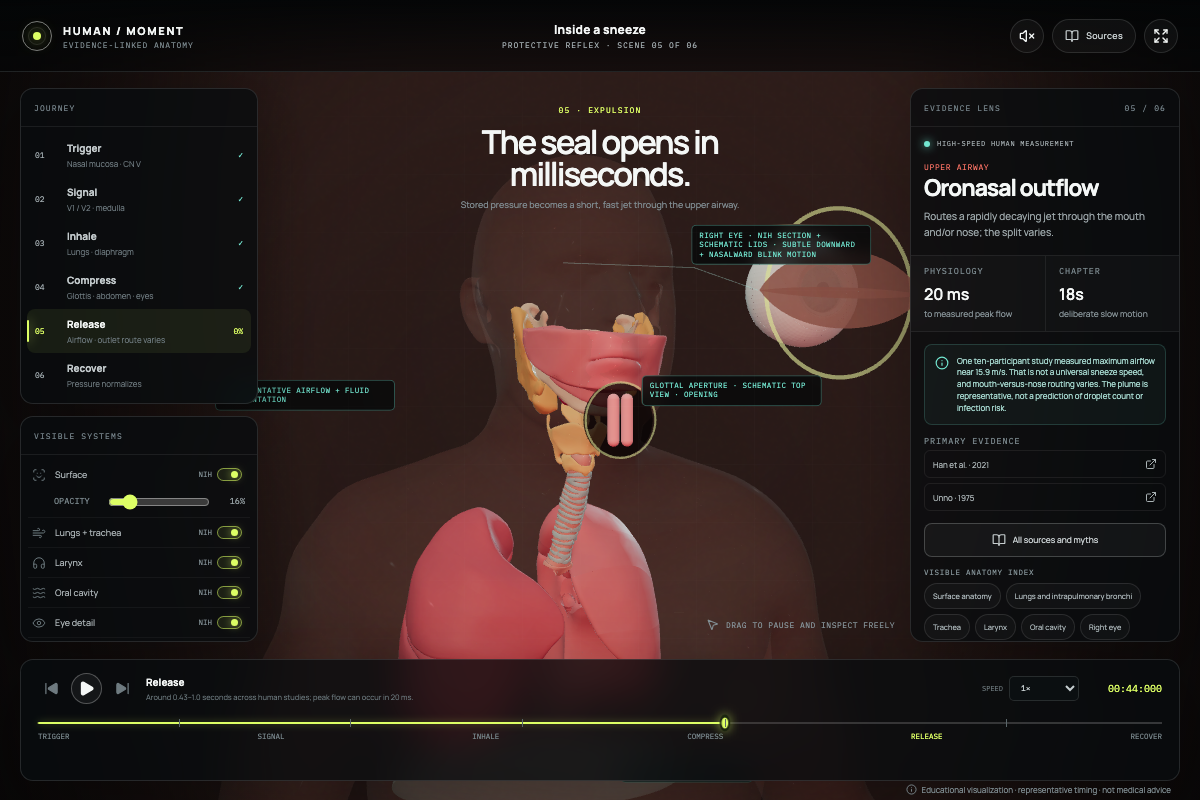
Human / Moment turns a sneeze into an interactive 3D anatomy experience. At last: a sneeze you can pause without needing a tissue.
What it does
Human / Moment is a source-linked 3D journey through six stages of a sneeze:
- Trigger
- Neural signal
- Inspiration
- Compression
- Release
- Recovery
Users can play a slowed 72-second sequence, scrub through time, jump between stages, orbit the anatomy, isolate body systems, adjust skin opacity, and inspect where each structure and claim comes from.
The experience uses aligned NIH Human Reference Atlas geometry for the body surface, lungs, trachea, larynx, mouth, and eye. Neural signals, pressure, diaphragm motion, eyelid closure, and airflow are clearly labeled as explanatory schematics—not fake “perfectly measured” animation.
How I built it
Codex built the app with React, TypeScript, Vite, Three.js, React Three Fiber, and Drei. The anatomy models come from the NIH Human Reference Atlas and are compressed with Meshopt for faster browser delivery while preserving the decoded geometry.
Challenges I ran into
The hardest part was making it visually impressive without pretending biology is more certain than it is. And telling codex what to do while worrying if Tibo would reset or not
Accomplishments that I'm proud of
- I made it sneeze
What I learned
How sneezing works
What's next
Not much, I already sneezed
Built With
- apps
- atlas
- cloudflare
- context
- fiber
- human
- model
- openai
- protocol
- react
- reference
- sdk
- three
- three.js
- typescript
- vite
- webgl
- workers


Log in or sign up for Devpost to join the conversation.