-
-
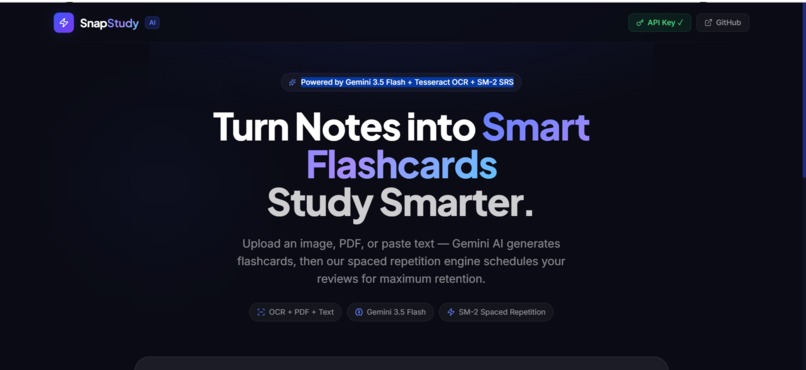
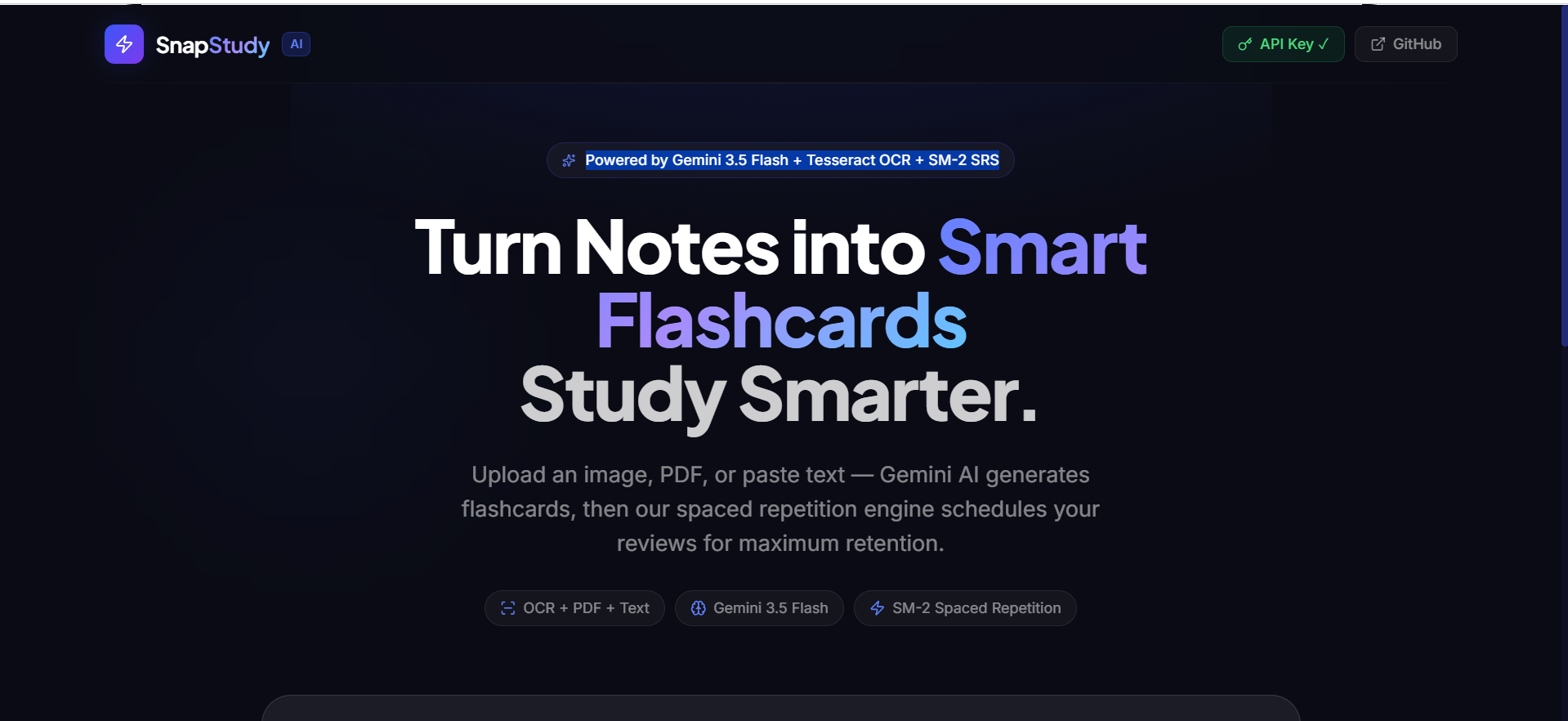
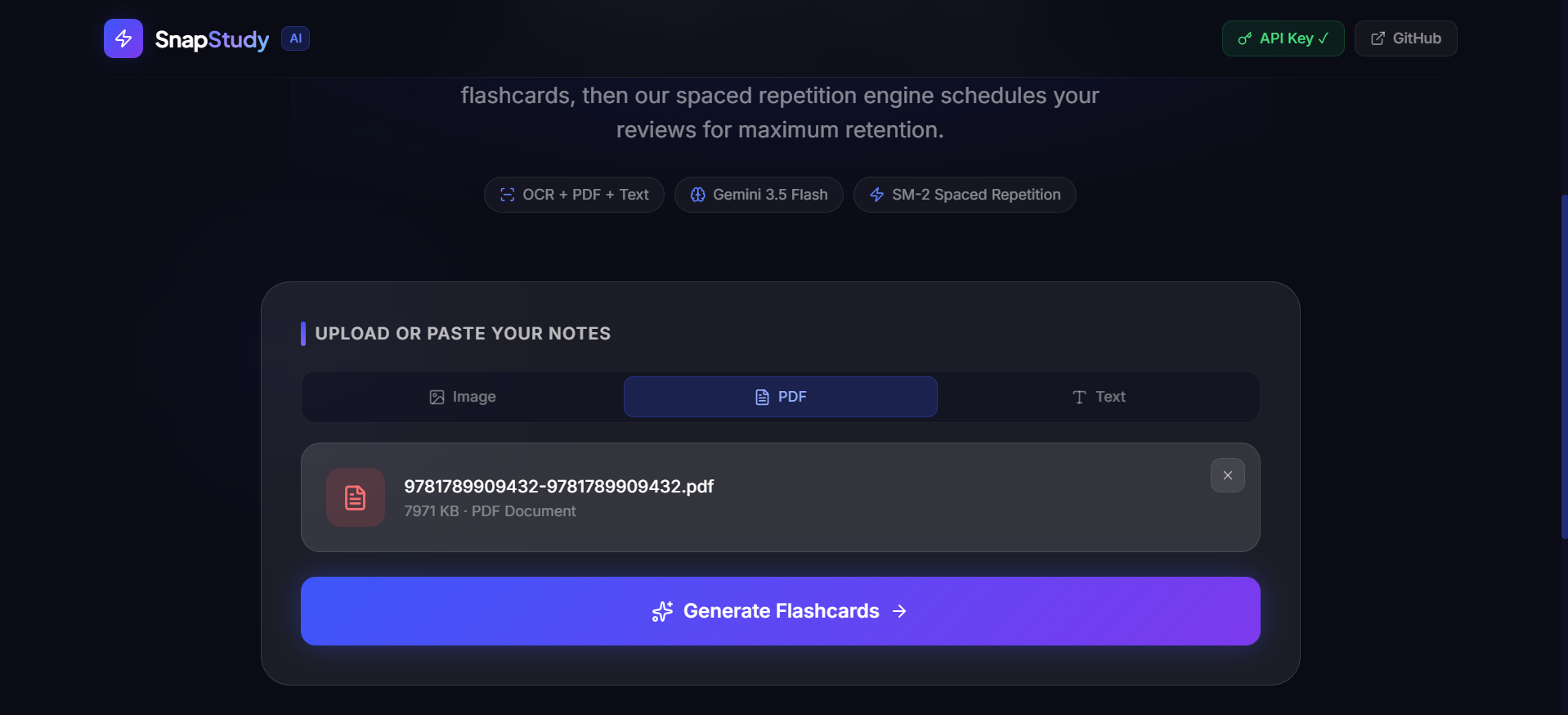
landing page
-
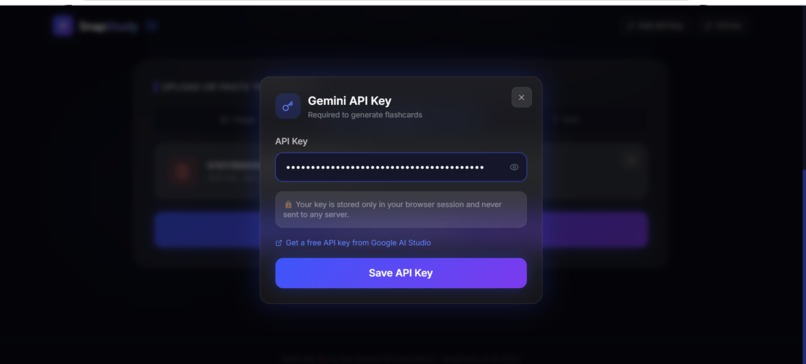
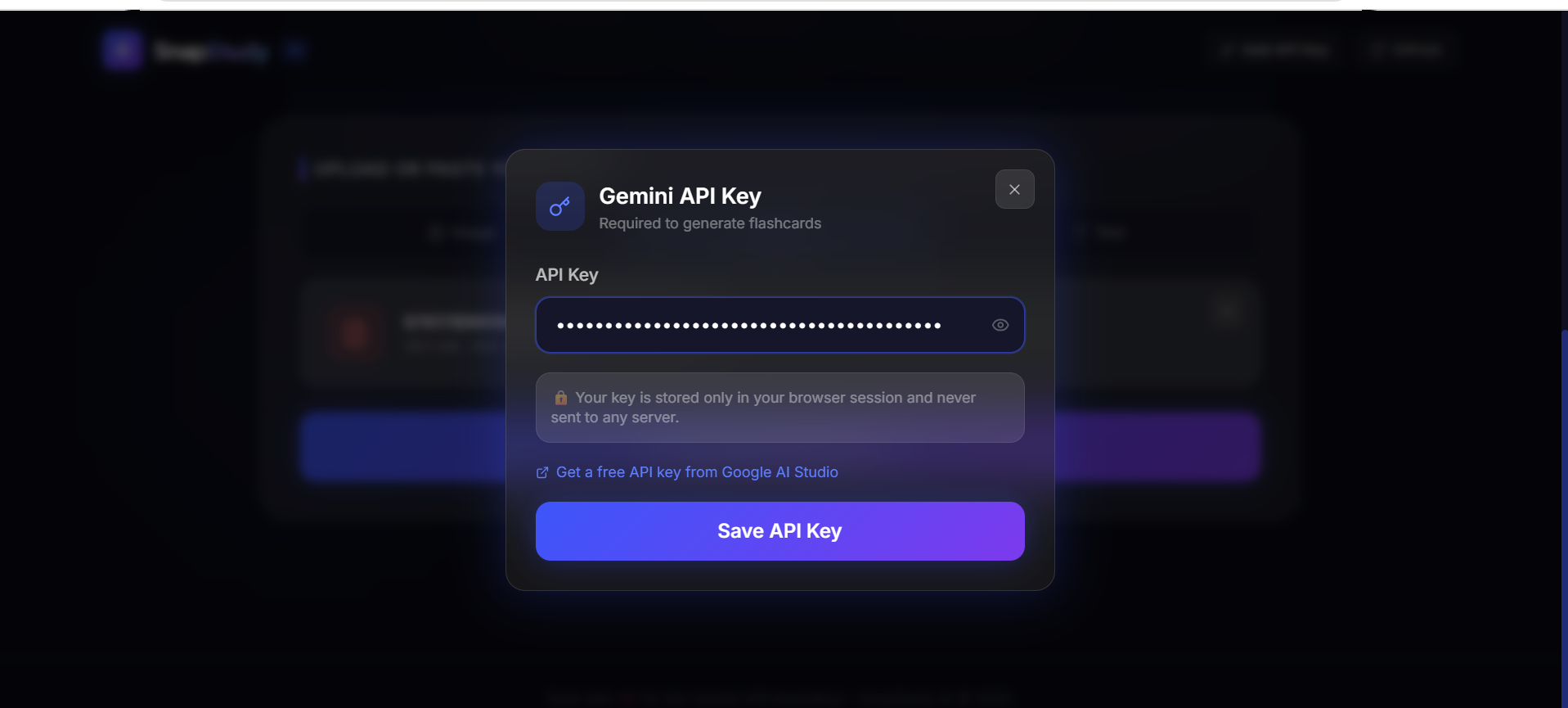
api-key enterying portion
-
-
-
-
Inspiration
The night before exams usually looks the same: hundreds of pages of notes, endless highlighting, and passive re-reading that barely sticks.
The real problem isn’t effort — it’s retention.
Research consistently shows that active recall and spaced repetition dramatically outperform passive studying for long-term memory. But creating high-quality flashcards manually takes time students rarely have.
I wanted to build a system that removes that friction completely.
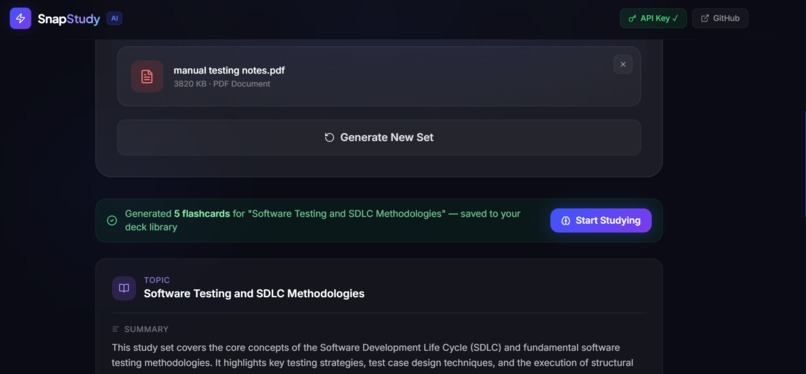
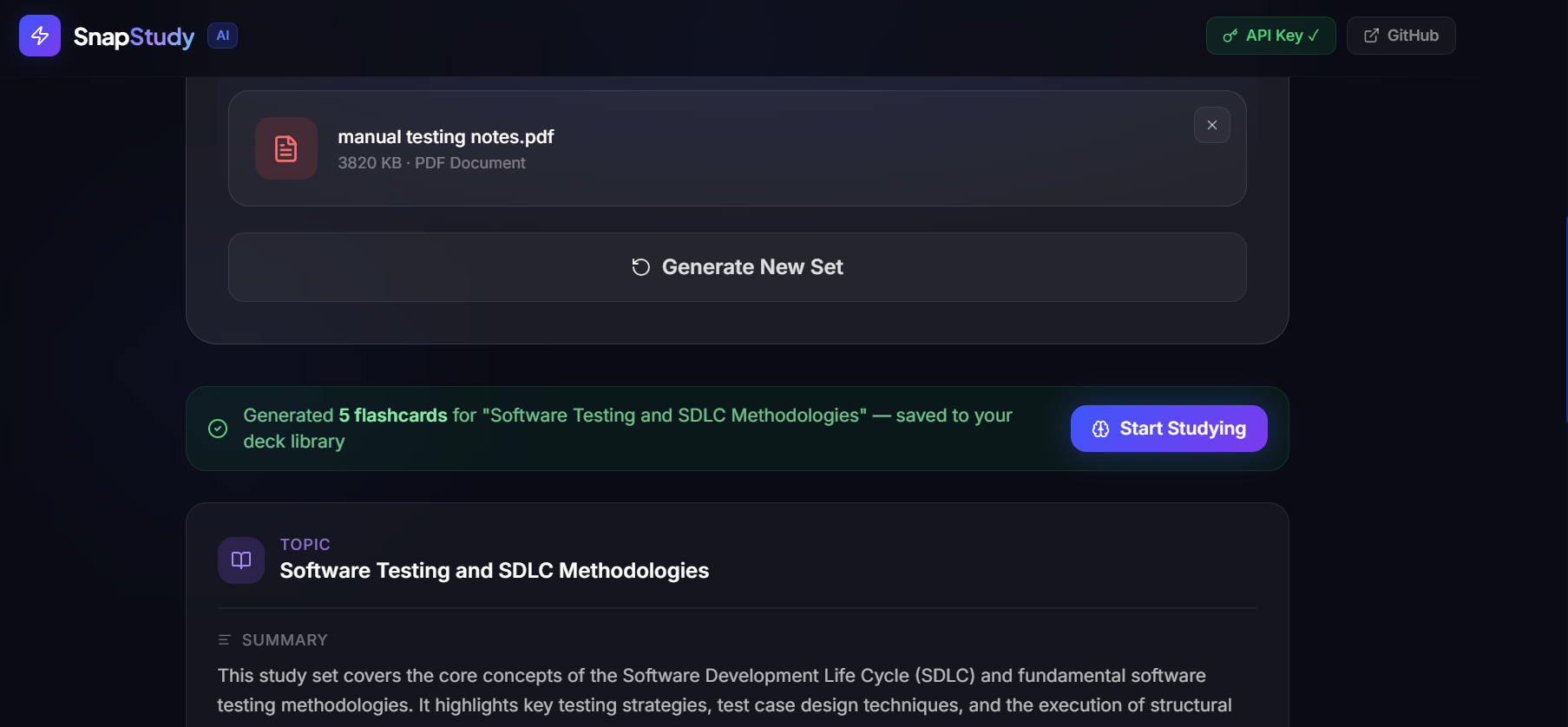
With SnapStudy AI, students can upload handwritten notes, PDFs, or raw text and instantly transform them into AI-generated flashcards powered by Gemini — then review them using scientifically optimized spaced repetition scheduling.
The goal was simple: Turn chaotic notes into a structured learning system in seconds.
What it does
SnapStudy AI converts study material into an AI-powered flashcard system entirely in the browser.
Input Support
- 📷 Upload handwritten or printed notes using OCR
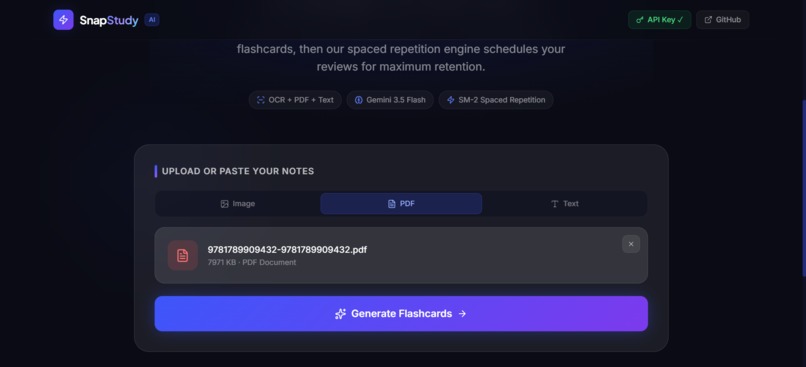
- 📄 Upload lecture slides or textbook PDFs
- ✏️ Paste raw text directly
AI-Powered Learning
Using Gemini Flash, the app automatically generates:
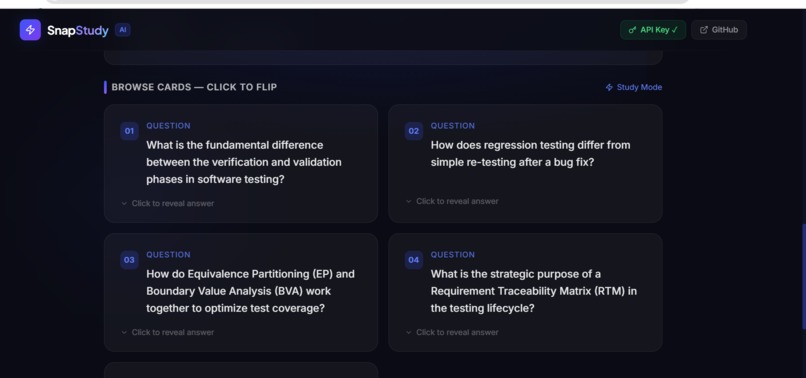
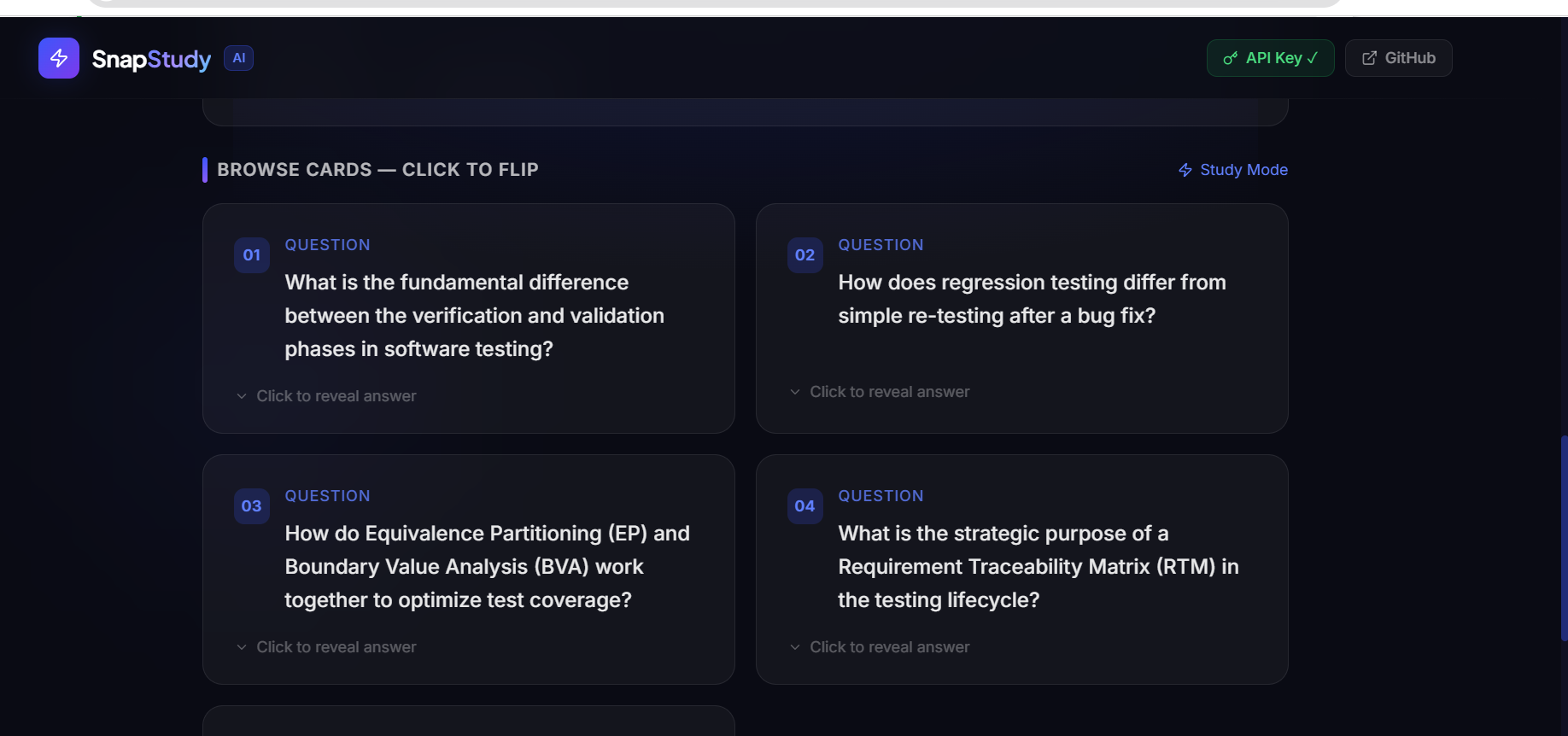
- Smart flashcards focused on core concepts
- Concise summaries
- Understanding-focused Q&A pairs
Instead of memorizing definitions blindly, the generated cards are designed to reinforce conceptual understanding.
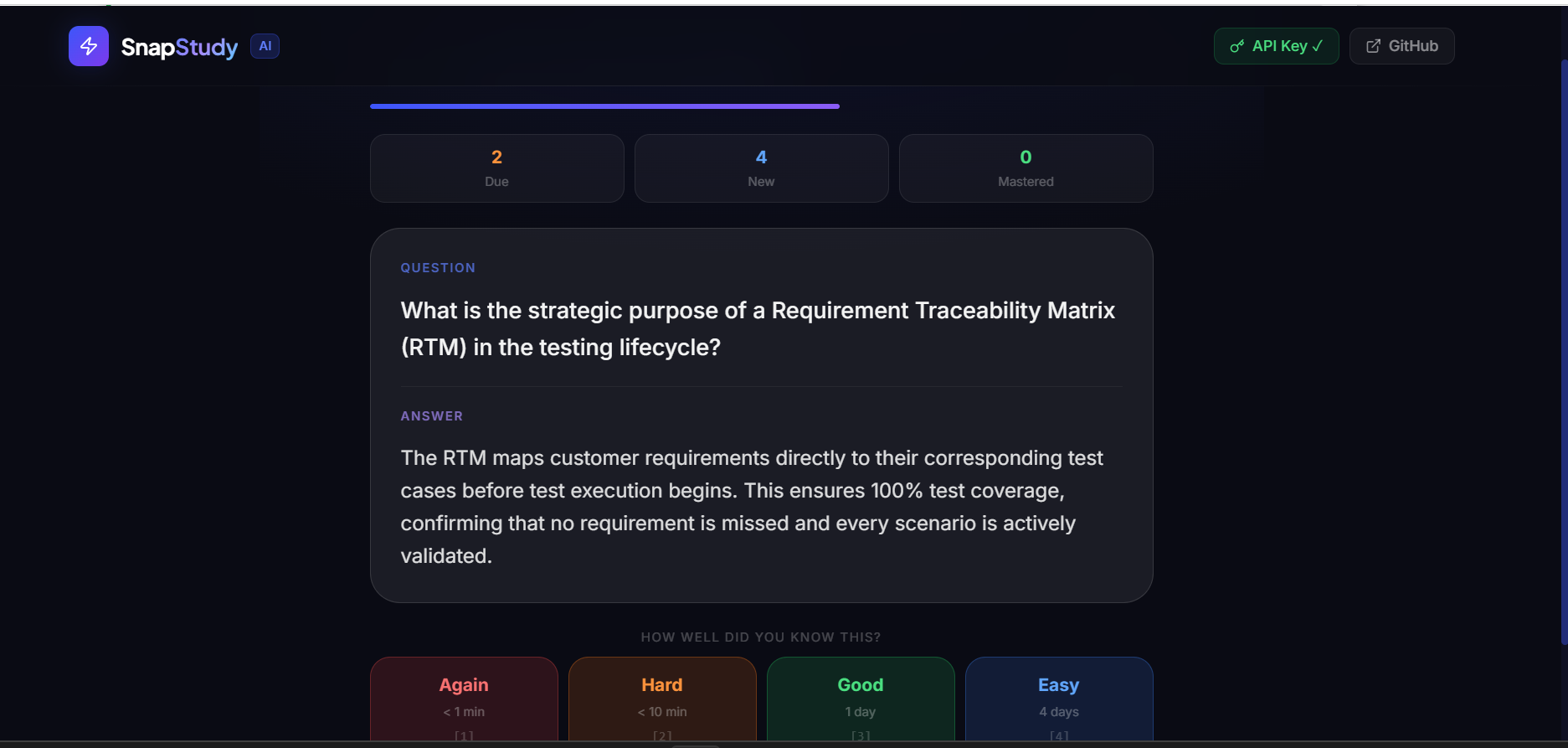
Spaced Repetition (SM-2 Algorithm)
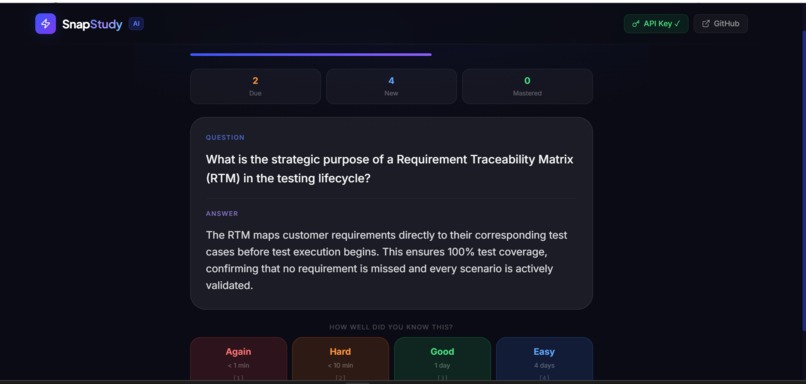
SnapStudy AI uses the SM-2 spaced repetition algorithm — the same foundational learning system popularized by Anki.
Cards are rescheduled dynamically based on performance:
| Rating | Next Review |
|---|---|
| Again 🔴 | < 1 minute |
| Hard 🟡 | < 10 minutes |
| Good 🟢 | 1 day |
| Easy 🔵 | 4+ days |
Cards you struggle with appear more frequently, while mastered cards fade into the background — maximizing retention while minimizing study time.
How I built it
The entire application runs 100% client-side with no backend infrastructure.
Tech Stack
- ⚛️ React + TypeScript + Vite
- 🎨 Tailwind CSS
- 🤖 Gemini Flash API (
@google/genai) - 🔍 Tesseract.js OCR
- 📄 PDF.js
- 🧠 Custom SM-2 spaced repetition engine
Architecture
Input (Image / PDF / Text) ↓ Extraction Layer (OCR / PDF Parsing) ↓ Gemini Flash Prompt Pipeline ↓ Structured Flashcard Generation ↓ SM-2 Scheduling Engine ↓ Interactive Study Interface
A major focus was prompt engineering.
Instead of simply asking Gemini to “generate flashcards,” the system enforces structured output, concept-focused questions, OCR-noise tolerance, and concise educational formatting.
Challenges I ran into
OCR Noise & Handwriting Quality
OCR output is often messy, especially with handwritten notes.
Instead of aggressively preprocessing the text, I used Gemini itself as a semantic cleanup layer by instructing it to gracefully infer and repair OCR inconsistencies.
This dramatically improved output quality while simplifying the pipeline.
PDF.js Worker Issues
PDF.js required a worker configuration that initially failed due to CDN version mismatches.
I resolved this by locally hosting the worker bundle, enabling fully offline PDF extraction directly in the browser.
Gemini Model Reliability
During development, several Gemini models produced:
- deprecation issues
- quota edge cases
- inconsistent availability
To improve resilience, I implemented a typed fallback strategy with prioritized error handling to avoid unnecessary failed requests.
SM-2 Edge Cases
The SM-2 algorithm behaves differently for first-time reviews.
I implemented the standard bootstrap progression: 1 day → 6 days → adaptive interval scaling
to ensure realistic review scheduling from the very first session.
What I learned
- Prompt engineering is effectively a new layer of software engineering
- Browser-native AI workflows are now powerful enough for real educational applications
- OCR + LLM pipelines work surprisingly well even with imperfect input
- Simple learning algorithms like SM-2 can dramatically improve retention outcomes
What's next
- 🎤 Voice-to-flashcard generation
- 📊 Retention analytics & forgetting curves
- 🤝 Shareable deck exports
- 🌍 Multi-language support
- 📱 PWA offline study mode
SnapStudy AI started as a hackathon prototype, but the long-term vision is larger: making effective learning tools accessible instantly, without friction, accounts, or expensive platforms.
Built With
- 3.5
- ai
- algorithm
- api
- css
- css3
- flash
- gemini
- html5
- javascript
- localstorage
- pdf.js
- react
- sm-2
- studio
- tailwind
- tesseract.js
- typescript
- vercel
- vite
- web
- workers

Log in or sign up for Devpost to join the conversation.