Inspiration
I was inspired to create a Business Card Reader application that leverages generative AI and OCR technologies to extract and organize information from business cards. The idea was born out of the need for a modern, efficient solution to manage and store contact details seamlessly.
What it does
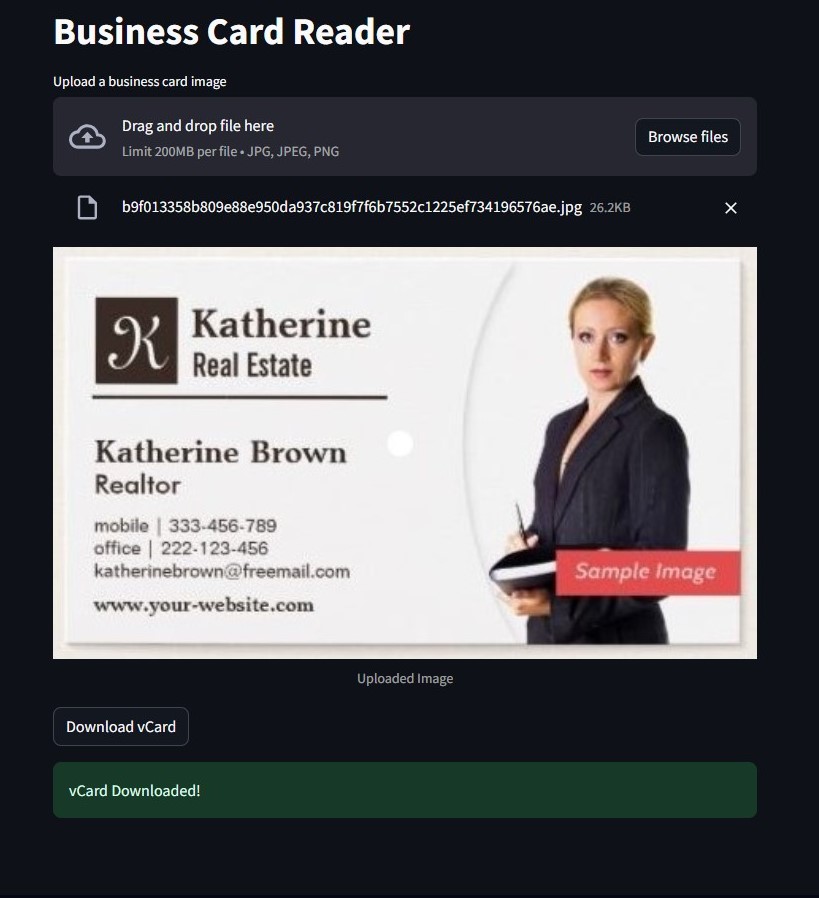
The app processes an image input and then extracts text data from it. The data is parsed and stored as a VCARD file which can be downloaded and stored digitally.
How we built it
Throughout the project, I learned valuable lessons in integrating various technologies, from computer vision using OpenCV to optical character recognition with Tesseract. The use of Streamlit for creating an interactive web interface allowed me to enhance the user experience. Additionally, handling environment variables with python-dotenv and structuring a project in a modular way improved the maintainability and scalability of the code.
Challenges we ran into
One of the primary challenges was ensuring seamless integration between the different components of the project. Managing dependencies, especially when dealing with external tools like Tesseract, required careful configuration. To give an example:
tesseract_path = os.getenv("TESSERACT_PATH")
pyt.pytesseract.tesseract_cmd = tesseract_path
Specifying the path to Tesseract in a .env file worked fine in the notebook but was inconsistent in the Streamlit app. This code is part of a critical function that reads the business card so it was important to get this issue resolved for proper project functionality.
Additionally, handling file uploads, error handling during OCR, and creating a robust VCF file generation mechanism presented challenges that were addressed through iterative testing and debugging.
Accomplishments that we're proud of
Successful Integration of Technologies: We take pride in seamlessly integrating generative AI, computer vision, and OCR technologies into a cohesive and functional application. The synergy between these technologies enhances the application's capabilities and provides users with a powerful tool for managing contact information.
Robust Error Handling: Implementing robust error handling mechanisms, especially during OCR and file processing, is an accomplishment we're proud of. Users are provided with informative messages in case of errors, ensuring a smooth and user-friendly experience.
Clean and Modular Codebase: The project boasts a clean and modular codebase, following best practices in Python development. Each component is well-organized, making the codebase easily maintainable and scalable for future enhancements.
Effective Use of Streamlit: Leveraging Streamlit for creating an interactive web interface has been a key accomplishment. The application provides users with a visually appealing and intuitive experience, showcasing our commitment to user-centric design.
Secure Handling of Environment Variables: The secure handling of environment variables, achieved through the use of python-dotenv, demonstrates our commitment to best practices in security. Sensible information like the Tesseract path is stored securely, ensuring the confidentiality of sensitive data.
What we learned
Ensuring a smooth user experience, particularly with Streamlit's file upload functionality, required attention to detail and effective communication with the user through informative messages in case of errors.
What's next for Snappy Biz
In the future, I plan to enhance the application by incorporating machine learning techniques for better OCR accuracy and data extraction. Additionally, I aim to improve the user interface and provide more customization options for users, making the application even more versatile.
Overall, the Business Card Reader project has been a rewarding journey, offering insights into the integration of cutting-edge technologies and practical problem-solving in the realm of contact information management.

Log in or sign up for Devpost to join the conversation.